Category Focus/categories/customer-service
Customer Service AI Tools
Discover and compare the best customer service AI tools and software. Browse 40+ curated tools with reviews and rankings.
Projects tracked
40
Sort mode
RECENT
Page
3
Typewise Nova is an AI customer experience platform that businesses use to run AI agents resolving customer service requests end to end across email, chat, WhatsApp and social. Nova, described as the AI Operator, builds and improves an AI customer experience team without a developer. Agents resolve whole requests — from orders and refunds to plan changes — across email, chat and WhatsApp, while the team stays in control. It is built for modern customer teams, from small and mid-size businesses just getting started to enterprises running support at scale, and it helps them boost customer satisfaction and reduce costs with next-gen AI they can trust. Traditional CX platforms and chatbots are measured on deflection rather than resolution, and running them typically requires an IT or dev team, with total cost described as $$$. Typewise positions itself differently: it is a resolution engine, not another chatbot, and it is measured on resolution. Rather than deflecting a customer, it completes the whole request — looking up the order, applying your policy, closing the ticket — and hands anything needing judgment to a person with full context. Typewise began in 2019 as a consumer keyboard app; that chapter closed in 2022 when the company joined Y Combinator and moved to business software. Today it is solely an AI customer experience platform for businesses. At the center of the platform is Nova, the AI operator that sets everything up. You describe in plain language how customers should be handled and connect your tools, and Nova builds the agents, tests them on past tickets and shows you what failed before anything goes live. There are no flowcharts, no code and no waiting on IT. Nova runs on conversation: asking 'Nova, create a specialist for billing & payments' produces a drafted Billing & Payments specialist that reads Stripe and your order system, with refunds over €100 kept human-approved. 'Nova, update the returns policy from this doc' recognizes that the return window goes from 14 to 30 days and that opened items are now eligible, and can update the specialist and the help-center article. 'Nova, connect WhatsApp as a support channel' prepares to connect WhatsApp Business with the same rules as email and chat, running a test message first. 'Nova, why did refund tickets spike this week?' reports that refunds are up 38%, mostly citing 'wrong size' after Tuesday's size-chart update, and offers to draft a reply macro. The workspace brings AI agents and human agents together in one place. A supervisor routes each request to the right specialist, works across your systems, brings in a person when it matters, and picks the ticket back up. The ticket view displays fields including Ticket #, Title, Customer, Channel, Priority, Status, CX score and Assigned to, with statuses such as 'AI resolving', 'AI asking an agent' and 'Done'. This lets teams see at a glance which requests are being handled autonomously and which have been handed to a person, while keeping every conversation visible in a single queue. Typewise meets customers where they already are. Support can start on Chat, Email, WhatsApp, Social, Voice, ChatGPT, Claude or In-App, and customers can start anywhere, switch channels freely, and keep context end to end. Channels are not isolated, so a conversation can move between them without the customer repeating the request. The platform also handles any language in and out, so a request that arrives in one language can be understood and answered in another without changing how the customer gets in touch. The platform's approach is summarized in three steps. It resolves: looks up the order, applies your policy and closes the ticket. You decide: your rules apply, every action is logged, and you can pause anytime. It learns: quality is watched, fixes are proposed, and nothing ships untested. Nova is the AI operator behind this — describe what you want in plain language, and Nova builds it, tests it, and takes it live in about 15 minutes. Unlike a traditional chatbot rollout, setup is conversational rather than technical, and the system keeps improving after launch by monitoring quality and proposing fixes 24/7 for approval. Real teams report measurable outcomes. Beurer achieved a 90% resolution rate on autonomous cases, with its Head of Service Team noting that changing the AI instructions directly changes how the AI Agents behave. Lehner Versand saw 95% of chat requests resolved by AI, with its Head of Customer Service saying every request now comes together in one place while people stay involved where experience and approval are decisive. HealGreen reports 70% of inquiries handled by AI across channels, with its CEO describing connecting systems directly with Typewise as a game-changer and Nova as making onboarding incredibly fast. Across the platform, Typewise cites 10M+ tickets resolved, 3,500+ integrations and a rating from G2 users. Because unresolved requests are free, the model rewards actual resolution rather than volume. Concrete workflows on the platform include resolving refund and returns requests by looking up the order and applying policy, handling order tracking help, and processing plan changes end to end. Teams also use Nova to create dedicated specialists, such as one for billing and payments that reads Stripe and the order system, or to update policies and help-center articles from a document. Support leaders can investigate trends, such as a spike in refund tickets, and have Nova propose a reply macro for affected customers. Connecting a new channel like WhatsApp Business is another workflow, where Nova applies the same rules as email and chat and runs a test message first. Typewise serves two broad groups. Small and mid-size businesses can go live in 15 minutes with easy conversational setup, getting better every week as it learns the business, with no developer needed. Enterprises get ISO 27001, GDPR and EU AI Act compliance, approvals and clean human hand-off they control, guided onboarding, a dedicated support team, and connections to their stack through 3,500+ integrations spanning CRM, ERP and ITSM, as well as help desks, inboxes, commerce and internal systems. Nothing has to be migrated to get started. Pricing is success based: a monthly plan plus a per-resolution rate that drops as volume grows, where a fully resolved request counts once, a partial hand-off counts half, and unresolved requests are free. You can start free with a batch of free resolutions and no credit card, connect your own inbox, and see performance on real tickets before paying. EU data residency is available. Typewise Nova's core promise is end-to-end resolution without losing control. It replaces deflection-focused chatbots with a resolution engine that completes real requests across channels and languages, is built and improved by an AI operator in plain language, tests itself before going live, and keeps humans in the loop through logged actions, approvals and one-click pause. For customer teams that want to boost satisfaction and reduce costs with AI they can trust, Nova offers a fast, self-improving path to first-class customer experience with zero busywork.
The Frigade Assist API makes the AI agent you already built an expert in your product. With one tool call, your agent can answer product questions and guide users through workflows, right inside the agent you already built. Frigade presents it simply: you add Frigade in one call, and your agent answers questions and guides users through your product. The API is described as a lightweight SDK and two primitives — you register it as a tool your agent can call in a few lines, and your agent can then run a live product tour or return a grounded product answer. It is aimed at product and engineering teams who have built their own agents and want those agents to know the product. It is also available to teams with no agent yet, since Frigade ships a full in-product assistant that learns your product and guides users in real time, with no code required. The problem Frigade addresses is that most in-app AI agents answer "how do I do this?" with a wall of text, because they cannot see the screen. As Frigade puts it, your agent has read your docs but has never used your product. Written documentation is accurate exactly once; Frigade shows a help center article updated nine months ago, featuring a broken 404 screenshot, telling users to open "Webhooks (formerly Integrations)" and paste a URL. Answers like that go stale the day you ship. The Assist API closes that gap by giving your agent the same product your user is looking at, so it can walk them through the workflow instead of linking a document from two releases ago. Integration is deliberately small. The example in Frigade's documentation defines a single tool, frigade_guide_tool, with a description telling the agent to call it to answer product questions or guide the user through a task, and a query parameter describing what the user is asking or wants to do. The tool's run function calls frigade.assist({ query }), and you add that tool to your agent's existing toolset. It is framework-agnostic by design: it works cleanly with the Vercel AI SDK today, and any agent that can call a tool can call Frigade, regardless of how the agent was built or which models it runs. Your agent keeps its own reasoning and voice, decides when to call Frigade, and decides what to do with the result. Frigade learns your product by using it. It deploys agents that work through your real workflows the way your users do, documenting how each one behaves and taking in your existing knowledge base. The site describes this in three steps: you invite Frigade the way you would a user, with nothing to document or configure first; it works through real workflows, clicking the same paths your users click and mapping how features actually connect; and it re-learns on every release, so the map updates itself and your agent is never a version behind. A visual list of product areas — Security, Retention, Dashboards, Webhooks, Notifications, Environments, Provisioning, Custom fields, Imports, Integrations, Data export, and Members — shows items marked as relearned, moved, mapped, or unchanged after a September release. Guidance is one of the two primitives. Rather than returning text alone, Frigade draws a step-by-step guide right on the page. In an example settings screen, a Frigade panel shows "Step 1 / 3" and instructs the user to "Open Security to manage SSO. Follow the highlight," with the real steps rendered inside your own UI. In another example, while a user adds a webhook, the guide reads: "Add the URL and I'll send a test event to confirm it's live," with a step counter showing 4 of 6 and navigation controls. The Assist API also tells the agent what the user is looking at, which is what allows the guide to be placed in context. Answers are grounded and controlled by your team. Frigade generates answers from how your product works in the current release, so they hold up even when the help center is two releases behind. Your team stays in control: anyone can rate any answer and write the behavior they want instead — no code required — and the change holds from the next conversation onward. An example conversation shows an agent answering whether the Growth plan includes SSO, with a note underneath: "Also mention SAML is on Enterprise only," which is saved without code. Frigade calls this steering: the more your team puts in, the better it gets. Frigade logs every reply your agent gives. You can see every conversation your agent handled through Frigade in the dashboard, in Slack, or over the API. A list of example queries shows how calls resolve: "Does the Growth plan include SSO?" resolved, "How do I connect Slack?" guided, "Our contractor needs API access" guided, "I want to cancel my account" handoff, "Why did my sync fail last night?" guided, and "Delete our workspace and all data" handoff. Insights let you see where users get stuck, where the agent helps, and where it hands off. Frigade also knows its limits: when it cannot help it says so and passes the conversation to your team, returning fast so your agent never stalls or burns latency. Alongside answering and guiding, Frigade can proactively surface the right feature to a user when they would benefit from it — the same idea as Frigade's Suggestions product — helping drive feature adoption and expansion revenue. Underneath the tool call, Frigade describes an entire engine that relearns your product, plus a platform your team manages with no code. Four components are named: the product model, built by using your product and rebuilt every release; grounded answers, written from your actual product rather than just your docs; guidance, the real steps rendered inside your own UI; and steering, where the more your team puts in, the better it gets. The company frames the difference bluntly: it is not just a tool call. The benefits are described throughout. Your agent stops linking stale documents and starts walking users through the workflow. Answers stay current because Frigade relearns on every release, so you do not have to retrain the agent or rewrite prompts. Support, CS, and CX teams own the answers without filing tickets to engineering. Every answer is logged, giving your team visibility in the dashboard or over the API. The agent stays in control of the conversation — Frigade adds product expertise, it never takes over. And when Frigade cannot help, it hands off cleanly. A customer story from Valley reports that Frigade solved over 400 queries a month that would otherwise have gone to support, equivalent to two hires the company did not have to make, paying for itself within the first two months. Typical scenarios appear directly in Frigade's content. A user asks whether the Growth plan includes SSO and gets a grounded answer about turning it on under Settings, then Security. A user needs to add a webhook: the agent starts a guided flow in the app, the user pastes an endpoint URL, and the guide confirms it will send a test event. A user asks how to set up SAML, connect Slack, or grant API access to a contractor, and the agent guides them. A user asks to cancel an account or delete a workspace and all data, and Frigade hands the conversation to the human team. A user asks why a sync failed or why a webhook stopped firing and gets guided help. Morning Consult reported a working prototype deployed in less than a few hours of automated training, able to generate product tours on the fly without manual configuration. Frigade Assist API is used by product and engineering teams who want the agents they built to gain real expertise in their product. Frigade says it is trusted by teams building the best products, naming Sanity, Arc, Merge, Productboard, Legora, Retell, Logicbroker, Hotplate, Spellbook, Perfect Venue, Simplify, and Typewise, and quotes Vercel CEO Guillermo Rauch calling Frigade "mind-blowingly good." On integration, the Vercel AI SDK is supported and the API stays framework-agnostic. On security, Frigade is SOC 2 Type II certified and fully GDPR compliant, with data encrypted in transit with TLS 1.2+ and at rest with AES-256, EU data residency, a zero-retention LLM policy, and automatic PII scrubbing. Guidance runs with the user's own permissions, so the agent only sees what the user can already see, and teams needing full data control can self-host Frigade with their own LLM keys. Pricing starts at $1,000 per month with usage-based scaling, and enterprise plans with custom pricing are available. For teams that have built their own agents, the Frigade Assist API is one tool call that turns those agents into product experts — grounded in the live product, able to draw step-by-step guidance inside your own UI, tunable by your team without code, and able to hand off cleanly when it cannot help. Frigade's own summary puts it simply: give your agent product superpowers.
Expressive Mode creates voice agents so expressive they blur the line between AI and human conversation. It is powered by Eleven v3 Conversational and a new turn-taking system for better-timed responses with fewer interruptions.
Social AI monitors, classifies, and responds to Facebook and Instagram comments automatically for e-commerce brands. It helps manage social interactions at scale without adding headcount by automating repetitive moderation tasks.
Foxchat is a lightweight, Intercom-style live chat widget for websites that lets customers reach you instantly. You can respond to messages without leaving Slack, with setup taking less than 5 minutes.
VerlyAI deploys intelligent AI agents for customer support across web chat, voice calls, and WhatsApp. The platform handles unlimited conversations simultaneously while reducing support costs by 80%.

Woise is an AI-powered feedback tool that enables users to submit screen recordings with voice narration instead of typing. It automatically transcribes voice recordings into text for clear, actionable feedback.
Zendesk Signals analyzes Zendesk tickets daily to detect emerging customer pain points and alerts your team in Slack. It identifies workaround language, feature confusion, and escalation spikes so you know exactly what needs fixing.
Obi is a voice AI agent that provides interactive customer onboarding and user activation. It guides users through setup, answers questions in real time, and shares insights after every session.
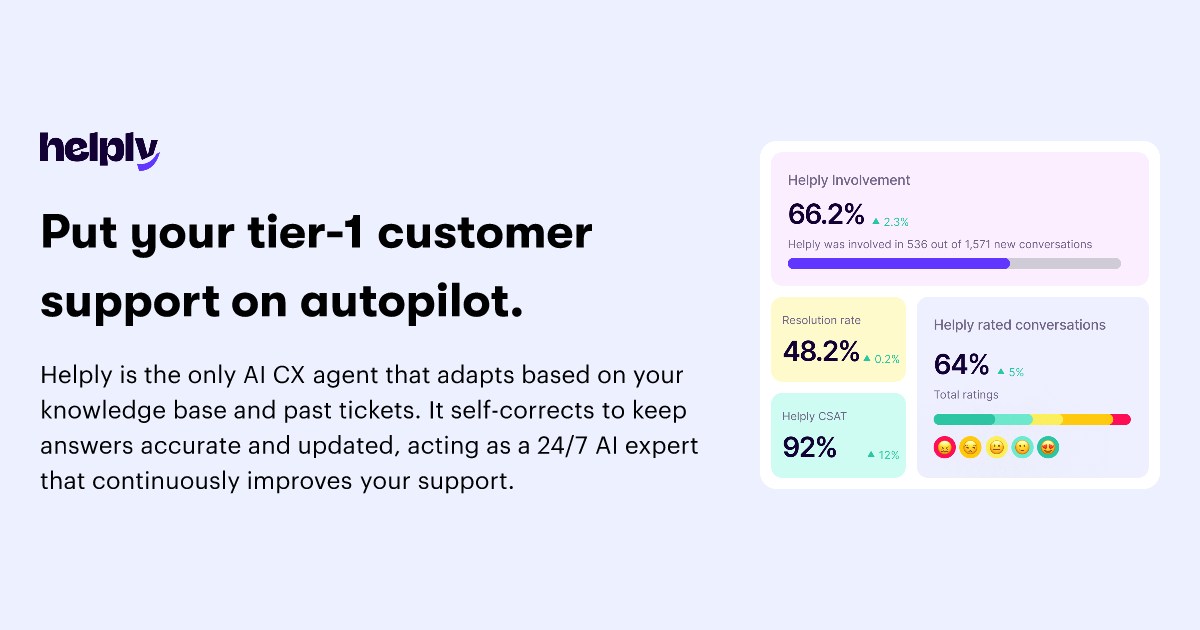
Helply is an AI support agent that resolves support conversations end-to-end with a 65% resolution rate guarantee within 90 days. It takes real actions, syncs to your help desk, and escalates with full context.