Category Focus/categories/automation
Automation AI Tools
Discover and compare the best automation AI tools and software. Browse 594+ curated tools with reviews and rankings.
Projects tracked
594
Sort mode
RECENT
Page
1
Discover and compare the best automation AI tools and software. Browse 594+ curated tools with reviews and rankings.
Projects tracked
594
Sort mode
RECENT
Page
1
Crosswalk is an AI newsletter reader built into Claude and ChatGPT, described by its makers as a third place for you and your agents. It provides an inbox, groups, calendar and notes, and it lets anything sent to you@crosswalk.to — or sent directly to @username — be read inside your Claude or ChatGPT. Claude reads anything you ask it, and can answer what's new, what matters, and store important stuff for later. The pitch is deliberately simple: catch up on everything and forget nothing, using the AI assistant you already work with as the reading surface instead of yet another standalone app to open, check and lose track of. The problem crosswalk addresses is stated plainly on the site: you have too many newsletters and emails that you never get to. AI reading the open web is working from content written by anyone for anyone. A crosswalk is framed as the opposite — curated, trusted sources plumbed directly into your agent. Your inbox is the first crosswalk, and only what you subscribe to gets in. That design choice matters because it means your agent reads sources you have deliberately chosen rather than whatever the open web happens to contain, which is what the site describes as giving your agent your point of view. Beyond your own inbox, you can also share with other people's agents — friends, groups, or your public feed. Getting started is intentionally short. Step one is to add crosswalk to your AI: one click for Claude, and four steps for ChatGPT, with a free ChatGPT plan supported too. In practice this means adding a custom connector named crosswalk with the remote MCP server URL https://mcp.crosswalk.to — the site notes the form is prefilled so you just press Add. The same route is offered for Claude Code, Codex and Cursor. Crosswalk supports a broad set of agents beyond the two headline assistants: Claude, ChatGPT, Cursor, Muse, Grok Bot, dots and Instinct, plus a more developer-oriented set covering Claude Code, Codex, Gemini CLI, GitHub Copilot, Windsurf, Zed, Cline, opencode, Warp and JetBrains AI. Step two is picking newsletters. You pick the ones you read and your agent reads them too. Crosswalk says it will sign you up, or you can use your crosswalk email anywhere. The site lists examples of the newsletters available, including One Useful Thing, Latent Space, Benedict Evans, The Pragmatic Engineer, 1440, Simon Willison's Weblog, Import AI, Platformer, Newcomer and Fabricated Knowledge. There is also a live-ranked list of the most subscribed newsletters on crosswalk and a ranked list of the most visited bundles, with the full directory reported as 773 newsletters. Step three is checking crosswalk: you ask Claude what's new, ask it to read an issue, or ask it anything about them. The site shows a sample exchange where the agent returns what is worth knowing today, one sharp idea worth noting, a note to skip the rest, and a summary line covering five issues and 42 minutes of reading. Beyond the inbox, crosswalk describes four related capabilities, and notes that the first two take a minute while the last two are the same idea, bigger. The first is your own crosswalk, where username@crosswalk.to lands. You already have one and it is private to you: pick a username and every email sent to that address becomes a post there, newest first. Your agents read it from every repo and session and can add to it, so it doubles as a CLAUDE.md that lives on the server instead of in one repo. The site notes that nothing else depends on this feature. The second is inviting a friend. One call, their email, and you share a duo crosswalk — nothing to install on their side. The suggested use is the thing you never quite send: the Paris list with all 47 places and 44 links, the setup that finally worked, the post-mortem. Your agent writes it up from what it already has, and their agent reads it. This turns an informal, half-finished share into something an agent on the other end can actually consume. The third is going public: other people's agents read your feed by name at @username. The public feed is separate from your inbox, which stays private. You can use it to broadcast your CLAUDE.md, the tips you keep repeating, or just a readme about you — how to reach you, what you're building, what you want to learn. The site notes that writing to public crosswalks is invite-only, which it frames as being for your agent's security. The fourth is group crosswalks, private for a team and public for a community. Private groups are suggested for decisions, post-mortems and playbooks. Public groups are suggested for a subreddit or a Discord used through agents. The site adds a specific case: if you ship an MCP server, CLI, or API that people use through agents, this is where your users trade best practices, tips, and things to try. Public crosswalks can be browsed on the popular page. Alongside the inbox, groups, calendar and notes, these capabilities form the broader "third place" the product is named for — a shared space that people and their agents both inhabit. The site also describes how crosswalk behaves from the agent's side. Facts, not instructions, is the framing. Crosswalk is an MCP server at mcp.crosswalk.to. For a connected agent, one get_context call returns the user's inbox — newsletters and email sent to their crosswalk address — along with what their friends and groups shared. Connecting is always user-initiated, whether through a terminal command or a connector the user adds in their client's settings. A machine-readable summary lives at /llms.txt, and the page states that it asks nothing of any agent reading it: whether to connect is the user's call. That stance is consistent with the newsletter model, where only what you subscribe to gets in. The benefits described follow directly from that design. Rather than letting subscriptions accumulate unread, you can ask a question and get an answer about what is new and what matters, with the agent able to store important things for later. Because the sources are curated and trusted rather than open-web, the agent's reading reflects your chosen point of view. Because crosswalk works inside Claude, ChatGPT and a long list of other agents, the workflow fits tools you already use, and your crosswalk address can follow you across repos and sessions. The result the product promises is summed up in its own headline: catch up on everything, forget nothing. Concrete use cases appear throughout the site. The most direct is catching up on newsletters by asking your agent what's new or asking it to read an issue. A second is sharing something personal and rich — the Paris list, the setup that finally worked, a post-mortem — with a friend's agent through a duo crosswalk, with no installation required on their side. A third is a private group crosswalk for a team's decisions, post-mortems and playbooks. A fourth is a public group crosswalk for a community such as a subreddit or Discord accessed through agents. A fifth is for builders who ship an MCP server, CLI, or API used through agents, who can host a crosswalk where their users trade best practices, tips and things to try. A sixth is treating your own username@crosswalk.to as a server-side CLAUDE.md that your agents read from every repo and session and can add to. Crosswalk is aimed at people drowning in newsletters and email they never get to, and at the agents they already rely on. The supported agent list spans everyday assistants such as Claude and ChatGPT and coding-oriented tools including Claude Code, Codex, Cursor, Gemini CLI, GitHub Copilot, Windsurf, Zed, Cline, opencode, Warp and JetBrains AI, which suggests the audience includes both general readers and developers. It also serves friends and groups who want to pass curated material between agents, teams that need a private space for decisions and playbooks, and communities or product builders who want a shared place where users of an MCP server, CLI or API can exchange tips. Connecting is always initiated by the user, either as a terminal command or through a connector added in the client's settings, and the connector setup lists the remote MCP server URL as https://mcp.crosswalk.to. Taken together, crosswalk positions itself as the inbox layer of a shared space for people and their agents. Its primary value proposition is straightforward and repeatedly stated: only what you subscribe to gets in, your agent reads it on your behalf, and you can ask your AI what's new, what matters, and keep what you need for later. By turning newsletters and email into curated, trusted sources plumbed directly into Claude, ChatGPT and a wide range of other agents, crosswalk aims to help you catch up on everything and forget nothing.
DailyHelm is an agentic AI business reviewer that watches a company's analytics, advertising, SEO and store data overnight, then tells the operator what to fix today. Instead of handing over charts that still have to be interpreted, it delivers a prioritized list of fixes ranked by likely revenue impact. It is built for founders and growth teams who run the whole business themselves, the people wearing the marketing hat, the engineering hat and the finance hat at the same time. The promise on its own site is simple: stop guessing what to do next, and start each day with a punch list that points at the issues worth acting on. Traditional dashboards answer the question of what happened but leave the harder question of what to do about it entirely to the person reading them. Founders describe opening five tabs and spending ninety minutes every morning reviewing data while still feeling like they were guessing. Meanwhile, the most expensive problems are silent: conversion tracking that breaks after a deploy so paid ads optimize against zero data, search terms burning budget with no conversions, near-me queries dropping out of the local pack, a best-selling product page returning a 404, a lead form that quietly stops submitting, or a surge in failed payments that churns subscribers for days before anyone notices. DailyHelm exists to surface exactly those kinds of issues and to rank them by the revenue they put at risk. The core of the product is the daily digest. Every morning it greets the user with a business review that states what changed overnight and lists today's recommended actions as a numbered, prioritized punch list. Each item carries an impact score and an effort estimate, so a high-impact, low-effort fix can be separated from lower-priority work. In the example shown on the site, the digest opens with a conversion tracking outage: tracking has been broken for four days and $8,400 of ad spend has been optimizing against zero conversion data. The two recommended actions are to restore GA4 conversion tracking at an impact of 9 out of 10 with low effort, and to pause campaigns until tracking is verified at an impact of 7 out of 10, also low effort. Findings are produced by six specialist AI agents, each of which owns a domain. Iris covers analytics and growth, including funnels, pipeline health and churn signals. Pitch covers ads, including spend, keywords, search terms and CPA. Echo covers SEO, including rankings, indexation and on-page signals. Ada covers code, investigating the repository when business data smells off. Penny covers cost, including cloud spend by SKU, cost forecasts and egress leaks. Sage covers site UX, including crawl-driven performance and conversion blockers. Aria is the lead agent: she correlates the specialists' findings, ranks them by expected impact and writes the morning brief, and she is also the agent users chat with when they want to dig deeper into a finding. Every finding is evidence-backed. A finding lists its impact score, a confidence percentage, an effort rating and the raw evidence behind it, for example a GA4 purchase metric reading zero for the window while Stripe shows 47 successful charges, alongside the specific commit that removed the tracking tag. From there DailyHelm recommends a concrete next action, such as restoring a line of code removed in a named commit and pausing a set of Google Ads campaigns until the next sync confirms tracking is live. Users can accept, snooze or dismiss a finding, or open a chat with Aria to ask what broke and how it slipped through. Findings can also come from more than one specialist at once, for instance Ada and Iris cross-referencing a tracking blackout, or Iris, Ada and Sage teaming up on a lead form regression, which is how a business-data symptom gets traced back to its technical cause. Setup is designed to be quick. Users first describe their business, including what they sell, who buys it and what success looks like, which anchors every later recommendation. They then connect platforms one click at a time: DailyHelm opens the approval page and the user confirms. Supported integrations shown on the site include Google Analytics 4, Google Ads, Google Search Console, Shopify, GitHub, Stripe, Meta Ads and a site crawler, with GCP billing also listed in the connection flow. DailyHelm pulls a daily snapshot from each platform and, in its own words, stores nothing it does not need. The site quotes a setup time of under five minutes on average and says findings start arriving within the hour. Because the product reads advertising, analytics and repository data, DailyHelm makes a point of being safe to plug in. It is read-only on every connector: OAuth scopes across GA4, Search Console, Ads, GitHub and the store are read-only, and the company states it cannot write, post or modify anything in connected accounts. Integrations use OAuth only, with no API keys, so users approve scopes on the platform's own consent screen and can revoke access from either DailyHelm or the platform at any time. Traffic is encrypted with TLS 1.2+, data is encrypted at rest, and OAuth refresh tokens and webhook secrets are encrypted at the field level. The company states that AI processing happens through providers contractually prohibited from training on customer data, and that the service is GDPR and CCPA compliant, with access, correction, export and deletion rights honoured. Deleting an account revokes every connected token, purges findings and removes personal information within 30 days. What makes the approach distinctive is that it is agentic rather than purely analytical. DailyHelm does not simply aggregate metrics into a dashboard; it runs a review, the way a specialist would, and returns conclusions. Each agent monitors its own domain overnight, Aria correlates their findings, ranks them and writes the brief, and every conclusion must cite its evidence and carry a confidence level. The cross-domain correlation, pairing a marketing symptom with a code change or a billing anomaly with a churn signal, is what lets the product point at a root cause rather than a chart. And because everything is read-only, the system's output is advice, so the user stays in control of every change. The stated outcomes are about time and money. Early users report that problems which used to go unnoticed for days are caught the same morning: one founder describes a Shopping campaign flagged at 6am for running against 47 zero-conversion search terms, with negatives added before lunch and $340 a day of spend recaptured. Another describes a Friday deploy that broke the GA4 purchase event and cost $2,200 over a weekend of blind paid ads, and says it will not happen again now that deploy-to-tracking breaks are caught the same day. A solo founder reports replacing 90 minutes across five dashboards with an eight-minute brief and one clear priority. The site also cites a 4.9 out of 5 rating from early users, a 24-hour path to a first finding, and a 100% read-only guarantee. The site groups findings by business type. For DTC and e-commerce businesses, Pitch flags wasted ad spend on specific keywords or search terms burning budget with zero conversions, and recommends negative keywords and bid changes. For SaaS and app businesses, Iris and Ada work together on conversion tracking blackouts, identifying the deploy that broke the tag and pointing at the line of code to restore. For local and service businesses, Echo catches local-search ranking collapses, surfacing which categories regressed and the on-page or schema fix likely behind it. For dropshippers, Echo and Ada catch a best-selling product page that disappeared from the sitemap or started returning a 404 after a deploy, within hours rather than weeks. For B2B and lead-gen teams, Iris, Ada and Sage cross-reference to catch lead forms that silently regressed after a deploy broke validation or the success event. For subscription businesses, Penny flags a surge in failed charges, the dunning gap behind it and the recoverable MRR before the churn compounds. DailyHelm is aimed at operators who run the whole business: DTC and Shopify founders, dropshippers, B2B SaaS operators, solo founders who want something like a part-time COO reading every dashboard, and, as a coming-soon capability, agencies that want to manage multiple client businesses from one panel with branded daily briefs they can forward to clients. It is also positioned for anyone short on time who would rather get a punch list than open eight dashboards. The product is offered with a 7-day free trial and no credit card, and setup is described as taking about five minutes. In short, DailyHelm turns the daily grind of checking analytics, ads, SEO and store tools into a single AI-written review that ranks the fixes most likely to protect or grow revenue. It combines domain-specific specialist agents, cross-agent correlation, evidence-backed recommendations and read-only access to the platforms a business already uses, so operators can stop guessing and start working on the thing that actually matters that morning.
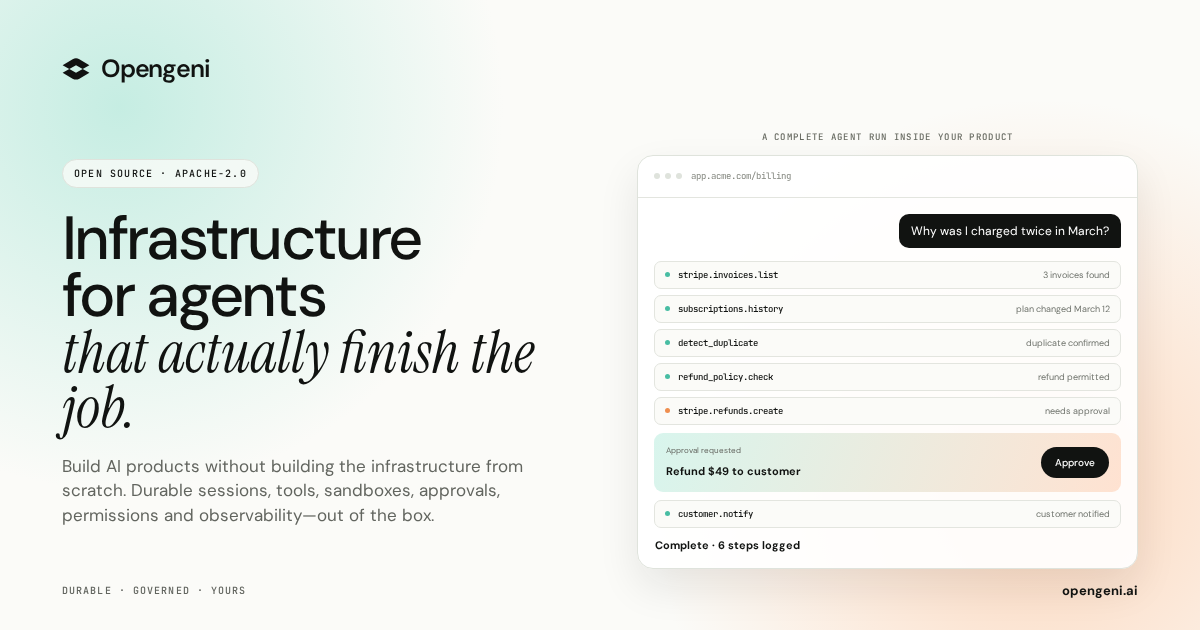
Opengeni is open-source AI infrastructure for putting agents inside your product, built so that you focus on your agents while Opengeni handles the infrastructure around them. It packages the pieces agents need to run in production: streaming, durable sessions, isolated sandboxes, tools, credentials, memory, multi-tenancy and React components. The project is licensed Apache-2.0 and, as the site states, it is built from running agents in production. The same API powers the Opengeni app, your product and your code, so a session can be rendered in the hosted app, embedded in your own interface, or driven programmatically. It is aimed at developers and teams who want to ship an agent feature rather than rebuild chat, sandboxing, credential and tenancy plumbing from scratch. The problem Opengeni addresses is the gap between an agent demo and an agent feature that survives real usage. The site lists the obstacles plainly: one dropped connection and the run is gone; agent code cannot run next to your secrets; every user needs their own OAuth tokens; every API needs wiring before an agent can use it; agents forget everything between sessions; every query has to know who is asking; and a better model ships, leaving you locked in. Each of these is framed as infrastructure you would otherwise have to build and operate yourself. Because the project comes from running agents in production, the emphasis is on the operational realities of restarts, failure recovery, per-user permissions and multiple paying customers rather than on an abstract architecture diagram. Durable sessions are the first thing Opengeni removes from your to-do list. Instead of a run dying when a worker restarts or a user closes a tab, the run keeps going and resumes at the event where it stopped; the site illustrates this with a run resuming at event 128. Sandboxes give the agent code somewhere isolated to execute, shown as a Python script that detects a duplicate charge using a scoped, short-lived token, so agent-generated code never sits next to your secrets. Credentials are handled per user, with connections to services such as Stripe, GitHub and Google Drive, and tokens that are refreshed automatically rather than pasted into prompts. Together, these three pieces mean an agent can be interrupted and still finish, can run code safely, and can act on behalf of one specific person without leaking long-lived secrets. Tools and MCP are how Opengeni connects agents to real systems. You point it at a specification such as billing.openapi.yaml and it exposes operations like invoices.list, refunds.create and customers.get as tools the agent can call; the site presents this as installing three tools from one file. That removes the manual wiring every API would otherwise need before an agent can use it. Memory is out of the box: agents learn from past sessions, so preferences such as refunds going to the original card, invoices being sent by email, or billing in EUR from April are retained, and the illustration labels memory entries with scopes such as Workspace and User. Memory removes the need to re-explain context in every conversation and lets an agent improve as it is used. Multi-tenancy is built in with row-level security, so every query knows who is asking; the illustration lists separate customers such as Acme, Globex and Initech. This means one deployment can safely serve many customers, which matters when you embed an agent for each of your own accounts. Opengeni is also model-agnostic: you can run agents on OpenAI, Azure OpenAI, OpenRouter or your own OpenAI-compatible endpoint, and swap between them so a better model shipping does not lock you in. Alongside these, the Product Hunt description highlights sessions that recover from failures, isolated sandboxes, 100+ integrations, human approvals, and visibility into every step and dollar spent. Opengeni is designed as a single API with multiple surfaces. The same session the Opengeni app renders at app.opengeni.ai can appear inside your own product or be driven from code. The code surface uses the @opengeni/sdk and @opengeni/react packages, with a provider, a session conversation component and a compiled stylesheet. The documented pattern is that your backend holds the API key and proxies the session routes, so the key never reaches the browser. Streaming, tool steps and the composer ship with the component, and these are the same packages the Opengeni app is itself built on, which keeps the embedded experience consistent with the hosted one. The React components are meant to be restyled in seconds. A single CSS custom property recolors every surface, and further variables control corners and typography, with accent options such as teal, violet, orange, blue, pink and graphite, corner styles ranging from sharp to soft to round, fonts such as DM Sans, Archivo and Mono, and a light or dark theme flipped by one attribute. A theme is applied with a wrapper class and a data attribute, so the agent adopts your existing design system instead of looking like a bolted-on widget. The site also includes an integration guide for embedding the assistant in your product and for keeping the key on your backend. Deployment is a choice between speed and control, and both options run the same Opengeni. Opengeni cloud is the fastest start: sign in and go, and you pay model cost plus 5%. Alternatively you can self-host the Helm chart on any Kubernetes, with Terraform for AWS, Azure and GCP, cloning the project from the Cloudgeni-ai/opengeni repository. Both paths share the same Opengeni API, workers and web app, so moving between them does not mean rewriting your integration. For the Product Hunt launch, the first 100 users receive $100 in cloud credit with the promo code PRODUCTHUNT100. The benefit is time to a working agent feature rather than a working demo. Sessions that survive failures mean users do not lose work when infrastructure hiccups; per-user credentials mean an agent can act with the right permissions for the right person; sandboxes mean agent code is contained; memory means the agent carries context forward; and multi-tenancy means the same deployment can serve many customers safely. Because streaming, tool steps and the composer come with the React component, the visible product experience is a few lines of code instead of a custom chat stack. The result is that engineering effort goes into the agent's behaviour and domain logic rather than into session durability, tool wiring and credential storage. The site's concrete example is a billing assistant. A customer asks why they were charged twice in March; the agent lists invoices, finds a duplicate, and issues a refund, then explains that two $49 charges landed on March 12 and that the refund will be back on the card in a few days. The same scenario is shown running in the Opengeni app, inside a customer's billing portal, and from React code. Other sessions listed in the app include a weekly churn summary, updating a refund policy document, and triaging failed webhooks, showing the same infrastructure applied to recurring analysis, internal document work and operational triage. Opengeni targets developers and engineering teams building AI agents into real products, and the Product Hunt topics are Open Source, Developer Tools, Artificial Intelligence and GitHub. The stack shown in the content is React and TypeScript on the client with CSS variables for theming, a backend that holds API keys, and Kubernetes, Helm, Terraform, AWS, Azure and GCP for self-hosting. Integrations named in the content include Stripe, GitHub and Google Drive, with other capabilities exposed as tools from OpenAPI specifications such as billing.openapi.yaml. Opengeni's promise is straightforward: agents in your product, infrastructure out of the box. By providing durable sessions, isolated sandboxes, credential handling, tool and MCP wiring, memory, multi-tenancy, model freedom and themable React components as one open-source, Apache-2.0 package that runs in the cloud or in yours, it shortens the distance between an agent idea and an agent feature your customers can actually use.
LaunchReel is a Claude Code plugin that edits talking-head videos and generates launch videos for your real product. According to the product's website, you record yourself and Claude cuts the footage, adds captions and zooms, and builds visuals around what you say; you can also pin a comment on any frame and it fixes just that spot. It is aimed at founders, makers and small teams who need finished videos for a product launch, without doing a manual editing pass themselves. The site positions it as a way to get a professional-looking video out of a raw recording and out of your own repository. The problem it addresses is the gap between describing an edit and actually getting it. In the site's own comparison, using Claude Code alone means that to fix one thing you describe it, wait, and render again; a small edit costs another prompt; there is no sound; the Reels version means starting again in portrait; and getting an MP4 means setting up a renderer yourself. LaunchReel is presented as the layer that removes each of those steps: you pin a comment on the frame instead of writing a prompt, you click text to change it, you get original music and voiceover, you say "make the 9:16 version," and you press Export. That framing matters because it turns video editing from a back-and-forth prompting loop into a visual, direct-manipulation workflow while keeping the automation. The core editing capability is on talking-head footage. LaunchReel cuts the fillers, pauses and retakes out of a recording, then — according to the site — listens back to check every cut before adding captions and zooms. That sequence is what makes the output usable: filler removal alone can leave awkward jumps, so the verification step is described as a check on each cut, and captions and zooms are layered on afterward to keep attention on the parts that matter. Recordings up to 5 minutes are supported on the Creator plan and up to 10 minutes on Pro, which sets the practical ceiling on a single talking-head project. The Studio is the manual-editing surface, and it opens while Claude works. It runs locally at localhost:4747 and gives you a live preview with sound. The site's headline example is pinning a comment on any frame — the preview shows an instruction such as "make this bigger" attached to a specific moment — and Claude then fixes just that spot. Alternatively, you can click text and change it directly, with no prompt involved. The Studio is also where structure becomes visible: the preview shows the narrative beats Hook, Problem, Demo, Proof and CTA, so you can see how the video is organised as you work. The selling point the site makes is that small fixes cost no prompt, which keeps iteration cheap once the first edit exists. Alongside talking-head editing, LaunchReel writes launch videos. Claude writes every scene as code for your real product, taken from your repository, rather than from generic stock. Those videos come with original music and voiceover — the pricing page describes this as an original score and studio voices — so the finished film ships with sound rather than silence. LaunchReel also adds what the site calls a director's playbook, described in the Creator plan as "the full playbook, always current." If you are not using Claude Code, the site offers a separate path: you can generate a video from a template. The workflow is deliberately short. First, you say one sentence — the example given is "cut this recording into a reel" — and Claude does the first edit. Second, the Studio opens while Claude works, so you can watch the video build rather than waiting blind. Third, you make it yours: pin comments or edit directly on the frame, then export when it's right. Setup is also minimal and command-line based: you run "/plugin marketplace add gajanansr/launchreel-plugin" and then "/plugin install launchreel@launchreel", one at a time, with Node 20 or later installed. Because the Studio runs on localhost, the editing happens on your own machine; the site notes that Claude's work uses your own Claude plan, while edits you make in the Studio do not. Talking-head projects keep working copies of your recording and use roughly 0.07 GB per minute of 1080p, and LaunchReel tells you the cost before it starts. The stated benefits follow from that workflow. Fixing a detail no longer requires describing it, waiting and re-rendering — you mark the frame. Changing wording no longer requires a prompt — you click the text. Portrait versions no longer mean a separate edit from scratch — you say "make the 9:16 version." Sound is included through original music and voiceover. Export is a button rather than a renderer you configure yourself. And output is finished to the format you need: 16:9 or 9:16, up to 4K, with 2K and 4K available on Pro. Concrete scenarios from the site include cutting a raw recording into a reel, producing a launch film describing your real product, making a demo video, and generating the vertical 9:16 version for Reels or Shorts from the same project. Because fixes and re-renders within the same month do not count as another video, the product is also suited to iterating on one video — re-rendering it and re-voicing it — until it is right. The template option covers people who want to generate a video without using Claude Code at all. Pricing is structured around projects. A free trial lets you make one full video with every feature, exported in 1080p with a small watermark in the corner. Creator is $19 per month after a founding discount (50% off the first three months with code FOUNDING50) and includes 5 videos a month, no watermark or end screen, 1080p export, talking-head recordings up to 5 minutes, original score and studio voices, the full playbook, and use on up to 2 computers. Pro is $49 per month and adds 20 videos a month, 2K and 4K export, recordings up to 10 minutes, use on up to 3 computers, and early access to new looks and features. Team is $149 per month with everything in Pro, 80 videos a month, up to 10 computers, and one invoice. A video is one project; fixing, re-rendering and re-voicing it in the same month do not consume another video, and the count resets on the first of the month. Plans renew monthly and can be cancelled anytime; prices are in USD, billed monthly by the reseller Dodo Payments, which handles tax and invoices. In short, LaunchReel's value proposition is that Claude does the editing work while the product supplies the parts that make the result shippable: a Studio for direct fixes, a director's playbook, original music and voiceover, and export in 16:9 or 9:16 up to 4K. For a founder or small team that records talking-head videos and needs launch videos for a real product, it collapses editing, sound and export into a short, mostly automated flow.
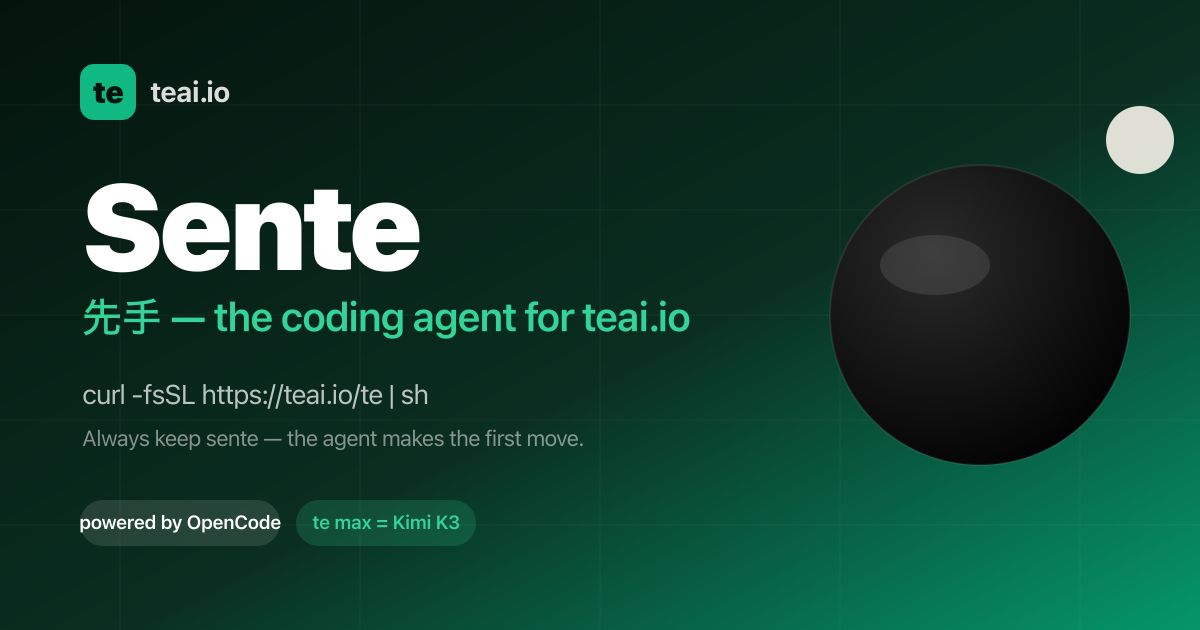
Sente is teai.io's official coding agent CLI, described as a thin launcher over OpenCode (MIT, 203k GitHub stars). One curl line installs it, and every teai.io model becomes an agent in your terminal. It is built for people who work in a repository rather than a chat window: Sente reads and edits the files in your repository, runs commands, and reports back. It sits in the teai.io CLI family alongside te, which you type at, and fuseki, which watches without being called. Sente itself is free; usage is metered through teai.io credits, and the site states the limits honestly rather than promising unlimited use. The starting point is the gap between a chat app and an actual working agent. A chat interface can answer questions, but it cannot reach into the files in your repository, run commands on your machine, or report back on what changed. Sente is built to remove that gap, and to do so without a conversion layer: teai.io is natively OpenAI-compatible, and Sente, being OpenCode-based, speaks OpenAI-compatible natively, so tool calls travel through teai without a translation step — zero conversion layer, nothing to break when routing through teai. The other half of the problem is trust and cost: agents fail, retries multiply, and metered usage can feel opaque. Sente's answer is billing that ignores empty responses and refunds failed paid media jobs and failed MCP tool calls, plus a safety model that asks before anything destructive. Sente is deliberately not a fork. The install is one line — curl -fsSL https://teai.io/te | sh — which installs OpenCode if it is missing and points OPENCODE_CONFIG at a teai.io-generated config. On each launch Sente syncs the teai.io model catalog, so upstream OpenCode improvements arrive without the project having to maintain a diverged codebase. A coding discipline file, sente-rules.md, is auto-written to ~/.config/teai/ and injected into every session, mechanically enforcing rules such as read before you write and always ship a deliverable. The command is short — te — and a sente alias is also installed. Setup continues with te login using a free API key obtained at registration. Sente exposes 380+ models on a single account and makes switching a one-line affair. The daily driver is glm-5.2 at roughly ¥0.34 per task; quality-critical work routes through te lux to the Claude/OpenAI flagship (Fable 5); hard tasks use te max on Kimi K3 (2.8T, 1M); and DeepSeek V4 Pro comes in around ¥0.03 per task. One base_url decides routing, which is how the product aims to stay cheap without breaking quality, and a task is measured as approximately 1K input plus 500 output tokens. Because the endpoints are OpenAI- and Anthropic-compatible, existing tooling patterns carry over, and the API-compatible endpoints never store request bodies — only metadata, kept for 90 days. Voice is a first-class input. te talk starts a voice conversation: you say what you want done and Sente reads its reply back to you, on macOS, Linux and WSL. Enrollment takes about one sentence — roughly ten seconds — and is consent-first: the delete key is yours, and teai.io states that it never clones a voice that isn't yours. For work that outlasts a laptop session, Sente Cloud at sente.teai.io runs in your browser on a cloud workspace; you sign in with an emailed one-time code, and closing your laptop doesn't stop the work. Optional GUI apps are installed explicitly with te app install sente for a menu-bar Sente.app, te app install koe for an always-listening Koe.app, or te app install both, and they are placed in /Applications only when you run that command. Safety is expressed as a three-tier risk model shared across the family: reads run automatically, writes are treated as reversible and proceed, and anything in the delete, send, publish or pay category asks first. fuseki, the third stage of the CLI family, is in Alpha and inherits the same tiers: it keeps an eye on your board — human-gates, recent repos — without being called, and only thinks and logs plus speaks a suggestion when something actually changes. It defaults to proposing only and never executes on its own; te stop stops it. The design intent is stated plainly: the agent moves before you do, but the risky moves still need you. Privacy is handled locally and is opt-in. te privacy scrub on masks emails, phone numbers, addresses, API keys, private keys and high-entropy tokens — plus names harvested from your Contacts dictionary with te privacy scrub harvest, Japanese honorific heuristics and Apple's on-device name recognition — on this Mac before the request reaches teai.io. The cost is about 0.1 ms per request with no local LLM required, and the reply is restored before it is shown. teai.io is explicit that this is not a guarantee of complete detection: Japanese given names without an honorific or a dictionary entry are not caught, and the optional Ollama layer (--llm) exists but is slow. Enterprise concerns are covered by invoice billing and a DPA, with BYOK in preparation. Five beta skills, announced for 2026-08, are backed by a reference corpus of 748 Q&A entries searched with lightweight retrieval — semantic embedding plus a relevance cutoff — before the model answers. te legal covers Japanese law with 259 entries across 21 topics and is cross-checked against actual e-Gov statute text, returning no match rather than fabricating; te security covers secure coding with 131 entries across 13 topics such as SQLi/XSS/CSRF mitigation, auth, secrets management and dependency vulnerabilities; te freelance covers 125 entries on contract checkpoints, Japan's invoice system, tax filing and social insurance; te infra covers 117 entries on Fly.io, Docker, CI/CD, SQLite/libsql, DNS and TLS, including real gotchas teai.io hit running this exact stack; and te license covers 116 entries on MIT/Apache/GPL-family licenses and AGPL's SaaS network clause. They are callable as te legal "question" or straight from the API by passing a model such as shitate/legal to /v1/chat/completions. The practical benefits are deliberately narrow and concrete. Nothing is billed for failure: empty responses are not billed, and failed paid media jobs and failed MCP tool calls are refunded in full, so you pay for results rather than errors. Cost control is explicit — cheap models for routine work, flagship routing for quality-critical work, and a maximum-performance tier when a task is hard — all switched with one line rather than a new subscription. Work continues while your Mac sleeps through Sente Cloud, discipline is enforced mechanically through sente-rules.md, and privacy scrubbing happens on-device before anything leaves the machine. Concrete workflows follow the same pattern. In a terminal you can run te run "explain this repo" for a one-shot explanation, ask te run "refactor this function" to edit code in place, or hand an agent a file generation task; switching to te max puts a hard task on Kimi K3. Away from the keyboard you can start te talk, describe the task out loud and hear the reply read back. For work that must keep going, Sente Cloud runs in the browser on a cloud workspace while the laptop is closed. Mid-implementation you can sanity-check risk with te security "how do I prevent SQL injection?"; outside code you can ask te legal about a statutory reserve share, te freelance how to register for Japan's invoice system, te infra how to set a secret on Fly.io, or te license what to watch for when using AGPL in a SaaS. Language settings also matter for Japanese and English users: /language (or /lang) switches the language dialog and skill list, /skills searches skills by display name, description or skill ID, and the initial language follows your terminal locale. Sente itself is free, and teai.io runs on credits. The Free plan gives 100 credits on signup with no credit card required — enough for roughly 300,000 short chats on Qwen3.7 Flash or about 2,000 on glm-5.2, at 1K input plus 500 output per task. Pro is ¥4,350 per month (about $29 USD) with 30,000 credits, and Business is ¥14,800 per month (about $99 USD) with 100,000 credits. Usage is metered rather than unlimited, and you top up monthly credits if you go over; invoice billing and a DPA are available, with BYOK in preparation. It runs on macOS, Linux and WSL (Windows through WSL), is Japan-built with a Tokyo region, JPY billing and Japanese support, and the source is MIT-licensed at github.com/yukihamada/sente. Documentation lives at teai.io/docs. Sente's proposition is narrow and consistent: one line to install, one account for 380+ models, three ways to call an agent — by typing, by speaking, or by letting fuseki watch — and a billing and privacy stance that refuses to charge for failures. For developers who want an agent inside their repository rather than inside a chat window, it is a thin, updatable, honestly metered layer over OpenCode.
WikiFix for Confluence is an app that keeps a Confluence wiki accurate — for the people who read it and for the AI tools that answer from it. It watches the spaces you care about and flags the pages that are wrong, from pages nobody owns any more to pages that contradict each other, and each finding resolves in a few clicks. It is aimed at Confluence admins and knowledge leads, and its purpose is simple: make sure the documentation your team depends on is true. The problem WikiFix addresses is drift. Documentation quietly stops matching reality: an incident runbook tells you to SSH into a host that no longer exists or restart a service that was renamed, a developer setup guide sends a new hire through screenshots and links that are long dead, and an HR handbook states that ten days of unused leave carry over while the leave policy says five. The page you need most in the moment is often the one that has rotted. There is also a newer risk: Rovo and every copilot answer from the same Confluence your team does, so whatever mistakes live in your docs get repeated back — and acted on — confidently and at scale. The practical blocker is scale: as the site states, you can't read 5,000 pages to find the ten that are wrong. WikiFix's first job is to find what is actually wrong, not just what is old. It is explicitly not a date filter. Instead it reads the content and finds the pages that disagree with each other, then lays the claims side by side, quoted from each page, so you can settle which one is right. In the example shown in the product, a finding about how many days of unused leave carry over lists the claim of "5 days" with the pages that state it and the claim of "10 days" with the pages that state it, so the conflict is visible before you decide anything. WikiFix only surfaces findings it is confident about, which keeps the review queue meaningful rather than noisy. Reviewing and fixing is designed to avoid busywork. Each finding is reviewable without opening the page: you pick the answer that's right, WikiFix writes the fix, you check it and click, and every page that disagrees is corrected. The product shows exactly what will change before it changes — for example, showing both the leave policy page and the onboarding checklist being updated to the chosen answer. Nothing happens without you: WikiFix writes nothing until you approve it, and a content fix reverts in one click, so the page goes back as it was. Reassigning the owner of an abandoned page is the one action that does not undo, and the card tells you before you click. Findings that reference a page you can't access are hidden. Today WikiFix catches three kinds of problem. Pages contradict each other — you choose which claim is right and every page that disagrees is corrected. Duplicate and near-duplicate content — you pick the page and unique facts that survive, and the rest fold and point to the source of truth. And the page owner has left — the scan spots an orphan and you reassign it in one click. If the page isn't yours, Ask owner posts an inline comment that lays out what each page says, @mentions the owner and the space admins, and moves the finding to the Escalated tab. A weekly scan summary is emailed to you with a per-space table showing the change versus the last scan and the number of open issues. WikiFix is also building detection for pages that contradict the live code, and has on its list broken links, buried important facts, the same thing called three different names, docs split across Confluence and Notion, and docs that live as Markdown in Git repos. WikiFix runs inside the Confluence you already have, so there is no migration and no new tool to roll out. It scans the spaces you care about — the product's own interface shows spaces such as Engineering, Product, Support, IT runbooks, People and Sales, each with its scan status and counts of conflicts, duplicates or unowned pages. Scans only spend credits on pages that are new or changed since the last scan, and billing runs through the Atlassian Marketplace on its per-user model. Every install starts with $50 of scan credits. The Advanced plan adds more credits for larger or busier wikis and the option to run scans on your own Anthropic key. The stated outcome is that people trust what they find in Confluence again. WikiFix keeps runbooks current so the page is right when you reach for it, turns a sprawling wiki into docs your team can actually follow, and makes the wiki a source of truth your AI can rely on. Because review happens on signal — concrete contradictions to act on — rather than on a calendar, teams stop re-reading the same spaces every quarter hoping to catch something, and nobody goes numb to the process. Concrete scenarios run through the product's own examples. An on-call engineer pulls up a payments outage runbook at 02:14 and finds half the steps no longer match reality — WikiFix finds and reconciles those pages so the runbook is right when it is needed. A new hire works through a developer setup guide step by step and hits dead links and missing files; the guide can be kept true instead. HR content that disagrees on leave carry-over between a handbook and a policy page can be settled in one review. And teams whose AI assistants answer from Confluence can reduce the chance that a copilot repeats and acts on a mistaken document. WikiFix is positioned for Confluence admins and knowledge leads, and its feedback form asks users to identify as a Confluence or space admin, a knowledge or documentation lead, an IT or sysadmin, or engineering/platform — with company Confluence sizes from under 100 to 2,000+ users and common pains listed as outdated pages, pages that contradict each other, factual errors and compliance. It is delivered as a Confluence app installed from the Atlassian Marketplace, and it is built around Confluence as the place docs live. Pricing is credit-based: roughly $0.10–$0.20 per new or changed page on average, with credits spent only on pages that are new or changed since the last scan. Standard costs $1.68–$0.29 per user a month with everything WikiFix does and a monthly credit allowance sized for an average wiki; Advanced costs $6.70–$1.15 per user a month with more credits and the option to use your own Anthropic key; Custom lets you adjust volume to your needs. Every install starts with $50 of scan credits. WikiFix's core promise is control without busywork: it finds the contradictions, duplicates and orphans that make a knowledge base untrustworthy, presents them for a decision you make in a few clicks, and changes nothing until you approve it — with a one-click revert if you change your mind.
Octri is a platform that takes a single OpenAPI specification and generates four connected products from it: a documentation site, client SDKs in ten programming languages, an MCP server for AI agents, and production monitoring. It is built for API teams and developers who want their API documentation, client libraries, and agent tooling to stay current without maintaining separate pipelines for each. The core promise is that one spec generates all four products and keeps them in sync, so there is never a second place to go and update when something changes. The problem Octri addresses is what happens after an SDK is published. As the site puts it, that is the moment code leaves your visibility: it runs on someone else's machine, fails on someone else's machine, and you hear about it in a support ticket three days later. Without monitoring of any kind, the typical timeline is three days with the integration still broken in production, no visibility into what went wrong, and angry support tickets stacking up. The stated alternative with Octri is a nine-minute window to a shipped fix with zero support tickets and nobody noticing. The broader context is that APIs are increasingly consumed not only by human developers reading docs but also by AI agents, which, without a structured source like MCP, integrate an API from memory and hallucinate its surface. API Studio generates documentation from the spec, with AI writing the first draft for every endpoint that you then edit like a document, so nobody has to open the YAML. It produces three-column endpoint pages with schema trees that open a level at a time, a live try-it playground on every endpoint, MDX guides alongside the generated reference, and support for your own domain on every tier including Free. Changes are stored per page, so a new spec revision only disturbs the endpoints that actually changed, and regeneration works around your edits. The generated docs also run an OpenAPI readiness audit, scoring a spec out of 10 against the same rules SDK Studio uses, surfacing missing schemas, undeclared path parameters and awkward method names before anyone generates a client. Fourteen rules are checked, covering things like successful responses declaring a schema, unique operationIds, path placeholders having parameters, a declared server URL, described authentication, shared models in components and referenced with $ref, and documented request bodies. SDK Studio generates idiomatic client libraries in ten languages: TypeScript, Python, Go, Java, Dart, Ruby, PHP, Rust, Swift, and Kotlin. Each language gets per-language config for namespaces, pagination, idempotency and code style, so you can rename methods, exclude endpoints, pick your HTTP engine and folder structure. You can write custom hooks compiled into the client, available as beforeRequest and afterRequest, and the generator handles included capabilities like pagination and streaming. SDKs auto-publish to the registries their users already install from: npm for TypeScript with type definitions generated from your spec and a choice of fetch or axios; PyPI for Python, async first with optional sync variants; git tag distribution for Go with standard library HTTP; Maven Central for Java, signed, under a groupId on a domain you own; pub.dev for Dart, for Dart and Flutter alike; RubyGems for Ruby with a class-style client; Packagist for PHP so Composer installs it; crates.io for Rust with doc comments becoming rustdoc; git tag and Swift Package Manager for Swift, with no registry account; and Maven Central for Kotlin with OkHttp or Ktor. Build history shows exactly what shipped and when. Monitoring has two ways in: flip it on and the telemetry compiles into your generated SDKs, or drop the standalone package straight into your backend. Either way there is no agent to deploy and nothing to instrument. Monitoring is off by default and switches on from the dashboard. It provides logs you can query directly by level, route, status code or release; issues grouped by fingerprint, each with the function and file that threw it; traces showing one request end to end across client, server, cache, database and queue, with the slow span called out; a service map of every service, the calls between them, and the error rate on each edge; N+1 query detection that finds the same query fired in a loop and counts it across traces; synthetic uptime probes on a schedule with run history behind every endpoint; and alerts that fire on burn rate and regressions so a single stray 500 never wakes anyone. Errors are traced to a commit. The site describes alert examples including a checkout 5xx spike with a threshold of 25 in 5 minutes, a new-issue alert on first sighting, a regression watch when a resolved issue starts erroring again, auth failures at 100 in 15 minutes, a latency guard at 50 in 10 minutes, a rate limit surge at 200 in 5 minutes, webhook delivery failures, and transcription timeouts. Security is handled by redacting credentials and identifiers on the client side before an event leaves your process, then again at ingest, covering tokens and direct identifiers such as email, phone and IP, with personal context waiting on your app's consent under a pre-signed GDPR Article 28 DPA. The MCP server turns your API into context and callable tools for Claude, Cursor and any MCP client. Seven documentation tools let the agent search, read and navigate your docs, and there is one callable tool per endpoint so the agent can hit your API for real. The server is curated by SDK Studio, so your exclusion list becomes the agent's permission list, and installation is one line: npx @octri/mcp, with nothing to host. The unique approach across all four products is that they share one source. Deprecate an endpoint in API Studio and the SDKs mark the method, the agent tools stop offering it, and monitoring shows you who still calls it. Add a language, cut a release, or push a new spec and the same thing happens. Nothing republishes behind your back: a spec change produces a draft and a diff of what moved, you approve it, and that is when new SDK versions reach the registries. The stated outcomes for users are visibility into integration failures before support tickets are filed, faster time from spec change to shipped fix, and consistency across docs, SDKs, agent tools and monitoring without manual synchronization. The site frames the shift as moving from three days of an unnoticed production failure to a fix shipped in nine minutes. For migrating teams, the importer reads an existing config file, bringing across navigation, custom pages, SDK settings, endpoint overrides, and theme and logotype, so you do not start from a blank project; a call with the team and onboarding help are both free of charge. Concrete use cases described in the content include integrating with an API through an agent: a user asks an AI assistant to integrate with Acme's Assistants API, the agent connects through the Octri MCP server with 15 tools over MCP and the npx @octri/mcp command, searches the docs, finds relevant pages, reads the POST /v1/assistants body schema, and wires it up with a TypeScript SDK package. A second scenario runs the same flow through a Python SDK, adding an assistant that answers billing questions, calling POST /v1/assistants and using the acme.assistants.create() method from a Python package. A third use case is writing a payment integration against a reference that shows GET /payments with limit, order, after and before query parameters, a paginated response with data, first_id, last_id and has_more, and a generated TypeScript SDK request example. Monitoring use cases include triaging grouped errors like a TypeError on GET /assistants/{assistant_id} with event and user counts and a last-seen time, tracking a regressed rate limit error, and routing alerts to Slack channels or ops webhooks. The spec audit is its own use case: pasting an OpenAPI URL and getting a score out of 10 with every missing schema and undeclared path parameter listed, optionally publishing the score at a public octri.dev address for public specs only, with the document not stored. The target audience spans indie developers shipping real APIs, growing teams shipping fast, and scaling products that need more, with the pricing tiers named Starter, Growth and Business respectively, plus Enterprise for unlimited scale with SLA guarantees. Plans are not per-product, so you can leave one of the four switched off and turn it on months later without redoing existing setup. The Free tier covers side projects and first APIs with one SDK language, 50 API endpoints, 100 one-time AI credits, 100 MB of monitoring ingress per month, AI-enhanced docs and chat, GitHub sync, custom domain and registry auto-publish. Growth at $99/mo adds four SDK languages, 300 endpoints, 2,500 AI credits, 5 GB ingress, versioning and custom code and components. Business at $249/mo adds all ten languages, 600 endpoints, 5,000 AI credits, 20 GB ingress, white-label and SDK CDN hosting. Enterprise adds SSO/SAML, unlimited scale and the ability to self-host the generator and docs renderer in your own infrastructure. Extra SDK languages are a flat $50/mo add-on, and annual billing saves 15%. Support ranges from Community on Free to Email, Priority and Dedicated on higher tiers. Everything Octri does starts from a specification you already have written. Whether you need readable docs, installable SDKs across ten ecosystems, agent-callable tools, or visibility into production failures, the same spec drives it all and keeps driving it as it changes, which is the value proposition the platform is built to reinforce.
Firetower is an open-source, self-hosted control plane for coding agents. It lets you run any coding agent — including Claude Code and Codex — on your own servers and manage them from a desktop or mobile client, from anywhere. You give Firetower a machine you can SSH into and a repository, and it handles the rest: picking a host, cutting a branch, making a worktree, starting tmux, launching the agent, and keeping it running. The product is aimed at developers and teams who want to run coding agents on infrastructure they control rather than on the device they start the work from. Its main purpose is to run coding agents on servers you own, keep them running reliably, and tell you the moment a session stops being useful without you. The problem Firetower addresses is that coding agents traditionally run on the device you started them from. If your laptop closes or the app crashes, the work is interrupted. Firetower changes that by running the agent on a server instead. Because the agent runs on your server, not on the device you started it from, every device can pick up exactly where another left off. Closing your laptop costs nothing, because the agent never ran on the laptop. Firetower also treats failure as something each part can experience on its own: if the Firetower server goes down, the workers keep running; if a worker dies, the worktree is still there, and your branch and every file the agent changed remain on that machine. By making each part independently resilient, the work survives every one of these failures. Firetower brings an entire workflow into one place. The flow runs from issue to shipped: you start from your Issues and Linear tickets, your agent runs your worktrees, you preview and annotate, and then you commit and open a PR. Firetower reads from your trackers as you look, and starting a ticket opens a workspace. A ticket list shows items such as "Add a dark mode toggle," "Fix the invite link on mobile," and "Rate-limit the webhook receiver," each with an ID, team, and how recently it was updated, with a Start action. This workflow ties the tracker, the agent, the diff, and the pull request together so the whole path from a ticket to a shipped branch stays in one surface. Firetower is designed so you can run remotely and close your laptop anytime. The agent runs on your server, not the device you started it from, which means you can pick up your phone and continue. If your laptop closes or the app crashes, nothing happens to the agent, because it never ran on the laptop; open Firetower on any other device and the conversation is exactly where you left it. If the Firetower server goes down, the workers keep running, and when the server comes back it catches up on everything that happened while it was away. If a worker dies, the worktree is still there — your branch and every file the agent changed are on that machine, and Firetower still knows about them, so you can restart the worker and carry on. Firetower runs your favorite agent on your favorite hardware. It reaches each machine over SSH and starts a worker there, and the agents run on that machine — in tmux, on their own worktree. Clients are available for macOS, Windows, iOS, and Android. Firetower is written in Rust and is described as the most efficient ADE on the market, with a small core, no accumulating terminal daemons, and workspace memory ceilings where the host supports them, built for work that keeps running. Its resource profile is presented in comparison charts: Firetower Desktop uses about 50 MB where a competing app and daemon report roughly 1.5 GB idle (30× more efficient); a Firetower worker uses about 5 MB with the agent CLI separate, where a competing agent process reports about 500 MB per agent (100× more efficient); and the Firetower control plane uses about 200 MB where a competing service reports about 1 GB after restart (5× more efficient). Firetower's unique approach rests on the idea that workers are authoritative. Workers write what happened to their own log before reporting it, and when the control plane comes back it asks for everything since the last thing it saw — so a closed laptop costs nothing and a reconnect is a replay, not a guess. The worker never opens a port: it reads frames from stdin and writes them to stdout, so who dials is a transport detail — a child process, a container exec, or SSH. The daemon cannot tell the difference, and neither can a firewall. In the architecture, desktop and mobile apps connect over HTTPS to the Firetower control plane, which is one compose file on a server you already own; the control plane then reaches machines over SSH, including a Mac Studio worker with tmux and git running Claude Code and Codex, and a Hetzner VM worker running Claude Code. Session indicators show a session that has stopped and needs you, one still working with nothing to do, and the SSH path the app uses to reach a machine you own. The benefits follow directly from this architecture. Because agents run on your own servers, closing your laptop costs nothing and you can continue from any device. Because each agent is on its own machine and in its own worktree, failures are isolated, and the work survives each of them. Because Firetower tells you the moment a session stops being useful without you, you can stop watching agents that need nothing and focus only on the ones waiting on you. Because workers are authoritative and reconnect as a replay rather than a guess, the state you see reflects what actually happened. And because Firetower is written in Rust with a small core and a small memory footprint, it is built for work that keeps running without consuming the resources a heavier tool would. Concrete scenarios include starting a task from a Linear or GitHub ticket so the agent begins work in a workspace automatically; running an agent on a Mac Studio or a Hetzner VM over SSH while you continue from your phone; closing your laptop mid-session and reopening the conversation on another device exactly where you left it; reviewing a diff and annotating it before committing and opening a pull request; and restarting a dead worker and carrying on because the worktree still holds the branch and every changed file. The workflow from issue to shipped — start from Issues and Linear tickets, run worktrees, preview and annotate, commit and open a PR — covers the day-to-day path a developer follows with an agent. Firetower is built for developers and teams who want to run coding agents like Claude Code and Codex on infrastructure they control. It integrates with trackers and source control: you start from your Issues and Linear tickets, and GitHub is among the connected sources (you can commit and open a PR). Its tech stack includes Rust as the implementation language, plus tmux, git, and SSH as the mechanisms that run agents each in their own worktree on a machine you own; the control plane is described as one compose file on a server you already own. Firetower is open source and self-hosted with no account required, and it installs in about five minutes on your server with a simple install command. Firetower's primary value proposition is control: it runs any coding agent on your own servers, from anywhere, and keeps the work running even when your laptop, the server, or a worker fails. By combining a self-hosted control plane, an issue-to-PR workflow, authoritative workers, and a small Rust core, it lets developers use the agents they already prefer on the hardware they already own — open source, no account, and built for work that keeps running.
Vitra.ai Universe is an agentic content platform that replaces a fragmented stack of content tools with one connected workflow. According to the website, it lets teams create, translate, personalize, review, and publish videos, images, documents, websites, and app content without jumping between tools. The site positions Universe as a way to "do the work of 12 AI tools in one place," and states that it is trusted by more than 120 enterprises globally. It addresses organizations whose content spans many languages, formats, and markets, including marketing, product, learning and development, and customer support teams. The core purpose is to keep the whole content workflow in one platform, with AI agents handling the repeat work while the team reviews what matters. The site emphasizes that you can start free with no credit card and build your first workflow in minutes. The problem Vitra.ai Universe addresses is tool sprawl and manual handoff. The website contrasts a "before" state of 23 manual handoffs and 12+ disconnected tools with one connected platform and unlimited content workflows. It lists the tools teams currently stitch together: asset manager, video editor, dubbing tool, image editor, image translator, translation app, CMS tool, lip-sync tool, personalization tool, website translator, app translator, Adobe apps, Figma, Canva, Office 365, SEO tool, spreadsheet, and document tool. The described consequence is people stuck between the tools, with files labeled "final_v7_revised," the recurring question "which version?", export-and-upload cycles, and missing context. The platform's stated intent is to stop video, images, documents, websites, and apps from being separate production lines by making them read and write the same brief, memory, brand system, approvals, and quality decisions. Under Create, Vitra.ai Universe covers video creation and image creation. Video creation turns an idea, a blog post, a deck, a PDF, or a product page into a finished video: it reads the blog, deck or PDF, drafts script and scenes, generates visuals and an avatar, adds voiceover and animated subtitles, burns captions onto the cut, and cuts long video into shorts. Image creation generates campaign-ready creative from a prompt or a brief, conditioned on your own brand kit; it reads the brief, conditions on the brand kit, composes the creative, fans out A/B variants, and runs a quality and compliance check. The benefit described is that the master is made once and multiplied without multiplying the work, because every capability shares the same brief and brand context. Translate & Adapt covers five capabilities. Video dubbing transcribes and splits speakers, clones each speaker's voice, carries emotion and prosody over, re-times lip-sync to the new audio, generates subtitles, and exports every delivery format. Image translation reads layers, fonts and positions, extracts the style kit, maps every text element, translates into 75+ languages, resizes type to fit the box, and rebuilds the file with layers intact, so designs do not have to be rebuilt. Document translation handles Word, PowerPoint, PDF, XLIFF, XML, JSON, HTML, DITA and more across 25+ formats and 75+ languages: it parses structure and tags, applies glossary and style guide, translates, reflows the layout, and writes back to translation memory. Website translation requires one snippet with no backend change: it crawls and segments the DOM, translates text, media and documents, server-renders so the site indexes, and picks up new content on its own. Mobile app translation drops in an SDK that reads the live screen, maps strings and dynamic content, translates on the fly, shares memory with web and video, and ships without a release. Personalization spans video personalization, image personalization, and hyper-personalization. Video personalization renders one video per person, product, or region: it starts from one master, reads the data rows, swaps name, offer and footage, re-voices and re-syncs per row, renders one cut per person, and delivers from your CRM or ESP. Image personalization takes one master creative and adapts it to every placement, audience, and market: it recomposes for each placement, resizes to every ratio, re-messages per audience, and holds the brand rules constant. Hyper-personalization starts from one video or one creative, picks the region, applies culture and festival rules, swaps the offer and creative, localizes the message, and broadcasts to WhatsApp and Facebook. Together these let a single approved asset become many localized, audience-specific outputs while brand rules remain fixed. Under Operations, Quality Control uses multimodal QC agents that check image, text, audio, and video before anything reaches an audience. The agents ingest image, text, audio and video, judge brand and accuracy, back-translate and compare, screen culture and compliance, and return APPROVED, REVIEW or BLOCKED with the evidence behind it. The site frames this as "review exceptions, not every asset," because no team can judge every language, format and market by hand. Back-translation catches drift so shifted meaning shows up as a concrete difference rather than a hunch, and regional rules and language acceptance are checked before anything ships. A blocked asset can be regenerated compliant for that market, from the decision itself. The platform's overall approach is agentic and memory-driven. A brief becomes shared intelligence: Universe connects the prompt to approved memory, product facts, brand rules, audience data, and prior campaign decisions before an agent creates anything; in the illustrated run, a memory agent linked 1,284 approved decisions to the launch brief and five context sources were connected. The demonstrated workflow expands from one brief to 200,000 content variants, moving through context, creation, 20 languages, 5 ratios, 1,000 partners, approval, and publishing, with a QC and human gate where agents verify all and reviewers resolve only the edge cases. VitraTM is described as one translation memory across video, images, documents, web and apps: it reuses exact, then fuzzy, then semantic matches, and only calls a model for genuinely new content. Approved work writes back so the next identical request is free, matches work in any direction because memory is stored per language, and glossaries are enforced during translation rather than corrected after. Review is built into the workflow engine rather than bolted on: one branch can wait for sign-off while every other branch keeps running, linguists, proofreaders and managers each see only the work that is theirs, every asset carries a defensible status of unverified, verified, or approved, and approvals or comments can be made from a phone so decisions never wait for a desk. Universe is described as not a dashboard with an API bolted on. Every capability is a callable skill that a person, event, workflow, or AI agent can trigger over MCP, REST, SDK, CLI and connectors. Any MCP agent can discover Universe skills and call them as tools; capabilities can be composed visually into one run and saved as a template; and a run can start from a business event via n8n, Make, Zapier, a CMS, or a webhook. Every run is recorded node by node against an append-only ledger and is auditable to the credit. The stated outcomes are that the content operation gets faster every time it runs, that every approved word makes the next campaign cheaper, and that handoffs such as creative handoffs, agency queues, and launch spreadsheets disappear. By team, marketing can launch one campaign in every market on the same day, turning one brief into localized video, imagery, landing pages, and social creative while every format stays on-brand and every market stays in sync, supported by 75+ languages, one shared campaign brief, market-level adaptation, and human approval before publishing. Product localizes before release, learning and development scales courses without re-recording, and customer support keeps every answer current. Integrations named in the content include Figma, Canva, Adobe apps, Office 365, CRM or ESP systems for delivering personalized video, Instagram and YouTube for publishing, CMS and LMS destinations, and automation platforms n8n, Make, and Zapier. On security and deployment, the site states SOC 2, GDPR and VAPT-aligned controls, with roles, tenant isolation, bring-your-own keys and buckets, content living where policy says, and an append-only audit ledger. Where cloud is not acceptable, the same operation runs fully air-gapped on your hardware with fine-tuned models, described as in production for defence today, and the platform can be white-labeled with tenancy, entitlements, credits and partner branding as your own product. A customer story from SOTC describes highly reliable and accurate website translation, market-specific adaptation that stayed true to brand identity, fast turnaround, and increased engagement and positive feedback after launching translated site versions. The product is rated 4.8/5 across Capterra, GetApp and Software Advice. On pricing, the website advertises starting free with no credit card and building your first workflow in minutes, without publishing specific paid tiers. Taken together, Vitra.ai Universe is a single agentic platform for content creation, translation, personalization, review, and publishing. Its primary value proposition is consolidation and controlled automation: one connected platform instead of 12+ disconnected tools, one shared memory and brand system instead of scattered files, and AI agents that handle repeatable production while people retain decision rights, approvals, and an auditable trail across every language and format a team operates in.
Phare C1 is an AI-powered smoke alarm from Phare Labs that detects fire and carbon monoxide early and accurately while cutting down on the false alarms that teach people to ignore their alarms. The company describes it as "the smoke alarm, minus the drama" and as "the upgrade your home has been waiting for," promising AI-powered early fire and CO detection backed by a peace and quiet guarantee. Phare C1 installs in place of your old smoke alarm — Phare calls it "plug and play peace of mind" and notes that being a smoke alarm is where the similarity with ordinary alarms ends. It pairs research-grade sensors with advanced AI and is, in Phare's words, meticulously engineered to protect the home that matters most: yours. Phare C1 is live in the UK, US pre-orders are now open, pricing starts from $149, and the product is a Red Dot Design Award Winner 2026. Phare frames the case for a new kind of alarm around three problems with the smoke alarms most homes already have. The first is false alarms: Phare states that up to 89% of the time a smoke alarm goes off, it is a false alarm. The second is missed fires: smoke alarms miss 28% of fatal fires, according to data from the NFPA. The third is the beeps themselves — Phare asks whether you actually know what they mean, adding that we do not speak morse code either. Together these failures produce alarms people stop trusting: one that cries wolf so often you silence it without thinking, yet can still fail to wake you when it counts. Phare's answer is a smoke alarm that detects fire, not toast — one that sounds for actual emergencies and nothing else, so that when it does go off you can be confident it is telling you something real. The core of Phare C1 is its multi-sensor array combined with Phare's AI algorithm. Phare says its AI algorithm detects more fires, earlier, and reduces false alarms, so that Phare alarms for fires and nothing else. The company states that Phare analyzes thousands of data points every minute to keep you safe, doing all of the worrying so that you do not have to. The alarm's detection algorithms learn and improve over time, which Phare says makes your home even safer the longer the device is installed. The practical result of this combination is early warning: the alarm responds sooner to real fires while rejecting the everyday cooking smoke and steam that trigger conventional units. Rather than being a single sensor with a fixed trip point, Phare is a system that evaluates what its sensors are seeing before it decides to sound. Phare C1 catches carbon monoxide sooner than other alarms. Phare measures CO with 0.1 ppm precision and sends exposure alerts before other alarms do, which means you can be told about a carbon monoxide problem while there is still time to act on it rather than only once levels have already climbed. Phare C1 and Phare C1 Pro also monitor air quality, which Phare says helps protect your health and longevity, turning the device into an ongoing indoor environment monitor as well as an emergency alarm. Alerts are delivered in the app — the product imagery shows a Phare Protect app carbon monoxide alert — so exposure warnings and other notifications reach you beyond the alarm itself. CO detection at fine precision and continuous air quality monitoring together make Phare a broader home safety and health device rather than a single-purpose siren. Phare C1 and Phare C1 Pro sense motion in the dark and softly light your path, so you are not fumbling for switches during a night-time trip down the hallway. Phare describes this as lighting the way at night, and customer reviews specifically call out the pathlights as something they value. When something happens, Phare tells you what is going on and what you can do about it instead of leaving you with mystery beeps, so you can respond before it gets loud and react before an alarm sounds to keep your home safe and quiet. The alarm tests itself and never needs batteries — Phare's instruction is simply to set it up and let the device do the rest. Phare C1 Pro adds intruder detection: its radar array spots intruders and sounds the alarm to drive them away. The Product Hunt listing notes that Phare C1 keeps much-loved features from the Nest Protect, such as early warnings, a night light and in-app alerts, and adds new ones including air quality monitoring and intruder detection. Phare's overall approach is to combine a multi-sensor array, research-grade sensors and advanced AI inside a device that replaces the smoke alarm already on your ceiling. Because Phare installs in place of your old smoke alarm, upgrading does not require rewiring your home or learning a new routine. Once installed, Phare continuously analyzes the data its sensors collect — thousands of data points every minute — and uses its detection algorithms to decide whether what it is sensing is a genuine emergency. That is what allows it to respond sooner to real fires while ignoring the toast. The Phare app, available at app.pharelabs.com, is where you log in to see what is happening, receive alerts such as early CO exposure warnings, and get Phare's guidance on what to do. Phare Labs also publishes API documentation, indicating the platform can be accessed programmatically, and states that Phare's detection algorithms learn and improve over time. The promised outcome is peace of mind backed by explicit assurances. Phare offers a Peace & Quiet Guarantee: no false alarms in the first 30 nights, or Phare will refund you in full. Free returns are available with no charge and no hassle from anywhere in the US and UK. An extended warranty provides up to 5 years of coverage with Phare+ Pro. Beyond the guarantees, the benefit Phare describes is a home that is protected earlier — fires and carbon monoxide caught sooner, an alarm that sounds only when it matters, guidance instead of confusion, and quieter nights thanks to pathlight. Customer reviews on Trustpilot echo these themes: users describe a straightforward installation, outstanding technical support for pre-sales and installation, a problem-free basic alarm function, great pathlights, and units that produce lots of useful home data. Concrete scenarios in the content include replacing an expiring alarm: one reviewer describes a successful transition from expired, mains-powered Nest Protect devices to three Phare C1 units, and others describe Phare as an amazing Nest replacement that provides far more detail than the Nest ever did. Another everyday scenario is the kitchen — the product is pitched as a smoke alarm that detects fire rather than toast, so cooking no longer routinely triggers the siren. At night, Phare C1 and C1 Pro sense motion in the dark and light a hallway path. For carbon monoxide, Phare sends exposure alerts with 0.1 ppm precision before other alarms do. Air quality monitoring supports ongoing awareness of the home environment, and Phare C1 Pro's radar array detects intruders and sounds the alarm to drive them away. More generally, Phare lets users respond before it gets loud — reacting before an alarm so the home stays safe and quiet. Phare C1 is aimed at homeowners who want earlier, more accurate fire and CO protection without false alarms — in particular people replacing older smoke alarms or expiring Nest Protect units, and households that want air quality monitoring and night-time pathlighting. Phare C1 is live in the UK and US pre-orders are now open, with pricing starting from $149. Phare currently offers $35 off any order of 2 Phares or more for people who leave an email, with the code PHARE25 shown at checkout. The site supports USD and GBP currencies, there is a shop with a comparison tool to find your Phare, and a cart flow for pre-orders. US orders ship once UL certification is complete, estimated summer 2027, and pre-orders can be cancelled anytime for a full refund. Support is available through the contact page, along with FAQ, legal, accessibility, privacy and API documentation pages. Phare C1's primary value proposition is simple: a smoke alarm that sounds for real emergencies and nothing else. By pairing a multi-sensor array and research-grade sensors with AI algorithms that detect more fires earlier, reduce false alarms and improve over time, Phare aims to restore trust in the alarm on your ceiling. Add early carbon monoxide detection with 0.1 ppm precision, air quality monitoring, pathlight, self-testing with no batteries, in-app guidance and — on Phare C1 Pro — radar-based intruder detection, and the C1 becomes more than a replacement alarm. Backed by a 30-night Peace & Quiet Guarantee, free returns in the US and UK and up to 5 years of warranty coverage with Phare+ Pro, Phare C1 is positioned as the upgrade your home has been waiting for: protection that works earlier, and a quieter home.