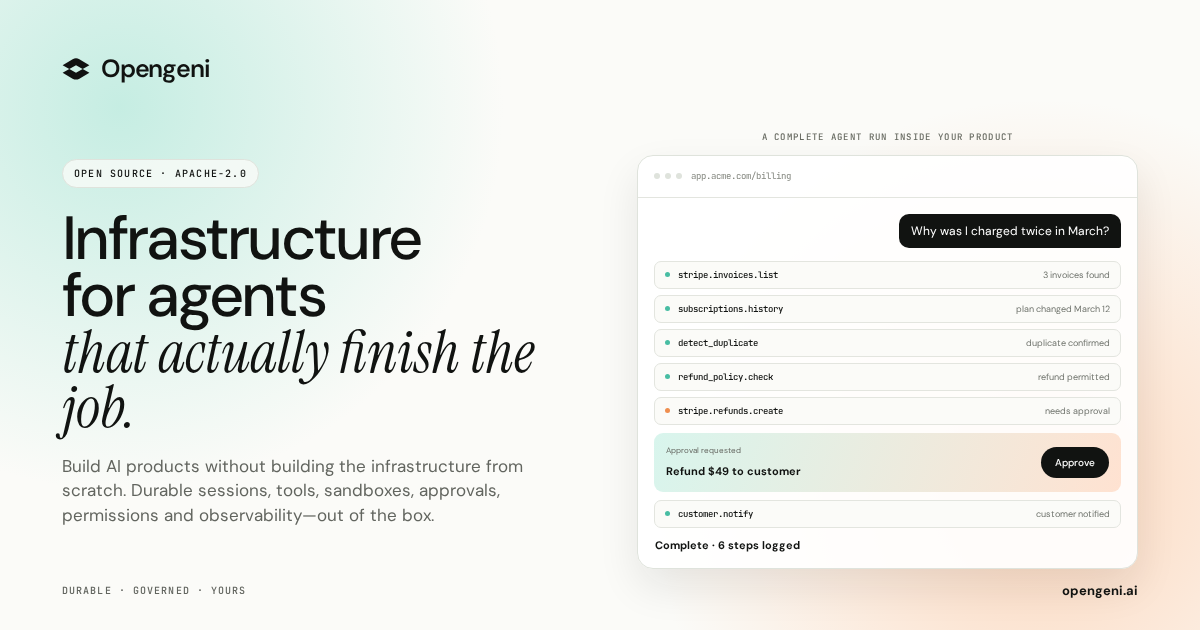
Opengeni is open-source AI infrastructure for putting agents inside your product, built so that you focus on your agents while Opengeni handles the infrastructure around them. It packages the pieces agents need to run in production: streaming, durable sessions, isolated sandboxes, tools, credentials, memory, multi-tenancy and React components. The project is licensed Apache-2.0 and, as the site states, it is built from running agents in production. The same API powers the Opengeni app, your product and your code, so a session can be rendered in the hosted app, embedded in your own interface, or driven programmatically. It is aimed at developers and teams who want to ship an agent feature rather than rebuild chat, sandboxing, credential and tenancy plumbing from scratch.
The problem Opengeni addresses is the gap between an agent demo and an agent feature that survives real usage. The site lists the obstacles plainly: one dropped connection and the run is gone; agent code cannot run next to your secrets; every user needs their own OAuth tokens; every API needs wiring before an agent can use it; agents forget everything between sessions; every query has to know who is asking; and a better model ships, leaving you locked in. Each of these is framed as infrastructure you would otherwise have to build and operate yourself. Because the project comes from running agents in production, the emphasis is on the operational realities of restarts, failure recovery, per-user permissions and multiple paying customers rather than on an abstract architecture diagram.
Durable sessions are the first thing Opengeni removes from your to-do list. Instead of a run dying when a worker restarts or a user closes a tab, the run keeps going and resumes at the event where it stopped; the site illustrates this with a run resuming at event 128. Sandboxes give the agent code somewhere isolated to execute, shown as a Python script that detects a duplicate charge using a scoped, short-lived token, so agent-generated code never sits next to your secrets. Credentials are handled per user, with connections to services such as Stripe, GitHub and Google Drive, and tokens that are refreshed automatically rather than pasted into prompts. Together, these three pieces mean an agent can be interrupted and still finish, can run code safely, and can act on behalf of one specific person without leaking long-lived secrets.
Tools and MCP are how Opengeni connects agents to real systems. You point it at a specification such as billing.openapi.yaml and it exposes operations like invoices.list, refunds.create and customers.get as tools the agent can call; the site presents this as installing three tools from one file. That removes the manual wiring every API would otherwise need before an agent can use it. Memory is out of the box: agents learn from past sessions, so preferences such as refunds going to the original card, invoices being sent by email, or billing in EUR from April are retained, and the illustration labels memory entries with scopes such as Workspace and User. Memory removes the need to re-explain context in every conversation and lets an agent improve as it is used.
Multi-tenancy is built in with row-level security, so every query knows who is asking; the illustration lists separate customers such as Acme, Globex and Initech. This means one deployment can safely serve many customers, which matters when you embed an agent for each of your own accounts. Opengeni is also model-agnostic: you can run agents on OpenAI, Azure OpenAI, OpenRouter or your own OpenAI-compatible endpoint, and swap between them so a better model shipping does not lock you in. Alongside these, the Product Hunt description highlights sessions that recover from failures, isolated sandboxes, 100+ integrations, human approvals, and visibility into every step and dollar spent.
Opengeni is designed as a single API with multiple surfaces. The same session the Opengeni app renders at app.opengeni.ai can appear inside your own product or be driven from code. The code surface uses the @opengeni/sdk and @opengeni/react packages, with a provider, a session conversation component and a compiled stylesheet. The documented pattern is that your backend holds the API key and proxies the session routes, so the key never reaches the browser. Streaming, tool steps and the composer ship with the component, and these are the same packages the Opengeni app is itself built on, which keeps the embedded experience consistent with the hosted one.
The React components are meant to be restyled in seconds. A single CSS custom property recolors every surface, and further variables control corners and typography, with accent options such as teal, violet, orange, blue, pink and graphite, corner styles ranging from sharp to soft to round, fonts such as DM Sans, Archivo and Mono, and a light or dark theme flipped by one attribute. A theme is applied with a wrapper class and a data attribute, so the agent adopts your existing design system instead of looking like a bolted-on widget. The site also includes an integration guide for embedding the assistant in your product and for keeping the key on your backend.
Deployment is a choice between speed and control, and both options run the same Opengeni. Opengeni cloud is the fastest start: sign in and go, and you pay model cost plus 5%. Alternatively you can self-host the Helm chart on any Kubernetes, with Terraform for AWS, Azure and GCP, cloning the project from the Cloudgeni-ai/opengeni repository. Both paths share the same Opengeni API, workers and web app, so moving between them does not mean rewriting your integration. For the Product Hunt launch, the first 100 users receive $100 in cloud credit with the promo code PRODUCTHUNT100.
The benefit is time to a working agent feature rather than a working demo. Sessions that survive failures mean users do not lose work when infrastructure hiccups; per-user credentials mean an agent can act with the right permissions for the right person; sandboxes mean agent code is contained; memory means the agent carries context forward; and multi-tenancy means the same deployment can serve many customers safely. Because streaming, tool steps and the composer come with the React component, the visible product experience is a few lines of code instead of a custom chat stack. The result is that engineering effort goes into the agent's behaviour and domain logic rather than into session durability, tool wiring and credential storage.
The site's concrete example is a billing assistant. A customer asks why they were charged twice in March; the agent lists invoices, finds a duplicate, and issues a refund, then explains that two $49 charges landed on March 12 and that the refund will be back on the card in a few days. The same scenario is shown running in the Opengeni app, inside a customer's billing portal, and from React code. Other sessions listed in the app include a weekly churn summary, updating a refund policy document, and triaging failed webhooks, showing the same infrastructure applied to recurring analysis, internal document work and operational triage.
Opengeni targets developers and engineering teams building AI agents into real products, and the Product Hunt topics are Open Source, Developer Tools, Artificial Intelligence and GitHub. The stack shown in the content is React and TypeScript on the client with CSS variables for theming, a backend that holds API keys, and Kubernetes, Helm, Terraform, AWS, Azure and GCP for self-hosting. Integrations named in the content include Stripe, GitHub and Google Drive, with other capabilities exposed as tools from OpenAPI specifications such as billing.openapi.yaml.
Opengeni's promise is straightforward: agents in your product, infrastructure out of the box. By providing durable sessions, isolated sandboxes, credential handling, tool and MCP wiring, memory, multi-tenancy, model freedom and themable React components as one open-source, Apache-2.0 package that runs in the cloud or in yours, it shortens the distance between an agent idea and an agent feature your customers can actually use.
Publisher
A
admin
Launch Date2026-10-06
Platformweb
Pricingfreemium
Tech Stack
#React#TypeScript#CSS custom properties#Kubernetes#Helm#Terraform