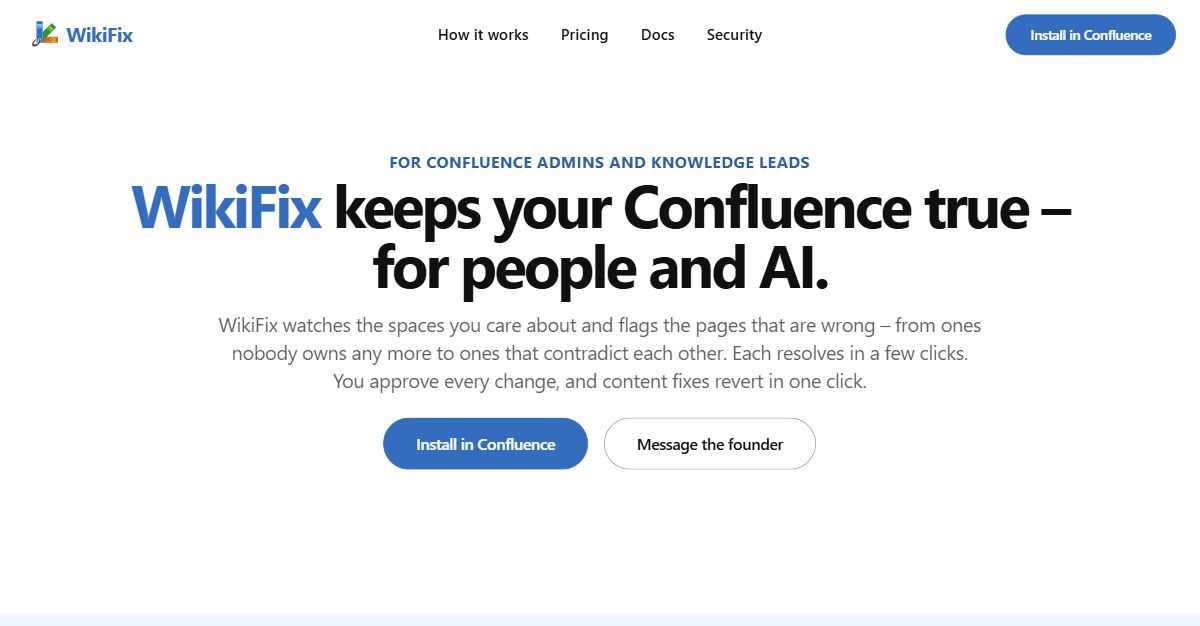
WikiFix for Confluence is an app that keeps a Confluence wiki accurate — for the people who read it and for the AI tools that answer from it. It watches the spaces you care about and flags the pages that are wrong, from pages nobody owns any more to pages that contradict each other, and each finding resolves in a few clicks. It is aimed at Confluence admins and knowledge leads, and its purpose is simple: make sure the documentation your team depends on is true.
The problem WikiFix addresses is drift. Documentation quietly stops matching reality: an incident runbook tells you to SSH into a host that no longer exists or restart a service that was renamed, a developer setup guide sends a new hire through screenshots and links that are long dead, and an HR handbook states that ten days of unused leave carry over while the leave policy says five. The page you need most in the moment is often the one that has rotted. There is also a newer risk: Rovo and every copilot answer from the same Confluence your team does, so whatever mistakes live in your docs get repeated back — and acted on — confidently and at scale. The practical blocker is scale: as the site states, you can't read 5,000 pages to find the ten that are wrong.
WikiFix's first job is to find what is actually wrong, not just what is old. It is explicitly not a date filter. Instead it reads the content and finds the pages that disagree with each other, then lays the claims side by side, quoted from each page, so you can settle which one is right. In the example shown in the product, a finding about how many days of unused leave carry over lists the claim of "5 days" with the pages that state it and the claim of "10 days" with the pages that state it, so the conflict is visible before you decide anything. WikiFix only surfaces findings it is confident about, which keeps the review queue meaningful rather than noisy.
Reviewing and fixing is designed to avoid busywork. Each finding is reviewable without opening the page: you pick the answer that's right, WikiFix writes the fix, you check it and click, and every page that disagrees is corrected. The product shows exactly what will change before it changes — for example, showing both the leave policy page and the onboarding checklist being updated to the chosen answer. Nothing happens without you: WikiFix writes nothing until you approve it, and a content fix reverts in one click, so the page goes back as it was. Reassigning the owner of an abandoned page is the one action that does not undo, and the card tells you before you click. Findings that reference a page you can't access are hidden.
Today WikiFix catches three kinds of problem. Pages contradict each other — you choose which claim is right and every page that disagrees is corrected. Duplicate and near-duplicate content — you pick the page and unique facts that survive, and the rest fold and point to the source of truth. And the page owner has left — the scan spots an orphan and you reassign it in one click. If the page isn't yours, Ask owner posts an inline comment that lays out what each page says, @mentions the owner and the space admins, and moves the finding to the Escalated tab. A weekly scan summary is emailed to you with a per-space table showing the change versus the last scan and the number of open issues. WikiFix is also building detection for pages that contradict the live code, and has on its list broken links, buried important facts, the same thing called three different names, docs split across Confluence and Notion, and docs that live as Markdown in Git repos.
WikiFix runs inside the Confluence you already have, so there is no migration and no new tool to roll out. It scans the spaces you care about — the product's own interface shows spaces such as Engineering, Product, Support, IT runbooks, People and Sales, each with its scan status and counts of conflicts, duplicates or unowned pages. Scans only spend credits on pages that are new or changed since the last scan, and billing runs through the Atlassian Marketplace on its per-user model. Every install starts with $50 of scan credits. The Advanced plan adds more credits for larger or busier wikis and the option to run scans on your own Anthropic key.
The stated outcome is that people trust what they find in Confluence again. WikiFix keeps runbooks current so the page is right when you reach for it, turns a sprawling wiki into docs your team can actually follow, and makes the wiki a source of truth your AI can rely on. Because review happens on signal — concrete contradictions to act on — rather than on a calendar, teams stop re-reading the same spaces every quarter hoping to catch something, and nobody goes numb to the process.
Concrete scenarios run through the product's own examples. An on-call engineer pulls up a payments outage runbook at 02:14 and finds half the steps no longer match reality — WikiFix finds and reconciles those pages so the runbook is right when it is needed. A new hire works through a developer setup guide step by step and hits dead links and missing files; the guide can be kept true instead. HR content that disagrees on leave carry-over between a handbook and a policy page can be settled in one review. And teams whose AI assistants answer from Confluence can reduce the chance that a copilot repeats and acts on a mistaken document.
WikiFix is positioned for Confluence admins and knowledge leads, and its feedback form asks users to identify as a Confluence or space admin, a knowledge or documentation lead, an IT or sysadmin, or engineering/platform — with company Confluence sizes from under 100 to 2,000+ users and common pains listed as outdated pages, pages that contradict each other, factual errors and compliance. It is delivered as a Confluence app installed from the Atlassian Marketplace, and it is built around Confluence as the place docs live. Pricing is credit-based: roughly $0.10–$0.20 per new or changed page on average, with credits spent only on pages that are new or changed since the last scan. Standard costs $1.68–$0.29 per user a month with everything WikiFix does and a monthly credit allowance sized for an average wiki; Advanced costs $6.70–$1.15 per user a month with more credits and the option to use your own Anthropic key; Custom lets you adjust volume to your needs. Every install starts with $50 of scan credits.
WikiFix's core promise is control without busywork: it finds the contradictions, duplicates and orphans that make a knowledge base untrustworthy, presents them for a decision you make in a few clicks, and changes nothing until you approve it — with a one-click revert if you change your mind.
Publisher
A
admin
Launch Date2026-10-05
Platformweb
Pricingpaid
Tech Stack
#Confluence#Atlassian Marketplace#Anthropic