Category Focus/categories/productivity
Productivity AI Tools
Discover and compare the best productivity AI tools and software. Browse 705+ curated tools with reviews and rankings.
Projects tracked
705
Sort mode
RECENT
Page
1
Discover and compare the best productivity AI tools and software. Browse 705+ curated tools with reviews and rankings.
Projects tracked
705
Sort mode
RECENT
Page
1
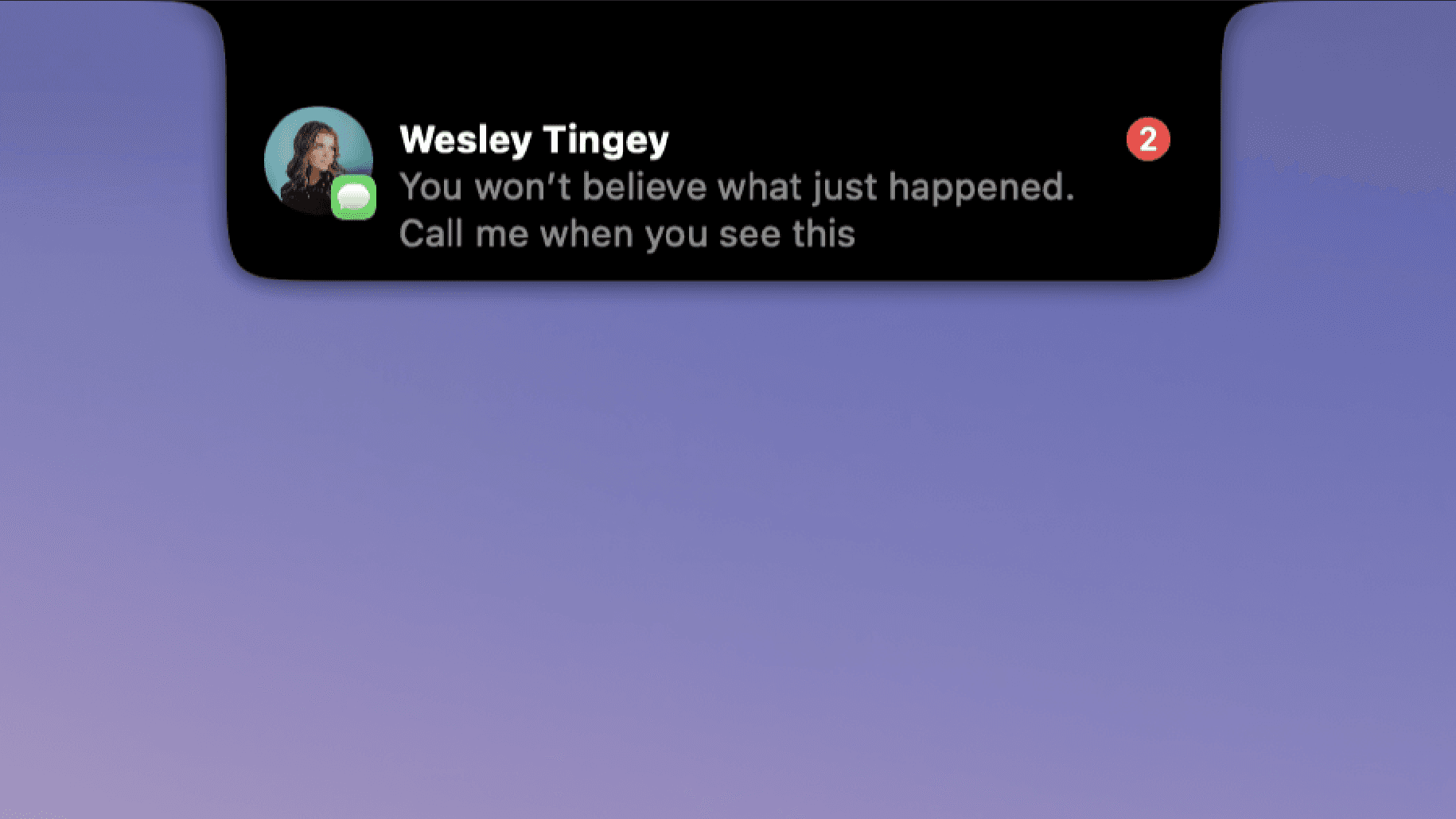
DynamicLake 2.0 is a Mac application that brings a Dynamic Island style experience to the Mac desktop. Its website describes it simply as "Dynamic Island for Mac", and its Product Hunt listing calls it "Dynamic Island for Mac with 3rd Live Activities and more". The product's own description lists plugins, notifications, drag and drop, a converter, calls, AirDrop and a timer among the things it offers. The site states that it is "Inspired by Apple Dynamic Island" and that it follows a "Liquid Glass Design - Inspired by Apple Liquid glass". It is intended for Mac users who want a compact, interactive presence on their screen that surfaces notifications and small everyday utilities in one place, rather than scattering them across separate apps and windows. The concept behind DynamicLake comes from Apple's Dynamic Island, the interactive element Apple introduced on iPhone that turns a small area at the top of the display into a live, changing surface for activities and alerts. DynamicLake translates that idea to the Mac. On Product Hunt the product is filed under the topics Mac, Menu Bar Apps and Apple, which places it in the family of small Mac utilities that live persistently on the desktop or in the menu bar area so they are always within reach. The appeal of such tools is that they reduce the friction of switching contexts: instead of hunting through windows or opening a separate application, users can glance at a single spot and interact with what is happening right there. Live Activities and notifications are central to the product. The Product Hunt tagline highlights "3rd Live Activities", indicating that third-party Live Activities are part of what DynamicLake displays, and the official description lists notifications as one of its main capabilities. The website's FAQ devotes specific questions to this area, including "How does Dynamic Lake Pro handle my notifications?" and "Will there be new features added to DynamicLake Pro?", which shows that notification handling is treated as a core part of the Pro experience. For a Mac user, having notifications presented in a single, consistent, island-style surface means the most relevant updates stay visible and actionable without covering the work in progress. Beyond notifications, DynamicLake bundles a set of small everyday tools. The product description names plugins, drag and drop, a converter and a timer. A converter and a timer are the kind of utilities that are frequently needed for a few seconds at a time and then abandoned, so placing them inside an always-accessible island removes the need to open a dedicated app or a web page for each one. Drag and drop suggests that items can be moved onto the island directly as part of the workflow, and plugins indicate that the surface can be extended with additional pieces of functionality. The tagline's "and more" leaves room for further tools within the same interface. Communication and file transfer features also appear in the description: calls and AirDrop. Calls listed alongside the other capabilities implies that call information or call handling is surfaced through the same Dynamic Island interface, keeping it visible while the user continues working. AirDrop being included points to dragging files onto the island to send them, or receiving them, through Apple's own transfer mechanism. The FAQ also references "DynaMusix" in the question "Does DynaMusix support all music apps?", which indicates a music-related component associated with the product. Visually, the site states the design is a Liquid Glass design inspired by Apple Liquid Glass, giving the interface a translucent, modern look that sits alongside macOS. Overall, DynamicLake works as a persistent, interactive layer on the Mac that is modelled on Apple's Dynamic Island. Rather than being a single-purpose utility, it acts as a container: Live Activities, notifications, a converter, a timer, calls, AirDrop and plugins all flow through the same island-shaped surface, and the Liquid Glass styling keeps it visually integrated with the system. The website's FAQ shows that the team thinks about the practical details of running the app day to day, covering which macOS versions are supported, whether it works on non-notch MacBooks, whether it supports external displays, and whether it is compatible with the BetterDisplay app. There are also questions about updating the app to the latest version and what to do when a bug is encountered. The benefits follow from that design. Placing frequently needed information and mini-tools in one persistent spot reduces app switching and keeps the user's attention on the task at hand. Notifications and Live Activities remain glanceable instead of interrupting with full-screen or modal interruptions. Small jobs such as converting a value or starting a timer no longer require leaving the current window. Communication cues for calls and file transfers arrive in the same place. Because it is inspired by Apple's own Dynamic Island and Liquid Glass design language, the experience feels familiar to anyone who uses an iPhone, while remaining a native-feeling part of the Mac desktop. Concrete situations the product is suited to include monitoring ongoing Live Activities while working in other applications, keeping notifications under control in a single island surface, running a quick conversion without opening another tool, timing a short task, managing calls so that call information stays visible during work, and sending or receiving files through AirDrop from the same interface. The FAQ also raises external displays and non-notch MacBooks, which correspond to the common setups where users would want the island to remain usable: a MacBook with an external monitor, or a Mac model that does not have a notch at the top of its built-in display. The music-app question tied to DynaMusix points to another scenario, listening to music while working. On requirements and practicalities, the FAQ covers which macOS versions are supported and whether DynamicLake works on non-notch MacBooks, so compatibility with a range of Mac hardware is part of the pitch. It also asks about external display support and BetterDisplay compatibility. The app appears to be a paid product with a Pro tier: the FAQ asks whether DynamicLake can be tried before purchasing, whether payment can be made with PayPal, and how DynamicLake Pro can be activated on multiple devices. New features are also signalled, with the site asking whether more will be added to DynamicLake Pro. Language support is another documented question. On the technical side, the site notes that the software uses code of FFmpeg licensed under LGPLv3.0. The site carries a 2025 copyright for Aviorrok, and the FAQ also clarifies that AppleLake or Dynamiclake.net are not the same as DynamicLake. In summary, DynamicLake 2.0 takes the Dynamic Island idea that Apple popularised on iPhone and carries it to the Mac, combining third-party Live Activities, notifications, plugins, drag and drop, a converter, calls, AirDrop and a timer into one Liquid Glass-styled surface. For Mac users who want their alerts, activities and small utilities in a single always-available place, it offers a focused, Apple-inspired way to keep that information close at hand.
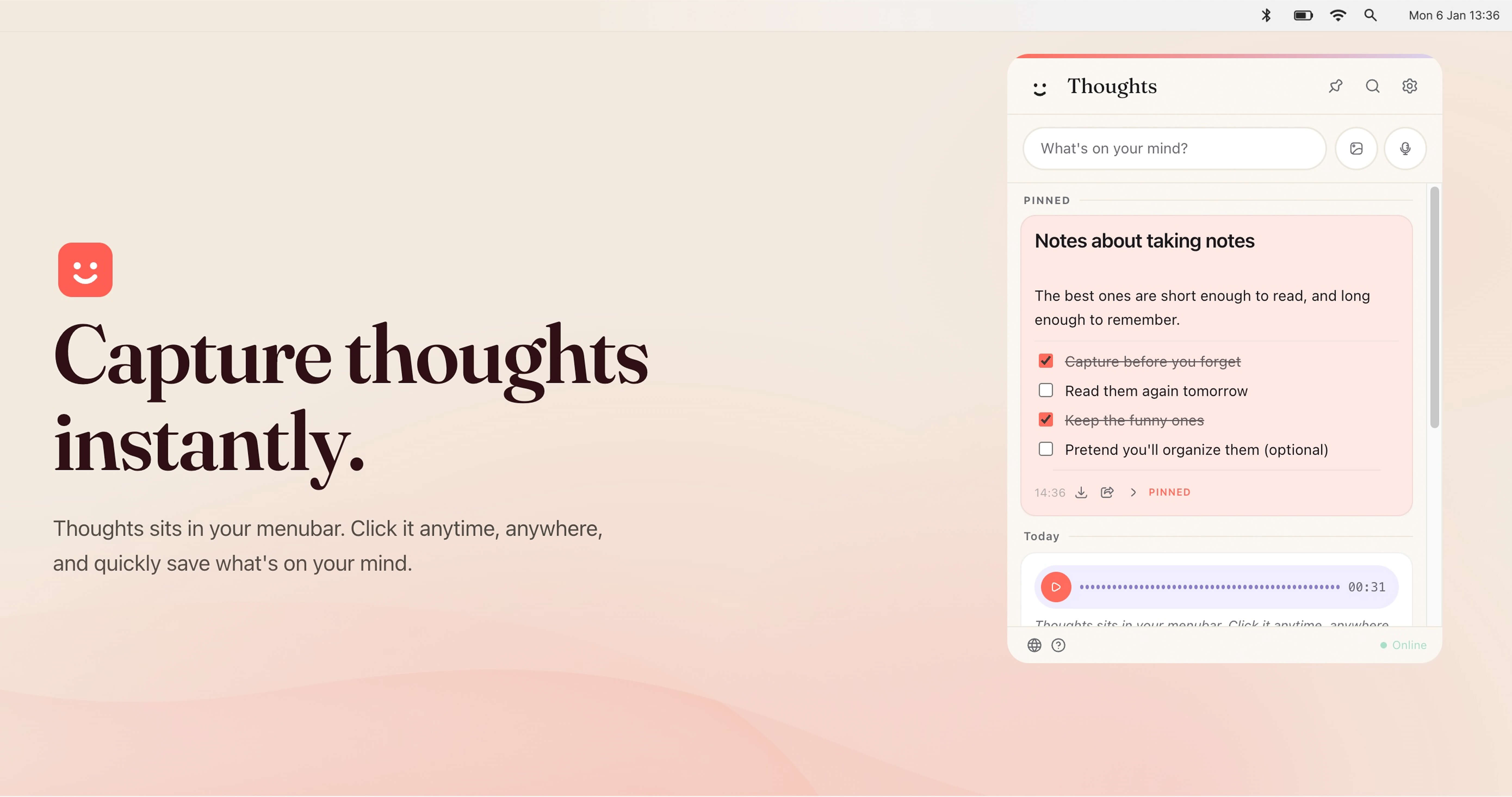
Thoughts for Mac is a native macOS menubar application for capturing notes, images, and voice recordings without leaving what you are doing. It sits in the Mac menubar, and a single click opens it so you can quickly save whatever is on your mind. The app captures structured text notes, checklists, code blocks, standalone links with previews, voice recordings, images, and text-like files such as TXT and CSV. It is presented as a small multi-tool for the menubar, and it is free to download and use, with all future updates included and no subscription. Because it lives alongside your other menu bar icons, it stays within reach while you work in other applications. The thinking behind Thoughts for Mac is speed of capture. Rather than opening a full note-taking application, creating a document, and finding a place to file it, the app puts a capture surface in the menubar where it is always one click away. The website frames this simply: Thoughts sits in your menubar, you click it anytime and anywhere, and you quickly save what is on your mind. That makes the app useful for the moment a thought, link, image, or spoken idea appears in the middle of other work. It also supports captures that arrive from outside the app itself: desktop builds can receive shared text, images, and audio through URL schemes, open-with actions, macOS Services, and native imports, so content can be sent to Thoughts from elsewhere on the system. The core capture experience covers the three input types the website presents as Write it, Drag in an image, and Talk to it. Writing produces structured text notes, and the app also handles checklists, code blocks, and standalone links that carry previews. Dragging an image in saves the image itself as a note, and screenshot capturing is listed among the app's capabilities. Talking records voice, which becomes a voice note that can later be transcribed with your own AI provider key. Beyond those interactive paths, Thoughts also accepts text-like files such as TXT and CSV, and on desktop it can take in shared text, images, and audio from URL schemes, open-with, macOS Services, and native imports. Voice recordings can be exported as MP3 in the desktop app whenever you want them. AI is optional and brought by you. In Settings you can connect OpenAI, Claude, or Gemini with your own API key. Once connected, the app can transcribe voice notes, context images to text, and perform simple text transforms such as capitalization, translations, spelling fixes, shortening, lengthening, summarizing, and converting case. The website also lists extracting text from images among the available actions. Claude is available for text actions, while transcription support depends on the provider you connect. Only AI-powered actions require a key: capturing notes, images, and audio does not need one. The app is free, and you use your own OpenAI, Gemini, or Claude API key for features like transcription, OCR, summaries, translations, and rewrites. Organizing what you capture is handled by search and pinning. Search works across notes, links, screenshots, and image names instantly, so a note can be found even when you only remember part of an image's name. Pinned Thoughts let you keep important notes at the top of your list so they are not buried under newer captures. The app also supports light and dark mode and adapts to whichever you prefer. Instant access is provided by a custom shortcut of your own choosing, meaning you can open Thoughts from anywhere on your Mac with a keystroke rather than reaching for the mouse. Thoughts works as a local-first menubar utility. In the desktop app, notes and settings are saved locally on your Mac, and media files are stored in the app's user data folder, with no account required. That means there is no sign-up step and no server-side account to manage for the core experience; AI actions are the exception, since they rely on the API key of the provider you connect. A browser preview mode also exists, but it is session-only, so notes created there are temporary. The free model and the bring-your-own-key approach combine to keep the tool light: you pay nothing to download or use it, including future updates, and you decide separately which AI provider, if any, powers the optional text and audio actions. Export and sharing are built in, so what you capture is not locked in. You can share notes as text, and you can export audio recordings whenever you want them. If you ever decide to leave, you can export all notes from Settings as JSON, or export individual notes in the best available format: text notes as TXT, image notes as image files, PDF attachments as PDF, and voice notes as MP3 in the desktop app. Benefits stated on the site include instant capture from the menubar, quick access through a custom shortcut, search that reaches into images and image names, pinning for important items, and both light and dark appearance modes. Concrete workflows follow from the capture types. During a call or a meeting you can talk to Thoughts and keep the recording as a voice note, then transcribe it later with your connected provider. While browsing, you can save a standalone link with its preview, or capture a screenshot of something you want to keep. When you drag in an image, the app can extract text from it through OCR once an API key is connected, turning a picture of text into usable content. You can bring in text-like files such as TXT and CSV, jot checklists, or store a code block you want to find again. Text actions handle small chores — summarizing a note, fixing spelling, converting case, shortening or lengthening text, or translating it. On the Mac, other apps and system services can send text, images, or audio into Thoughts through URL schemes, open-with, macOS Services, and native imports. Thoughts for Mac is built for macOS users who want a fast place to put thoughts, notes, links, images, and voice memos without opening a larger note-taking app. The site lists its topics as Productivity, Writing, and Menu Bar Apps. Integrations are limited to the AI providers you connect — OpenAI, Claude, or Gemini — using your own API key, and to macOS system entry points such as URL schemes, open-with, macOS Services, and native imports. Pricing is straightforward: the app is free to download and use, including future updates, with no subscription; the only cost you may incur comes from the API provider whose key you use for AI features. The download is delivered through the linked Gumroad page, and the app is native to macOS. Thoughts for Mac keeps capture at the edge of your screen: a menubar click or a custom shortcut, a written note, a dragged image, or a spoken thought, all saved locally with no account required. Search, pinning, export, and light and dark modes make the notes usable afterwards, while optional bring-your-own-key AI actions add transcription, OCR, summaries, and translations through OpenAI, Claude, or Gemini. It is free, and every feature is available at no cost with future updates included.
Axari is an AI twin for cybersecurity teams — an AI workforce product that is given real work rather than asked questions. The company's pitch is simple: you plus your AI twin equals indefatigable. A security leader spends the working day setting strategy and priorities, leading the security program, and making the decisions that matter. The twin, meanwhile, runs 24/7: it understands what needs attention, coordinates work across tools and teams, and executes, follows up and verifies until the work is actually done. Users can assign it a goal, let it work proactively, or give it recurring responsibilities, and all of this happens from within Slack or Microsoft Teams. It is aimed squarely at security organizations rather than general business users, and it is meant to be given real security work, not just to answer questions. The problem Axari addresses is the coordination overhead that surrounds security work. Security teams already own scanners, ticketing systems, identity platforms, cloud accounts and compliance tools; what they often lack is someone to keep the resulting work moving between them. Axari's own framing of this is quantitative: it claims time back of 10–15 hours per person, per week, on coordination-heavy work, notes that organizations spend $8–10 per $1 hiring people to operate a security tool, and describes a cognitive load of 17 of 20 items already in motion before a leader opens Slack — leaving only the 3 that genuinely need them. Its overhead claim is zero: no training sessions, onboarding programs, or new tools to learn. Customer quotes echo the same theme, including "We couldn't hire more people; we hired Axari," "We didn't rip out a single tool," and a fractional CISO noting that control drift used to be caught during the next audit cycle but is now flagged the same day it happens. Axari works across the tools a security team already runs instead of replacing them. The integrations shown on the site include Slack, Jira, GitHub, Gmail, Wiz, Splunk, Okta, Snyk, CyberArk, Tenable, Vanta, AWS, Datadog, Kubernetes, Google Cloud, Terraform, Confluence, CrowdStrike Falcon, Google Drive and HubSpot. The important point is what the twin does with those connections: it reads finding and asset context from a scanner, writes and assigns tickets, pulls policy language, collects evidence, scores vendors, lists entitlements, groups alerts and enriches them with telemetry. Because the twin operates inside the collaboration layer — Slack or Microsoft Teams — colleagues see the work happening in the channels they already use, and owners can be nudged or asked for a decision without anyone logging into a separate console. Several of the documented use cases concern exposure and threat work. In critical exposure protection, the twin pulls the finding and asset context from Wiz, creates the ticket in Jira and assigns the owner, then re-checks the scanner before anything is closed. In cloud exposure protection, it detects the misconfiguration, maps it to the owning AWS service, and prepares the fix in GitHub for review. In threat response assurance, it groups overnight alerts from Splunk, enriches them with endpoint telemetry from CrowdStrike Falcon, and opens the investigation in Jira with an owner assigned. In ransomware resilience, the twin confirms containment, revokes compromised sessions, and keeps legal and leadership on a single timeline in Slack. Each of these follows the same pattern: gather context, do the coordination, and hand the judgement call to a human. A second group of use cases covers governance and assurance work. For continuous compliance, the twin collects access evidence, maps that evidence to controls in Vanta, and chases owners in Slack who have not responded. For trusted vendor onboarding, it requests missing documents by email, scores the vendor against your policy, and routes the decision to the risk owner. For security review acceleration, it drafts from your approved answers, pulls current policy language from Confluence, and flags the answers that need human judgement. For access assurance, it lists every account and entitlement, nudges reviewers with a cutoff, then revokes and confirms the removal. The recurring theme is follow-up: the twin does not stop at producing an artifact, it pursues the response it needs and verifies that the change actually happened. Axari describes its approach in four stages. Connect: it maps what your tools do and learns exactly how your team operates daily. Understand: it works out who owns what, what matters, how work is routed, and where you are needed — the product illustration shows a daily brief in Slack summarizing priorities and where you are needed. Act: it prepares the work, assigns owners, follows up, and executes what you authorize; in the example shown, the twin drafts a SOC 2 reply in Slack with approve, edit and discard actions. Compound: it learns how you decide, anticipates what's next, and keeps getting smarter — for instance, proactively asking whether it should check with a colleague before sending a vendor exception approval. The site labels this "compounding intelligence," suggesting the twin's usefulness grows as it observes more of your decisions. The stated outcomes are time, money, cognitive load and overhead. The company reports 10–15 hours back per person, per week, on coordination-heavy work; a spend pattern of $8–10 per $1 currently going to people operating a security tool; a cognitive load figure of 17 of 20 items already in motion before the leader opens Slack, so only 3 need them; and zero overhead in training sessions, onboarding programs or new tools to learn. Testimonials support the positioning: one CISO says that nothing was ripped out and Axari simply made existing tools work harder, a CIO says the team could not hire more people so they hired Axari, and a former Google Chrome security lead describes Axari as a full AI security team that learns how an organization works and actually gets the work done. Concretely, a security team might use Axari in a daily rhythm. Overnight, the twin groups alerts, enriches them, and opens investigations with owners attached, so the morning starts with work already in motion rather than a blank page. During the day, it keeps compliance evidence flowing — collecting, mapping and chasing — and nudges access reviewers before a cutoff so certifications do not stall. When a vendor request arrives, it asks for the missing documents, applies the policy score, and asks a human before sending an exception. When a security questionnaire lands, it drafts from approved answers and flags what needs judgement. Because the twin lives in Slack or Teams, each of these shows up as a short, actionable exchange rather than another dashboard to check. The site names CISO / Head of Security, GRC, Security Operations, Security Engineering and Security PMO as the roles Axari serves, and lists customers and partners including HiddenLayer, Boyd, Supabase, CAVA, Yext, Hydrolix and OpenLoop. On trust, Axari emphasizes control, security-native design and security posture. Controls include scoped access, human approval for consequential actions, a complete audit trail, the promise that your data stays yours, and the ability to bring your own model. The company says the product is shaped by 300+ conversations with security leaders and built alongside security leaders from Google, Anthropic, Atlassian, Supabase and Roblox. It reports SOC 2 Type 1 complete, red-teaming against the OWASP Top 10, zero data retention where applicable, and BYOC / on-prem support in progress. A CISO testimonial notes that Axari earned access rather than asking for it all on day one. Axari's core proposition is straightforward: security leaders cannot hire their way out of coordination work, and attackers are not going to use less AI. By giving teams a persistent AI twin that lives in Slack or Microsoft Teams, understands the environment, coordinates across existing tools, and follows work through to verification, Axari aims to close the execution gap that sits between a security program's plans and its outcomes — without replacing a single tool in the stack. As the company puts it, you plus your AI twin equals indefatigable.
Voiskey is an AI voice typing tool that turns natural speech into polished, ready-to-use text. Rather than transcribing words literally, it starts from what you meant: you speak a rough thought and it comes back shaped for where it is going and who is reading it. It produces text for messages, emails, notes, documents, AI prompts and more. Voiskey is available on macOS, Windows, iOS and Android, works anywhere on your computer and in any language, and is described as 5x faster than typing. It is free to start, with a free month of Pro for people who join during launch. The problem Voiskey addresses is the gap between how quickly people think and how quickly they can type. An average keyboard runs at roughly 45 words per minute, while Voiskey voice is presented at 220+ words per minute. That gap shows up as friction in everyday work: the first draft is the hardest part, ideas hit fast but drafting is slow, thoughts disappear quickly before they can be captured, and meeting details are easy to forget. The same friction appears in professional routines — prompting takes longer than coding now, the faster the follow-up the warmer the deal, and tickets pile up faster than a support agent can type. Voiskey's answer is to let people speak the way they naturally would and let the product handle the shaping. Voiskey is built to listen for meaning rather than to capture every sound. The website describes it as more than listening — it understands. When you speak the way you naturally would, fillers, stumbles, changes of mind and grammar slips are all caught by Voiskey rather than passed through into the final text. The point is that you should not have to tidy your speech before you start; you think out loud, and Voiskey handles it. This is what makes the output ready to use rather than a raw transcript that still needs editing, and it is the foundation for everything else the product does with your words. Voiskey is built to adapt, and the content says it always lands right. It knows what you are going for and automatically tailors the formatting, tone and word choice so that every output fits your intent and is ready to send. The Product Hunt listing describes the same behaviour from the opposite direction: a spoken thought comes back shaped for its destination and its reader — casual with a friend, composed with a colleague, technical with an AI. This matters because the same idea needs a different form in a text message, an email, a meeting note or an AI prompt, and Voiskey applies that shaping automatically instead of leaving it to you to rewrite. Voiskey also learns your style. According to the website, it learns your names, jargon and spelling preferences so that your words always land in your style. This is a personalisation layer: rather than producing generic, uniform text, it keeps the vocabulary and spellings you actually use, which matters for people working with specialist terminology, product names, colleague names or in-house shorthand. The stated outcome is that you still sound like you — the product cleans up the mechanics of speech without erasing the voice of the person speaking. Voiskey covers voice to native-sounding text in more than 100 languages, and it presents a long list of supported languages on the site, including English, Japanese, Spanish, Korean, French, Portuguese, Arabic, Russian, Italian, Thai, Vietnamese, Dutch, Polish, Danish, Swedish, Finnish, Greek, Czech, Romanian, Hungarian, Bulgarian, Slovenian and Estonian, among others. The site states that Voiskey works anywhere on your computer and in any language. It also covers translation: you speak in your own language when you need to translate, and Voiskey turns your voice into fluent, native text across 100+ languages. That makes dictation and translation part of the same speaking workflow rather than two separate tools. A distinctive capability is turning spoken intent into AI-ready instructions. Voiskey lets you tell your AI what to build just by speaking: you talk through what you want to build or change, and Voiskey turns it into a clean AI-ready prompt with files, paths, commands and key details captured. This is presented as a practical answer to the observation that prompting now takes longer than coding, and it is a core part of how Voiskey is positioned for engineers — spoken intent becomes prompts, commits and design docs. Capturing files, paths and commands automatically means the details that are easy to lose when speaking are preserved in the final prompt. Voiskey's overall approach is a single voice experience that follows you across every device. It runs on macOS, Windows, iOS and Android, and the site states that it works anywhere on your computer — wherever you type and however you speak, Voiskey is ready. There is no separate destination app to paste into: you dictate into the place where the text is going, and the output arrives cleaned up and ready to send. The product is positioned as starting from what you meant rather than just what you said, which is the through-line connecting its filler handling, its adaptive tone and formatting, its style learning, its multilingual output and its AI prompt generation. The stated benefit is speed and readiness in the same step. Voiskey is described as arriving 5x faster than typing, cleaned up and ready to send, while you still sound like you. The comparison the site makes is 45 wpm for a keyboard against 220+ wpm for Voiskey voice, which means thoughts get out before the keyboard slows them down. Because formatting, tone and word choice are adapted automatically, the output is not a draft that needs a second pass. And because Voiskey learns names, jargon and spellings, the speed does not come at the cost of sounding generic. Voiskey frames its use cases around the formats people write in and the roles they work in. By format, the site names Messages (texts, DMs and quick replies), Emails (rough drafts shaped into clear, structured emails), Notes (reminders, quick lists and random ideas captured the moment they show up), Meetings (decisions, action items and follow-ups) and Teams (clear updates, handoffs and action items). By role, it lists Engineers (prompts, commits and design docs), Sales (call notes, CRM updates and replies), Customer Support (tickets, live chats and help articles), Writers and Creators (posts, scripts and book chapters), Students (lecture notes, essays and emails), Founders (updates, replies and job posts) and Legal and Consulting (memos, client letters and contracts). Voiskey is aimed at anyone who writes more slowly than they think, and the role pages make that concrete: engineers, sales people, customer support teams, writers and creators, students, founders, and legal and consulting professionals. It is available on macOS, Windows, iOS and Android, with a single voice experience across all four. Pricing is free to start, and the launch offer includes a free month of Pro for people who join during the launch period. No specific price points or further plan details are stated in the provided content. Voiskey's core promise is that you can say it rough and send it right. It listens for meaning rather than words, strips out fillers and stumbles, adapts tone, formatting and word choice to the reader and destination, learns your names, jargon and spellings, works in 100+ languages with translation, and turns spoken intent into AI-ready prompts. It delivers all of that across macOS, Windows, iOS and Android at a stated 5x faster than typing, and it is free to start. For anyone whose ideas outrun their keyboard, that combination is the value proposition.
Product Launch Checklist is a free list for people launching software, from the moment the product works to the first month after launch. It covers SaaS, mobile apps, AI tools, browser extensions, open source projects and developer tools. Every item says why it matters and says when you can skip it. Pick what you are launching and the list gets shorter, not longer: billing and trials come in for SaaS, store review and privacy labels for apps. Your ticks are remembered in the browser, and the whole thing is readable without an account, an email or a payment. It is also built for AI agents: the checklist is available as Markdown, through a no-auth MCP server and as an agent skill.
OzBrain is a hosted knowledge base that acts as a shared brain every AI agent you use can read and write. Instead of each assistant keeping its own private memory, OzBrain provides one structured source of truth that sits underneath Claude, ChatGPT, Cursor, Claude Code and other connected agents. It is built for people and teams who already use several AI tools every day and want the work they have already done to be available the next time any agent starts a task. The company describes it as your Dropbox for agent knowledge: a place where structured articles with links, provenance and freshness live behind the connector menu that Claude and ChatGPT already show you. Today, context lives in your chats and your teammate's context lives in theirs, and the two never meet. People share a doc, drop a message and paste the same things over and over again. Meanwhile copies of the same plan sit in Drive, on laptops, in Downloads, in email, and no one is sure which version is current. Platform memory does not solve this either: as the site puts it, that memory is a few preferences and a thin summary of past chats. OzBrain's answer is to hold the work itself — your projects, decisions, research and the thinking you have already done — so an agent starts with what the task needs instead of whatever fits in a profile. The centrepiece is a single shared brain. Point everyone at one OzBrain and your agents and their agents read and write to the same place, so what one person works out, everyone's agents already have. The site illustrates this with a team view: a company brain holding company vision, rules and skills, engineering plans, customers, research and the roadmap, with individual people connected through Claude, Cursor, Codex and Claude Code. Because the knowledge sits outside any single chat product, it is not owned by whichever assistant happened to be used first. Sharing on brains you own is included in every plan, including the free one. OzBrain breaks your knowledge into nested pieces so that an agent pulls the exact slice it needs — the email body, not the whole launch plan. The site shows a launch plan at 11,842 tokens and 47.3 KB nesting into launch campaigns at 1,486 tokens and 5.9 KB, which in turn nests into launch email at 218 tokens and 0.87 KB. The argument is straightforward: the less an agent has to load, the faster and cheaper it answers, and the less it invents from context it never needed. Alongside this, OzBrain keeps the latest version out front. Instead of copies of the same plan scattered across Drive, laptops, Downloads and email, every agent decides from the current version rather than an old copy. When newer thinking lands, OzBrain goes back through your knowledge on its own, marks the old notes as replaced and points to the latest. You never have to hunt down every place an old decision lived, and no agent answers from a version you have moved past. The site gives the example of a website launch plan being updated when the company acquired a new domain, with related company details marked as updated to ozbrain.com. Every change is also on the record: which agent made it, what changed and the reasoning. Changes are proposed before they land, so several agents can work at once without writing over each other, and a recent-changes table shows the time, agent, article and reason for each edit. Privacy and ownership are handled explicitly. Your brain is encrypted at rest and sealed to your account, so nothing leaks between tenants. The site states that it never trains on your data and never sells it, describing OzBrain as a sovereign place for your data. Export is available at any time — everything as markdown, including after you cancel — on the principle that your knowledge should not be locked in anywhere, including OzBrain. Deleting your account removes your content: delete means deleted. The company also notes that it runs OzBrain on OzBrain, with its own data sitting next to yours, because it wanted the safest and easiest tool for itself as well as for users. Getting started does not require any coding. You add OzBrain from the connector menu in Claude or ChatGPT, sign in and approve it; there is nothing to install. Connect guides exist for Claude and ChatGPT, and the same brain can be reached from Claude Code, Cursor, OpenClaw, Hermes Agent, Gemini Spark where Google makes it available (US, Spark eligibility) and any client that supports connectors. Because it is one URL, anything that speaks the protocol can hold the same brain. Rather than being a memory API that developers code against, OzBrain is described as a brain you connect — structured articles with links, provenance and freshness, and one source of truth rather than a separate memory in each product. The stated outcomes for users are practical. Agents make fewer mistakes because they pull only the slice of knowledge a task needs. Answers are faster and cheaper because less context has to be loaded. Nobody has to maintain or "work" the brain, since replaced notes are marked automatically and the current version stays out front. Teams stop pasting the same context into several separate chats, and a brand-new chat can know what everyone has already worked on. Because everything is exportable as markdown, users keep an exit route and can move their knowledge to whichever tools serve them best. Concrete scenarios appear throughout the site. In one, a team connects individual agents through Claude, Cursor, Codex and Claude Code so the whole team's agents work together on the same knowledge — company vision, rules and skills, engineering plans, customers, research and roadmap — instead of each person's context living in a separate chat. In another, a website launch plan is updated when the company acquires a new domain, and OzBrain marks related articles, such as company details, as updated so no agent answers from the old domain. The changelog example shows several agents, including Claude, making coordinated changes to articles such as a website launch plan, an MCP setup guide and a surfaces page with a stated reason for each edit. A further scenario is a new chat starting with what a team has already worked on rather than from a blank slate. OzBrain is aimed at individuals and teams whose work already runs through multiple AI agents, from a single person's venture and personal knowledge to an organisation where agents run the operation from one brain. Supported integrations include Claude and ChatGPT through their native connector flows, plus Claude Code, Cursor, OpenClaw, Hermes Agent, Gemini Spark where Google makes it available (US, Spark eligibility) and any client that supports connectors. Pricing starts with Free at $0 forever, with up to 50 articles, sharing on brains you own, unlimited brains, reads, writes and connections, write-time size discipline and markdown export anytime. Pro is $20 per month with up to 500 articles, described as room for one venture plus personal knowledge. Max is $99 per month with up to 5,000 articles, for when agents run the operation from one brain. Enterprise sits above the Max ceiling with org-owned shared brains and per-seat pricing designed with you. Every plan includes unlimited reads and writes, and free plans mean you can start without a credit card. The takeaway is that OzBrain turns scattered, agent-specific context into one shared, encrypted and exportable brain that every agent and teammate can read and write. It keeps the current version out front, prunes replaced notes automatically, records who changed what and why, and lets you walk away with everything in markdown whenever you choose.
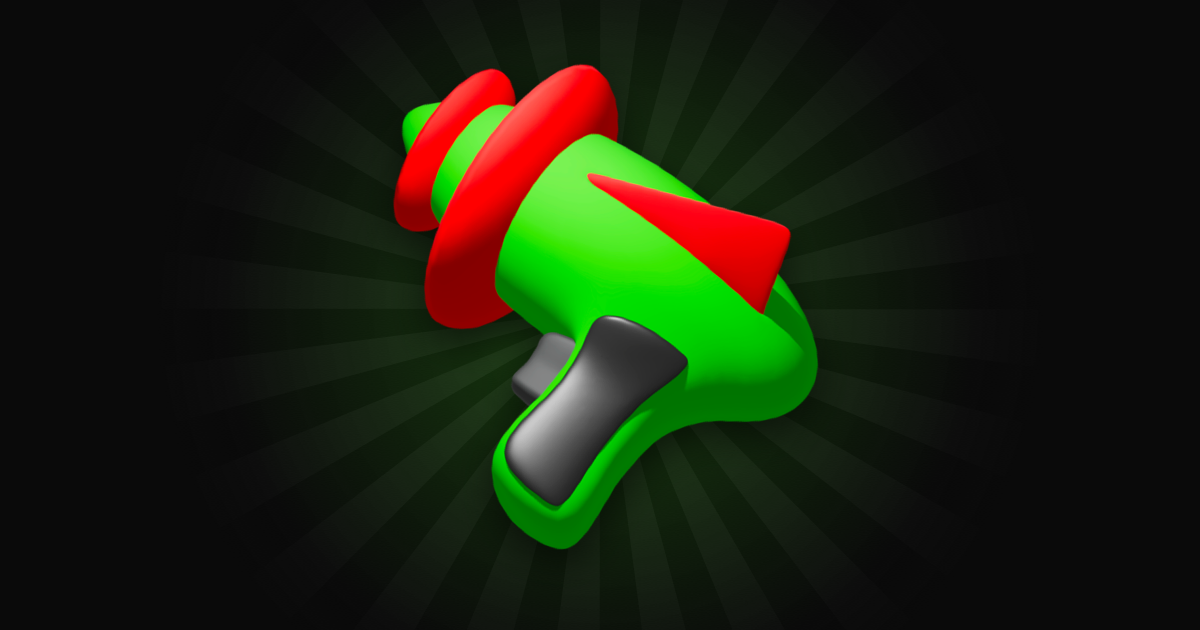
AppZapper 3000 is an uninstaller for macOS - the most fun uninstaller for the Mac, according to its developers. The idea behind it is deliberately simple: you drag any app into the AppZapper 3000 window, the app instantly finds all of the extra files that application has left around your system, and then you delete them with a real 3D zapper. The tagline for the product says it plainly: this is the uninstaller Apple forgot. It is made for Mac users who want to remove an application properly, along with everything that application installed, instead of only dragging a single icon to the Trash. It suits both people who have zapped apps for years and anyone who has never used a dedicated uninstaller before and simply wants a cleaner Mac. The original AppZapper was first released in 2006, and AppZapper 3000 is described as a rebuild of that tool for the 31st century. The site marks a 20 year legacy and states that the team is forever grateful to everyone who has been zapping apps over the past twenty years. That history points to the problem the product addresses. A Mac application does not consist of one file: alongside the app itself, there are caches, preferences and support files. Removing only the application leaves all of that material where it was. AppZapper 3000 exists to close that gap - to find everything an app installed and deal with it as a group, rather than leaving pieces behind for the user to hunt down manually. The problem matters because it is a routine, repetitive chore that is easy to do incompletely, and the tool turns it into a single, decisive action. The core interaction is drag, drop, zap. The first step is an empty AppZapper 3000 window, waiting for an app to be dragged into it. Once you drop an app in, AppZapper 3000 instantly rings in and targets every related file: caches, preferences and support files, described on the site as the junk an app installs. A ring-in moment announces that the related files have been located - the site's phrase, target locked, captures the point at which the app has assembled the complete set of items belonging to the application you dropped in. Nothing here requires you to know where macOS keeps application support data. The point of the feature is that you do not have to go looking through system folders yourself, and you do not have to guess which files are safe to remove. You see what was found, and you decide to zap. The deletion itself is the distinctive part: a real 3D zapper, with real laser bolts that blast away your unwanted apps and the junk they install. The business end of the zapper is a genuine laser bolt effect rather than a progress bar, and it is aimed with instant mouse aiming, so pointing at your target feels immediate rather than stepped or delayed. Recoil is described as manageable, which means the shooting mechanic stays controllable while still feeling physical. Firing is a single action - one click, one shot - which gives each removal a clear, satisfying conclusion. The site also shows explosion and smoke effect artwork that reinforces the zap. The zapper turns an otherwise invisible housekeeping task into something you can actually watch happen. AppZapper 3000 has also been rebuilt with the fluidity, agility and smoothness that the team says it always dreamed of - built to fly, in the site's words. That matters for a tool used in quick bursts: drag, aim, fire. Alongside the performance work, the app offers cosmetic choice through its sleek finish options. You can keep the classic livery, the look long-time users will recognise, or apply one of the new blaster themes to zap in style, so the tool can match your taste without changing how it works. For bulk cleanup there is Zap All, which lets you skip the one-click-one-shot rhythm entirely and blast them all away automatically. Between the single-shot mode and Zap All, the app covers both the careful, one-app-at-a-time case and the broader sweep when you have several applications you want gone. The overall approach is built around a deliberately playful metaphor: uninstalling as shooting. Rather than presenting a list of checkboxes and filenames and calling it housekeeping, AppZapper 3000 turns the same underlying job into a physical act, with an aim, laser bolts, recoil and a target-locked moment when the app's related files have been found. The workflow stays three steps - drag, drop, zap - and the fun is layered on top rather than offered in place of function. That is also why the 20 year legacy matters to the design: this is a rebuild of a tool people have used for two decades, keeping the same core promise of finding all of an app's extra files while updating the feel, the speed and the visual style for a new release. Some of the clearest statements of value come from the user comments gathered on the site. One user calls AppZapper an indispensable app, another says it is one of the first apps they install on a new machine, and others describe it as simple yet powerful, accurate, and something that just works. Several long-term users describe more than a decade of use - since a first Mac 15 years ago, over 15 years in the dock, and years of use without it ever failing. The recurring theme is reliability combined with simplicity: people expect it to remove an app and its extra files, and they expect the process to be quick. For anyone with the same expectation, the outcome is a Mac that no longer carries the residue of software you have already decided to remove. Concretely, AppZapper 3000 fits a handful of recurring situations. You have decided an app is no longer wanted and you want it gone properly, along with the caches, preferences and support files that belong to it. You have a batch of apps to clear out and use Zap All to blast them all away automatically rather than shooting them one at a time. You are setting up a new Mac and want to be able to install and remove software freely without leaving a trail of files behind - several commenters note the app is among the first things they install on a new machine. Or you simply want to try the tool before committing, in which case three free zaps let you drag, aim and fire a few times to see how it feels. In each case the workflow is the same: drag the app in, let AppZapper 3000 find everything, and zap. AppZapper 3000 is available for download from the AppZapper website, where there are also Try, Buy and Help options. The app is version 1.0 and requires macOS 15 or later. Pricing works as a try-then-buy arrangement: you can try three free zaps before deciding, and the Buy page handles the purchase. Existing customers are looked after through a license resend option on the site, and support is available by email, so recovering a license or getting help with the app does not require anything more than the website. AppZapper 3000 takes a task most Mac users treat as an afterthought - deleting an application - and gives it a full ritual: drag the app in, watch it find every cache, preference and support file it left behind, then destroy all of it with a real 3D zapper, one click at a time or all at once with Zap All. It is the legendary Mac uninstaller, first released in 2006, rebuilt with the fluidity, agility and smoothness the team always dreamed of and standing on a 20 year legacy of zapping apps. Its promise is narrow and clear, and that is the point: when you remove an app, remove everything it installed too.
Oats is a free, open-source meeting notetaker that records your meetings directly on your Mac — and on Windows in beta — without a bot joining the call and without sending your audio to a third-party cloud. When a meeting is over, Oats gives you a clean summary and a todo list you can actually work through, pulling out every action item along with who owns it, all from what was actually said. It is built for people who treat notes as the place a meeting's work starts rather than where it ends, and who want their recordings and AI processing to stay on their own machine. Oats is distributed as a desktop app, published openly on GitHub, and is free forever. Most note-takers want your recordings in their cloud. Many of them also join your calls as a visible bot, which can be awkward in external meetings and often needs host approval. Others put a paywall in the way — a seat count, a trial timer, or a limit that shows up around meeting number six. Oats was designed to not get in the way of your meetings: no bots, and no subscription needed when it runs locally with an on-device LLM. The product's stated principle is simple: your meetings stay on your machine. Oats records locally, runs AI locally, and never forces your audio off-device, while still offering richer cloud-backed features for people who want them. On-device recording is the foundation. Oats records directly from your Mac's audio — there is no browser extension, no bot, and no third-party server that ever touches the audio stream. It also works everywhere, because it captures any audio your Mac can hear: Zoom, Google Meet, Microsoft Teams, a phone call, or even a hallway chat. That means the tool does not depend on which conferencing platform a meeting happens in, and it does not require the meeting host to admit a recording bot before the conversation can be captured. After each meeting, Oats produces AI-written notes. These include a quick digest, a full summary, action items broken out per person, and a quality score derived from the conversation itself. In the app's own example, a weekly sync with three attendees and a #standup tag produces a quick digest noting the roadmap was at risk of slipping, that the team aligned on an August 12 ship date, and that Q3 pricing was locked — followed by two action items, one owned by Sarah (own the API rework, unblock by Friday) and one owned by Max (confirm the August 12 ship date with the PM), plus a meeting quality score. The result is a summary you can read in seconds and a task list that already names the owner. Action items are not left buried in a document. They collect in a Todos tab, and when you tick one off in the notes it closes, so follow-ups actually get followed up on. On the local backend, notes are plain Markdown and action items are stored as Obsidian Tasks inside a vault you choose — you can open the vault in Obsidian, sync it, or move it anywhere. Oats also lets you download a meeting's recording and export its notes wherever you want them in one click, and every meeting you record lands in a searchable library where you can ask questions across your whole history, such as what you decided about pricing. Oats works in three steps: hit record, get notes instantly, follow through. You start Oats and begin your meeting; it listens on your Mac with no bot and no third-party cloud, and nothing joins the call. When the meeting ends, Oats writes a structured summary and pulls out every action item with its owner. Those action items then land in your Todos, and ticking one off in the notes or in Obsidian closes it. You can run everything on-device with a local model and keep audio fully private, or connect your Ariso account for richer AI features — the Ariso.ai cloud backend adds enhanced transcription, multi-language support, speaker recognition, assessment, coaching, and auto-tracking of follow-ups. Speaker tagging matches each voice in a recording to the person who said it, so notes say who rather than "Speaker 2" (currently available on the ariso.ai backend), and you can sign in with Microsoft using your work account alongside Google from onboarding, Settings, or the menu bar. The benefits follow from that design. Because recording and AI notes can run entirely on your Mac with a local model, zero data leaves your device when you choose the local path. Because the software is free forever — no seats, no trial timer, no paywall waiting at meeting six — there is no cost barrier to capturing every meeting. Because it is fully open source on GitHub, you can audit every line, fork it, self-host it, or ship your own features on top. And because local notes are plain Markdown in an Obsidian vault, there is no lock-in: you can export anything, owe nothing, and leave whenever you want. In practice, Oats fits recurring team rituals and ad-hoc conversations alike. A weekly sync or standup becomes a digest, a decision log, and a per-person task list without anyone taking minutes. Calls that happen across Zoom, Meet, or Teams are captured the same way, since Oats listens to system audio rather than integrating with one platform. A phone call or an in-person hallway chat your Mac can hear can be turned into notes too. Afterwards, action items flow into a Todos list or into an Obsidian vault, and the searchable library lets you look back across your entire meeting history to answer questions like what was decided about pricing. Oats is aimed at individuals and teams who hold meetings on a Mac and want notes without a bot in the room, including people who care about keeping audio on-device and users who prefer open-source, self-hostable software. It also suits Obsidian users, since local notes are plain Markdown with Obsidian Tasks and can live in a vault of their choosing. Related integrations mentioned in the content include Google and Microsoft sign-in and the optional Ariso.ai cloud backend. Oats ships as a desktop download for macOS and Windows (beta), and pricing is free — free forever, with no seats or trial timer. Oats is a free, open-source, on-device meeting notetaker whose core promise is that your meetings stay on your machine. It records without a bot, writes summaries and owner-tagged action items from what was actually said, pushes follow-ups into Todos or an Obsidian vault, and lets you add cloud AI only if you want it.
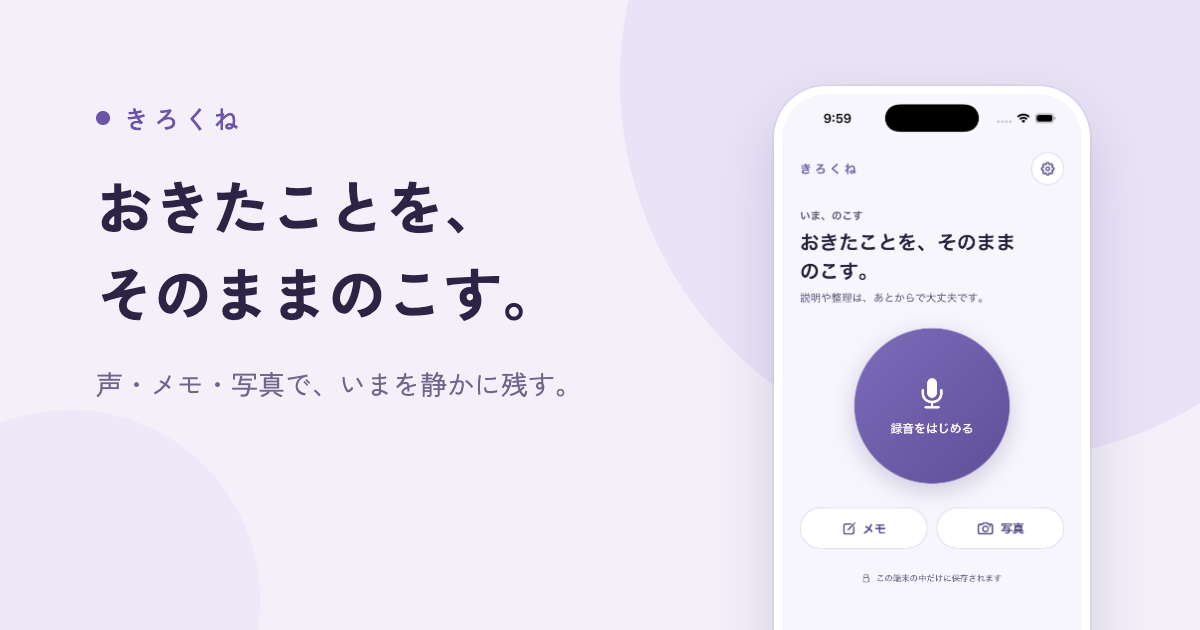
Kirokune is an iPhone app for logging work and personal incidents. It lets you capture what happened in your own words — through a short note, a voice recording, or a photo — and keeps that record on your iPhone, organized into a timeline inside a private case. The app is designed for people who have been told to document everything but have no simple, private place to do it. Unlimited records in one case are free, and no account is required to start; you open the app and begin. Kirokune also offers a free workplace incident log template and example on its website, so you can start documenting even before you install anything. Everyone says document everything, but the practical question of where to write it down rarely gets answered. Work and personal incidents often happen at moments when you have neither the energy nor the time to sit down and compose a careful written account. Details fade, exact wording is lost, and the sequence of events blurs together. Kirokune addresses that gap by lowering the effort of capture to almost nothing: one tap starts a recording, and a photo or a quick note works just as well. The record you create while it is fresh stays on your iPhone until you decide what, if anything, you want to do with it — you do not have to let it go just to get through the day. The core of Kirokune is capturing what happened while it is fresh. A short note written in your own words is enough to begin, and a single tap starts an audio recording for the moments when you cannot bring yourself to type. Photos can be saved alongside notes and recordings, so a visual detail sits with the written account rather than in a separate camera roll. All of these record types live together in the same place, which means you are not choosing one format at the expense of another. The app does not require any setup before you start — you open it and immediately begin a note, a recording, or a photo. Once records exist, Kirokune organizes them rather than rewriting them. Events are shown in time order — dates, times, and exact words — and the timeline is reviewed alongside your original notes. Critically, nothing you already wrote gets changed; the app keeps your own record organized and that is all. Records are grouped into cases, and the free plan allows unlimited records inside one case. Kirokune Plus adds unlimited cases, so people who are tracking more than one situation can keep each one separate. Sorting happens later, when you have the energy, rather than at the moment of capture. Kirokune can also save a chat export as a record. You choose a supported export file from Apple Messages, Messenger, or Instagram — without connecting your chat accounts to the app. Kirokune keeps the file's whole original text alongside the messages it can display, so the original wording stays attached to the record. Because the app does not connect to those services, the guidance suggests choosing the conversation and date range before exporting, where the service allows it. This makes it possible to fold a written conversation into the same private case as your notes, recordings, and photos. The workflow Kirokune describes has three steps. First, get it down: open the app and start a note, a recording, or a photo, with no setup first. Second, sort it later: when you have the energy, group what you saved into a private case. Third, look back: everything is in order, exactly the way you wrote it. Underneath that workflow is a deliberate approach — the app stores records on your device and requires no account. Nothing leaves the app unless you export it yourself. Kirokune states plainly that it does not decide what happened, does not diagnose, and does not give legal advice; it keeps your own record organized. The benefit is that you won't have to go from memory. When you decide to talk it through — with someone you trust, HR, a lawyer, or a support service — having it written down in your own words helps you explain what happened. Because capture takes one tap or one short note, you can document something at the moment it happens instead of reconstructing it weeks later. Because records stay on your iPhone, privacy is the default rather than a setting you have to find. And because you can name the other person however you like — initials or a nickname you would recognize later — you are never forced to record a name you don't want to write. Typical uses follow the situations the app was built for. Someone documenting a workplace incident notes the date, the time, where it happened, what was said, and who was there, as soon as they can, and Kirokune keeps all of that together in one private place in time order. Someone who wants a record in the moment but cannot type taps record instead. Someone preparing for a conversation looks back at what they saved, at their own pace, and pulls it into a summary they can walk someone through. Someone with a written chat conversation exports it and saves the file as a record so the original text stays with it. The free worksheet on the website lets anyone start this practice without an app at all. Kirokune is for iPhone users running iOS 17 or later. There is no Android app; the website's free worksheet can be saved and used in your own notes without installing anything or creating an account. The app is available in the United States and India, with English, Japanese, Traditional Chinese, Korean, and Spanish interfaces. Kirokune is a free download with in-app purchases: the free plan covers unlimited notes, recordings, photos and other records organized in one case, with no account required. Optional Kirokune Plus adds unlimited cases, detailed reviews, PDF export, and removal of ads, available as monthly, yearly, or one-time lifetime purchases, with local price and renewal terms shown in the purchase screen. Two practical notes appear in the app's own guidance. Rules about recording and sharing a conversation vary by place and by situation, so Kirokune suggests considering letting the other person know and checking the rules where you are; the app cannot tell you whether a recording is lawful or how it would be treated. Also, Restore Purchases checks access to your paid plan and does not restore a backup of your records, because records are stored on your device and the app currently provides no automatic sync or cloud backup — so keep your own copies before deleting the app. The takeaway is simple: Kirokune is a private place to write down what happened, on your iPhone, until you decide to talk to someone.
Ghostwriter by MyHandler is a Windows desktop writing tool that drafts text for you directly inside whatever application you are already using. Instead of opening a separate chat window and describing what you want written, you place your cursor in a text field, double-tap the hotkey, and your Handler reads what is actually on your screen — the thread above the cursor, the question beside it, the half-finished sentence inside it — works out what you would write next, and types that draft at your cursor in your voice. There is no prompt to type and nothing to say out loud. It is built for people who spend their day answering messages, email threads, Slack conversations, browser forms and comment boxes, and who want the first draft of a reply to already be there, in their own style, without leaving the app they are working in. The problem Ghostwriter addresses is the gap between knowing what to say and getting it written. Most AI writing tools require the user to describe the request first: you have to summarise the thread, explain the tone, paste in context, and then copy the result back to where it belongs. That description step is often the same work the user was trying to avoid — as the site puts it, describing what you want was the work you were avoiding. Meanwhile the context that actually matters — the conversation on screen, who is speaking to whom, what is being asked — is already sitting in front of the user, and the calendar that determines whether a proposed time is even possible lives somewhere else entirely. Ghostwriter's approach is to take the screen itself as the input, remove the prompt, remove the copy-and-paste round trip, and leave the final decision — whether to send — with the person. The interaction model is deliberately minimal. There is no prompt field, no sidebar, no dictation. You put your cursor where the words go and double-tap the hotkey in any text field, in any app — the Product Hunt listing names double-tap Left Ctrl. The Handler then captures the screen around that cursor: the thread above it, the question beside it, the unfinished sentence in it. That capture happens on your own machine, against an encrypted vault on your PC, and the assembled context is sent to the cloud model with zero data retention to write the draft. Because the screen in front of you is the entire input, it works the same way across the applications the site names — your mail client, Slack, a browser form, a comment box — with nothing per-app to set up. Before writing a single word, Ghostwriter decides what kind of writing it is looking at. The site describes the situations it distinguishes: a reply owed in a thread, a sentence to continue from exactly where it stops, a blank box under a question that wants a real answer, and a message the context obviously calls for. Getting that classification right is described as most of the job, which is why the decision is made before any drafting begins. The consequence is behavioural: a continuation does not restate your own sentence back at you, and a reply does not summarise the thread back at the person who just wrote it. If the reply it produces proposes a time, that time is checked against the next two weeks of your calendar first — the product states plainly that it won't double-book you. Ghostwriter also tracks who is who in a conversation. It maps each message to its sender, works out which handle is yours, and follows who asked whom for what, so that the draft answers the other party rather than replying to your own words. On top of that identity mapping, it matches how you write to that specific person, down to the sign-off. The material it draws on can include the thread on screen, your calendar, your files and your past meetings, indexed in an encrypted vault on your PC. Together these two behaviours — correct attribution and per-person voice — are what separate a draft you can send from one you have to rewrite. Nothing is ever sent. Ghostwriter types its draft into the text box and stops; you read it, change it, delete it or send it, and that last step stays yours. If you select text first, the double-tap rewrites the selection instead of drafting something new. Architecturally the product is split: the screen capture and the encrypted vault live on your own PC, while the assembled context goes to a cloud model with zero data retention in order to write the draft. Ghostwriter is part of the MyHandler desktop app, so it ships alongside the same Handler's other capabilities — Dictation, which turns held-key speech into text at the cursor; an AI Gatekeeper that watches every connected channel, screens the noise on your PC and never sends a word on its own; Contact Intelligence, which builds living contact profiles automatically on your machine from messages, meetings and activity already in your vault; and a Daily Briefing written from local data. The stated benefits follow directly from that design. There is no prompt to write, so the whole interaction collapses to a double-tap. The Handler reads the situation rather than just the words, so the draft lands in the right register: a continuation continues, a reply replies, a form gets filled, and a message the context calls for gets composed from scratch. It gets who's who right, so the answer addresses the other party rather than your own words. And because the draft arrives at the cursor in your voice, in the style you use with that person, the editing pass is a light one rather than a full rewrite. The outcome the product advertises is the end of rewriting the same reply over and over: it drafts, and you decide. Concrete scenarios come straight from the described workflow. You are in your mail client with a thread open and your cursor in the reply box; a double-tap puts a reply drawn from the thread above the cursor in place. You are in Slack and a question is sitting there for you; the Handler maps the message to its sender and drafts the answer to the other party. You are in a browser form or a comment box with a blank field under a question, and it composes a real answer rather than leaving the box empty. You have half a sentence on screen and want the next part; it continues from exactly where the text stops. You are arranging a meeting and the draft proposes a time; the next two weeks of your calendar are checked before the words appear. Or you have already written something and want it said differently: select the text, double-tap, and the selection is rewritten. Ghostwriter is aimed at people whose working day is made of written replies — anyone living in email, team chat, browser forms and comment boxes who wants the first draft to already exist and to sound like them. It runs on Windows 10 or 11, requires a cursor in a text field to trigger, and needs a connected calendar only for the scheduling cross-check; everything else works without one. The product is described as free for Windows 10 and 11, with macOS and Linux coming soon. Because the screen capture happens locally and the index lives in an encrypted vault on the PC, that side stays on your machine, while the drafting step uses a cloud model with zero data retention. Ghostwriter's proposition is narrow and clear: two taps and it's already written. Every other AI writes what you tell it; Ghostwriter writes what you already know, using the screen in front of you as the input and your own voice as the output, and it hands the last step — sending — back to you.