Category Focus/categories/automation
Automation AI Tools
Discover and compare the best automation AI tools and software. Browse 599+ curated tools with reviews and rankings.
Projects tracked
599
Sort mode
RECENT
Page
10
Discover and compare the best automation AI tools and software. Browse 599+ curated tools with reviews and rankings.
Projects tracked
599
Sort mode
RECENT
Page
10
Muse is a personal AI agent from Meta, described on its website as an agent that gets things done. Instead of stopping at conversation, Muse is designed to be given a goal or an everyday task and then to handle the rest, covering areas such as finances and health through to shopping and the people you care about. It is built for people who want to delegate real tasks rather than just ask questions, while remaining in control of what the agent actually does on their behalf. Everyday life is full of small but consequential jobs: paying attention to finances, keeping up with health, shopping for the right item, staying in touch with the people you care about, and turning long-term intentions into actual progress. These are the kinds of activities that consume time and attention without being anyone's main job. Muse is positioned around taking tasks and projects off your plate, so that recurring work and longer-running goals keep moving even when you are busy elsewhere. Because these tasks often involve accounts, money, and personal messages, doing them well requires more than a chat window: it requires an environment where an agent can act, a way for the owner to approve actions, and clear guarantees about privacy and security. Muse's product choices are organized around exactly those requirements. Muse Secure VM is the foundation of how the agent does work. It runs on a persistent, isolated Linux virtual machine equipped with a full browser and enough storage, CPU, and memory to do the kinds of things you would do on your own computer. Treating the agent's working environment as a dedicated, secure computer, separate from your own device, means Muse can work inside a browser the way a person would rather than being limited to a fixed set of pre-built integrations. The isolation of that machine is part of the security story: the agent's work happens in its own environment rather than directly on your personal computer. The product imagery on the site shows the agent working with floating browser, search, map, calendar, and confirmation panels, illustrating how much surface area a single task can span. Muse is designed around the way you already communicate. You chat with your agent in the same way you message other people, using the Muse app or directly in WhatsApp. There is, in the company's words, no learning curve, because you simply tell Muse what you want to get done. The site's illustrations highlight familiar messaging conventions such as message bubbles, voice notes, reactions, and a shared photo, which signals that the interaction model is deliberately conversational rather than a dashboard or a command language. For many people that is the difference between an agent that gets used every day and one that is abandoned, because delegating a task ends up feeling like sending a message rather than operating software. Control is built into the flow. You approve actions your agent takes on your behalf before they happen, such as sending emails and making purchases. Muse also shows a complete audit trail of everything the agent has done and what it is planning to do. Together, approval prompts and an activity record give you a way to review what happened and to intervene before something irreversible occurs. The site visualizes this with purchase, message, activity, permission, and decision controls, so these safeguards are presented as part of the product experience rather than something buried in settings. Muse also places heavy emphasis on keeping your data secure and private. Your logins can be saved to a secure credential store that Muse cannot see, and a 1Password integration is described as coming soon. When shopping, a one-time card number is generated at checkout so your real card stays hidden from both the merchant and your agent. Eligible purchases are covered by Link's purchase protections, described as a first for AI agents, and the site states that your conversations are not shared with Meta's ad systems. Each of these choices reduces how much sensitive information is exposed while a task runs: the agent can complete a purchase without ever holding your real card details, and it can log in to services without being able to read the stored credentials. Muse is also designed to be proactive rather than purely reactive. It helps you stay on top of things, takes tasks and projects off your plate, and turns long-term goals into real progress. Muse learns from conversations, reflects on what matters and gets sharper, coming back with ideas built around what you actually need, ready to act on them under your direction. The key qualifier is "under your direction": suggestions and ideas arrive ready to be actioned, but they remain subject to your approval. The site illustrates this with checklist, calendar, route, progress, and idea panels, showing how goals, schedules, and plans sit alongside the conversation. Muse connects to the apps you use daily, such as email, calendar, and Instagram. You decide what your agent can see and what it can do, which keeps permissions explicit rather than open-ended. If a task needs a tool that does not exist, your agent builds it for you. That combination, connecting to familiar services and generating new tools on demand, is what allows Muse to keep working when it encounters something outside its standard set of capabilities instead of stopping and asking you to do it manually. Taken together, Muse's approach is to pair a conversational interface with an execution environment. You start with a message: a goal or an everyday task. Muse interprets it, works in its secure virtual machine and through connected apps, and either completes the task or pauses for your approval when an action needs it. Everything it does and plans to do is recorded, credentials are stored where the agent cannot read them, and purchases can be made with a one-time card number rather than your real one. Proactive suggestions and self-built tools extend the same loop: Muse reflects on what matters to you, proposes next steps, and can build the tool it needs to follow through. The stated benefits follow from that design. Tasks and projects come off your plate instead of piling up, and long-term goals turn into real progress rather than remaining intentions. You stay in control through approvals and an audit trail, and you get privacy reassurance in the specific forms described on the site: a credential store the agent cannot see, one-time card numbers at checkout, Link purchase protections on eligible orders, and conversations that are not shared with Meta's ad systems. Because the interaction happens in the Muse app or in WhatsApp, using the agent fits into messaging habits people already have. Concrete scenarios described on the site include handling aspects of finances, keeping up with health, shopping, where Muse can generate a one-time card number at checkout and where eligible purchases are covered by Link's protections, and staying connected with the people you care about. The agent can also act on your behalf in communication, since sending emails is one of the actions you can approve in advance. Connecting email, calendar, and Instagram means tasks that span work and personal life can be handled through one agent, and turning long-term goals into progress covers the longer-horizon work of staying on top of plans, checklists, and schedules. Access begins by logging in or creating an account using a mobile number or email. The site notes that you may receive SMS notifications if you use your mobile number, and links to Meta's help pages for more detail. Muse can be used through the Muse app or directly in WhatsApp, and the website offers app downloads alongside a guided product walkthrough presented by a product designer. Product Hunt lists Muse by Meta under Android, Bots, and Facebook Messenger, and the site points to two further resources, "How We Designed Muse" and "How We Built Safety Into Muse," for readers who want to understand the product choices and the safety principles behind the agent. Muse's proposition is simple to state and ambitious to deliver: a personal AI agent you message like a person, which works in its own secure computer, connects to the apps you already use, and asks permission before it does something that matters. With approvals, an audit trail, a credential store the agent cannot read, one-time card numbers at checkout, and purchase protections on eligible orders, Muse is presented as an agent built to deserve your trust while it takes tasks and projects off your plate.

99xDev is an AI app builder designed to create full-stack web applications. Its main purpose is to enable users to build production-grade web apps using artificial intelligence, providing a comprehensive solution for app development. The product offers built-in database and storage capabilities, eliminating the need for separate infrastructure setup. It supports custom domains, allowing users to brand their applications professionally. A key feature is the ability to download the generated source code, which enables self-hosting and avoids vendor lock-in. The unique approach of 99xDev lies in its AI-powered development process that generates complete, functional web applications. By leveraging AI, it streamlines the creation of full-stack apps that include both frontend and backend components in a single workflow. The primary benefit is the creation of production-grade web applications that maintain high quality standards. This makes it suitable for developers and teams looking to rapidly prototype or build deployable web applications without compromising on technical robustness. Target users include developers, AI engineers, and teams interested in AI-assisted coding and full-stack development. The platform integrates AI coding capabilities with traditional web development workflows, though specific technical details about integrations are not explicitly mentioned in the provided content.

Wingbits AI is a platform that enables users to create AI agents for real-time monitoring of airspace activity and receive alerts when specific events occur. It is powered by an independent global network of over 5,600 antennas across 120 countries, processing terabytes of ADS-B data daily to provide insights into aircraft movements, including military, private, and government jets. Key features include the ability to ask questions in plain English about current flights, such as "where is Air Force One right now?" or "Which private jets visited Davos last weekend?". Users can create monitoring agents that send alerts to platforms like Slack, email, Telegram, or Teams when criteria are met. The platform also offers scheduled reports and analysis on topics like competitor routes and can compare GPS jamming events across different regions. The system is built on a proprietary data infrastructure that ingests and cleans approximately 3TB of raw ADS-B data daily with under 1-second latency. It deduplicates and processes transponder messages before agents query the clean data. The platform identifies common query patterns and pre-aggregates relevant data to enable efficient querying over longer time windows. Benefits include extracting geopolitical or operational insights from aviation data without requiring a data science team. Use cases include tracking military aircraft, monitoring private jet movements for competitive analysis or news reporting, detecting GPS jamming spikes, and receiving alerts about specific aircraft like those of traveling friends or family members. The platform helps users get fewer, higher-confidence alerts by using alert history to determine if something has meaningfully changed. The product is designed for reporters, prediction markets, competitive analysts, route planners, and aviation enthusiasts. It integrates with communication tools like Slack, Teams, Telegram, and email for alert delivery. The underlying technology includes a global antenna network for data collection and real-time stream processing to handle high-frequency event streams with low latency.
Gwal is a mobile-first platform that lets you create, deploy, and manage customized AI agents directly from your phone. These persistent agents collaborate to automate complex workflows using 8000+ plug-and-play skills.
Deforge is a no-code platform that enables users to build and deploy AI agents without writing code. Users can create agents visually or conversationally and deploy them in minutes.
Shadow is your smart assistant that listens during calls and provides real-time prompts to help you have smarter conversations. It helps turn messy calls into productive ones by slipping you the right prompts while you're on the call.

Getbeel connects to your Gmail and extracts every invoice automatically. Founders and brands use Getbeel to collect invoices, track spending, and save hours every month.
Copperlane is an AI-native mortgage origination platform that guides borrowers through documentation and verifies files instantly. It helps loan officers close faster with fewer conditions by automating document collection and processing.
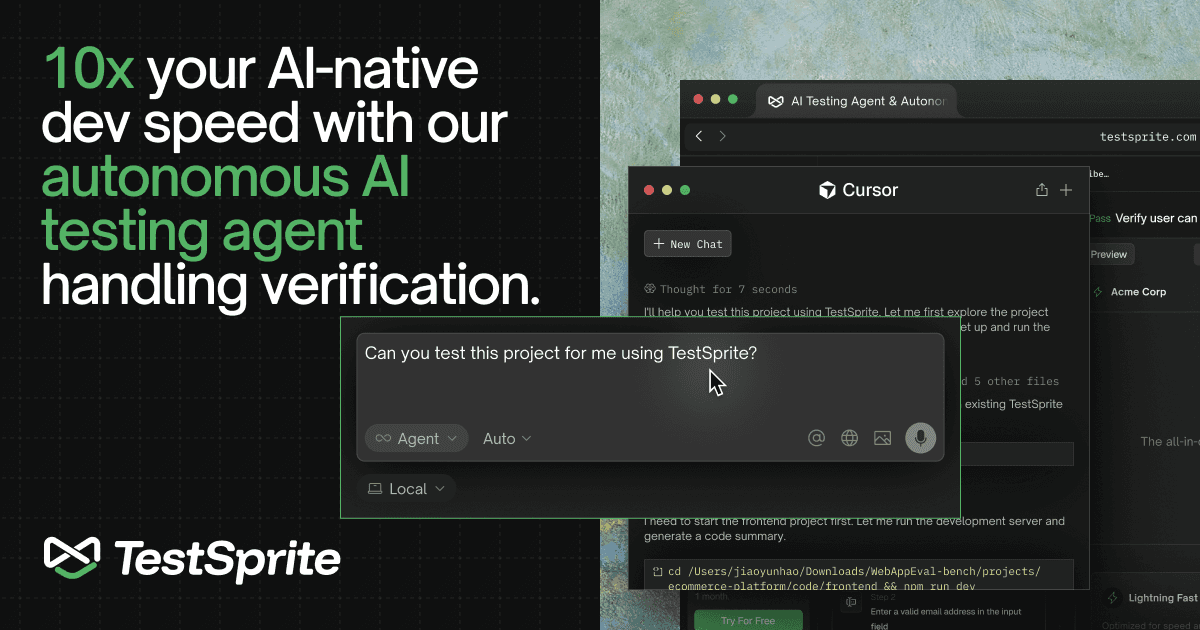
TestSprite is an autonomous AI testing agent that automates the entire software testing process. It generates, executes, and maintains test cases across applications to boost AI-code pass rates from 42% to 93%.
nolink.ai enables users to build multi-step AI workflows using a visual editor that chains together text, image, audio, video, and document models. Users can publish workflows to a marketplace to earn commissions or keep them private.