Category Focus/categories/seo
SEO AI Tools
Discover and compare the best seo AI tools and software. Browse 54+ curated tools with reviews and rankings.
Projects tracked
54
Sort mode
RECENT
Page
2
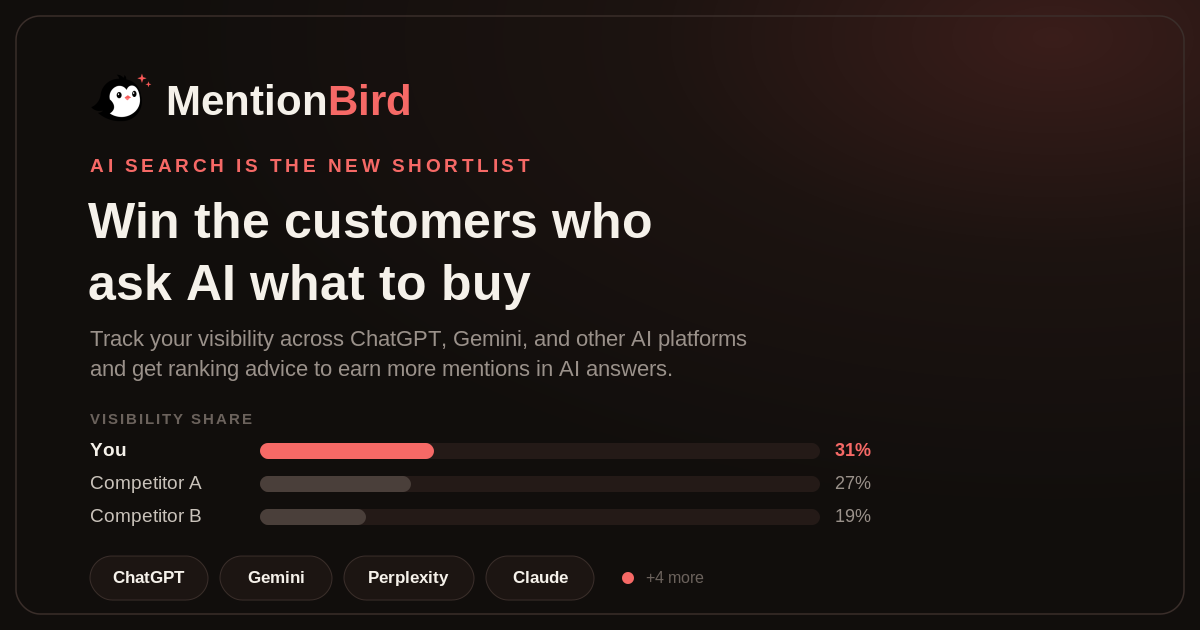
MentionBird is an AI visibility tool that shows brands why AI assistants recommend their competitors instead of them — and what to do about it. When buyers ask ChatGPT, Perplexity, or Gemini what to buy, the answer is assembled from a small set of sources that the model trusts for that specific question. MentionBird finds those sources for the prompts that drive a company's sales and gives a concrete plan to get the brand into them. It is built for any business whose customers research products or services online, and it positions itself as the "Ahrefs for AI Search." Buyers no longer start with ten blue links. They ask an AI assistant, get two or three brand names, and shop from that shortlist. The shortlist now forms inside the answer itself, and if AI does not say your name, you were never in the running — and you would never know. AI answers are built from a small set of pages, reviews, and videos that the model trusts for that specific question. Get into those sources and you get recommended; stay out, and your competitor takes the customer. Because most categories have no clear winner in AI answers yet, starting early can help a brand become the default answer. The first step is picking the prompts that bring customers. Users add the real questions buyers ask — examples on the site include "Best running shoes for daily use," "Best marathon shoes for men," "Best running shoes for flat feet," and "Most comfortable shoes for long runs." MentionBird then tracks exactly which sources AI cites for each one. For a given prompt, it lists the sites the models check and marks each as cited or not cited — showing, for example, that runnersworld.com and runrepeat.com are cited while a brand's own listings are not. That visibility into the underlying citations is the difference between knowing you are losing and knowing where to go to fix it. For any tracked prompt, MentionBird generates AI Ranking Advice. It reviews the answers, the named brands, and the cited sources, then recommends practical steps and shows the effort required for each one. Advice can include getting featured in trusted roundups and comparison guides, publishing guides that answer the questions buyers ask before choosing, adding clearer product facts such as fit and durability details to product pages, or earning videos and mentions from trusted websites. Each recommendation is labelled with impact and effort — for example, "Medium effort · High impact" — so teams know what to fix first. The platform checks and updates AI visibility data once every 24 hours. It tracks ChatGPT, Perplexity, Gemini, and Claude, as well as Google AI Overviews, Grok, Microsoft Copilot, and DeepSeek. Tracking is prompt by prompt: cited, not cited, or no brand named yet. Users see share of AI recommendations versus each competitor week over week, and every score change is traced to the exact prompt, model, or citation that caused it. A weekly brand visibility share view can show, for instance, one brand up four points while another drops three. MentionBird describes itself as built around the question that matters: what do I do to get mentioned for this prompt? It contrasts itself with other AI visibility trackers that show a mentions chart, tell you when you dropped, and leave the "now what?" to you. MentionBird instead shows the sources behind every answer, gives a per-prompt plan to win them, and proves the plan worked with daily tracking. It also distinguishes itself from SEO rank tracking: SEO tools show a webpage's position in Google search results, while MentionBird checks whether AI answers mention your brand, which sources AI cites, and how your visibility compares with competitors. The outcome MentionBird promises is movement from "never mentioned" to the brand AI often mentions. Users can watch themselves become the answer, because every plan they execute shows up in the numbers. Teams quoted on the site describe concrete gains: Risely discovered it won the category questions but lost the comparison ones, which it called exactly backwards for a buying decision; Facets learned the exact questions where engineering buyers saw it as invisible; Recooty found AI was recommending an ATS to every buyer who asked, just never theirs; Superfans reported being in 83% of "alternatives to the category leader" answers after MentionBird found the gap; and Helixo, despite 3300+ reviews, could pinpoint the questions where AI still was not recommending it. Typical use cases start with evidence gathering: a brand runs the free AI Visibility Report to see whether AI recommends its competitors, then adds its brand, prompts, and competitors to track the questions that matter. Marketing and SEO teams use prompt-level data to decide which pages, guides, or product details to fix first. Agencies manage several clients in one workspace, using tags to organize prompts by brand, product, or project. E-commerce and software companies watch comparison and category prompts separately, since the two can behave very differently. Multi-brand teams keep several brands or product lines in a single workspace, and anyone entering a new category can move early to become the default AI answer before a clear winner emerges. MentionBird works for any business whose customers research online, including e-commerce stores, software companies, healthcare providers, law firms, financial services, real estate, travel, and education, plus home services, automotive companies, and local businesses. Agencies, marketing teams, and SEO teams are explicitly supported, and the site suggests starting with 20 to 50 real buying questions rather than hundreds of broad prompts. No installation is required — there is no code, plugin, or tracking tag to add to a website, and setup takes only a few minutes. Pricing includes a free AI Visibility Report tool and a Starter plan at $19/mo for three months with the Product Hunt code PH19. Plans can be changed anytime, with upgrades applying immediately and downgrades beginning with the next billing period, while saved prompts, labels, and past data remain available. MentionBird's core value proposition is simple: it turns AI visibility from a chart you cannot act on into a per-prompt plan you can execute and verify. By revealing the sources behind every AI answer, explaining why competitors get recommended, and tracking progress daily across the major AI platforms, it helps brands get into the shortlist that now forms inside the answer — before their competitors do.
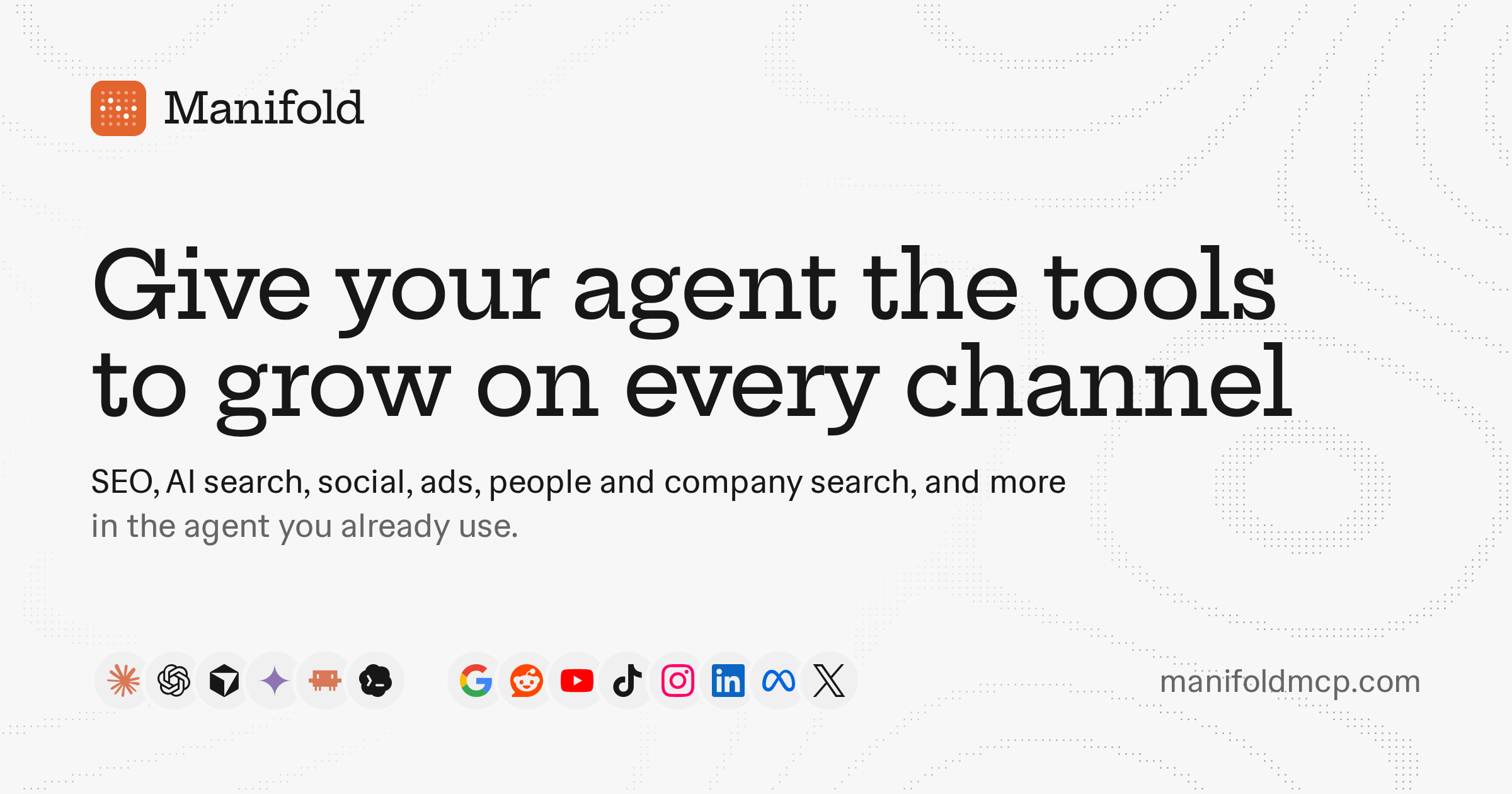
Manifold is a hosted MCP server that gives your AI agent live marketing data across every channel you grow on. Rather than opening another dashboard, you connect Manifold to the AI app you already use — Claude, ChatGPT, Cursor, Claude Code, Codex, Gemini CLI, Grok, OpenCode or any other client that supports remote MCP servers — and ask questions in plain words. Your agent picks the right tools and brings back answers built on real data: Google rankings and backlinks, what AI assistants say about a brand, social posts and videos, Reddit threads, competitors' live ads, and companies and people with verified work emails. It is aimed at marketers, founders and growth teams, and it is free to start for every new workspace. Marketing data is usually spread thin. Rankings live in one tool, AI answer visibility in another, creator research somewhere else, competitor ads in an ad library, and buyer intent across LinkedIn, X and Reddit. Pulling that together means a pile of tabs, several logins and API keys for services like Reddit, LinkedIn or a search data provider. Manifold collapses it into one hosted connection: your agent signs in once and uses Manifold's own provider accounts, so there is no Reddit API app, no LinkedIn login and no DataForSEO deposit to manage. The result is a single place where an agent can look up live marketing data whenever it needs to, and answer with real numbers rather than guesses. SEO is the first data group. Your agent can see every keyword you rank for, who outranks you and why, and what to fix on your site. A typical question — which keywords do we rank 5 to 15 for that could reach page one? — returns terms sitting just below the first page. A sample answer might tell you to put a phrase in a page title because you already rank seventh for it, to answer a question directly on the page because an AI assistant gets it wrong, or to link to that page from your best-ranking posts. Because the data is fetched live from search providers, the recommendations reflect current rankings rather than a stale export. AI answers, sometimes called AEO, covers how assistants describe your brand. Your agent can ask ChatGPT, Claude, Gemini, Perplexity and Google's AI Overviews any prompt, on demand, and report which brands each answer names, in what position, and which pages it cites. You can check whether AI assistants recommend you for the questions your buyers ask, see who they name instead, and review which pages they cite. You pay per prompt and engine rather than a monthly fee for tracked prompts, and a free check shows whether your site lets AI crawlers read it — a prerequisite for appearing in AI answers at all. Social research finds the creators and videos already winning your niche. Your agent can locate the TikTok, YouTube and Instagram creators your buyers watch, along with their audience and their top videos with transcripts — for example, which sales creators on TikTok and YouTube get the most views and what their top videos are. Instagram, Facebook, LinkedIn and X are covered too. Ad libraries sit alongside this: you can pull competitors' live ads on Meta and Google, see what each one says, and check how long it has run, so you can write better ads by seeing what already works. Reddit and lead research connect that data to action. Your agent can find every thread that asks for what you make, read the replies and draft your answer — for instance, threads this month asking for a CRM, or Reddit threads asking for recommendations. On the people side, Manifold spots posts on LinkedIn and X about the problem you solve and returns each author's verified work email, so you can reach buyers who are looking right now. The agent writes from this data too: blog posts, Reddit replies, ad copy and outreach emails are drafted in the chat with real numbers behind them, and you check the drafts and use them where you want. Manifold is the data your agent works from — not a scheduler or an autoposter. Under the hood, Manifold is a remote MCP server. You connect your agent once — in Claude, add the URL as a custom connector and sign in; in Claude Code, run claude mcp add --transport http manifold followed by the URL — and every client uses one URL, https://mcp.manifoldmcp.com/mcp, and one credit balance. Tools carry names such as seo_get_ranked_keywords, aeo_run_ai_answers, reddit_search_posts and linkedin_search_posts, and your agent picks the ones it needs for your question. Manifold fetches data live from specialist providers when your agent asks: search, keyword, backlink and AI answer data come from DataForSEO, while Reddit, TikTok, Instagram, YouTube, Facebook, LinkedIn, X and the ad libraries come from the platforms' public data. Results are cached briefly — most for a day to a week — so a repeat question comes back fast and costs less. Answers you can act on are the point. Instead of raw exports, the agent returns specifics: what to fix on a page, who to reach out to, which threads to join. From there it can take the next steps for you, drafting the content or the outreach in the same conversation. You get real numbers rather than estimates, one balance and one URL across every client instead of a collection of keys and logins, and cost control built in — every call is paid from a single credit balance, each tool states its price before it runs, and your agent can cap what a call spends. Concrete workflows run across the product. In SEO, teams ask which keywords they rank 5 to 15 for that could reach page one. In AI visibility, they ask whether they are recommended for a query like "best CRM for startups". In social, they ask which sales creators on TikTok and YouTube get the most views and what their top videos are. In prospecting, they ask who posted about leaving their CRM this week. In competitive research, they ask what a competitor is running on Meta this week. And in community marketing, they ask for threads posted this month asking for a CRM. Manifold is for marketers, founders and growth teams doing SEO, AEO, social, ads or lead research, and it works with Claude, ChatGPT, Cursor, Claude Code, Codex, Gemini CLI, Grok, OpenCode and any other client that supports remote MCP servers. Clients without OAuth use a Manifold API key instead. Pricing is easy to start: every new workspace gets 250 free credits, then a Pro plan from $20 a month for 2,500 credits, or Max at a lower rate per credit, with top-ups from $10 between renewals. Manifold is a marketing data MCP server founded in London in September 2026 by Jesse Sibley, and it is not related to Manifold Markets. Manifold MCP turns the AI assistant you already use into a marketing research and growth partner. One connection, one credit balance, and live data from Google, AI answers, Reddit, social platforms, ad libraries and lead sources — so your agent can answer in plain language, then help act on what it finds.
ReSO is a generative engine optimization platform that helps brands show up and get recommended in AI search results. It is built for founders, CMOs, and growth teams who want to turn buyer intent expressed in ChatGPT, Perplexity, and Google AIO into visibility, citations, and traffic. The product is pitched as an agentic employee you onboard so that your brand is recommended in the answer when buyers ask AI. Instead of only tracking rankings, ReSO analyzes intent, competitors, content gaps, and technical issues, then turns them into priority actions to improve AI recommendations. The site also invites visitors to check their AI visibility and to run a detailed AI visibility analysis across brand, content, technical setup, and competitive gaps worth $500 at no cost. The problem ReSO addresses is a shift in how buyers discover products. As the site puts it, your buyers are searching on ChatGPT, and in 2026 AI will dictate discovery. B2B buyers increasingly use ChatGPT, Perplexity, or Google AIO to research solutions, compare vendors, and shortlist providers. If a brand is absent from those answers, competitors can influence the buying journey before a prospect ever reaches the website. The FAQ frames the discipline as AI Search Optimization (AISO) and notes that AISO, GEO, AEO, and LLMO are overlapping terms for optimizing visibility in AI-generated answers: AISO focuses broadly on AI search, GEO on generative engines, AEO on direct-answer visibility, and LLMO on large language models. The same FAQ observes that most organizations still cannot clearly say how ready they are for AI search, which makes it difficult to identify gaps, prioritize investment, or measure progress. The core of the platform is a proprietary intent model mapped to real buyer queries on AI. ReSO says LLMs interpret intent, not keywords, and its proprietary model analyzes 30+ intent-driven search variables to decode exactly what customers are looking for. Users can curate a list of 75 high search intent-based prompts, view brand share of voice across the entire awareness-to-conversion funnel, and map visibility against competitors. The features section illustrates the Discovery stage of the buyer journey, described as exploration where people look for the best options, trends, and possibilities before narrowing down what fits their needs, with example prompts such as “Best budgeting apps for managing personal finances?”, “Best fitness trackers for everyday use?”, and “Best tools for automating B2B lead qualification?” Citation Intelligence helps create content that gets a brand mentioned by LLMs. Each piece is built around the signals that influence AI visibility: prompt trends, citation behavior, and content gaps across the category. The approach promises a consistent weekly publishing cadence, a 100% customised content strategy to become a category leader on LLMs, and content created in formats that improve mention potential. The site pairs this with an AI citation chat interface. The underlying logic described in the FAQ is that to be cited by AI search engines, a site needs clear, authoritative answers, strong entity signals, useful source material, and structured content that AI systems can interpret easily. ReSO analyzes which sources AI platforms cite within a category and identifies gaps in content and authority signals. The Technical Engine audits the technical issues that affect how AI systems and search engines access, interpret, and trust a website. It delivers technical edits intended to increase LLM visibility, entity mapping and code-level changes to make the website AI-readable, and improvements to discoverability across search platforms. Alongside these engines, ReSO presents a visibility dashboard: the imagery on the site shows a laptop user dashboard, a competitor gap view, a brand visibility score, and a “new opportunity found” alert. The platform is described as multi-platform search optimization, focused on how a brand shows up across AI search rather than a single engine. The workflow ReSO describes starts with onboarding the agentic employee and checking your AI visibility. From there, you identify the questions your buyers are asking LLMs and where your brand currently appears in those answers. ReSO maps high-intent prompts across the buyer journey, measures your share of voice against competitors, and identifies the content and technical gaps that may be limiting visibility. Those findings are converted into prioritized actions: the pages, topics, and site improvements most likely to increase brand mentions and recommendations. On the content side, pieces ship on a weekly cadence and are shaped by prompt trends and citation behavior; on the technical side, entity mapping and code-level changes are applied so the site is easier for AI systems to read and trust; and throughout, visibility against competitor mentions is tracked. ReSO reports multi-platform search optimization outcomes of 3X traffic increase from LLM-driven search, +38% citation growth month-on-month, +25% signup conversion directly from ChatGPT referrals, and +30% visibility score quarter-over-quarter growth. Three case studies are listed on the site. SMC Global, a publicly listed fintech in India, saw a 132% increase in clicks from ChatGPT, a 162% increase in website clicks (up from 37,200), and a 516% increase in impressions (up from 923,000). An EoR platform in HRTech achieved a 12X increase in citations from LLMs in three months, a 364% increase in blog traffic (from 824 to 3,825 monthly clicks), a 5x increase in AI mentions (up from 10 to 50), and a 41% lift in AI visibility (up from 8%). A US-based LegalTech company recorded a 92% increase in brand mentions (up from 288), 60% total traffic growth (up from 23,400), and 55% impressions growth (up from 2,080,000). The use cases described on the site center on buyer research and comparison. Buyers ask AI for the best budgeting apps for personal finances, the best fitness trackers for everyday use, or the best tools for automating B2B lead qualification, and ReSO aims to make a brand part of those answers. B2B teams use it to appear when prospects research solutions, compare vendors, and shortlist providers. Marketing teams use the weekly content engine to publish material shaped by prompt trends and citation behavior, and the technical engine to remove barriers to being accessed, interpreted, and trusted. Growth teams track whether their brand is mentioned or recommended versus competitors at each buyer-intent stage, and prioritize the biggest visibility gaps. ReSO is aimed at founders, CMOs, and growth teams, and says it is trusted by founders and CMOs across high-growth startups and enterprise; logos shown include SMC Global, Mountmiller, Dhisana, Boundless, Early, 5 Day, Gaia Dynamics, Sprouts, and Strong. The platform positions itself as a replacement for agencies, consultants, and fragmented internal workflows — “replace your SEO agency with an agentic employee” — while working alongside traditional SEO rather than replacing it. Getting started requires no credit card and no commitment, and the site offers a detailed AI visibility analysis across brand, content, technical setup, and competitive gaps worth $500 at no cost for now. Beyond the free visibility check, ReSO directs interested teams to book a call to hire an AI employee that grows their business. In short, ReSO's value proposition is turning AI search from guesswork into a measurable, actionable channel. It combines intent analysis across intent-driven search variables, a curated set of high-intent prompts, a weekly content engine, and a technical audit into one agentic employee, so brands can move from being overlooked in AI answers to being mentioned, cited, and recommended. For founders, CMOs, and growth teams who want to know how LLMs see their brand and what to do about it, ReSO offers both the diagnostic — a free AI visibility check — and the ongoing execution to improve it.
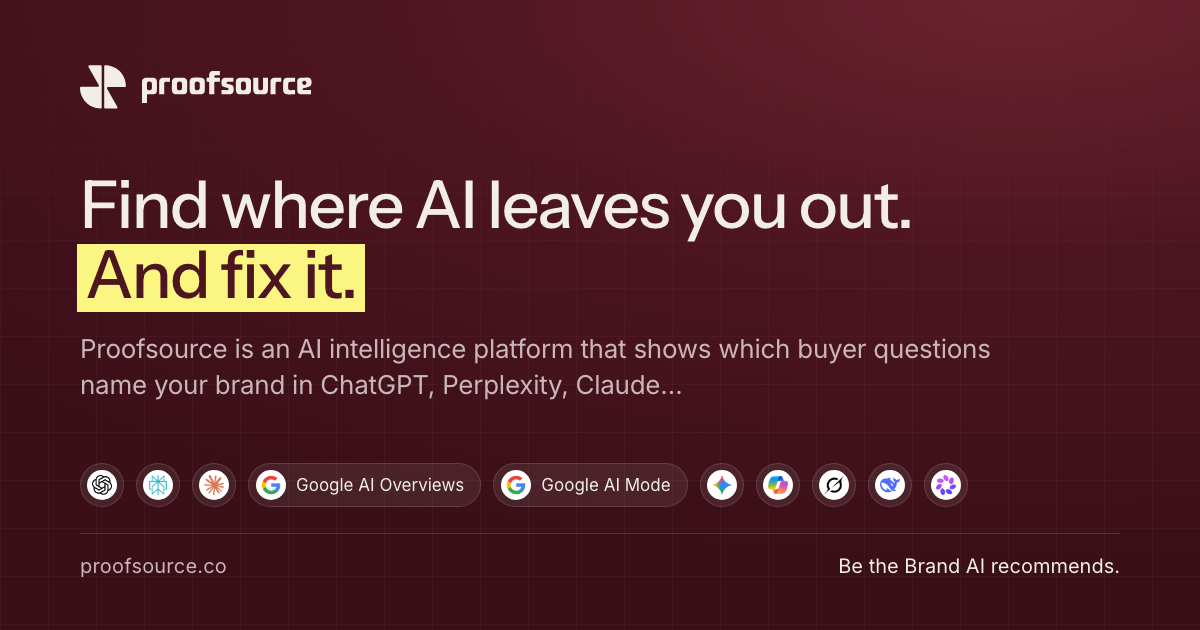
Proofsource is an AI intelligence platform that shows whether ChatGPT, Perplexity, Claude and Google AI Overviews name your brand, who they name instead, which sources they cite, and what to fix. Its stated purpose is to make the AI shortlist visible day by day and engine by engine, and then to close the gaps behind every lost answer. The site names four audiences it is built for: growth and brand leaders, writers and search teams, agencies running many brands, and founders and small businesses. Rather than stopping at a visibility score, Proofsource continues through to drafted fixes drawn from your own content, so a gap in an AI answer becomes a change you approve and publish. Buyers now ask AI for a shortlist. An answer engine names three to five brands and moves on, and if your brand is not one of them there is no second page to rank on and no click to measure. Proofsource's own published measurement illustrates how contested that shortlist is: across 947 citations and four engines, 43.5% of the sources AI cited for category questions were comparison pages — listicles, alternatives and versus pages. In the same scan, 387 different websites were cited across just 80 answers, meaning your own site is one voice among hundreds. A separate branded-question read, done by hand, found that only one of four engines described a brand-new company correctly, while the other three answered from what they already believed. The company also published research stating that 0.8% of AI citations point to the brand's own website. These findings explain why Proofsource argues that rank trackers, which measure blue links, do not answer the question of whether an answer engine recommends you. The core visibility layer answers the first question: are you in the answer? For each brand, Proofsource reports mention rate, share of voice and average position per engine, so you can see the share of buyer answers that name you, how large your share of the named brands is, and where you typically appear. Every number carries a 95% confidence range — the site specifies a 95% Wilson interval — so a bad day never looks like a trend. The platform keeps the full text and a screenshot of every answer, which means a visibility claim can be traced back to the actual engine response rather than a summary score. On paid plans the questions are asked every day, because AI answers shift from day to day and a weekly snapshot can miss the day a competitor enters your shortlist. The free trial runs two scans, today and tomorrow, covering 25 questions on every engine for 200 answers in total. Once visibility is measured, Proofsource surfaces who AI names instead of you. Every brand the engines name for your questions lands on a single leaderboard, ranked by answers and broken out per engine, including brands you never thought of as competitors. Any of them can be added to tracking with one click, so the competitive set grows as the engines reveal it, and the leaderboard shows the specific questions where each competitor beats you. The citation layer then explains why: answers are built from sources, so Proofsource lists every page the engines cite for your questions, which cited pages mention you, and which are open to a pitch, a listing or a correction. It flags cited domains and exact pages, listicles that leave you out, and the pages on your own site that engines read versus the ones they skip. In the Tesla example shown on the site, youtube.com was cited in 29 answers, en.wikipedia.org in 24, reddit.com in 20 and tesla.com in 17 — the first naming Tesla outright, the next two naming it partly, and the last being the brand's own site. Proofsource also checks what the engines get wrong about you. Because engines answer from what they already believe, the platform asks about your brand by name, reads the answers, and flags wrong prices, old features and mixed-up identities, with the source behind each claim. An illustrative claim check on the site shows an engine reporting a price the brand retired last year and a free tier that does not exist, tracing it to a 2024 review page, and suggesting an update to the pricing page plus a request for the reviewer to refresh. Profile checks run on the sites engines lean on, and the platform audits crawler access — whether GPTBot, ClaudeBot and PerplexityBot can read you at all. When gaps are found, Proofsource ranks them by likely lift against effort, names the page or source to change, and drafts the fix from your own content for you to approve. The Product Hunt listing describes the final step: agents publish the approved changes, verify that the answers changed, and learn from every change. Proofsource describes one loop from the answer to the fix, summarised as Know, Act, Prove, Repeat. Most AI visibility tools stop at a score; Proofsource continues through what the engines say, why they say it, what to change, and whether the change worked. Onboarding follows a three-step path. First, you tell Proofsource your site; it reads it, works out your category and your competitors, and drafts the buyer questions worth tracking, and you approve every one. Second, the platform asks the engines those questions, keeping every answer with its sources and a screenshot. Third, you get the shortlist and the fixes: where you are named, who is named instead, which sources decided it, and the gaps worth closing first. The site also publishes a methodology page describing how it measures AI answers. For growth and brand leaders, Proofsource offers one number for AI visibility that can be defended in a board meeting, with the questions, engines and confidence range behind it. For writers and search teams, it supplies the questions you lose, the pages the engines cite instead, and drafts grounded in your own site — as the site puts it, search taught you to rank, this shows you how to be quoted. For agencies running many brands, the platform supports unlimited brands on one account, a weekly report per client, and a roll-up of who is winning and losing across the book. For founders and small businesses, the free trial gives 200 answers over two days with no card, so you can see in minutes whether ChatGPT recommends you and then fix the one page that matters most. Because each brand chooses how many questions it tracks, spend can be tied to the brands that earn their place. Concrete workflows follow directly from those roles. A founder can run a free scan before a launch, check whether ChatGPT names the company for its category questions, and start with the single highest-value page to change. A search or content team can look at the citation list, find a listicle that leaves the brand out, and pitch a listing or a correction on that cited page. A brand can run accuracy checks, discover that an engine is quoting a retired price from an old review, and draft a fix plus a reviewer refresh request. An agency can scan each client brand, send a weekly report per client, and roll up the results to see which brands are winning across its whole book. A growth lead can bring a mention rate with a confidence range, backed by the questions and engines behind it, into a board discussion about AI visibility. Proofsource tracks ChatGPT, Perplexity, Claude and Google AI Overviews on every plan, with Grok and DeepSeek available as add-ons on Custom plans. The site's logo strips also display Google AI Mode, Gemini, Microsoft Copilot and Meta AI. The free trial is described as 200 answers, 25 prompts per question, top AI engines, two days, free, and no card, with two scans — today and tomorrow. After that, custom plans start at $64 per brand per month, with the final price discussed on a demo call, and each brand chooses how many questions it tracks. The site also publishes side-by-side comparison pages against Profound, Otterly.AI, Peec AI, Semrush, Ahrefs, Scrunch, SE Ranking, Rankscale and AthenaHQ, covering engines covered, sampling cadence, statistics, fixes and price, with sources for every claim about another product. The shortlist for your category is being written right now by answer engines, and most brands never see it. Proofsource's value proposition is that it makes that shortlist visible — who is named, who is named instead, which sources decided it — and then keeps going with ranked gaps, drafted fixes drawn from your own content, and verification that the answers actually changed. Start free with 200 answers, 25 questions on every engine, and no card, and find out whether AI names your brand.
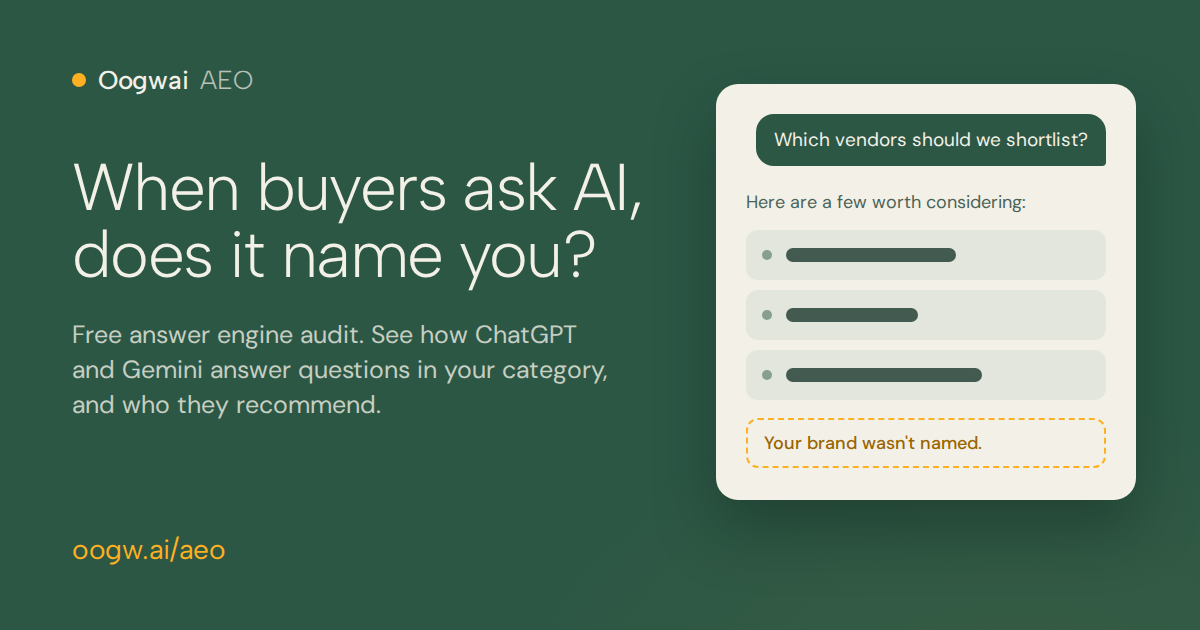
Oogwai Beacon is an answer engine optimization audit from Oogwai. It puts 20 real buyer questions about your category to the AI assistants your buyers use — none of the questions name your brand — and records how often each engine names your brand, who it names instead, and which sources it relied on to decide. The audit reports two halves separately: whether AI crawlers can read your site at all, and whether the engines actually cite you when they answer. It is built for the marketing, SEO and content teams of companies that sell into a category where buyers now ask an assistant for a shortlist rather than scanning a page of search results. The instant readability check runs on the page in seconds with no sign-up, and the citation report follows by email. The problem Beacon was built around is a change in buying behaviour. A buyer evaluating your category used to type a query, scan a page of results and form their own shortlist. Now they ask an assistant, and the assistant hands back a shortlist already formed — three names, a sentence each, and a follow-up question. Whoever is not in those three is not in the evaluation. Answer engines do not rank pages the way a search engine does. They assemble a reply from three things: what the model absorbed during training, what it retrieves live from the web at the moment of asking, and which of those sources it trusts enough to lean on. Your own website influences the first two weakly and the third barely at all — because when a buyer asks who the best vendor is, an engine will not settle the question by quoting the vendor. That is the gap answer engine optimisation works in: not keywords and rankings, but presence, corroboration and machine legibility, measured by whether you get named. Half one is readability, and it is pure HTTP with no engine calls — which is why the result lands on the page within seconds. It answers whether GPTBot, ClaudeBot, PerplexityBot and Google-Extended can reach your pages and find anything on them. The check covers robots.txt rules for each named AI crawler; whether the site serves server-rendered HTML rather than an empty shell filled in by JavaScript; Organisation, Product and FAQ structured data; llms.txt and a machine-readable summary of what you sell; heading structure, canonical URLs and clean sitemaps; and consistent entity facts — one name, one description. Because it is a technical pass, the fixes are usually a short engineering job, and Oogwai hands over the exact changes whether or not you go on to work with them. Half two is citation, and it is the part that requires actually asking the engines. Beacon puts buyer questions about your category to the engines in your tier. None of the questions mention your brand — because a question that names you proves nothing about whether you would be recommended. The report shows how often each engine names your brand unprompted, which competitors it names instead and how consistently, the sources each engine cited to get there, what the engines believe you do (correct or not), the question types where you are strong and where you vanish, and a ranked list of the sources worth being on next. That list is evidence from your own market rather than a generic media plan. Which engines run depends on tier. The free check queries ChatGPT and Gemini. The paid audit adds Claude, and Perplexity is covered on the managed programme, where regional variations and buyer personas are also tested; Copilot is covered on the managed programme as well. Claude grades markedly harder than the other two, so a two-engine result reads higher than a three-engine one — which is exactly why the AEO score is reported only on the paid audit, where it is measured against the full set. The free citation report — who ChatGPT and Gemini name instead — requires a free business-email account. Beacon's stated position is that AEO has two halves and only one of them is a technical problem. Most tools sell a single number, and a single number hides the distinction that matters, so Beacon reports the two halves separately. A perfect readability score with zero citations is common, and the audit treats it as the most useful result it produces: it tells you the problem is not on your website. Fixing robots.txt takes an afternoon; getting named takes presence on the pages an engine reaches for when it is asked to compare vendors — roundups, review platforms, comparison pages, community threads, editorial coverage, transcripts — almost never the vendor's own homepage. The Oogwai media and content team runs that work: source mapping from your own report's citations, editorial placement, review platforms such as G2, Capterra, Product Hunt, Clutch and TrustRadius, comparison coverage, community answers on Reddit, Quora, Stack Overflow and industry Slack and Discord recaps, video and audio transcripts, quotable owned content, entity consistency and monthly measurement. The engagement runs as four stages: Audit, Map, Place, Measure. The outcome for a user is a clear answer to two different questions. First, can AI crawlers read the site — delivered in seconds, free, with no sign-up and no credit card. Second, do the engines actually recommend the brand when a buyer asks — delivered as an emailed report that names the competitors being cited instead. Because the report records the exact domains each engine cited for your category, the follow-on work is targeted at sources that demonstrably feed AI answers in your market rather than at a generic media plan. Every gap the audit finds comes with the fix, and the technical changes are handed over whether or not you continue with the programme. Monthly re-runs of the identical question set let you see share of answers over time, which competitors gained or lost ground, and which placements moved the number, so the programme is judged on citations rather than impressions. Concrete scenarios the audit is built around: a B2B marketing team suspects competitors are being recommended by ChatGPT and wants the evidence, question by question. An SEO lead runs the free readability check in seconds to learn whether GPTBot, ClaudeBot, PerplexityBot and Google-Extended can reach the site at all, before any content work begins. A content or PR team takes the cited-domain list from a report and turns it into a ranked target list for editorial placement, review platforms and comparison pages. A company with a strong readability score but zero citations learns that the problem is off-site and points its investment at third-party presence instead of the website. And a team tracking a category month to month can see whether a placement moved a number weeks later, separately from what the model has absorbed on the far slower training cycle. Beacon is aimed at the marketing, SEO and content functions of companies that are bought through evaluation, and it is equally usable by teams that suspect they are already being named and need less work than they thought — the baseline is delivered before anything is promised. The free tier covers the readability check and the ChatGPT and Gemini question set. The paid audit adds Claude and carries the AEO score. The managed programme adds Perplexity and Copilot, regional variations and buyer personas, plus the media and content work. The readability score appears on the page in seconds; the full citation report is usually in an inbox within a few minutes and always within one business day. Free use requires no credit card. Beacon's proposition is narrow and specific: stop guessing what AI assistants say about your category and measure it. It separates machine legibility from citation, tests brand naming against unbranded buyer questions put to the engines themselves, and turns the citations it finds into a workplan — with the fix attached to every gap.
lurk is a free, open-source monitoring tool that watches Reddit and X to help you find customers, get cited by AI services such as ChatGPT, Claude, Perplexity and Gemini, and rank on Google. It keeps an eye on Reddit and X for people asking for a product like yours, scores every post with a one-line reason, and sends new ones to email, Slack, Discord or a webhook. Alongside lead monitoring, it finds the Reddit threads Google already ranks for your keywords, and shows which competitors get recommended in the conversations your leads sit in. It is built for founders, marketers, sales teams and anyone doing go-to-market work who wants to know where a buying conversation is happening, who started it, why it matched, and what the community allows before deciding whether to join in. It exists because watching social platforms by hand does not scale, and simple keyword alerts are not accurate enough to act on. A keyword alert fires on every match, so you get volume without judgement. lurk takes a different approach: unlike a keyword alert, it reads the whole post and the community rules before it calls something a lead. That means a post is not just a match on a string, it is assessed in context, with the stage the person is at, a written reason, and the exact phrase that triggered the match. The result is a shorter, more trustworthy list of conversations worth joining. The tool also targets a second, longer-lived opportunity: Reddit threads that already rank on Google and are increasingly cited by AI assistants, where one useful reply can keep working for a long time. Lead detection is the core of lurk. Every Reddit post, Reddit comment and X post it scans is scored, and each score comes with a written reason and the phrase that matched, so you can see the evidence rather than trust a black box. Leads are labelled by the stage the person is at, such as comparing or solution seeking, and carry signals like fit, intent and engagement. Because lurk reads the whole thread, it also surfaces cases where one thread contains more than one person asking, saving the conversation so you can follow it as a whole. Each lead shows who asked, what they said, why it matched, and the policy of the community it appeared in, such as a rule requiring you to contribute value instead of blatantly promoting yourself. Reddit SEO is the second column of the product. lurk searches your keywords on Google, filters the results down to Reddit discussions that already rank, and lists the threads along with their position, the community they sit in, when they were posted and how many comments they have. It also notes when a competitor is named in a thread, because a thread that already compares tools is a natural place for a careful answer. Positions and metrics are saved at the time they were observed, so you can see which threads are still alive rather than relying on a single snapshot, and the hosted plan refreshes this SEO data every seven days. The stated value is durability: these are threads Google already ranks, so one reply keeps working. Competitor tracking shows who gets recommended in the threads your leads sit in, measured over the last 30 days. lurk counts how many times each competitor is mentioned, for example Jotform, Typeform and Google Forms each with seven mentions in the sample shown, and it also reports how each mention was meant, including negative mentions, so you can see whether sentiment is running for or against a given tool. It groups recurring pain themes across your saved leads, such as people looking for a simpler alternative to a particular product or struggling with repetitive form building, and labels leads by situation: asking for what you sell, leaving a competitor, or building their own. Posts where someone is building their own are ranked by reach, so a reply is more likely to be seen. Delivery is deliberately low-effort. New leads arrive as a digest in Slack or Discord or by email, or they can be pushed to a custom webhook, and each item carries the score, the reason and a link, so no one has to open a dashboard to triage. Scan cadence is daily, at the hour you pick, and the product keeps 30 days of saved examples. Community policy is surfaced next to each lead, so you can see whether a subreddit forbids blatant self-promotion or requires you to contribute value first, and when the policy cannot be read, lurk says so rather than guessing. In the hosted free tier you get two projects, 25 keywords per project, 10 communities per project, daily scanning, seven-day SEO refresh, 1,000 API reads per day and daily alerts to Slack and Discord plus one custom webhook. The approach is read-only and evidence-first. lurk never posts and never sends DMs, and there is no tool in its API for posting or sending a DM; its job is to find and explain, not to act on your behalf. The software itself is open source under the MIT licence and can be self-hosted in one command: Docker starts the app and Postgres, and the scoring instructions live in a file in src/lib/prompts.ts rather than being a hidden secret, so you can run it on your own key and with your own model. A read-only API and an MCP server let your own tools and agents read projects, leads and SEO rows, and an API schema and agent guide are published for that purpose. The hosted option keeps a wallet-based free tier for people who would rather not run anything. Practically, lurk is meant to shorten the distance between a public question and a useful answer. Instead of scrolling subreddits and timelines or sifting an unfiltered keyword feed, you get a scored shortlist with the reasoning attached, which is faster to act on and easier to trust. Because community rules are shown alongside the post, you can join conversations in a way that respects the space, and because the same lead appears with its matched phrase and stage, you can prioritise the people who are furthest along. The SEO side aims at durable visibility rather than one-off traffic: threads that already rank on Google keep being found, and the same threads are increasingly surfaced by AI assistants, which is why the product frames its promise as getting cited by AI as well as ranking on Google. All of this runs on a free tier or on your own infrastructure, so the cost of watching a market is low. Concrete workflows follow the lead types. A founder selling a scheduling tool watches Reddit and X for people asking for a Calendly alternative and replying that they want round-robin scheduling; lurk surfaces that post, explains that the person needs an affordable Calendly alternative for round-robin scheduling, and flags it as a good lead so the founder can answer with something useful. A marketing team tracking a form builder looks for people who find an established tool overkill for basic surveys and want something non-technical staff can manage, then replies in the ranked Reddit threads that already sit at positions four and five on Google. A sales team routes the daily digest into Slack so account owners can pick up new asks as they appear, while a growth team checks competitor mentions to see who is being recommended and whether any of that sentiment has turned negative. Agents and internal tools can pull the same data through the read-only API or MCP to build their own views. lurk is aimed at founders, indie makers, marketers and sales teams who sell into communities rather than only through ads, and at teams that already do social listening but want scoring and SEO context instead of raw alerts. Its stated integrations are Slack, Discord, email and custom webhooks for alerts, plus a read-only API and an MCP server for tools and agents. Self-hosting requires Docker and Postgres, with the scoring logic editable in src/lib/prompts.ts and the option to run on your own key and model. Pricing is free at the base level, with a hosted free plan that includes two projects, 25 keywords per project, 10 communities per project, daily scanning, 1,000 API reads per day, and daily Slack and Discord alerts plus one custom webhook; you can also start on a house wallet within the hosted free limits, connect your own wallet, or self-host. For comparison, published entry plans for similar tools are listed at $10, $13.99 and $29 per month, while lurk itself is described as free. Taken together, lurk is best understood as a listening layer for people who sell in public. It watches Reddit and X, decides which posts are genuinely worth your attention and explains why, points you at the Reddit threads Google already ranks, and shows how competitors are being discussed in the same conversations. It never posts or DMs, it can be self-hosted from a single Docker command, and it exposes its data through a read-only API and MCP so other tools can build on it. The promise it repeats on its own homepage is simple: find the ask, and bring something useful.
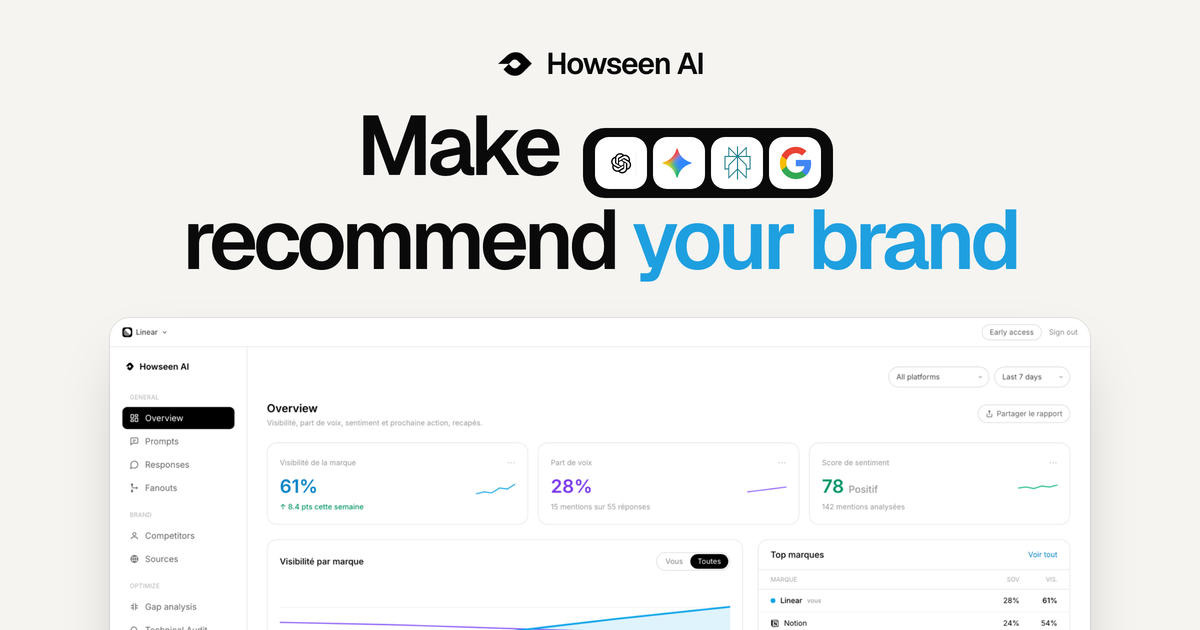
Howseen AI is an AI visibility tool for brands, marketers and agencies that tracks how a brand is recommended across ChatGPT, Gemini, Perplexity, Google AI Overviews and Google AI Mode. Its stated purpose is to help companies make AI their next growth channel: it measures how you are seen when buyers ask AI tools what to buy, and works to ensure the brand the AI names is you. The platform brings AI visibility tracking, competitor benchmarking, citation tracing, a GEO action plan and content generation together in one screen. The problem Howseen AI addresses is a shift in how buyers choose products. The site explains that buyers now ask ChatGPT, Gemini and Perplexity which tool or brand to buy, and the AI answers with a shortlist. According to the content, the brands cited in community threads, review sites and editorial make that shortlist, while the rest never come up. Howseen frames this as a new distribution channel: every day, buyers pick tools from AI answers, so being named in those answers matters. The founder states, "I believe the best product doesn't win, the most visible one does. The shelf just moved to AI, and Howseen makes sure yours gets seen." The core of the product is AI visibility and performance tracking. Howseen recaps visibility, share of voice, sentiment and a next action, tracked across ChatGPT, Perplexity, Gemini and Google AI. It shows brand visibility, share of voice and a sentiment score that compares how AI talks about you versus competitors on a -9 to +9 scale, derived from how AI describes each brand in tracked answers. A visibility-by-platform view breaks performance down per AI surface, and a brands table ranks you and competitors by visibility, share of voice, sentiment and position. This lets a team see, at a glance, whether they are named in AI answers and how that compares with the competition. Prompt tracking is the second pillar. The site argues that buyers ask full questions now, not keywords, so Howseen tracks every prompt that matters across every AI surface. You can add the prompts you want to win from day one, get high-intent suggestions from real search data, and see visibility and sentiment per prompt, per model, every 3 days. Prompts are organized by topic and tagged with intent such as buying intent, comparison or learning. A prompt table shows visibility, sentiment, position, mentions, citations, share of voice, location and when each prompt was added, making clear exactly where a brand appears and where it does not. Competitor benchmarking and citation tracing complete the measurement layer. Howseen lets you see who the models recommend when buyers compare options, right next to the recorded answer, benchmark visibility, sentiment and position against every competitor, watch AI share of voice move with each run, and spot the exact prompts where a competitor replaced you. The competitor view includes a brand comparison table, a brand-by-model heatmap, and a prompt-by-brand ranking matrix showing the top brands AI cites per tracked prompt. Because LLMs don't cite at random, Howseen traces every answer to the pages it cited, mapping each citation to its domain, page and source type so you can find the review sites, forums and wikis the models trust and prioritize outreach by how often each domain gets cited. A technical audit flags what blocks Google and AI models from reading and citing your site, covering page speed, LLM optimization, SEO optimization, indexability, sitemap.xml, robots.txt, LLMs.txt, server-rendered content, Bing indexing and trust signals. From measurement, Howseen moves to action with an action plan and content agents. Data-driven recommendations are built from citation patterns, competitor gaps and prompt performance, each tagged with priority, type (off-page, technical or content), AI engines and effort, alongside a GEO score broken into technical, off-page and content components. Content agents then turn every gap into a scheduled article written from your real buyer prompts in your voice, pushed straight to your CMS. The content plan pre-plans buyer prompts across the month, generating, queuing and publishing drafts; one-click publishing is supported to WordPress, Shopify and Next.js, and there is a recurring content calendar designed to close gaps automatically. Content is structured for specific engines, such as research pages structured so ChatGPT can cite them, product listicles created so Google AI shows them in product searches, and explainer pages written so Perplexity pulls them into detailed answers. The product's methodology is a closed loop rather than a score. Most tools stop at a score, whereas Howseen measures and then acts: it tracks where AI recommends you, benchmarks you against competitors, traces the sources that feed the answers, and publishes the fixes on a schedule. The site describes it as going from invisible to cited on autopilot, and as an agent that acts, not a dashboard that hands you a score. Everything that decides whether AI recommends you, from tracking to competitor share of voice to content and off-page citations, is brought together in one screen instead of being scattered across a dozen tools. The benefits Howseen claims center on clarity and momentum. Branded versus unbranded visibility, who gets cited ahead of you, and the exact sources behind every answer are surfaced without inflated numbers, which the company frames as "no black box". Every scan feeds a trend so you can watch your share of voice climb week after week, alongside analytics for AI-referred visits, average position and answers appeared in. The recurring content calendar keeps closing gaps, so improvement is continuous rather than a one-off audit. The site also highlights that a lead in sentiment is a real edge because AIs stay mostly neutral. Concrete scenarios in the content include an ecommerce activewear brand tracking prompts such as "best gym leggings for squats" or "most durable workout leggings", spotting gaps where AI recommends a rival instead, and then generating comparison guides, how-to posts and resource lists like "Gymshark vs Lululemon" or "affordable Lululemon alternatives" to win those prompts. Other example questions the tool is designed around include "Best CRM for B2B companies?", "What payroll tool do startups use?", "Cheapest email marketing software?" and "Which project management tool do agencies use?". Agencies use Howseen across all their client brands and share white-label reports, turning GEO into a recurring service they can sell. Howseen AI is a web platform aimed at brands and agencies that want to be recommended by AI. It tracks any AI engine including ChatGPT, Gemini, Perplexity, Google AI Overview and Google AI Mode, supports tracking and analysis in every market and location and content generation in every language your buyers speak, and includes prompt personas with ICP match prompts. Publishing integrations listed are Shopify, WordPress and Next.js. The site offers a free scan to test your AI visibility in 30 seconds with no card required, plus a demo booking link for deeper evaluation. In short, Howseen AI's primary value proposition is to turn AI from an opaque question mark into a measurable, actionable growth channel: it shows whether ChatGPT, Gemini, Perplexity and Google AI name your brand, explains why through citations and competitor benchmarks, and then generates and auto-publishes the GEO-optimized content needed to get you cited.
LLMagnet is the official WordPress plugin that makes a website visible and understandable to AI assistants such as ChatGPT, Claude, Perplexity and Gemini. It tracks visits from AI bots in real time, gives insights into how language models interpret your content, measures an AI Visibility Score, automatically generates llms.txt files and manages schema.org structured data so that models can accurately read, cite and act on your pages. The product is made by web creators and built for agents and marketers, helping brands build a measurable presence in the AI ecosystem instead of guessing how AI search treats them. Search behavior is shifting. People increasingly ask AI assistants directly for answers, recommendations and products, so the traffic that matters no longer arrives only from classic search engines. AI crawlers and assistants fetch, parse and summarize pages on their own terms, and llms.txt is described by LLMagnet as an emerging standard, like robots.txt for search engines, that helps AI models understand a site's structure and content. Without that guidance, and without any data about which bots visit and what they read, site owners are essentially blind to how AI represents them. LLMagnet closes that gap by giving websites an AI visibility layer: real-time analytics on AI bot activity plus the files and schema data that make content easier for models to read, rank, connect with and trust. It turns an opaque new channel into something that can be watched, measured and improved. The core of the plugin is LLM Analytics, which tracks real AI-bot traffic and reports detailed insights into visits, impressions and clicks coming from major models including ChatGPT, Gemini, Claude and more. LLMagnet detects visits from ChatGPT, Claude, Perplexity, Gemini, Grok, Bing AI, Mistral, DeepSeek, Llama and others. Sitting alongside the raw traffic numbers is the AI Visibility Score, a single metric that reflects how well large language models can access and understand your content across the web. Trends & Insights then tracks that visibility over time so you can spot rising opportunities and content drops instantly, turning scattered bot activity into a picture of whether your AI footprint is growing or decaying. To make a site AI-ready, LLMagnet automatically builds and maintains an llms.txt file so AI crawlers can better understand site structure and content focus, and it keeps that file up to date without manual work. Depending on the plan, it also generates a Full-llms.txt and .md files. The plugin manages schema.org structured data as well, which helps AI assistants accurately read and cite pages. Because llms.txt is positioned as robots.txt for AI, it acts as a signpost for crawlers; generating it automatically means site owners do not have to research the format, write the file or remember to refresh it whenever content changes. Prompt Tracking & Optimization shows where your brand actually appears in AI answers. LLMagnet tracks the prompts that mention your site and shows how your ranking evolves over time, including which prompts include your brand, how visibility shifts by LLM, and what to improve next. Alongside this, Automated Reports & Insights sends weekly and monthly reports that summarize your visibility and growth, with auto performance reports, visual traffic breakdowns and actionable visibility tips. Together these features move the product beyond measurement into guidance: you can see not only that AI assistants are reading your pages, but which questions bring you in and where you are missing. For stores, LLMagnet is positioned around the future of AI-driven commerce. It turns a shop into AI-ready content by connecting to your product data so that AI can display accurate information in generative search, with auto product and price sync keeping details current, an AI-search visibility boost and product mention tracking. WooCommerce integration and product tracking are part of the Plus plan, and the FAQ notes that Plus and Enterprise plans add product visibility scores and AI revenue funnel tracking for WooCommerce stores. The result is that product listings, prices and brand mentions stay aligned with what assistants tell shoppers. Installing LLMagnet starts from the WordPress plugin directory: you enter your WordPress site and are redirected to your site's plugin installer so the plugin can be added in one click, with no setup or code required. Once active, it begins capturing real-time AI bot activity. The dashboard reveals which AI bots visit your site, what they read and how to improve your visibility inside AI answers through visual dashboards. Compatibility is broad: the plugin works with Elementor, Gutenberg, Divi, WooCommerce and more, runs alongside Yoast SEO and RankMath without conflicts, and integrates into the Elementor editor with per-page AI visibility scores and schema management. On WordPress 6.9 and later it connects directly to Claude, ChatGPT and Cursor via the WordPress Abilities API so AI assistants can query your site's data natively, and an MCP Connector is included in the plans. The approach is deliberately lightweight and privacy-safe: file generation and analytics run in the background, so there is no impact on front-end performance or page load speed, and bot visit analytics are stored locally in your WordPress database and never sent externally. Optional integrations are off by default, and the tool is fully GDPR-compliant with built-in data export and erasure tools. The stated benefits revolve around control and clarity. AI Visibility Control means knowing exactly how large models see your content; Smart Automation keeps llms.txt and your data always updated automatically; Deep Insights analyze which pages drive the most AI engagement; Enhanced Collaboration streamlines workflows with team-friendly features; Data Security safeguards your data with top-tier encryption; and Continuous Improvement lets AI adapt and improve with evolving data. In practice, users describe straightforward setup, clear understanding of AI-related traffic to their site, and a practical llms.txt generator that saved them time. LLMagnet is explicitly not framed as a magic SEO plugin, but as a solid tool for gaining visibility into how AI search is evolving. LLMagnet is aimed at web creators, marketers, solopreneur store owners and WooCommerce store managers who want to prepare for AI-driven discovery rather than react later. The free plan is available with no credit card required, and core features such as analytics, llms.txt generation and schema tools work on any WordPress site. Paid tiers add depth: Pro at $29 per month per site covering analytics from ChatGPT, Claude and Perplexity plus Full-llms.txt, .md files and an MCP connector; Plus at $100 per month per site with analytics from all bots, WooCommerce integration, product tracking and product visibility; and Ultra at $149 per month per user with prompt tracking and chat support. Yearly billing lowers those prices, and a Product Hunt launch offer advertises 50% off. A Shopify app is also available alongside the WordPress plugin. LLMagnet gives WordPress and Shopify sites a measurable AI visibility layer. By tracking AI bot traffic, scoring how well models can access your content, generating the llms.txt and schema data crawlers look for, and tracking the prompts where your brand appears, it converts an opaque new channel into something you can watch, report on and improve. For teams that want evidence of how AI assistants read, cite and recommend them, that combination of analytics, AI-ready files and prompt tracking is the product's core value proposition.
Neopress is an AI website builder that lets you build, publish, and grow a website by chatting with an AI assistant. Instead of assembling pages by hand, you describe what you want in plain language and the assistant helps create pages, organise structured content, and refine the result. It is aimed at people who need a real content workflow behind their site — a built-in CMS, server-rendered SEO, GEO tools, forms, and analytics — rather than a static page that never changes. Neopress describes itself as connecting website creation, structured content publishing, SEO tools, and traffic insights into a single workspace so you can keep improving after launch. The problem Neopress addresses is that a website is not finished when it goes live. As the site explains, a website needs ongoing content updates, search settings, and performance review after launch, and those tasks usually live in separate tools. Neopress was built by a team that has shipped hundreds of content sites, and it is optimised for one thing: websites that get found — clean structure, a real CMS, and SEO that works by default. The product brings content management, search configuration, and analytics into one place, so the post-launch loop of updating, measuring, and improving becomes part of the same workflow as building the site in the first place. Neopress works through agents that operate alongside you. The first is a design agent: describe the page you want in plain language and watch it take shape, then refine layout, copy, and style through conversation. The stated advantage is that there are no templates to wrestle with and no design tools to learn. The second is a CMS agent: work with AI to draft and organise content in CMS collections, review the copy and SEO settings, then publish when you are ready. The Launch plan includes unlimited pages, unlimited CMS collections, and unlimited forms and lead capture, so the content structure of the site is not capped by the plan. Search visibility is handled by built-in SEO and GEO tools. Neopress delivers page content as server-rendered HTML, so search engines and AI crawlers read the structure and text of a page instead of an empty browser-rendered shell. Metadata and Open Graph settings can be reviewed and edited for search results and social previews. Neopress generates a sitemap.xml automatically so search engines can understand and crawl the site structure, and it publishes the emerging llms.txt standard for you — a clean, curated map of your key pages for AI assistants. Structured data (JSON-LD) can be added and reviewed to help search engines understand a page's content, and robots.txt gives control over crawler access so you can block pages you do not want indexed. Beyond the core tags, Neopress adds the plumbing that content sites usually need later: HTTPS with SSL by default, automatic canonical tags to avoid duplicate content, a custom 404 page, 308 redirects from old URLs to new pages when reorganising a site, an automatically generated RSS feed, image alt text for accessibility and image search, and clean, human-readable, keyword-friendly URL slugs. Fonts are self-hosted and preloaded to cut layout shift and speed up first paint, images are optimised for size, format, and delivery, and pages are responsive so you can review how they appear on mobile screens. Neopress states it is built for Core Web Vitals, with server rendering, caching, and a global CDN supporting fast page delivery. Multilingual publishing lets you configure site languages, review translations, and publish language versions with hreflang support. Neopress describes its overall approach as a flywheel with four stages: build, publish, measure, and improve. You build by chatting with AI, publish structured content through the CMS, measure with the analytics dashboard, and improve by asking AI to review site and performance data. One agent focuses on measurement: ask AI about the analytics available for your site, review its explanation and suggested changes, then choose what to improve. Another agent reviews available site and performance data, identifies issues, and suggests changes for you to decide which improvements to apply. The recurring theme is that AI proposes and explains, while you review and decide — publishing and publishing changes always remain your choice. The stated outcome is a website that gets found and keeps improving. Because every page ships as real HTML rendered on the server, crawlers can access content without relying on browser-side rendering. Because the CMS, SEO settings, and analytics sit in the same workspace, there is no gap between writing content and configuring how it is indexed. Analytics covers tracking search queries, checking post indexing status, seeing which LLMs crawl your pages, and tracking paid, campaign, and visitor data, with Google Search Console and Google Analytics integrations available on the Growth plan. On ownership, Neopress states that you retain full ownership of all content, copy, and structural assets generated by the AI — Neopress provides the hosting and the engine. Neopress is used to build and grow content-driven websites. Its template gallery shows the range: Blog & Editorial, Corporate, Documentation, and Landing Page templates, with published examples spanning skincare and dermatology clinics, a non-surgical spine and joint hospital, an oriental medicine clinic, a boutique Pilates studio, an artisan bakery and cafe, a design studio journal, and a bespoke jewellery atelier. For teams with an existing site, Neopress offers website migration — moving your existing pages, content, domain, and redirects over without a rebuild from scratch — and design services for a new page or a fresh look, discussed directly with the Neopress team. Day to day, the workflow is drafting and organising content in CMS collections, publishing pages, then reviewing analytics and applying SEO improvements. Pricing is subscription-based with plan-based AI usage and traffic allowances, and it starts with a 7-day free trial. Launch costs $25 per month per site with 10,000 pageviews per month included and $1 per additional 1,000 pageviews. It includes AI chat creation and editing, unlimited pages, unlimited CMS collections, unlimited forms and lead capture, built-in SEO and AEO optimisation, search-readable pages via SSR, llms.txt, robots.txt and sitemap control, JSON-LD structured data, RSS feed, URL redirect rules, custom domain connection, logo and favicon settings, a social share (OG) image, a custom 404 page, removal of the Made by Neopress badge, a real-time analytics dashboard covering the last three months, one editor seat with unlimited viewers, version history and Rewind restore, and MCP support. Growth costs $99 per month per site with 50,000 pageviews included, about three times the AI usage of Launch, ten editor seats with role-based permissions, real-time collaboration presence, full analytics with paid, campaign and visitor tracking, visibility into which LLMs crawl your pages, search query tracking, post indexing status, Google Search Console and Google Analytics integrations, two years of data history, multi-language support, a multilingual sitemap with hreflang, and priority support. When a trial ends or you stop paying, published content remains available on your Neopress subdomain on the Free plan while custom domains pause. Pageviews count human visits plus crawls made by AI to cite your pages in its answers; search engine indexing and AI training crawlers are not counted. Security and trust features include Supabase infrastructure with authentication-controlled database access, Supabase Auth, Vercel's DDoS protection, Polar as merchant of record for payments, and version history for restoring previous versions of pages and site layout. In short, Neopress positions itself as one AI-powered loop for building and growing a website: you create pages through conversation, publish structured content through a real CMS, ship server-rendered HTML that search engines and AI crawlers can read, and then use analytics plus AI review to decide what to improve next. The core value proposition is a website that gets found and keeps getting better, managed end to end in a single workspace rather than scattered across separate building, CMS, SEO, and analytics tools.
Visiby is an AI visibility platform that measures and grows how brands appear across AI search platforms, including ChatGPT, Claude, Perplexity, Gemini, Google AI Overviews and Copilot. It acts as a visibility layer for the AI-search era, mapping entity presence across the top AI engines so marketing teams can see where they are recommended, where they are missing, and which competitor is being cited instead. The product is built for marketing operators and agencies who need to own the answer layer rather than only rank in traditional search results. Vendor discovery has moved. According to the content, 1 in 3 B2B buyers now start vendor research inside an AI assistant, and ChatGPT, Perplexity, Google AI Overviews, Gemini and Copilot are quietly intercepting traffic that used to land on a company's site — if the model does not surface the brand, the conversation never starts. The site states that 62% of enterprise marketers are already optimising for AI engines, citing the State of AEO 2026 from FNA Research, while the well-funded brand in a category treats Answer Engine Optimisation as a budget line whose citations compound week over week. Meanwhile, Visiby argues that zero tools in a typical stack measure what AI is saying about a brand: Semrush ranks, Ahrefs ranks, GA counts clicks, but none of them sample prompts, parse model answers, or explain why ChatGPT recommended a competitor instead of you. Visiby exists to close that blind spot with a continuous, prompt-level view of AI answers. The workspace opens on an Overview that serves as the weekly headline: search performance, AI visibility and the next moves the team should ship, readable in 90 seconds. Headline scores include Visibility, Share of Voice, Prompts won and Briefs ready. Search Performance explains a brand's organic traffic and click-through rates, tracking clicks over 28 days with month-over-month change, impressions, click-through rate and average position across tracked non-brand terms. AI Visibility shows where a brand appears and where it does not, presenting per-engine citation share across every prompt in the universe, with each cell clickable to reveal the underlying answer. In the illustrated workspace, ChatGPT sits at 42%, Perplexity at 51%, Claude at 34%, Gemini at 24% and AI Overviews at 18%. The Prompts Explorer is a workbench for the full prompt universe — more than 50,000 AI prompts are tracked weekly, and the sample workspace shows 50,127. It supports stacked filters, a cluster view and a three-way live answer diff, and each row drills into which competitor was cited, why, and the play to win the prompt back. The Citations Explorer works beneath the prompt universe across every URL the engines cite — 2,418 URLs in the example — ranking every cited URL and identifying honey-pot pages, dead-weight pages and counter-content briefs, with passage-level provenance. The Brand Entity module shows the adjectives a brand owns and the ones owned against it across engines, with per-engine portraits and reframe plays to move them; the sample adjective sets include trustworthy, established, enterprise, scalable, innovative, modern, consultative, agile, long-tenured and data-driven. Competitor Intelligence reads the field at a glance, presenting citation share by brand and topic with clickable cells that drill to the prompts and passages behind them, plus a per-competitor recipe diff comparing cited elements across engines, such as H2 headings, FAQ blocks, tables and lists. Recipe Intelligence delivers a per-engine pulse on which on-page element the AI is actually extracting from, producing the structural blueprint a team should publish to; Visiby reports that seven elements are tracked, including H2 headings, FAQ blocks with FAQPage schema, tables, bulleted lists and case studies. Site Audit is a citability-first audit that ranks every issue by AI impact with the fix and affected URLs attached, surfacing examples such as pages blocked from indexing, pages missing OpenGraph tags and meta descriptions, thin pages under 250 words, missing Organization schema, missing FAQ schema and image alt text gaps. The Action Plan converts all of this into a prioritised, priced playbook ranked by effort against impact, where every move carries an argument, a score breakdown covering why-now signal, forecast confidence, effort and dependency, evidence links, and a ready-to-ship deliverable brief. Visiby runs as a weekly ritual. Every Tuesday at 07:42 IST, the platform fuses three live data streams — the prompts buyers actually ask, where the brand is losing citations, and the recipes competitors win with — into one prioritised action plan, with no analyst required. The pipeline runs overnight and lands in the inbox as a citation sweep, share-of-voice deltas, a prioritised action plan, content briefs and an executive summary. A weekly digest email example reports the number of prompts run across engines, the movement in citation share, the action moves ranked by projected lift in points, and a forecast of the week when citation share returns to a target level. The platform continuously samples engines, and the site positions the cadence at seven days from signal to a shipped fix. Benefits described include replacing guesswork with evidence about what AI engines recommend, seeing exactly which competitor is being cited first on high-value prompts, and knowing which structural elements and content formats win citations on each engine. Instead of a dashboard nobody opens or a spreadsheet exercise, teams receive an inbox-ready brief with ranked moves and attached briefs, so prioritisation and writing can start immediately. Ranking moves by effort against impact lets a small team focus on the highest-lift work, and the prescribed fixes — schema, content refresh, comparison pages, original research — are tied to specific projected visibility gains. Concrete scenarios in the content include a marketing team reading the weekly overview and shipping the queued moves; a brand losing citation share to a named competitor and building a comparison page in response; refreshing a contact page for AI parseability because it lacks crucial entity definitions and brand identifiers; adding FAQ schema to a services pillar of 14 core URLs missing structured Q&A data; producing original research on AEO benchmarks to capture data and stats queries; and running community and earned-media plays such as a Reddit thread cluster or listicle outreach to G2 and Capterra. Agencies can use the same workspace to run client AEO programmes, and the Agency tier supports white-label client reports and multi-workspace reporting. Visiby is aimed at marketing operators, enterprise marketers, SEO and AEO specialists, and agencies. It complements rather than replaces existing SEO platforms, and the site compares its capabilities against Semrush, Profound, Conductor and Ahrefs across AI visibility tracking on five engines, SEO and rank tracking, brand entity audits, passage-level citation provenance, recipe intelligence, priced action plans, ready-to-ship content briefs, an autonomous weekly pipeline and multi-workspace reporting. Pricing has four tiers: Lite at $49/mo with 25 prompts a month and one seat; Starter at $99/mo with 50 prompts a month, 10 action items and Site Audit plus Action Plan; Pro at $249/mo with 150 prompts, 30 action items, three seats and three brands, daily refresh, Brand Entity, Competitor Intelligence, Sentiment Analysis and priority support; and Agency at $499/mo with 500 pooled prompts, 50 action items, 10 seats and 10 workspaces, white-label client reports, API access and SSO/SAML, custom engines and regions, and a dedicated success manager with an SLA. A free visibility report is offered in 60 seconds with no card required. That combination makes Visiby a visibility layer for the AI-search era: it measures how brands and competitors appear inside AI-generated answers, explains the structural recipes that earn citations, and turns those signals into a prioritised, priced plan a team can ship on Monday.