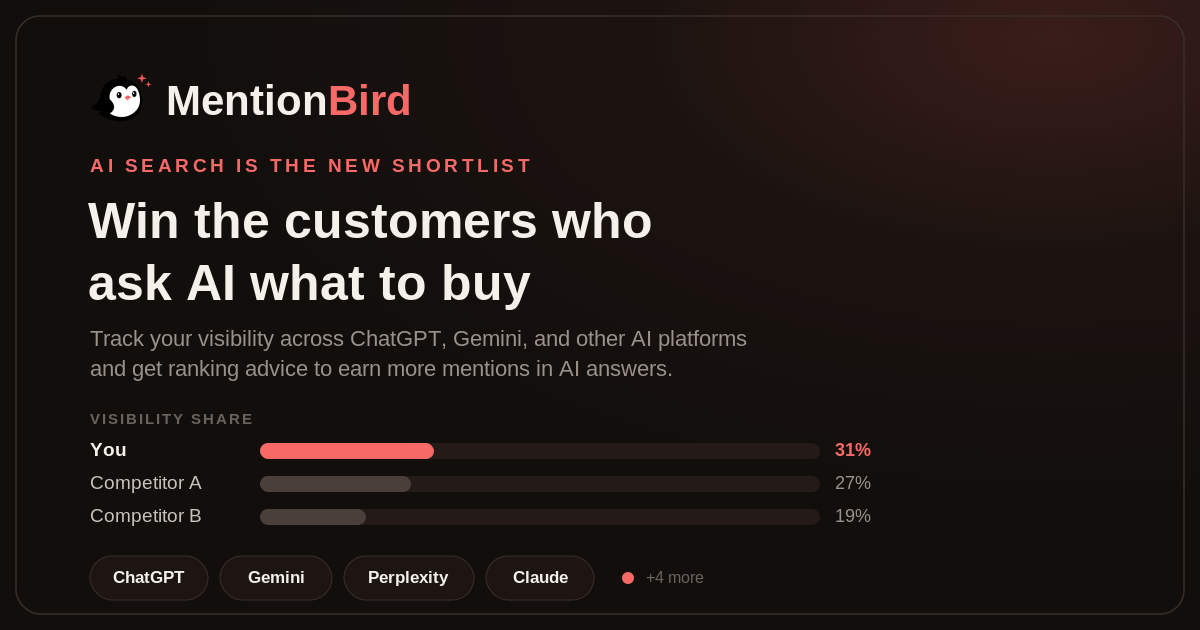
MentionBird is an AI visibility tool that shows brands why AI assistants recommend their competitors instead of them — and what to do about it. When buyers ask ChatGPT, Perplexity, or Gemini what to buy, the answer is assembled from a small set of sources that the model trusts for that specific question. MentionBird finds those sources for the prompts that drive a company's sales and gives a concrete plan to get the brand into them. It is built for any business whose customers research products or services online, and it positions itself as the "Ahrefs for AI Search."
Buyers no longer start with ten blue links. They ask an AI assistant, get two or three brand names, and shop from that shortlist. The shortlist now forms inside the answer itself, and if AI does not say your name, you were never in the running — and you would never know. AI answers are built from a small set of pages, reviews, and videos that the model trusts for that specific question. Get into those sources and you get recommended; stay out, and your competitor takes the customer. Because most categories have no clear winner in AI answers yet, starting early can help a brand become the default answer.
The first step is picking the prompts that bring customers. Users add the real questions buyers ask — examples on the site include "Best running shoes for daily use," "Best marathon shoes for men," "Best running shoes for flat feet," and "Most comfortable shoes for long runs." MentionBird then tracks exactly which sources AI cites for each one. For a given prompt, it lists the sites the models check and marks each as cited or not cited — showing, for example, that runnersworld.com and runrepeat.com are cited while a brand's own listings are not. That visibility into the underlying citations is the difference between knowing you are losing and knowing where to go to fix it.
For any tracked prompt, MentionBird generates AI Ranking Advice. It reviews the answers, the named brands, and the cited sources, then recommends practical steps and shows the effort required for each one. Advice can include getting featured in trusted roundups and comparison guides, publishing guides that answer the questions buyers ask before choosing, adding clearer product facts such as fit and durability details to product pages, or earning videos and mentions from trusted websites. Each recommendation is labelled with impact and effort — for example, "Medium effort · High impact" — so teams know what to fix first.
The platform checks and updates AI visibility data once every 24 hours. It tracks ChatGPT, Perplexity, Gemini, and Claude, as well as Google AI Overviews, Grok, Microsoft Copilot, and DeepSeek. Tracking is prompt by prompt: cited, not cited, or no brand named yet. Users see share of AI recommendations versus each competitor week over week, and every score change is traced to the exact prompt, model, or citation that caused it. A weekly brand visibility share view can show, for instance, one brand up four points while another drops three.
MentionBird describes itself as built around the question that matters: what do I do to get mentioned for this prompt? It contrasts itself with other AI visibility trackers that show a mentions chart, tell you when you dropped, and leave the "now what?" to you. MentionBird instead shows the sources behind every answer, gives a per-prompt plan to win them, and proves the plan worked with daily tracking. It also distinguishes itself from SEO rank tracking: SEO tools show a webpage's position in Google search results, while MentionBird checks whether AI answers mention your brand, which sources AI cites, and how your visibility compares with competitors.
The outcome MentionBird promises is movement from "never mentioned" to the brand AI often mentions. Users can watch themselves become the answer, because every plan they execute shows up in the numbers. Teams quoted on the site describe concrete gains: Risely discovered it won the category questions but lost the comparison ones, which it called exactly backwards for a buying decision; Facets learned the exact questions where engineering buyers saw it as invisible; Recooty found AI was recommending an ATS to every buyer who asked, just never theirs; Superfans reported being in 83% of "alternatives to the category leader" answers after MentionBird found the gap; and Helixo, despite 3300+ reviews, could pinpoint the questions where AI still was not recommending it.
Typical use cases start with evidence gathering: a brand runs the free AI Visibility Report to see whether AI recommends its competitors, then adds its brand, prompts, and competitors to track the questions that matter. Marketing and SEO teams use prompt-level data to decide which pages, guides, or product details to fix first. Agencies manage several clients in one workspace, using tags to organize prompts by brand, product, or project. E-commerce and software companies watch comparison and category prompts separately, since the two can behave very differently. Multi-brand teams keep several brands or product lines in a single workspace, and anyone entering a new category can move early to become the default AI answer before a clear winner emerges.
MentionBird works for any business whose customers research online, including e-commerce stores, software companies, healthcare providers, law firms, financial services, real estate, travel, and education, plus home services, automotive companies, and local businesses. Agencies, marketing teams, and SEO teams are explicitly supported, and the site suggests starting with 20 to 50 real buying questions rather than hundreds of broad prompts. No installation is required — there is no code, plugin, or tracking tag to add to a website, and setup takes only a few minutes. Pricing includes a free AI Visibility Report tool and a Starter plan at $19/mo for three months with the Product Hunt code PH19. Plans can be changed anytime, with upgrades applying immediately and downgrades beginning with the next billing period, while saved prompts, labels, and past data remain available.
MentionBird's core value proposition is simple: it turns AI visibility from a chart you cannot act on into a per-prompt plan you can execute and verify. By revealing the sources behind every AI answer, explaining why competitors get recommended, and tracking progress daily across the major AI platforms, it helps brands get into the shortlist that now forms inside the answer — before their competitors do.
Publisher
A
admin
Launch Date2026-10-14
Platformweb
Pricingfreemium