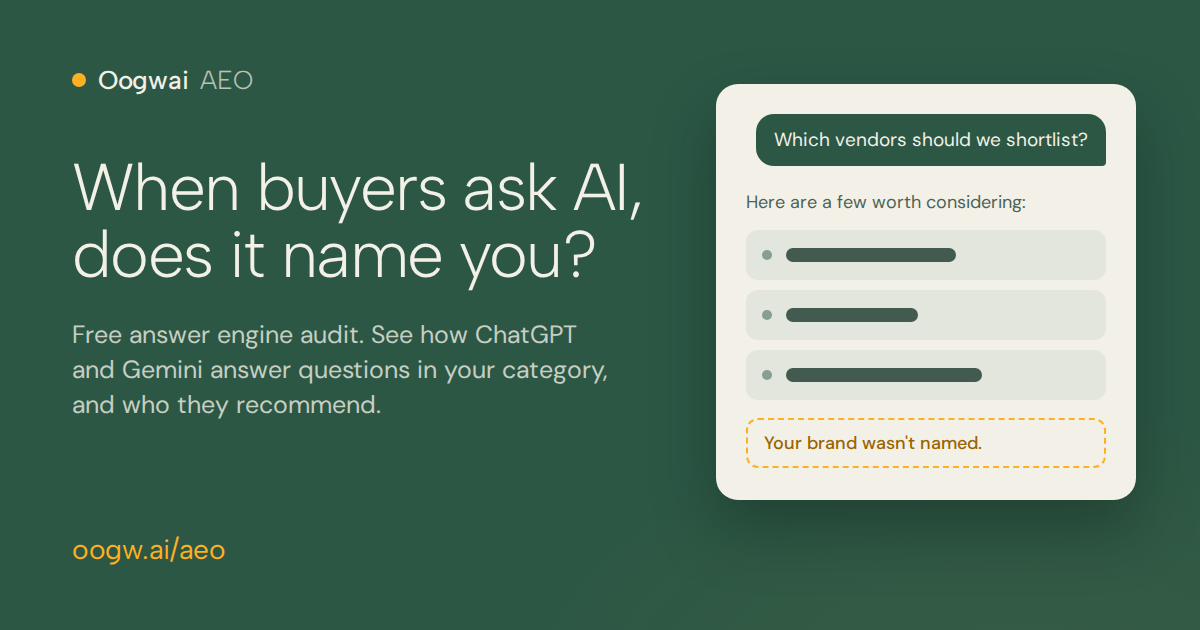
Oogwai Beacon is an answer engine optimization audit from Oogwai. It puts 20 real buyer questions about your category to the AI assistants your buyers use — none of the questions name your brand — and records how often each engine names your brand, who it names instead, and which sources it relied on to decide. The audit reports two halves separately: whether AI crawlers can read your site at all, and whether the engines actually cite you when they answer. It is built for the marketing, SEO and content teams of companies that sell into a category where buyers now ask an assistant for a shortlist rather than scanning a page of search results. The instant readability check runs on the page in seconds with no sign-up, and the citation report follows by email.
The problem Beacon was built around is a change in buying behaviour. A buyer evaluating your category used to type a query, scan a page of results and form their own shortlist. Now they ask an assistant, and the assistant hands back a shortlist already formed — three names, a sentence each, and a follow-up question. Whoever is not in those three is not in the evaluation. Answer engines do not rank pages the way a search engine does. They assemble a reply from three things: what the model absorbed during training, what it retrieves live from the web at the moment of asking, and which of those sources it trusts enough to lean on. Your own website influences the first two weakly and the third barely at all — because when a buyer asks who the best vendor is, an engine will not settle the question by quoting the vendor. That is the gap answer engine optimisation works in: not keywords and rankings, but presence, corroboration and machine legibility, measured by whether you get named.
Half one is readability, and it is pure HTTP with no engine calls — which is why the result lands on the page within seconds. It answers whether GPTBot, ClaudeBot, PerplexityBot and Google-Extended can reach your pages and find anything on them. The check covers robots.txt rules for each named AI crawler; whether the site serves server-rendered HTML rather than an empty shell filled in by JavaScript; Organisation, Product and FAQ structured data; llms.txt and a machine-readable summary of what you sell; heading structure, canonical URLs and clean sitemaps; and consistent entity facts — one name, one description. Because it is a technical pass, the fixes are usually a short engineering job, and Oogwai hands over the exact changes whether or not you go on to work with them.
Half two is citation, and it is the part that requires actually asking the engines. Beacon puts buyer questions about your category to the engines in your tier. None of the questions mention your brand — because a question that names you proves nothing about whether you would be recommended. The report shows how often each engine names your brand unprompted, which competitors it names instead and how consistently, the sources each engine cited to get there, what the engines believe you do (correct or not), the question types where you are strong and where you vanish, and a ranked list of the sources worth being on next. That list is evidence from your own market rather than a generic media plan.
Which engines run depends on tier. The free check queries ChatGPT and Gemini. The paid audit adds Claude, and Perplexity is covered on the managed programme, where regional variations and buyer personas are also tested; Copilot is covered on the managed programme as well. Claude grades markedly harder than the other two, so a two-engine result reads higher than a three-engine one — which is exactly why the AEO score is reported only on the paid audit, where it is measured against the full set. The free citation report — who ChatGPT and Gemini name instead — requires a free business-email account.
Beacon's stated position is that AEO has two halves and only one of them is a technical problem. Most tools sell a single number, and a single number hides the distinction that matters, so Beacon reports the two halves separately. A perfect readability score with zero citations is common, and the audit treats it as the most useful result it produces: it tells you the problem is not on your website. Fixing robots.txt takes an afternoon; getting named takes presence on the pages an engine reaches for when it is asked to compare vendors — roundups, review platforms, comparison pages, community threads, editorial coverage, transcripts — almost never the vendor's own homepage. The Oogwai media and content team runs that work: source mapping from your own report's citations, editorial placement, review platforms such as G2, Capterra, Product Hunt, Clutch and TrustRadius, comparison coverage, community answers on Reddit, Quora, Stack Overflow and industry Slack and Discord recaps, video and audio transcripts, quotable owned content, entity consistency and monthly measurement. The engagement runs as four stages: Audit, Map, Place, Measure.
The outcome for a user is a clear answer to two different questions. First, can AI crawlers read the site — delivered in seconds, free, with no sign-up and no credit card. Second, do the engines actually recommend the brand when a buyer asks — delivered as an emailed report that names the competitors being cited instead. Because the report records the exact domains each engine cited for your category, the follow-on work is targeted at sources that demonstrably feed AI answers in your market rather than at a generic media plan. Every gap the audit finds comes with the fix, and the technical changes are handed over whether or not you continue with the programme. Monthly re-runs of the identical question set let you see share of answers over time, which competitors gained or lost ground, and which placements moved the number, so the programme is judged on citations rather than impressions.
Concrete scenarios the audit is built around: a B2B marketing team suspects competitors are being recommended by ChatGPT and wants the evidence, question by question. An SEO lead runs the free readability check in seconds to learn whether GPTBot, ClaudeBot, PerplexityBot and Google-Extended can reach the site at all, before any content work begins. A content or PR team takes the cited-domain list from a report and turns it into a ranked target list for editorial placement, review platforms and comparison pages. A company with a strong readability score but zero citations learns that the problem is off-site and points its investment at third-party presence instead of the website. And a team tracking a category month to month can see whether a placement moved a number weeks later, separately from what the model has absorbed on the far slower training cycle.
Beacon is aimed at the marketing, SEO and content functions of companies that are bought through evaluation, and it is equally usable by teams that suspect they are already being named and need less work than they thought — the baseline is delivered before anything is promised. The free tier covers the readability check and the ChatGPT and Gemini question set. The paid audit adds Claude and carries the AEO score. The managed programme adds Perplexity and Copilot, regional variations and buyer personas, plus the media and content work. The readability score appears on the page in seconds; the full citation report is usually in an inbox within a few minutes and always within one business day. Free use requires no credit card.
Beacon's proposition is narrow and specific: stop guessing what AI assistants say about your category and measure it. It separates machine legibility from citation, tests brand naming against unbranded buyer questions put to the engines themselves, and turns the citations it finds into a workplan — with the fix attached to every gap.
Publisher
A
admin
Launch Date2026-10-06
Platformweb
Pricingfreemium