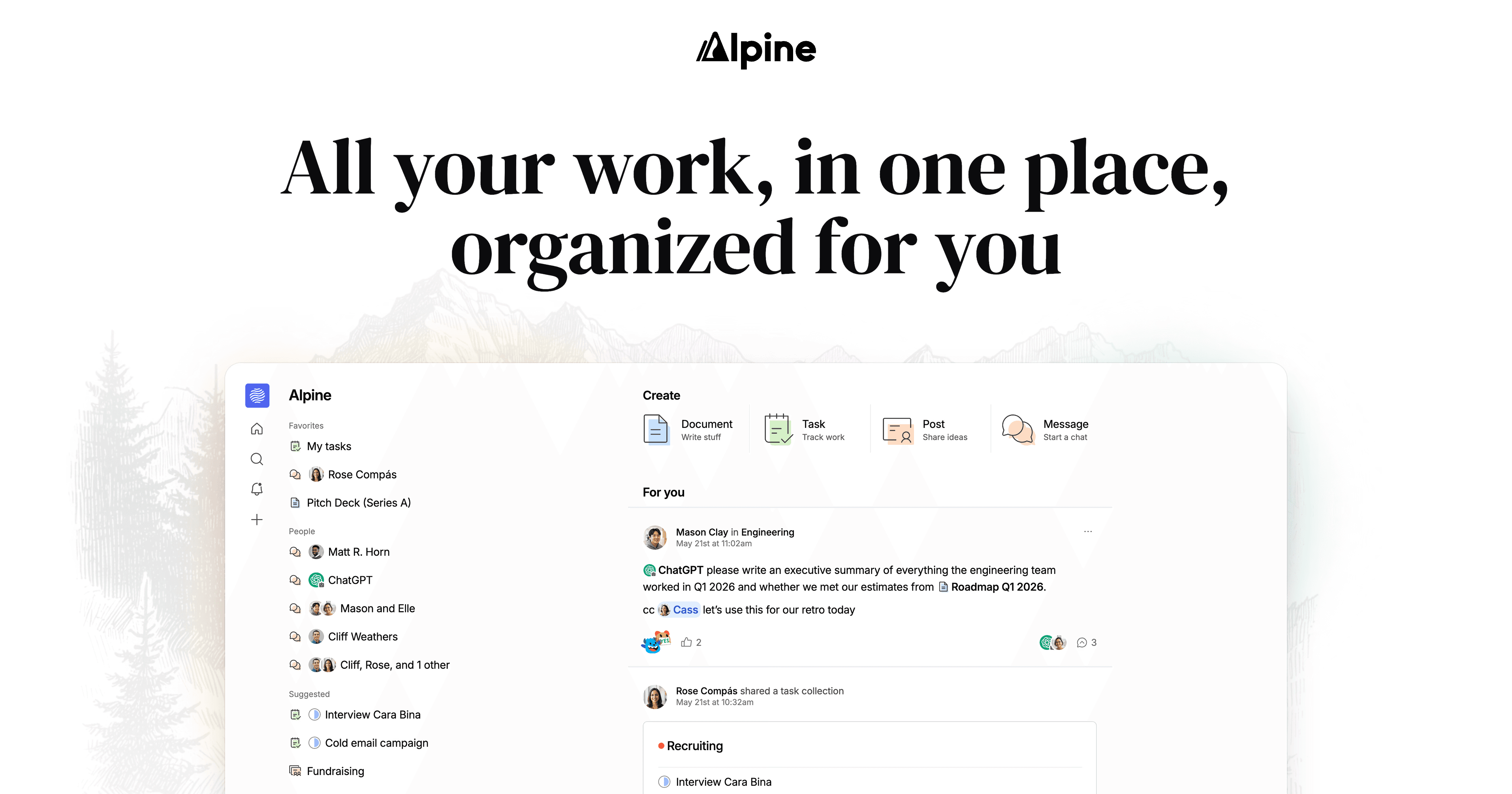
Alpine is a unified workspace tool that combines documents, tasks, chat, and AI into a single, self-organizing platform. Designed for teams and individuals tired of constant context switching, it eliminates the need to juggle multiple apps by bringing essential work functions under one roof. The core value proposition is simple: instead of spending time managing tools, users can focus on their actual work. Alpine achieves this by offering a cohesive suite where each component—Docs, Tasks, Forum, Chat, Feed, Inbox, Search, and AI—is fully integrated. The platform organizes itself, surfacing relevant content and notifications without manual sorting. For anyone seeking an all-in-one solution to replace the fragmented landscape of productivity apps, Alpine provides a streamlined alternative that prioritizes efficiency and ease of use.
The primary pain point Alpine addresses is the erosion of work quality caused by scattered tools. Conversations are spread across Slack, email, and project management apps, losing their backstory. Tasks become detached from the documents and discussions that gave them context, forcing users to waste time hunting for information. Alpine’s existence is a direct response to this fragmentation—it reverses the erosion by preserving context. Users no longer have to remember where a task came from or which channel held a key decision. Instead, everything lives in one searchable, interconnected workspace. This matters because every minute spent searching or switching is a minute stolen from deep, meaningful work. By eliminating that overhead, Alpine helps professionals reclaim focus and produce higher-quality outcomes without the constant mental load of tool management.
Alpine’s Documents module is designed for simplicity and beauty. Users can write and format documents effortlessly, with added capabilities like image galleries that turn photos into stunning layouts, presentations that automatically handle text boxes so creators focus on content, and generated covers that give each document a distinct visual identity without distracting from the work. The Tasks module is equally robust: tasks are captured quickly by pressing Enter to add a new item or Tab to turn it into a subtask. Users can paste a list to batch create tasks, and tasks are private by default, ideal for early ideas or sensitive items. Sharing is possible when ready. Built for scale, the task system handles over one million entries without performance degradation, thanks to engineers obsessed with speed. Filters and sorts allow personalized views, and a dedicated “My tasks” opinionated view is available. Collaboration is streamlined by ranking people based on frequency of interaction.
admin
The Forum and Chat components facilitate seamless asynchronous collaboration. In the Forum, posts are surfaced through the personalized feed, meaning users do not need to join every channel to stay informed—relevant content finds them. Every post is treated as a complete thread, eliminating the common frustration of fragmented conversations that require “moving to a thread.” New replies are silently added to the inbox, piling up until the user is ready to engage, reducing pings and interruptions. Chat is integrated directly alongside documents and AI agents, reducing context switching even further. A standout feature is inline reply: instead of quoting an entire paragraph to respond to one sentence, users can select the specific text within a message and reply directly. This eliminates reply clutter and makes conversations cleaner. The combination of forum and chat provides both synchronous and asynchronous communication options within one unified workspace.
Beyond core collaboration, Alpine includes intelligent tools that further reduce overhead. The Feed delivers a personalized “for you” experience, highlighting updates from the people and projects each user cares about, removing the need to monitor every channel. The Inbox prioritizes signal over noise, surfacing important work at the top and only pinging users when they are genuinely needed, drastically cutting down on interruptions. Search across all content—documents, tasks, chats, forum posts—goes beyond simple keyword matching; it uses relevance, recency, and large language models to rank results, ensuring the most pertinent information appears first. Finally, AI is woven throughout the platform: AI coworkers are available wherever needed, equipped with full context across all work. This means users can ask questions, generate content, or surface insights without manually collecting context from disparate sources.
Alpine’s overall approach is modular and flexibility-first. It is designed as a suite of interconnected products, each of which is useful independently. Users can adopt as much or as little as they need, and no migration is required—the platform works alongside existing tools. For example, a team might continue using Google for email and calendar, while adopting Alpine for everything else. Another team might keep Slack for chat but move documents and tasks to Alpine. Even within an organization, some teams can use Alpine while others stick with their preferred tools, with Alpine serving as the bridge. The engineering team, composed of former members from Meta, Amazon, Asana, Duo Security, and Automattic, prioritizes performance obsessively. Rarely will users see a loading spinner; the p99 duration for backend requests is under 500 milliseconds. This commitment to speed ensures that the workspace remains fluid and responsive.
Concrete scenarios highlight Alpine’s impact. A project manager who previously juggled Slack for daily updates, Notion for docs, and Asana for tasks can now unify everything in Alpine. The personalized feed surfaces task updates from key team members without requiring channel subscriptions, saving hours of scanning. Search with AI ranking instantly finds last week’s design brief referenced in a chat thread, eliminating the frustration of lost information. Another scenario: a remote team uses Alpine’s forum for asynchronous standups—each post is a thread, replies queue in the inbox, and members catch up in their own time without endless notifications. The outcome is higher productivity, less context switching, and more time for deep work. Alpine even offers a lifetime access plan for $250, ensuring users lock in their price permanently as the platform evolves beyond its current free offering.
Target users include engineers, product managers, designers, and remote teams who feel the pain of tool fragmentation. The platform works on the web and is optimized for speed across all operations. Pricing is currently free as Alpine gathers feedback, with a lifetime access option for $250 that includes increased agent token limits and file storage. The company’s security team includes a founder with a patent in enterprise security (US 12153703), and SOC 2 compliance is coming soon. The technology stack is built by engineers who care deeply about every dropped frame and backend p99. In summary, Alpine is a unified workspace tool that reverses the erosion of work by bringing documents, tasks, chat, and AI into one context-rich, high-performance environment. It allows users to focus on what matters most: doing their best work without the distraction of managing tools.
Alpine is built for professionals and teams overwhelmed by tool fragmentation, including engineers, product managers, designers, and remote workers. It suits startups seeking an affordable all-in-one solution, as well as enterprise users who need a flexible suite that can integrate with existing tools like Google Workspace or Slack. Knowledge workers who manage documents, tasks, and conversations daily will benefit most from Alpine’s unified context. The platform is also ideal for teams that value performance, as it handles large volumes of tasks without slowdowns. Early adopters interested in lifetime pricing and contributing feedback during the beta phase are a key segment.