Category Focus/categories/seo
SEO AI Tools
Discover and compare the best seo AI tools and software. Browse 40+ curated tools with reviews and rankings.
Projects tracked
40
Sort mode
RECENT
Page
1
Discover and compare the best seo AI tools and software. Browse 40+ curated tools with reviews and rankings.
Projects tracked
40
Sort mode
RECENT
Page
1
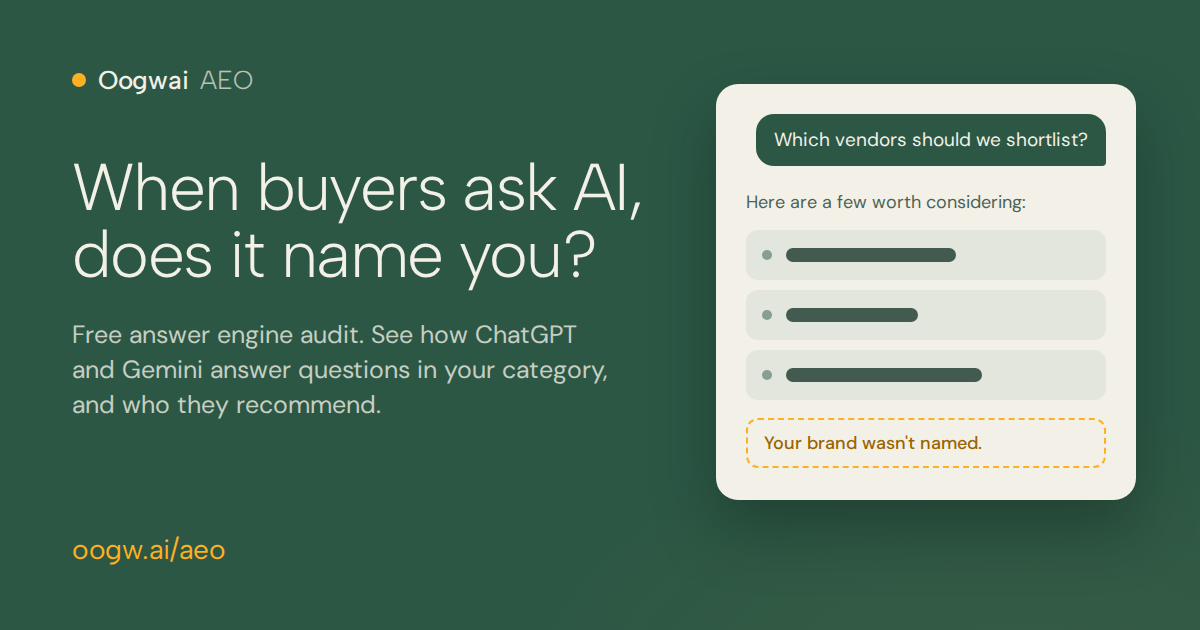
Oogwai Beacon is an answer engine optimization audit from Oogwai. It puts 20 real buyer questions about your category to the AI assistants your buyers use — none of the questions name your brand — and records how often each engine names your brand, who it names instead, and which sources it relied on to decide. The audit reports two halves separately: whether AI crawlers can read your site at all, and whether the engines actually cite you when they answer. It is built for the marketing, SEO and content teams of companies that sell into a category where buyers now ask an assistant for a shortlist rather than scanning a page of search results. The instant readability check runs on the page in seconds with no sign-up, and the citation report follows by email. The problem Beacon was built around is a change in buying behaviour. A buyer evaluating your category used to type a query, scan a page of results and form their own shortlist. Now they ask an assistant, and the assistant hands back a shortlist already formed — three names, a sentence each, and a follow-up question. Whoever is not in those three is not in the evaluation. Answer engines do not rank pages the way a search engine does. They assemble a reply from three things: what the model absorbed during training, what it retrieves live from the web at the moment of asking, and which of those sources it trusts enough to lean on. Your own website influences the first two weakly and the third barely at all — because when a buyer asks who the best vendor is, an engine will not settle the question by quoting the vendor. That is the gap answer engine optimisation works in: not keywords and rankings, but presence, corroboration and machine legibility, measured by whether you get named. Half one is readability, and it is pure HTTP with no engine calls — which is why the result lands on the page within seconds. It answers whether GPTBot, ClaudeBot, PerplexityBot and Google-Extended can reach your pages and find anything on them. The check covers robots.txt rules for each named AI crawler; whether the site serves server-rendered HTML rather than an empty shell filled in by JavaScript; Organisation, Product and FAQ structured data; llms.txt and a machine-readable summary of what you sell; heading structure, canonical URLs and clean sitemaps; and consistent entity facts — one name, one description. Because it is a technical pass, the fixes are usually a short engineering job, and Oogwai hands over the exact changes whether or not you go on to work with them. Half two is citation, and it is the part that requires actually asking the engines. Beacon puts buyer questions about your category to the engines in your tier. None of the questions mention your brand — because a question that names you proves nothing about whether you would be recommended. The report shows how often each engine names your brand unprompted, which competitors it names instead and how consistently, the sources each engine cited to get there, what the engines believe you do (correct or not), the question types where you are strong and where you vanish, and a ranked list of the sources worth being on next. That list is evidence from your own market rather than a generic media plan. Which engines run depends on tier. The free check queries ChatGPT and Gemini. The paid audit adds Claude, and Perplexity is covered on the managed programme, where regional variations and buyer personas are also tested; Copilot is covered on the managed programme as well. Claude grades markedly harder than the other two, so a two-engine result reads higher than a three-engine one — which is exactly why the AEO score is reported only on the paid audit, where it is measured against the full set. The free citation report — who ChatGPT and Gemini name instead — requires a free business-email account. Beacon's stated position is that AEO has two halves and only one of them is a technical problem. Most tools sell a single number, and a single number hides the distinction that matters, so Beacon reports the two halves separately. A perfect readability score with zero citations is common, and the audit treats it as the most useful result it produces: it tells you the problem is not on your website. Fixing robots.txt takes an afternoon; getting named takes presence on the pages an engine reaches for when it is asked to compare vendors — roundups, review platforms, comparison pages, community threads, editorial coverage, transcripts — almost never the vendor's own homepage. The Oogwai media and content team runs that work: source mapping from your own report's citations, editorial placement, review platforms such as G2, Capterra, Product Hunt, Clutch and TrustRadius, comparison coverage, community answers on Reddit, Quora, Stack Overflow and industry Slack and Discord recaps, video and audio transcripts, quotable owned content, entity consistency and monthly measurement. The engagement runs as four stages: Audit, Map, Place, Measure. The outcome for a user is a clear answer to two different questions. First, can AI crawlers read the site — delivered in seconds, free, with no sign-up and no credit card. Second, do the engines actually recommend the brand when a buyer asks — delivered as an emailed report that names the competitors being cited instead. Because the report records the exact domains each engine cited for your category, the follow-on work is targeted at sources that demonstrably feed AI answers in your market rather than at a generic media plan. Every gap the audit finds comes with the fix, and the technical changes are handed over whether or not you continue with the programme. Monthly re-runs of the identical question set let you see share of answers over time, which competitors gained or lost ground, and which placements moved the number, so the programme is judged on citations rather than impressions. Concrete scenarios the audit is built around: a B2B marketing team suspects competitors are being recommended by ChatGPT and wants the evidence, question by question. An SEO lead runs the free readability check in seconds to learn whether GPTBot, ClaudeBot, PerplexityBot and Google-Extended can reach the site at all, before any content work begins. A content or PR team takes the cited-domain list from a report and turns it into a ranked target list for editorial placement, review platforms and comparison pages. A company with a strong readability score but zero citations learns that the problem is off-site and points its investment at third-party presence instead of the website. And a team tracking a category month to month can see whether a placement moved a number weeks later, separately from what the model has absorbed on the far slower training cycle. Beacon is aimed at the marketing, SEO and content functions of companies that are bought through evaluation, and it is equally usable by teams that suspect they are already being named and need less work than they thought — the baseline is delivered before anything is promised. The free tier covers the readability check and the ChatGPT and Gemini question set. The paid audit adds Claude and carries the AEO score. The managed programme adds Perplexity and Copilot, regional variations and buyer personas, plus the media and content work. The readability score appears on the page in seconds; the full citation report is usually in an inbox within a few minutes and always within one business day. Free use requires no credit card. Beacon's proposition is narrow and specific: stop guessing what AI assistants say about your category and measure it. It separates machine legibility from citation, tests brand naming against unbranded buyer questions put to the engines themselves, and turns the citations it finds into a workplan — with the fix attached to every gap.
lurk is a free, open-source monitoring tool that watches Reddit and X to help you find customers, get cited by AI services such as ChatGPT, Claude, Perplexity and Gemini, and rank on Google. It keeps an eye on Reddit and X for people asking for a product like yours, scores every post with a one-line reason, and sends new ones to email, Slack, Discord or a webhook. Alongside lead monitoring, it finds the Reddit threads Google already ranks for your keywords, and shows which competitors get recommended in the conversations your leads sit in. It is built for founders, marketers, sales teams and anyone doing go-to-market work who wants to know where a buying conversation is happening, who started it, why it matched, and what the community allows before deciding whether to join in. It exists because watching social platforms by hand does not scale, and simple keyword alerts are not accurate enough to act on. A keyword alert fires on every match, so you get volume without judgement. lurk takes a different approach: unlike a keyword alert, it reads the whole post and the community rules before it calls something a lead. That means a post is not just a match on a string, it is assessed in context, with the stage the person is at, a written reason, and the exact phrase that triggered the match. The result is a shorter, more trustworthy list of conversations worth joining. The tool also targets a second, longer-lived opportunity: Reddit threads that already rank on Google and are increasingly cited by AI assistants, where one useful reply can keep working for a long time. Lead detection is the core of lurk. Every Reddit post, Reddit comment and X post it scans is scored, and each score comes with a written reason and the phrase that matched, so you can see the evidence rather than trust a black box. Leads are labelled by the stage the person is at, such as comparing or solution seeking, and carry signals like fit, intent and engagement. Because lurk reads the whole thread, it also surfaces cases where one thread contains more than one person asking, saving the conversation so you can follow it as a whole. Each lead shows who asked, what they said, why it matched, and the policy of the community it appeared in, such as a rule requiring you to contribute value instead of blatantly promoting yourself. Reddit SEO is the second column of the product. lurk searches your keywords on Google, filters the results down to Reddit discussions that already rank, and lists the threads along with their position, the community they sit in, when they were posted and how many comments they have. It also notes when a competitor is named in a thread, because a thread that already compares tools is a natural place for a careful answer. Positions and metrics are saved at the time they were observed, so you can see which threads are still alive rather than relying on a single snapshot, and the hosted plan refreshes this SEO data every seven days. The stated value is durability: these are threads Google already ranks, so one reply keeps working. Competitor tracking shows who gets recommended in the threads your leads sit in, measured over the last 30 days. lurk counts how many times each competitor is mentioned, for example Jotform, Typeform and Google Forms each with seven mentions in the sample shown, and it also reports how each mention was meant, including negative mentions, so you can see whether sentiment is running for or against a given tool. It groups recurring pain themes across your saved leads, such as people looking for a simpler alternative to a particular product or struggling with repetitive form building, and labels leads by situation: asking for what you sell, leaving a competitor, or building their own. Posts where someone is building their own are ranked by reach, so a reply is more likely to be seen. Delivery is deliberately low-effort. New leads arrive as a digest in Slack or Discord or by email, or they can be pushed to a custom webhook, and each item carries the score, the reason and a link, so no one has to open a dashboard to triage. Scan cadence is daily, at the hour you pick, and the product keeps 30 days of saved examples. Community policy is surfaced next to each lead, so you can see whether a subreddit forbids blatant self-promotion or requires you to contribute value first, and when the policy cannot be read, lurk says so rather than guessing. In the hosted free tier you get two projects, 25 keywords per project, 10 communities per project, daily scanning, seven-day SEO refresh, 1,000 API reads per day and daily alerts to Slack and Discord plus one custom webhook. The approach is read-only and evidence-first. lurk never posts and never sends DMs, and there is no tool in its API for posting or sending a DM; its job is to find and explain, not to act on your behalf. The software itself is open source under the MIT licence and can be self-hosted in one command: Docker starts the app and Postgres, and the scoring instructions live in a file in src/lib/prompts.ts rather than being a hidden secret, so you can run it on your own key and with your own model. A read-only API and an MCP server let your own tools and agents read projects, leads and SEO rows, and an API schema and agent guide are published for that purpose. The hosted option keeps a wallet-based free tier for people who would rather not run anything. Practically, lurk is meant to shorten the distance between a public question and a useful answer. Instead of scrolling subreddits and timelines or sifting an unfiltered keyword feed, you get a scored shortlist with the reasoning attached, which is faster to act on and easier to trust. Because community rules are shown alongside the post, you can join conversations in a way that respects the space, and because the same lead appears with its matched phrase and stage, you can prioritise the people who are furthest along. The SEO side aims at durable visibility rather than one-off traffic: threads that already rank on Google keep being found, and the same threads are increasingly surfaced by AI assistants, which is why the product frames its promise as getting cited by AI as well as ranking on Google. All of this runs on a free tier or on your own infrastructure, so the cost of watching a market is low. Concrete workflows follow the lead types. A founder selling a scheduling tool watches Reddit and X for people asking for a Calendly alternative and replying that they want round-robin scheduling; lurk surfaces that post, explains that the person needs an affordable Calendly alternative for round-robin scheduling, and flags it as a good lead so the founder can answer with something useful. A marketing team tracking a form builder looks for people who find an established tool overkill for basic surveys and want something non-technical staff can manage, then replies in the ranked Reddit threads that already sit at positions four and five on Google. A sales team routes the daily digest into Slack so account owners can pick up new asks as they appear, while a growth team checks competitor mentions to see who is being recommended and whether any of that sentiment has turned negative. Agents and internal tools can pull the same data through the read-only API or MCP to build their own views. lurk is aimed at founders, indie makers, marketers and sales teams who sell into communities rather than only through ads, and at teams that already do social listening but want scoring and SEO context instead of raw alerts. Its stated integrations are Slack, Discord, email and custom webhooks for alerts, plus a read-only API and an MCP server for tools and agents. Self-hosting requires Docker and Postgres, with the scoring logic editable in src/lib/prompts.ts and the option to run on your own key and model. Pricing is free at the base level, with a hosted free plan that includes two projects, 25 keywords per project, 10 communities per project, daily scanning, 1,000 API reads per day, and daily Slack and Discord alerts plus one custom webhook; you can also start on a house wallet within the hosted free limits, connect your own wallet, or self-host. For comparison, published entry plans for similar tools are listed at $10, $13.99 and $29 per month, while lurk itself is described as free. Taken together, lurk is best understood as a listening layer for people who sell in public. It watches Reddit and X, decides which posts are genuinely worth your attention and explains why, points you at the Reddit threads Google already ranks, and shows how competitors are being discussed in the same conversations. It never posts or DMs, it can be self-hosted from a single Docker command, and it exposes its data through a read-only API and MCP so other tools can build on it. The promise it repeats on its own homepage is simple: find the ask, and bring something useful.
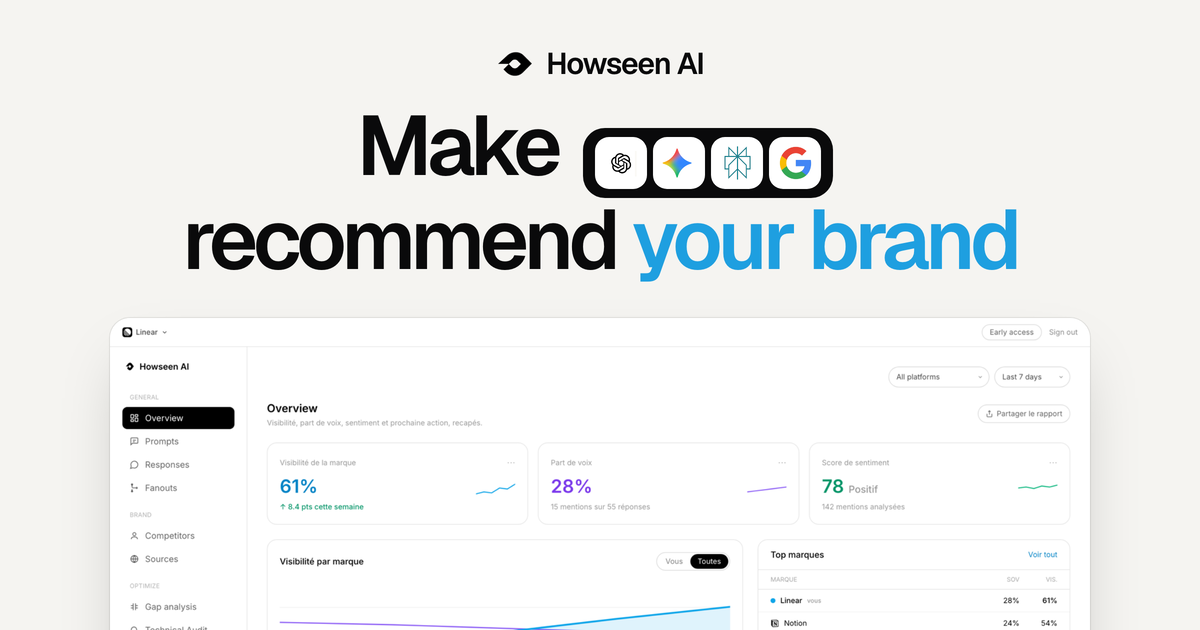
Howseen AI is an AI visibility tool for brands, marketers and agencies that tracks how a brand is recommended across ChatGPT, Gemini, Perplexity, Google AI Overviews and Google AI Mode. Its stated purpose is to help companies make AI their next growth channel: it measures how you are seen when buyers ask AI tools what to buy, and works to ensure the brand the AI names is you. The platform brings AI visibility tracking, competitor benchmarking, citation tracing, a GEO action plan and content generation together in one screen. The problem Howseen AI addresses is a shift in how buyers choose products. The site explains that buyers now ask ChatGPT, Gemini and Perplexity which tool or brand to buy, and the AI answers with a shortlist. According to the content, the brands cited in community threads, review sites and editorial make that shortlist, while the rest never come up. Howseen frames this as a new distribution channel: every day, buyers pick tools from AI answers, so being named in those answers matters. The founder states, "I believe the best product doesn't win, the most visible one does. The shelf just moved to AI, and Howseen makes sure yours gets seen." The core of the product is AI visibility and performance tracking. Howseen recaps visibility, share of voice, sentiment and a next action, tracked across ChatGPT, Perplexity, Gemini and Google AI. It shows brand visibility, share of voice and a sentiment score that compares how AI talks about you versus competitors on a -9 to +9 scale, derived from how AI describes each brand in tracked answers. A visibility-by-platform view breaks performance down per AI surface, and a brands table ranks you and competitors by visibility, share of voice, sentiment and position. This lets a team see, at a glance, whether they are named in AI answers and how that compares with the competition. Prompt tracking is the second pillar. The site argues that buyers ask full questions now, not keywords, so Howseen tracks every prompt that matters across every AI surface. You can add the prompts you want to win from day one, get high-intent suggestions from real search data, and see visibility and sentiment per prompt, per model, every 3 days. Prompts are organized by topic and tagged with intent such as buying intent, comparison or learning. A prompt table shows visibility, sentiment, position, mentions, citations, share of voice, location and when each prompt was added, making clear exactly where a brand appears and where it does not. Competitor benchmarking and citation tracing complete the measurement layer. Howseen lets you see who the models recommend when buyers compare options, right next to the recorded answer, benchmark visibility, sentiment and position against every competitor, watch AI share of voice move with each run, and spot the exact prompts where a competitor replaced you. The competitor view includes a brand comparison table, a brand-by-model heatmap, and a prompt-by-brand ranking matrix showing the top brands AI cites per tracked prompt. Because LLMs don't cite at random, Howseen traces every answer to the pages it cited, mapping each citation to its domain, page and source type so you can find the review sites, forums and wikis the models trust and prioritize outreach by how often each domain gets cited. A technical audit flags what blocks Google and AI models from reading and citing your site, covering page speed, LLM optimization, SEO optimization, indexability, sitemap.xml, robots.txt, LLMs.txt, server-rendered content, Bing indexing and trust signals. From measurement, Howseen moves to action with an action plan and content agents. Data-driven recommendations are built from citation patterns, competitor gaps and prompt performance, each tagged with priority, type (off-page, technical or content), AI engines and effort, alongside a GEO score broken into technical, off-page and content components. Content agents then turn every gap into a scheduled article written from your real buyer prompts in your voice, pushed straight to your CMS. The content plan pre-plans buyer prompts across the month, generating, queuing and publishing drafts; one-click publishing is supported to WordPress, Shopify and Next.js, and there is a recurring content calendar designed to close gaps automatically. Content is structured for specific engines, such as research pages structured so ChatGPT can cite them, product listicles created so Google AI shows them in product searches, and explainer pages written so Perplexity pulls them into detailed answers. The product's methodology is a closed loop rather than a score. Most tools stop at a score, whereas Howseen measures and then acts: it tracks where AI recommends you, benchmarks you against competitors, traces the sources that feed the answers, and publishes the fixes on a schedule. The site describes it as going from invisible to cited on autopilot, and as an agent that acts, not a dashboard that hands you a score. Everything that decides whether AI recommends you, from tracking to competitor share of voice to content and off-page citations, is brought together in one screen instead of being scattered across a dozen tools. The benefits Howseen claims center on clarity and momentum. Branded versus unbranded visibility, who gets cited ahead of you, and the exact sources behind every answer are surfaced without inflated numbers, which the company frames as "no black box". Every scan feeds a trend so you can watch your share of voice climb week after week, alongside analytics for AI-referred visits, average position and answers appeared in. The recurring content calendar keeps closing gaps, so improvement is continuous rather than a one-off audit. The site also highlights that a lead in sentiment is a real edge because AIs stay mostly neutral. Concrete scenarios in the content include an ecommerce activewear brand tracking prompts such as "best gym leggings for squats" or "most durable workout leggings", spotting gaps where AI recommends a rival instead, and then generating comparison guides, how-to posts and resource lists like "Gymshark vs Lululemon" or "affordable Lululemon alternatives" to win those prompts. Other example questions the tool is designed around include "Best CRM for B2B companies?", "What payroll tool do startups use?", "Cheapest email marketing software?" and "Which project management tool do agencies use?". Agencies use Howseen across all their client brands and share white-label reports, turning GEO into a recurring service they can sell. Howseen AI is a web platform aimed at brands and agencies that want to be recommended by AI. It tracks any AI engine including ChatGPT, Gemini, Perplexity, Google AI Overview and Google AI Mode, supports tracking and analysis in every market and location and content generation in every language your buyers speak, and includes prompt personas with ICP match prompts. Publishing integrations listed are Shopify, WordPress and Next.js. The site offers a free scan to test your AI visibility in 30 seconds with no card required, plus a demo booking link for deeper evaluation. In short, Howseen AI's primary value proposition is to turn AI from an opaque question mark into a measurable, actionable growth channel: it shows whether ChatGPT, Gemini, Perplexity and Google AI name your brand, explains why through citations and competitor benchmarks, and then generates and auto-publishes the GEO-optimized content needed to get you cited.
LLMagnet is the official WordPress plugin that makes a website visible and understandable to AI assistants such as ChatGPT, Claude, Perplexity and Gemini. It tracks visits from AI bots in real time, gives insights into how language models interpret your content, measures an AI Visibility Score, automatically generates llms.txt files and manages schema.org structured data so that models can accurately read, cite and act on your pages. The product is made by web creators and built for agents and marketers, helping brands build a measurable presence in the AI ecosystem instead of guessing how AI search treats them. Search behavior is shifting. People increasingly ask AI assistants directly for answers, recommendations and products, so the traffic that matters no longer arrives only from classic search engines. AI crawlers and assistants fetch, parse and summarize pages on their own terms, and llms.txt is described by LLMagnet as an emerging standard, like robots.txt for search engines, that helps AI models understand a site's structure and content. Without that guidance, and without any data about which bots visit and what they read, site owners are essentially blind to how AI represents them. LLMagnet closes that gap by giving websites an AI visibility layer: real-time analytics on AI bot activity plus the files and schema data that make content easier for models to read, rank, connect with and trust. It turns an opaque new channel into something that can be watched, measured and improved. The core of the plugin is LLM Analytics, which tracks real AI-bot traffic and reports detailed insights into visits, impressions and clicks coming from major models including ChatGPT, Gemini, Claude and more. LLMagnet detects visits from ChatGPT, Claude, Perplexity, Gemini, Grok, Bing AI, Mistral, DeepSeek, Llama and others. Sitting alongside the raw traffic numbers is the AI Visibility Score, a single metric that reflects how well large language models can access and understand your content across the web. Trends & Insights then tracks that visibility over time so you can spot rising opportunities and content drops instantly, turning scattered bot activity into a picture of whether your AI footprint is growing or decaying. To make a site AI-ready, LLMagnet automatically builds and maintains an llms.txt file so AI crawlers can better understand site structure and content focus, and it keeps that file up to date without manual work. Depending on the plan, it also generates a Full-llms.txt and .md files. The plugin manages schema.org structured data as well, which helps AI assistants accurately read and cite pages. Because llms.txt is positioned as robots.txt for AI, it acts as a signpost for crawlers; generating it automatically means site owners do not have to research the format, write the file or remember to refresh it whenever content changes. Prompt Tracking & Optimization shows where your brand actually appears in AI answers. LLMagnet tracks the prompts that mention your site and shows how your ranking evolves over time, including which prompts include your brand, how visibility shifts by LLM, and what to improve next. Alongside this, Automated Reports & Insights sends weekly and monthly reports that summarize your visibility and growth, with auto performance reports, visual traffic breakdowns and actionable visibility tips. Together these features move the product beyond measurement into guidance: you can see not only that AI assistants are reading your pages, but which questions bring you in and where you are missing. For stores, LLMagnet is positioned around the future of AI-driven commerce. It turns a shop into AI-ready content by connecting to your product data so that AI can display accurate information in generative search, with auto product and price sync keeping details current, an AI-search visibility boost and product mention tracking. WooCommerce integration and product tracking are part of the Plus plan, and the FAQ notes that Plus and Enterprise plans add product visibility scores and AI revenue funnel tracking for WooCommerce stores. The result is that product listings, prices and brand mentions stay aligned with what assistants tell shoppers. Installing LLMagnet starts from the WordPress plugin directory: you enter your WordPress site and are redirected to your site's plugin installer so the plugin can be added in one click, with no setup or code required. Once active, it begins capturing real-time AI bot activity. The dashboard reveals which AI bots visit your site, what they read and how to improve your visibility inside AI answers through visual dashboards. Compatibility is broad: the plugin works with Elementor, Gutenberg, Divi, WooCommerce and more, runs alongside Yoast SEO and RankMath without conflicts, and integrates into the Elementor editor with per-page AI visibility scores and schema management. On WordPress 6.9 and later it connects directly to Claude, ChatGPT and Cursor via the WordPress Abilities API so AI assistants can query your site's data natively, and an MCP Connector is included in the plans. The approach is deliberately lightweight and privacy-safe: file generation and analytics run in the background, so there is no impact on front-end performance or page load speed, and bot visit analytics are stored locally in your WordPress database and never sent externally. Optional integrations are off by default, and the tool is fully GDPR-compliant with built-in data export and erasure tools. The stated benefits revolve around control and clarity. AI Visibility Control means knowing exactly how large models see your content; Smart Automation keeps llms.txt and your data always updated automatically; Deep Insights analyze which pages drive the most AI engagement; Enhanced Collaboration streamlines workflows with team-friendly features; Data Security safeguards your data with top-tier encryption; and Continuous Improvement lets AI adapt and improve with evolving data. In practice, users describe straightforward setup, clear understanding of AI-related traffic to their site, and a practical llms.txt generator that saved them time. LLMagnet is explicitly not framed as a magic SEO plugin, but as a solid tool for gaining visibility into how AI search is evolving. LLMagnet is aimed at web creators, marketers, solopreneur store owners and WooCommerce store managers who want to prepare for AI-driven discovery rather than react later. The free plan is available with no credit card required, and core features such as analytics, llms.txt generation and schema tools work on any WordPress site. Paid tiers add depth: Pro at $29 per month per site covering analytics from ChatGPT, Claude and Perplexity plus Full-llms.txt, .md files and an MCP connector; Plus at $100 per month per site with analytics from all bots, WooCommerce integration, product tracking and product visibility; and Ultra at $149 per month per user with prompt tracking and chat support. Yearly billing lowers those prices, and a Product Hunt launch offer advertises 50% off. A Shopify app is also available alongside the WordPress plugin. LLMagnet gives WordPress and Shopify sites a measurable AI visibility layer. By tracking AI bot traffic, scoring how well models can access your content, generating the llms.txt and schema data crawlers look for, and tracking the prompts where your brand appears, it converts an opaque new channel into something you can watch, report on and improve. For teams that want evidence of how AI assistants read, cite and recommend them, that combination of analytics, AI-ready files and prompt tracking is the product's core value proposition.
Neopress is an AI website builder that lets you build, publish, and grow a website by chatting with an AI assistant. Instead of assembling pages by hand, you describe what you want in plain language and the assistant helps create pages, organise structured content, and refine the result. It is aimed at people who need a real content workflow behind their site — a built-in CMS, server-rendered SEO, GEO tools, forms, and analytics — rather than a static page that never changes. Neopress describes itself as connecting website creation, structured content publishing, SEO tools, and traffic insights into a single workspace so you can keep improving after launch. The problem Neopress addresses is that a website is not finished when it goes live. As the site explains, a website needs ongoing content updates, search settings, and performance review after launch, and those tasks usually live in separate tools. Neopress was built by a team that has shipped hundreds of content sites, and it is optimised for one thing: websites that get found — clean structure, a real CMS, and SEO that works by default. The product brings content management, search configuration, and analytics into one place, so the post-launch loop of updating, measuring, and improving becomes part of the same workflow as building the site in the first place. Neopress works through agents that operate alongside you. The first is a design agent: describe the page you want in plain language and watch it take shape, then refine layout, copy, and style through conversation. The stated advantage is that there are no templates to wrestle with and no design tools to learn. The second is a CMS agent: work with AI to draft and organise content in CMS collections, review the copy and SEO settings, then publish when you are ready. The Launch plan includes unlimited pages, unlimited CMS collections, and unlimited forms and lead capture, so the content structure of the site is not capped by the plan. Search visibility is handled by built-in SEO and GEO tools. Neopress delivers page content as server-rendered HTML, so search engines and AI crawlers read the structure and text of a page instead of an empty browser-rendered shell. Metadata and Open Graph settings can be reviewed and edited for search results and social previews. Neopress generates a sitemap.xml automatically so search engines can understand and crawl the site structure, and it publishes the emerging llms.txt standard for you — a clean, curated map of your key pages for AI assistants. Structured data (JSON-LD) can be added and reviewed to help search engines understand a page's content, and robots.txt gives control over crawler access so you can block pages you do not want indexed. Beyond the core tags, Neopress adds the plumbing that content sites usually need later: HTTPS with SSL by default, automatic canonical tags to avoid duplicate content, a custom 404 page, 308 redirects from old URLs to new pages when reorganising a site, an automatically generated RSS feed, image alt text for accessibility and image search, and clean, human-readable, keyword-friendly URL slugs. Fonts are self-hosted and preloaded to cut layout shift and speed up first paint, images are optimised for size, format, and delivery, and pages are responsive so you can review how they appear on mobile screens. Neopress states it is built for Core Web Vitals, with server rendering, caching, and a global CDN supporting fast page delivery. Multilingual publishing lets you configure site languages, review translations, and publish language versions with hreflang support. Neopress describes its overall approach as a flywheel with four stages: build, publish, measure, and improve. You build by chatting with AI, publish structured content through the CMS, measure with the analytics dashboard, and improve by asking AI to review site and performance data. One agent focuses on measurement: ask AI about the analytics available for your site, review its explanation and suggested changes, then choose what to improve. Another agent reviews available site and performance data, identifies issues, and suggests changes for you to decide which improvements to apply. The recurring theme is that AI proposes and explains, while you review and decide — publishing and publishing changes always remain your choice. The stated outcome is a website that gets found and keeps improving. Because every page ships as real HTML rendered on the server, crawlers can access content without relying on browser-side rendering. Because the CMS, SEO settings, and analytics sit in the same workspace, there is no gap between writing content and configuring how it is indexed. Analytics covers tracking search queries, checking post indexing status, seeing which LLMs crawl your pages, and tracking paid, campaign, and visitor data, with Google Search Console and Google Analytics integrations available on the Growth plan. On ownership, Neopress states that you retain full ownership of all content, copy, and structural assets generated by the AI — Neopress provides the hosting and the engine. Neopress is used to build and grow content-driven websites. Its template gallery shows the range: Blog & Editorial, Corporate, Documentation, and Landing Page templates, with published examples spanning skincare and dermatology clinics, a non-surgical spine and joint hospital, an oriental medicine clinic, a boutique Pilates studio, an artisan bakery and cafe, a design studio journal, and a bespoke jewellery atelier. For teams with an existing site, Neopress offers website migration — moving your existing pages, content, domain, and redirects over without a rebuild from scratch — and design services for a new page or a fresh look, discussed directly with the Neopress team. Day to day, the workflow is drafting and organising content in CMS collections, publishing pages, then reviewing analytics and applying SEO improvements. Pricing is subscription-based with plan-based AI usage and traffic allowances, and it starts with a 7-day free trial. Launch costs $25 per month per site with 10,000 pageviews per month included and $1 per additional 1,000 pageviews. It includes AI chat creation and editing, unlimited pages, unlimited CMS collections, unlimited forms and lead capture, built-in SEO and AEO optimisation, search-readable pages via SSR, llms.txt, robots.txt and sitemap control, JSON-LD structured data, RSS feed, URL redirect rules, custom domain connection, logo and favicon settings, a social share (OG) image, a custom 404 page, removal of the Made by Neopress badge, a real-time analytics dashboard covering the last three months, one editor seat with unlimited viewers, version history and Rewind restore, and MCP support. Growth costs $99 per month per site with 50,000 pageviews included, about three times the AI usage of Launch, ten editor seats with role-based permissions, real-time collaboration presence, full analytics with paid, campaign and visitor tracking, visibility into which LLMs crawl your pages, search query tracking, post indexing status, Google Search Console and Google Analytics integrations, two years of data history, multi-language support, a multilingual sitemap with hreflang, and priority support. When a trial ends or you stop paying, published content remains available on your Neopress subdomain on the Free plan while custom domains pause. Pageviews count human visits plus crawls made by AI to cite your pages in its answers; search engine indexing and AI training crawlers are not counted. Security and trust features include Supabase infrastructure with authentication-controlled database access, Supabase Auth, Vercel's DDoS protection, Polar as merchant of record for payments, and version history for restoring previous versions of pages and site layout. In short, Neopress positions itself as one AI-powered loop for building and growing a website: you create pages through conversation, publish structured content through a real CMS, ship server-rendered HTML that search engines and AI crawlers can read, and then use analytics plus AI review to decide what to improve next. The core value proposition is a website that gets found and keeps getting better, managed end to end in a single workspace rather than scattered across separate building, CMS, SEO, and analytics tools.
Visiby is an AI visibility platform that measures and grows how brands appear across AI search platforms, including ChatGPT, Claude, Perplexity, Gemini, Google AI Overviews and Copilot. It acts as a visibility layer for the AI-search era, mapping entity presence across the top AI engines so marketing teams can see where they are recommended, where they are missing, and which competitor is being cited instead. The product is built for marketing operators and agencies who need to own the answer layer rather than only rank in traditional search results. Vendor discovery has moved. According to the content, 1 in 3 B2B buyers now start vendor research inside an AI assistant, and ChatGPT, Perplexity, Google AI Overviews, Gemini and Copilot are quietly intercepting traffic that used to land on a company's site — if the model does not surface the brand, the conversation never starts. The site states that 62% of enterprise marketers are already optimising for AI engines, citing the State of AEO 2026 from FNA Research, while the well-funded brand in a category treats Answer Engine Optimisation as a budget line whose citations compound week over week. Meanwhile, Visiby argues that zero tools in a typical stack measure what AI is saying about a brand: Semrush ranks, Ahrefs ranks, GA counts clicks, but none of them sample prompts, parse model answers, or explain why ChatGPT recommended a competitor instead of you. Visiby exists to close that blind spot with a continuous, prompt-level view of AI answers. The workspace opens on an Overview that serves as the weekly headline: search performance, AI visibility and the next moves the team should ship, readable in 90 seconds. Headline scores include Visibility, Share of Voice, Prompts won and Briefs ready. Search Performance explains a brand's organic traffic and click-through rates, tracking clicks over 28 days with month-over-month change, impressions, click-through rate and average position across tracked non-brand terms. AI Visibility shows where a brand appears and where it does not, presenting per-engine citation share across every prompt in the universe, with each cell clickable to reveal the underlying answer. In the illustrated workspace, ChatGPT sits at 42%, Perplexity at 51%, Claude at 34%, Gemini at 24% and AI Overviews at 18%. The Prompts Explorer is a workbench for the full prompt universe — more than 50,000 AI prompts are tracked weekly, and the sample workspace shows 50,127. It supports stacked filters, a cluster view and a three-way live answer diff, and each row drills into which competitor was cited, why, and the play to win the prompt back. The Citations Explorer works beneath the prompt universe across every URL the engines cite — 2,418 URLs in the example — ranking every cited URL and identifying honey-pot pages, dead-weight pages and counter-content briefs, with passage-level provenance. The Brand Entity module shows the adjectives a brand owns and the ones owned against it across engines, with per-engine portraits and reframe plays to move them; the sample adjective sets include trustworthy, established, enterprise, scalable, innovative, modern, consultative, agile, long-tenured and data-driven. Competitor Intelligence reads the field at a glance, presenting citation share by brand and topic with clickable cells that drill to the prompts and passages behind them, plus a per-competitor recipe diff comparing cited elements across engines, such as H2 headings, FAQ blocks, tables and lists. Recipe Intelligence delivers a per-engine pulse on which on-page element the AI is actually extracting from, producing the structural blueprint a team should publish to; Visiby reports that seven elements are tracked, including H2 headings, FAQ blocks with FAQPage schema, tables, bulleted lists and case studies. Site Audit is a citability-first audit that ranks every issue by AI impact with the fix and affected URLs attached, surfacing examples such as pages blocked from indexing, pages missing OpenGraph tags and meta descriptions, thin pages under 250 words, missing Organization schema, missing FAQ schema and image alt text gaps. The Action Plan converts all of this into a prioritised, priced playbook ranked by effort against impact, where every move carries an argument, a score breakdown covering why-now signal, forecast confidence, effort and dependency, evidence links, and a ready-to-ship deliverable brief. Visiby runs as a weekly ritual. Every Tuesday at 07:42 IST, the platform fuses three live data streams — the prompts buyers actually ask, where the brand is losing citations, and the recipes competitors win with — into one prioritised action plan, with no analyst required. The pipeline runs overnight and lands in the inbox as a citation sweep, share-of-voice deltas, a prioritised action plan, content briefs and an executive summary. A weekly digest email example reports the number of prompts run across engines, the movement in citation share, the action moves ranked by projected lift in points, and a forecast of the week when citation share returns to a target level. The platform continuously samples engines, and the site positions the cadence at seven days from signal to a shipped fix. Benefits described include replacing guesswork with evidence about what AI engines recommend, seeing exactly which competitor is being cited first on high-value prompts, and knowing which structural elements and content formats win citations on each engine. Instead of a dashboard nobody opens or a spreadsheet exercise, teams receive an inbox-ready brief with ranked moves and attached briefs, so prioritisation and writing can start immediately. Ranking moves by effort against impact lets a small team focus on the highest-lift work, and the prescribed fixes — schema, content refresh, comparison pages, original research — are tied to specific projected visibility gains. Concrete scenarios in the content include a marketing team reading the weekly overview and shipping the queued moves; a brand losing citation share to a named competitor and building a comparison page in response; refreshing a contact page for AI parseability because it lacks crucial entity definitions and brand identifiers; adding FAQ schema to a services pillar of 14 core URLs missing structured Q&A data; producing original research on AEO benchmarks to capture data and stats queries; and running community and earned-media plays such as a Reddit thread cluster or listicle outreach to G2 and Capterra. Agencies can use the same workspace to run client AEO programmes, and the Agency tier supports white-label client reports and multi-workspace reporting. Visiby is aimed at marketing operators, enterprise marketers, SEO and AEO specialists, and agencies. It complements rather than replaces existing SEO platforms, and the site compares its capabilities against Semrush, Profound, Conductor and Ahrefs across AI visibility tracking on five engines, SEO and rank tracking, brand entity audits, passage-level citation provenance, recipe intelligence, priced action plans, ready-to-ship content briefs, an autonomous weekly pipeline and multi-workspace reporting. Pricing has four tiers: Lite at $49/mo with 25 prompts a month and one seat; Starter at $99/mo with 50 prompts a month, 10 action items and Site Audit plus Action Plan; Pro at $249/mo with 150 prompts, 30 action items, three seats and three brands, daily refresh, Brand Entity, Competitor Intelligence, Sentiment Analysis and priority support; and Agency at $499/mo with 500 pooled prompts, 50 action items, 10 seats and 10 workspaces, white-label client reports, API access and SSO/SAML, custom engines and regions, and a dedicated success manager with an SLA. A free visibility report is offered in 60 seconds with no card required. That combination makes Visiby a visibility layer for the AI-search era: it measures how brands and competitors appear inside AI-generated answers, explains the structural recipes that earn citations, and turns those signals into a prioritised, priced plan a team can ship on Monday.
FreeScan.app is a website audit tool that reviews any public URL across SEO, AEO, GEO, website security, accessibility, and design. It is built for builders, developers, and site owners who want to know what is hurting their visibility, trust, and conversions. A single scan runs 40 focused checks and returns scores, supporting evidence, prioritized fixes, and insights. The free audit requires no signup and no private access, so anyone can paste a public page and immediately see where the page stands and what to work on next. The stated purpose is to uncover problems and missed opportunities and turn them into an actionable plan rather than an unexplained score. Most site owners do not know which specific issues are holding a page back. Auditing normally means piecing together separate tools for SEO, security headers, accessibility, and design, then interpreting raw output without context. FreeScan.app addresses that fragmentation by running discoverability, security, accessibility, design, and page quality checks in one focused scan on one public URL. Every finding is paired with evidence and an explanation of why it matters, so the user can decide what to fix first. The site positions this as a way to stop guessing whether a page is crawlable, secure, accessible, clearly designed, or ready to convert before a launch, campaign, or SEO push. Running the free audit is deliberately simple. You paste any public page URL and start a scan without signing up or granting private access. The scan performs 40 focused checks across discoverability, security, accessibility, design, and page quality. Results are presented as four category scores — SEO / AEO / GEO, security, accessibility, and design — that can be compared side by side, plus an overall view. The report bundles scores, supporting evidence, prioritized fixes, and insights into one shareable audit report. Results are organized into three action-ready views: Fixes, which shows what is costing points, why it matters, and what to change first, ordered by impact; Opportunities, which surfaces high-leverage ways to improve visibility, trust, usability, and conversion beyond failed checks; and Insights, which explains what the page already does well, backed by rendered checks, schema, previews, and page signals. The SEO, AEO, and GEO portion of the audit covers technical SEO and answer-engine readiness. It reviews titles, meta descriptions, headings, canonical tags, robots.txt, sitemap.xml, structured data, Open Graph, internal links, llms.txt, and answer-ready page structure. The stated goal is to see whether the site is structured for search engines and AI answer systems to understand it. Pro extends this into site-wide AI visibility, where FreeScan.app looks for crawler blocks, content gaps, and citation-readiness issues across scanned pages, showing what needs attention for search and AI discovery. For teams tracking how generative and answer engines surface their content, these checks translate directly into specific pages and specific problems rather than a general recommendation to improve SEO. The security checks look at public website signals visible from the page: HTTPS, mixed-content indicators, common public security headers, insecure forms, sensitive file exposure, and cookie flags. The accessibility fundamentals check finds missing alt text, form labels, heading-order problems, landmark gaps, unclear controls, language issues, contrast risks, small tap targets, and rendered accessibility errors. The design evaluation is conversion-focused, assessing hero and CTA clarity, content density, trust signals, mobile viewport setup, readability, spacing, visual hierarchy, runtime health, performance, and layout stability. FreeScan.app is explicit that this is a focused public-page audit and not a replacement for expert SEO strategy, penetration testing, accessibility certification, or analytics, so the checks should be read as signals and starting points rather than formal certification. The methodology centers on evidence over totals. Instead of returning a single number, FreeScan.app attaches supporting evidence to each finding, explains why it matters, and states how to fix it — the site describes this as turning audit results into clear next steps. Findings are ordered by impact so the highest-value work is visible first, and the report includes practical next steps for every result, along with opportunities and insights derived from rendered checks, schema, previews, and page signals. Because the output is framed as fixes plus explanations rather than vague advice, results can be handed to a coding agent. Builders in community testimonials describe running a scan, giving the results URL to their agent, reviewing the pull request, and shipping — with accessibility scores moving from 72 to 100, or an overall page score going from 40 to 86 after working the list. FreeScan Pro is a single plan at $19 per month, cancellable at any time, that moves from a single page to the whole site. Pro runs automated site-wide audits and organizes results into SEO, AI Visibility, and Fixes workspaces in one private dashboard. A site-wide fix board groups findings from across the site into a prioritized board where you can see affected pages, track each fix, and give your agent the evidence to act. Agent workspaces let you export full SEO, AI Visibility, and Fixes workspaces as Markdown, and Pro MCP lets a coding agent read private findings and request rescans. Pro also audits key pages automatically each week, sends email reports, compares progress, monitors uptime, and supports an optional shareable status page. Stated limits include up to 60 baseline and 25 recurring pages, five sites, and five manual scans per week per site. FreeScan.app also publishes a leaderboard of the highest scoring Pro homepages, ranked by each website's latest homepage audit. Users come to FreeScan.app to find out what a page is missing and exactly what to fix. The stated outcomes are improved search rankings, AI visibility, user trust, and conversions. Because each failed check includes evidence and a concrete fix, teams can turn audit output into a work list — one testimonial describes shipping against the list like a sprint backlog and reaching 100 out of 100 across SEO/AEO, security, accessibility, and design. Pro adds tracking so you can see what improves and catch new issues as the site changes, with weekly audits, progress comparisons, uptime monitoring, and downtime alerts. Public, shareable audit reports also make it easy to show progress before and after a fix cycle. Together these turn a one-time score into an ongoing improvement loop for visibility and trust. The most obvious use case is running the free audit before a launch, campaign, or SEO push, so you do not guess whether a page is crawlable, secure, accessible, and ready to convert. Another is remediation with coding agents: scan a page, hand the findings or the results URL to an agent such as Claude Code, apply the suggested fix, and rescan to confirm. Teams also use it to check a single public URL for SEO, security, accessibility, and design issues and see what to fix first, and to review answer-engine and AI visibility signals such as llms.txt, structured data, and crawler access. For ongoing operations, Pro supports weekly site-wide audits of key pages, a fix board for tracking work across the site, and uptime monitoring with a shareable status page. FreeScan.app also publishes practical guides on website audit checklists, technical SEO audits, and auditing a SaaS website safely. The product targets builders, developers, indie makers, and website owners who ship sites and want fast, evidence-backed feedback, including teams working with coding agents. The audit is a web-based, public-page tool: you paste a URL and it scans, with no signup required for the free check. Pro is priced at $19 per month with cancellation at any time and covers up to 60 baseline and 25 recurring pages, five sites, and five manual scans per week per site. Integration points explicitly described are Markdown export of SEO, AI Visibility, and Fixes workspaces, connection through Pro MCP so agents can read private findings and request rescans, weekly email reports, and an optional shareable status page. The site also notes the tool complements rather than replaces expert SEO strategy, penetration testing, accessibility certification, and analytics. FreeScan.app gives anyone a fast, free way to see what a public page is missing across SEO, AEO, GEO, security, accessibility, and design, and exactly what to fix first. The free 40-check audit runs without signup and returns four category scores, prioritized fixes, opportunities, and insights in one shareable report. Pro at $19 per month turns that into whole-site monitoring: automated weekly audits, a unified fix board, agent workspaces and MCP access, private scan history, and uptime monitoring with status pages. For builders who need to know whether a page is crawlable, secure, accessible, and ready to convert — and who want evidence they can hand straight to a coding agent — FreeScan.app packages discovery, diagnosis, and next steps into one workspace.
.png)
Rankfender is an AI visibility intelligence platform that monitors your brand across 7 AI systems. It provides visibility scores, competitive analysis, and automated content publishing to improve search presence.
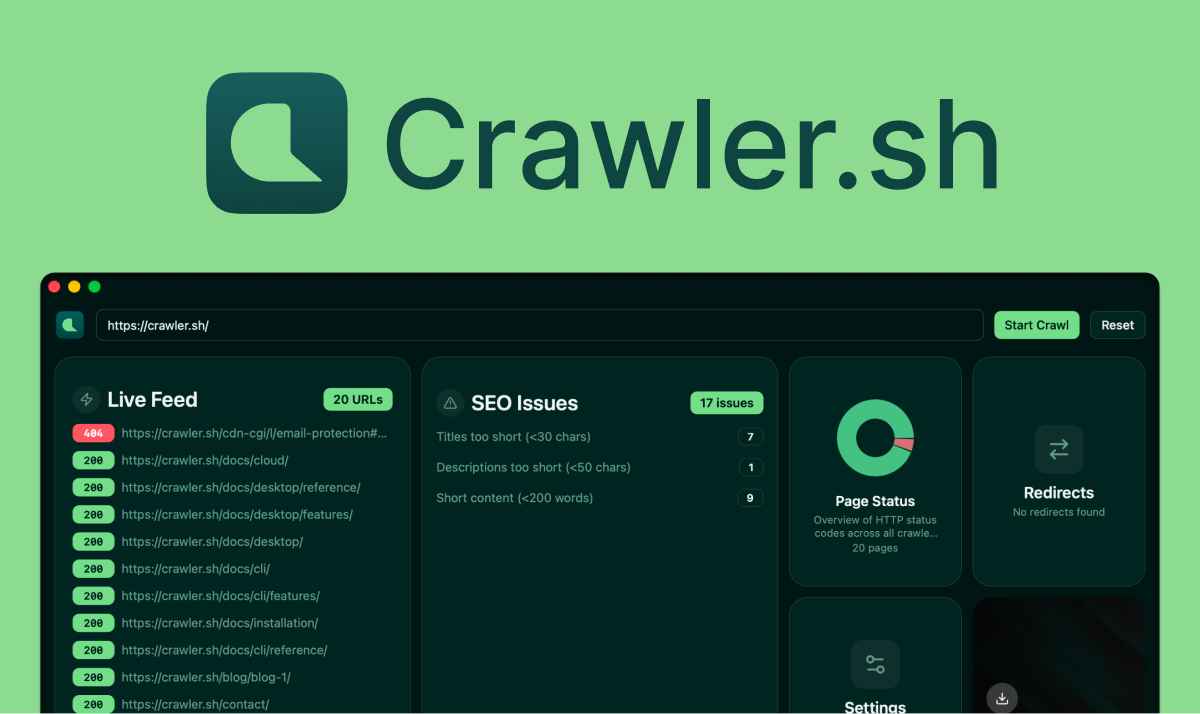
Crawler.sh is a fast, local-first web crawler and SEO analysis tool that crawls websites in seconds. It extracts clean content as Markdown and exports data to JSON, CSV, or Sitemap XML.

Track how AI agents and bots interact with your website. Analyze traffic trends by platform, page, and topic to understand how this traffic turns into human visits.