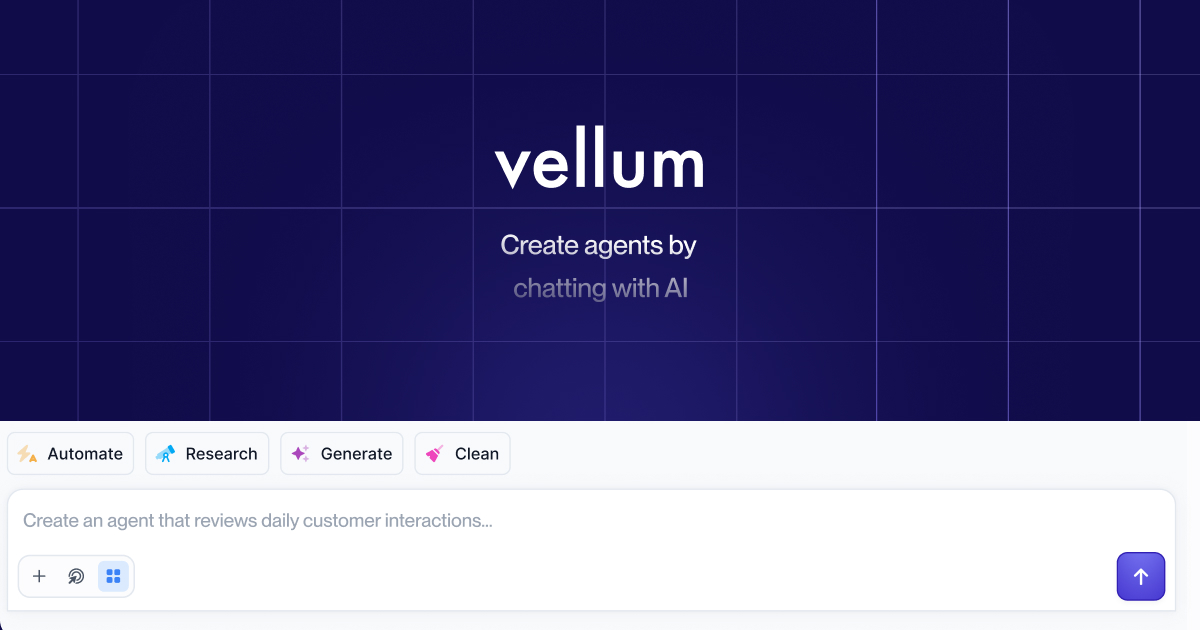
Vellum is an AI agent builder and platform that empowers users to create autonomous assistants by simply describing tasks in plain English. It is designed for developers, power users, and teams who need custom AI agents that function across multiple channels without requiring deep machine learning expertise. The core value of this AI agent platform lies in its ability to automatically generate working agents from natural language descriptions, dramatically reducing setup time and complexity. Vellum's agents are not static; they adapt by learning from user preferences and improve over time, becoming increasingly tailored to individual workflows. With support for scheduling, API triggers, and direct UI interaction, Vellum provides a flexible foundation for automating both routine tasks and complex processes alike.
Many AI tools suffer from persistent memory gaps, forcing users to repeatedly provide context and re-explain their needs. This leads to inefficiency and frustration, especially for complex ongoing tasks. Vellum solves this pain point with a sophisticated managed memory system that includes episodic, semantic, procedural, and emotional layers. Episodic memory records specific past events, such as clearing a user's calendar when they spontaneously help a colleague, allowing the agent to act proactively. Semantic memory stores factual knowledge and user preferences, while procedural memory automates sequences of actions. Emotional memory captures sentiment to adjust tone and responses. Together, these memory types ensure the agent maintains coherent long-term interactions and adapts to evolving user behavior, eliminating the need for constant re-iteration.
The first major feature group is Vellum's multi-layered memory system, which distinguishes it from many basic AI assistants. Episodic memory allows the agent to recall and act on concrete past instances, like noticing a pattern of helping colleagues and automatically rescheduling tasks. Semantic memory retains user-defined facts and general knowledge, such as preferred meeting times or project guidelines. Procedural memory enables the agent to learn and automate sequences, like a routine data backup process. Emotional memory tracks user mood and communication style, adjusting responses to be more empathetic or professional as appropriate. This combination ensures that the agent not only remembers what was said but understands context and intent, providing a truly personalized and intelligent experience that improves with each interaction.
The second major feature group is the skill adaptation and learning system. Vellum's skills explicitly 'adapt to how you work, learning from your preferences and getting better over time.' This means that as users interact with the agent, it fine-tunes its behavior based on repeated actions and explicit feedback. For example, if a user consistently asks for a summary of their morning email in a bulleted list, the agent will learn to default to that format. Users can also pick a name and set a personality, giving the assistant a distinct character that aligns with their brand or personal style. This continuous learning process reduces manual configuration and makes the agent feel like a true collaborative partner that understands individual workflows and anticipates needs.
admin
The third feature group encompasses Vellum's extensive native channel support and integrations. The platform works across iOS, MacOS, Web, Voice, Email, Telegram, Slack, and CLI, allowing users to interact with their assistant wherever they are. Native integrations include managed OAuth connections, eliminating the hassle of manually securing third-party services. Scheduling is handled via Cron and Heartbeat, enabling agents to perform tasks at specific times or monitor for triggers. Hosting is flexible: users can deploy agents on Vellum's cloud for zero-maintenance operation or self-host for maximum control. Built-in security ensures credentials are stored separately from the assistant, and users can control the level of autonomy, migrating from platform-hosting to self-hosting at any time without losing data.
Vellum's overall workflow is designed for speed and simplicity. A user starts by describing the task they want accomplished in plain English—no coding or prompt engineering required. They then pick a name, set a personality, and connect accounts via OAuth. Within seconds, the agent is live on the Vellum Platform, ready to be accessed from any supported channel. The agent automatically leverages its memory layers to understand context from past interactions and begins adapting to the user's preferences. Users can schedule tasks via Cron or Heartbeat, trigger actions via API, or interact directly through the UI. The agent operates autonomously within the boundaries set by the user, who can adjust autonomy levels at any time. This streamlined process makes AI agent creation accessible to non-experts while providing depth for advanced users.
Concrete use cases demonstrate Vellum's practical value. A project manager can create an agent that monitors Slack for support tickets, uses episodic memory to recall past resolutions, and automatically responds with relevant knowledge base articles—reducing response time by 80%. A sales team might deploy an agent on the phone channel to handle follow-up calls, using semantic memory to recall customer history and emotional memory to adjust tone based on sentiment. A developer can set up a CLI agent that runs nightly automated tests, logs results, and triggers alerts if failures occur—freeing up time for more creative work. Another user might have a personal agent on iOS that learns their daily commute patterns and suggests route changes, proactively updating their calendar. In each case, the agent's ability to learn and remember ensures outcomes are not just automated but intelligent and adaptive.
Vellum targets developers, product managers, customer support teams, solo entrepreneurs, and IT administrators who need custom AI automation without building from scratch. The platform is accessible via web, macOS, iOS, Slack, Telegram, CLI, and more, and is built on a flexible tech stack that leverages large language models for natural language understanding. Pricing starts with a free tier covering basic usage and API costs, with paid plans for additional features and higher limits. This makes Vellum suitable for individuals experimenting with AI agents as well as teams deploying production-grade assistants. The combination of plain English creation, adaptive skills, managed memory, and multi-channel support positions Vellum as a versatile AI agent builder that democratizes autonomous assistant creation, enabling anyone to benefit from intelligent automation that truly understands and grows with them.
Vellum is designed for developers seeking to embed custom AI agent capabilities into applications, product managers automating workflows across tools like Slack and Telegram, customer support teams building intelligent ticket resolution assistants, solo entrepreneurs requiring a personal AI assistant that learns their routines, and IT administrators looking for secure, self-hosted AI automation. It also serves power users who want to create tailored agents via plain English descriptions without coding, making advanced AI accessible to non-technical professionals.