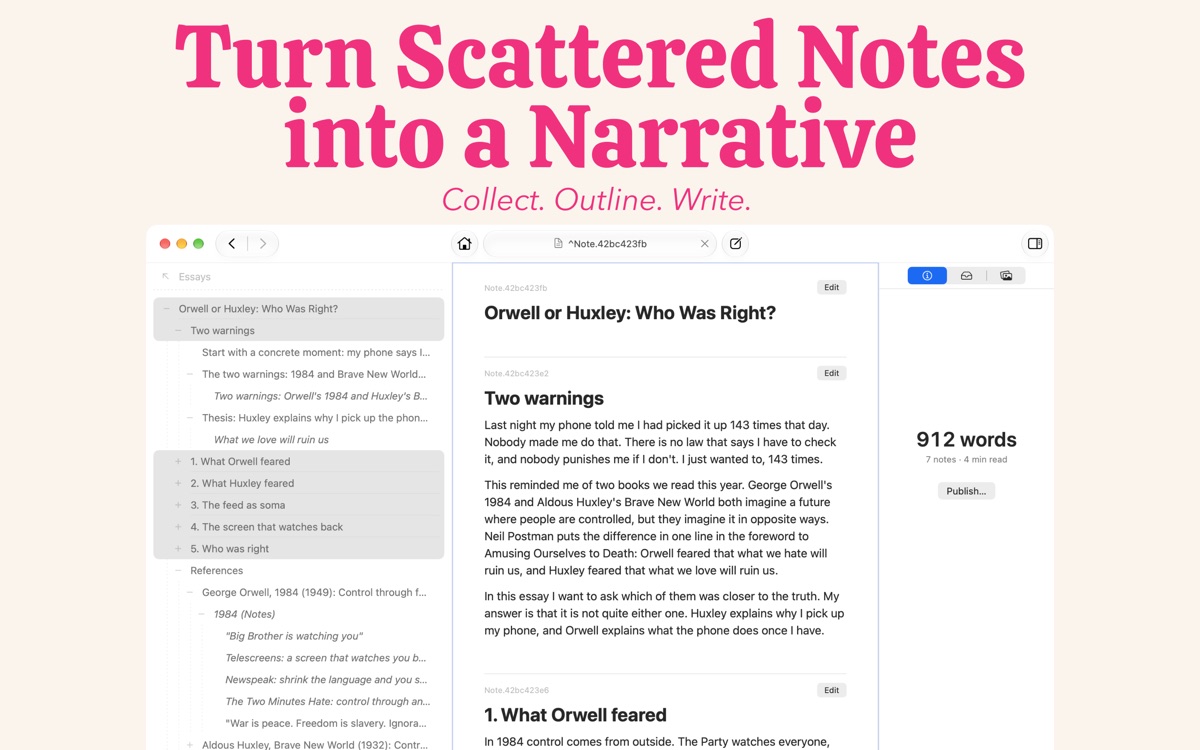
Understory is a Mac notes app for people who take notes in order to write something. It is built for students, researchers and bloggers, and for anyone carrying a research paper, an essay, a blog post, a video script or even a book from the first note to the finished draft. The app is described as part outliner and part notes app: you collect your research, shape it into an outline, write the draft, and then publish the finished piece, all inside one application and without copying anything from one app to another.
The problem Understory addresses is the gap between taking notes and writing. Notes tend to be taken in one place while the writing happens in another, so material has to be moved across before it can be used. Understory closes that gap by treating notes as the raw material of a draft rather than as a separate archive. It also distinguishes itself from a conventional outliner: an outliner is good for shaping ideas into a hierarchy, but every item in it is a bullet, whereas in Understory every item is a whole note written as regular text, and the same note can appear in several outlines, or in none at all.
The first step in the workflow is collecting. Understory is designed for taking notes as you read, chapter by chapter: a note is just text, and you do not have to come up with a title or a filename before you start writing. You keep each quote or idea as a short note filed under the book and the chapter it came from, so the source of every thought is preserved in the structure of the notebook rather than in a separate record. Notes can also be linked to one another; the app's own material shows reading notes filed chapter by chapter, with one note linking to a related note taken from another book, so ideas that cross between sources stay connected without being merged into a single block of text.
The second step is outlining, where the argument is built out of the notes already taken. You add a note for each main point and then put the notes you have already collected underneath the points they support, moving things around until the structure works. Because every item in the outline is a full note rather than a bullet, the same note can sit in more than one place, so an idea can belong to every subject it touches. That means a single piece of research can support several arguments at once without being duplicated or rewritten, and it can also sit in no outline at all until it is needed.
The third step is writing the draft. Each point is drafted in its own note, with the research you gathered listed right beneath it in the sidebar, so the supporting notes stay visible while the section is being written rather than sitting in a separate window or document. Selecting the main points lets you read the whole piece from beginning to end as one continuous draft, which gives you a way to check how the sections read together before anything is published. The app shows sections being drafted in Markdown, with their supporting notes listed alongside.
Publishing turns the outline into a document that can be shared. The finished piece is published as a PDF, Rich Text, Markdown or a website, in the order you arranged it, so the structure built during outlining carries straight through to the output. The same project can therefore become a printable PDF, an editable Rich Text or Markdown file, or a web page without being rebuilt. The published result follows the arrangement of the outline rather than the order in which the notes were originally taken.
The app's approach to storage is part of how it works. Notes are kept in a plain folder of Markdown files on your Mac, which Understory calls a Project Notebook, or in your own iCloud account as a Personal Notebook synced between your Macs. In both cases there is no Understory account to create, and nothing of yours passes through the developer's hands. Because the notes live as Markdown files in an ordinary folder, they remain in a form that is not tied to an account on someone else's service.
For the writer, the benefit is that research and drafting live in the same place. Nothing has to be copied from one app to another between the first note and the finished draft, so quotes and ideas stay attached to the books and chapters they came from while they are being shaped into an argument. Because the same note can serve several outlines, an idea does not have to be rewritten to fit each piece it appears in. And because the published document follows the arrangement of the outline, the structure worked out during outlining becomes the structure of the final output.
Use cases follow the writing the app was designed for. A student writing an essay or a research paper can take notes from each book and chapter, add a note for each main point, and move existing notes underneath the points they support until the structure works. A researcher working through a long book can file quotes and ideas chapter by chapter and link related notes from other books. A blogger can turn reading notes into a post by arranging them into an outline and drafting each section with the research beside it. The same workflow is described for a video script or a whole book, and the finished piece can be published as a PDF, Rich Text, Markdown or a website. Because one note can sit in more than one outline, a writer working on several subjects at once can reuse the same idea in every piece it touches.
Understory is aimed at students, researchers and bloggers, and more broadly at anyone who takes notes in order to write something. It is a Mac app, downloaded from the Mac App Store: there is no iPhone or iPad version yet, and the app is Mac only for now. Pricing is not a subscription, as one purchase makes it yours. It is free to try first, with every feature working from the first launch, publishing included; the only limit is on how many notes a notebook holds, and there is enough room to find out whether it works for you. A one-time payment removes that limit, and the pricing page has the details. Support is available by email, and there is a Discord community for talking about the app.
Understory's value proposition is straightforward: it is a notes app for writing, not just a notes app for storing. It carries a research paper, an essay, a blog post, a video script or a book from the first note to the finished draft in one place, letting you collect notes as you read, arrange them into an outline, draft each section with your research beside it, and publish in the order you arranged. Its tagline, notes that tell the tale, captures the intent: the notes are not an archive, they are the path to a finished piece of writing.
Publisher
A
admin
Launch Date2026-10-13
Platformdesktop
Pricingfreemium
Tech Stack
#Markdown#iCloud#macOS