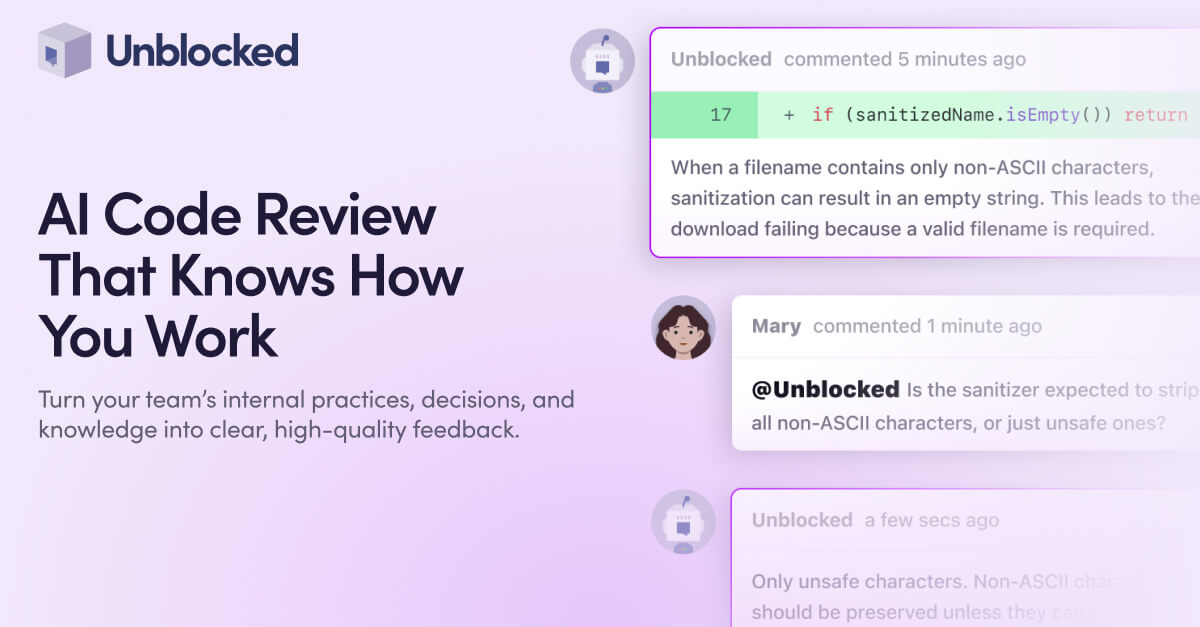
Unblocked provides AI-powered code review that understands your team's context and conventions. It draws on your repository, Slack, Jira, docs, and PR history to deliver high-signal comments.
Unblocked Code Review is an AI code review tool that understands your team's unique context and conventions, delivering high-signal, low-noise feedback. It is engineered for engineering teams who want to move beyond generic best practices and catch logic errors, race conditions, and security risks that matter. By building a knowledge graph from repositories, Slack conversations, Jira tickets, and documentation, Unblocked adapts to each team's standards rather than applying one-size-fits-all rules. Senior engineers and development managers use it to reduce rework, save tokens, and achieve mergeable code faster. The core value is simple: more signal, less noise, so every review comment is actionable and relevant.
Traditional code reviews are plagued by noise—style nits, trivial suggestions, and generic warnings that waste time and frustrate developers. Unblocked solves this by filtering feedback through the lens of the team's actual history and decisions. Instead of flagging a long line, it catches a cache TTL violation that breaks a past convention documented in Slack. This matters because senior engineers spend hours reviewing pull requests, and every irrelevant comment erodes trust and slows delivery. Unblocked ensures that the feedback that lands in a PR is the kind that prevents production incidents or architectural drift. The outcome is faster review cycles, higher developer satisfaction, and code that aligns with team practices.
Team Memory is the first major feature that sets Unblocked apart. It references your actual Slack discussions, past PRs, and documented decisions instead of applying generic best practices. For example, when a developer uses a 3600-second TTL for a cache key, Unblocked finds the Slack thread where the team decided on 300 seconds and the PR where that change was made. It then posts a comment: "The team decided to use 300s TTL for user cache in #eng-platform and PR #2847. This cache causes stale data." This works because Unblocked continuously syncs data from GitHub, Slack, and Confluence, building a living map of decisions. The benefit is that teams no longer repeat past mistakes or forget tribal knowledge.
System-Aware is the second major feature group. Unblocked understands your system's architecture and flags issues based on your patterns and constraints, not what works in theory. For instance, if a developer writes `const user = await fetchUser(id)` in a checkout flow, Unblocked recognizes that the checkout flow expects synchronous user lookups per the UserService pattern. It comments: "This checkout flow expects synchronous user lookups, as per the UserService pattern. Async calls here will break the transaction sequence." This feature draws on the knowledge graph that maps code dependencies, service interactions, and architectural rules. It prevents subtle bugs that would otherwise slip through into production.
Publisher
A
admin
Launch Date2026-02-04
Platformweb
Pricingfreemium
Domain Authority
Ahrefs DR53/100
Traffic Insights
Month2026-10
Estimated Visits12.4K
MoM Visits Growth+0.0%(+0)
Avg Time on Site-