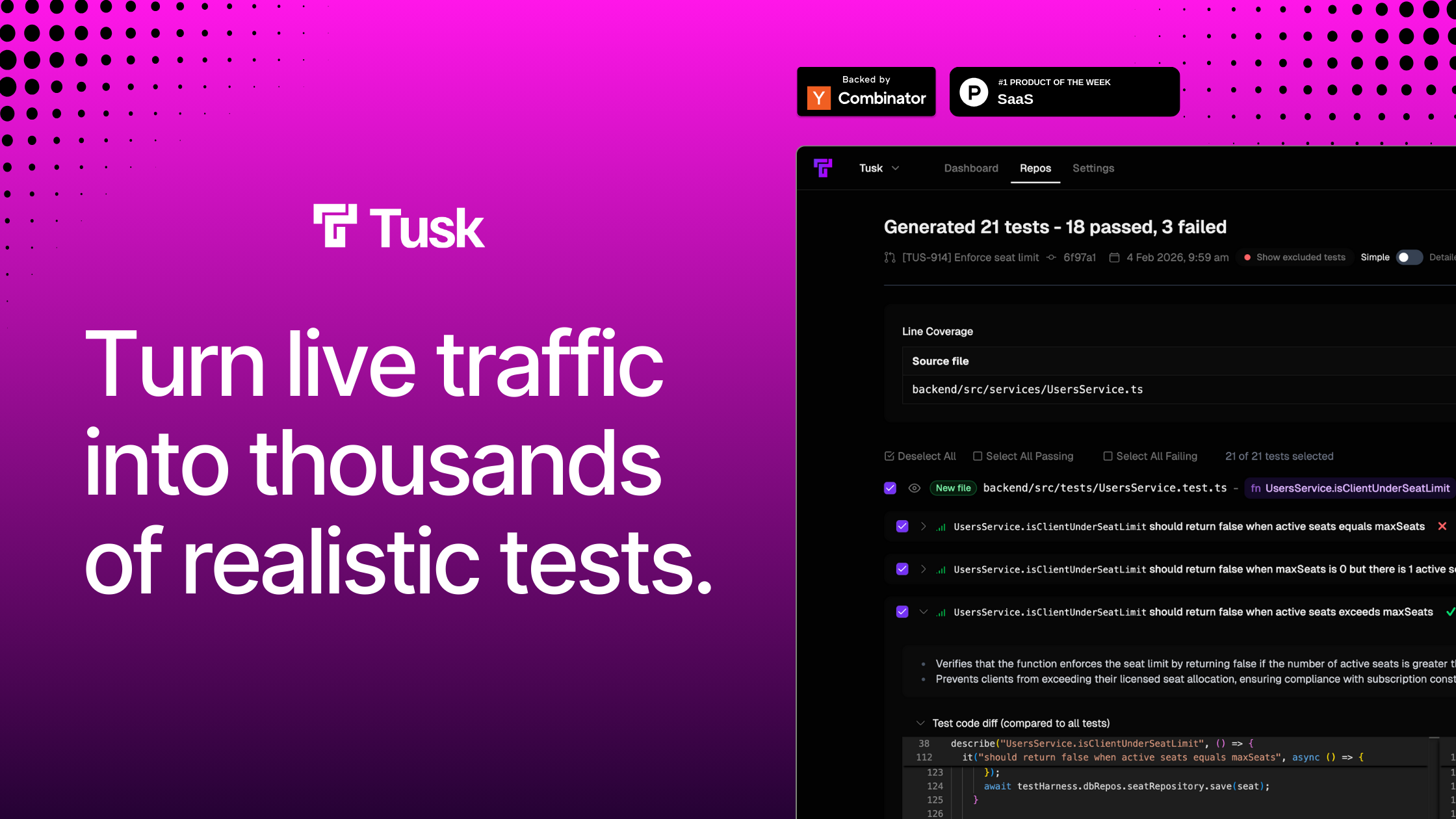
Tusk is an AI testing platform that automatically converts live production traffic into high-quality unit and API tests, serving as a robust verification layer for coding agents and human engineers alike. It is designed for engineering teams at fast-growing companies who want to accelerate development while maintaining quality. The core value proposition is its ability to generate test cases from real-world traffic patterns, covering thousands of edge cases in minutes without manual test writing. This approach tackles the persistent challenge of keeping test coverage high in fast-paced development cycles, enabling teams to ship code changes with confidence. By leveraging actual production data, Tusk ensures that tests reflect genuine user behavior and system interactions, catching regressions that synthetic tests would miss. This makes it an essential tool for any organization committed to shift-left testing and quality-first engineering.
Tusk solves the specific problem of regressions slipping through despite existing test suites. According to the platform, its tests catch real-world regressions in 43% of pull requests, highlighting the inadequacy of manual and synthetic tests. By generating tests from production traffic, Tusk covers blind spots that traditional unit tests miss. This matters because undetected regressions cause customer-facing bugs, increase maintenance costs, and slow down releases. With Tusk, teams can identify and fix functional bugs before they reach production, ensuring a stable user experience. The platform's self-healing capability further reduces maintenance overhead by automatically updating tests as business logic evolves.
Tusk Drift is a dedicated feature for API test generation that leverages production traffic to create comprehensive API tests. By recording real-world requests and responses, Tusk Drift generates test cases that validate endpoint behavior, detect contract breaks, and catch functional regressions. These tests are fully executable and integrate seamlessly into CI/CD pipelines, providing immediate feedback on pull requests before merge. The feature supports continuous API contract monitoring, alerting teams when changes to code or third-party integrations cause unexpected failures. This is crucial for organizations with microservices or heavily API-dependent systems, where even minor contract violations can cascade into major issues. With Tusk Drift, teams can ensure API reliability without writing tedious manual tests, reducing the risk of production incidents and speeding up development.
admin
CoverBot is Tusk's autonomous unit test generation feature that writes, executes, and iterates on tests without human intervention. Using live production traffic and business context, CoverBot identifies critical code paths and generates tests that cover edge cases and core functionality. When tests fail, CoverBot automatically adjusts the test logic and retries, ensuring tests are accurate and reliable. This self-iteration capability means engineers do not need to engage in back-and-forth with an AI copilot—CoverBot delivers ready-to-run tests. Real-world results from Hamming show dramatic coverage gains: 2,500 to 7,000 tests in a month, demonstrating the feature's effectiveness. CoverBot supports major unit testing frameworks and can be initiated with a simple CLI command, making it a powerful tool for any development team aiming to improve test coverage quickly.
Tusk's self-healing tests automatically update existing test suites on every commit to ensure they reflect the latest business logic. This eliminates the common problem of tests becoming obsolete or generating false positives as code evolves. When combined with Tusk's AI code review—which analyzes pull requests using production traffic context—the platform provides end-to-end quality assurance. The code review flags context-specific bugs and suggests improvements, integrating seamlessly with GitHub checks. These two features work together to maintain continuous test coverage and code quality. For engineering teams, this means less time spent on test maintenance and more confidence in releases. Self-healing tests and AI code review are particularly beneficial for fast-moving teams using coding agents, where automated verification is essential.
Tusk's workflow is designed for minimal setup and maximum autonomy. Engineers start by installing the Tusk CLI with a single curl command in their service root. Running `tusk drift setup` automatically connects to production traffic and begins observing real API calls and database interactions. The AI then generates test cases that cover edge cases, focusing on critical paths and potential regression points. These tests are executable and can be run locally or in CI, providing immediate feedback. If tests encounter errors, Tusk's autonomous agents self-iterate to fix them, eliminating manual debugging. The platform continuously maintains tests, updating them on each commit to reflect the latest business logic. This end-to-end autonomy allows engineering teams to adopt shift-left testing practices without additional overhead. Tusk integrates directly with GitHub checks, showing pass/fail status on PRs and ensuring quality gates are met before merge.
Concrete use cases for Tusk include regression testing, where the platform verifies that pull requests do not introduce new bugs by running tests derived from real production traffic. This catches regressions in 43% of PRs, preventing issues before they reach production. Safe refactoring is another key use case—teams can refactor legacy codebases with confidence, knowing that Tusk's tests will flag any unintended behavioral changes. API contract monitoring via Tusk Drift continuously validates endpoints against live traffic patterns, alerting on contract breaks. Outcomes reported by customers include DeepLearning.AI's head of engineering stating that Tusk gives engineers a sense of security when pushing code. Hamming's experience with CoverBot shows coverage gains from 2,500 to 7,000 tests in a month. These results lead to faster release cycles, higher code quality, and reduced incident rates.
Tusk is built for engineering leaders and teams at fast-growing companies, including DeepLearning.AI, Hamming, Promptfoo, Payflow, and others. The target audience includes heads of engineering, CTOs, and developers who rely on coding agents or manage large, legacy codebases. Tusk integrates with any CI/CD system and provides GitHub checks for pass/fail status. It is a CLI-based tool that works on any machine, generating tests in popular frameworks. Security is ensured through SOC 2 Type II certification. While exact pricing is not disclosed on the landing page, Tusk offers a demo and has a dedicated pricing page for interested teams. The platform's primary takeaway is its ability to autonomously generate, execute, and maintain tests using production traffic, enabling a shift-left testing culture without burdening engineers. With Tusk, organizations can ship code faster with higher confidence in quality.
Tusk is designed for engineering leaders, heads of engineering, CTOs, and development teams at fast-growing companies who want to accelerate development with coding agents while maintaining quality. It is ideal for teams struggling with test coverage, especially those with legacy codebases, and for organizations that need automated regression detection and API contract monitoring in their CI/CD pipeline. Trusted by teams at DeepLearning.AI, Hamming, Promptfoo, Payflow, and others, Tusk supports engineering cultures focused on shift-left testing and quality-first practices.