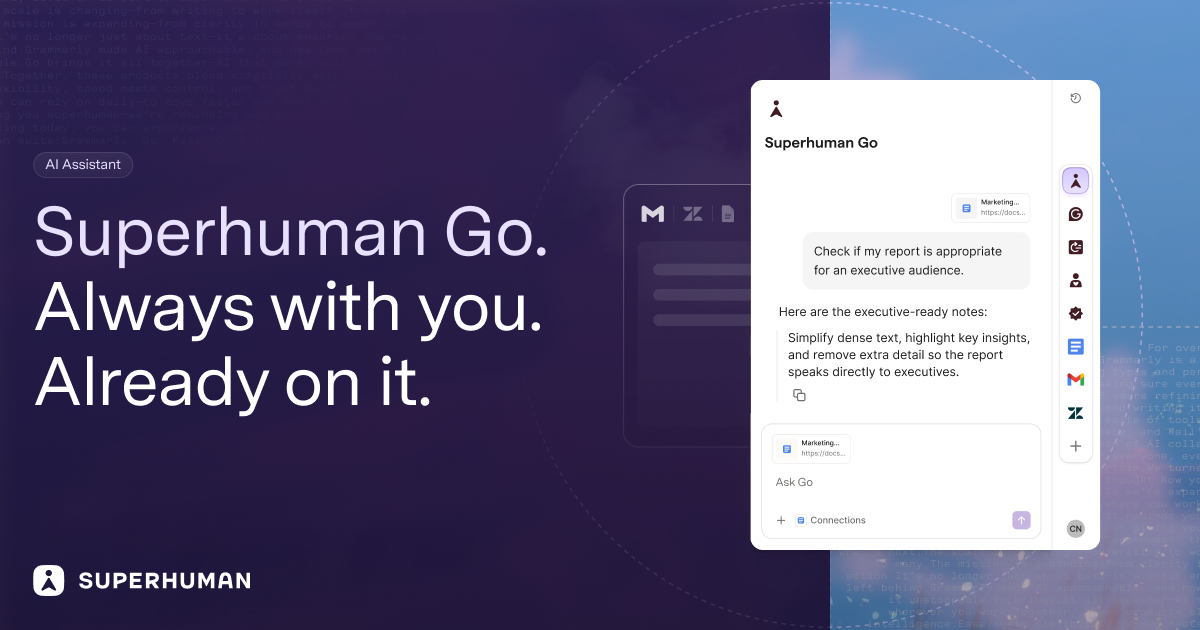
Superhuman Go is an AI assistant and agent platform that works everywhere you work and can offer help proactively across more than 1 million apps and websites. Instead of waiting for a prompt, Go automatically looks for opportunities to help you say something better or do something faster. It annotates in real time everywhere you write, pointing out where you could be clearer or more convincing, or when you are just wrong. It is built for people who communicate for a living — professionals working inside email, Slack, docs, and the browser — and for teams and schools that need trusted security and controls around AI.
The problem Go sets out to solve is the friction of general-purpose AI chatbots. ChatGPT, Claude, Cowork, and Gemini are powerful general-purpose chatbots: you open a separate window, describe what you need, and copy the result back into your work. That workflow means switching tabs, re-explaining context, and pasting answers back and forth, with prompt engineering required to get anything useful. Go is built for the opposite experience. It lives inside the apps where you already write and work, so help arrives in the flow of what you are doing. Because Go works in context, it already understands the email you are replying to, the document you are drafting, or the message you are about to send — no prompt engineering required. Rather than waiting for you to ask, Go surfaces the right suggestion at the right moment, the way Grammarly's underlines always have.
Go's most visible capability is suggestions as you type. Everywhere you write, Go annotates in real time, pointing out where you could be clearer or more convincing — or when you are just wrong. In your text, Go gives you the knowledge you need as you type: a grammatical rule, a company-approved stat, or a forgotten tidbit from last week's meeting. The assistant also works on your cursor: simply highlight text in any app and it will cue a list of actions from your favorite agents. A context-aware side chat is always at your side, ready to chat about whatever you are reading, writing, or wondering. Underpinning the writing help is Grammarly's 17 years of writing intelligence, which Superhuman maintains and brings inline wherever you are already working.
Go manages your email the way you wish you could. It sorts your incoming mail and pre-drafts replies in your voice and with your context, so you can respond in record time. The Email Assistant agent does the same work in more depth, sorting your inbox and drafting replies informed by your voice, calendar, and connected apps; it is powered by Superhuman Mail. Go is also a meeting co-host: you can ask it to handle the prep and follow-through, crowdsourcing the agenda before a team sync or auto-assigning tasks when the meeting ends. Because Go connects to your data sources, you can give it more complex tasks, such as building out a team project tracker and keeping it up to date.
Agents are your team of AI collaborators in Go, built for the common tasks that fill up your workday, like summarizing long threads, drafting reports, or finding information across tools. Go comes with a powerful set of default agents and lets you build custom ones tailored to you and your team's needs without coding or engineering experience. The default roster includes a customizable Grammarly agent — tell it which underlines you find useful and it adjusts the feedback going forward — alongside the Email Assistant, the Knowledge Checker, which searches your data sources for evidence to back up your claims and prevent you from making the wrong one, and the Daily Brief, which starts every day with a custom report based on your apps, such as deals about to close in Salesforce, Jira tickets from last night, and tasks and meetings that need your attention.
Custom Agents let you design agents for your workflows and routines, configuring them to show up as you type, on a schedule, or after an event, like when a meeting ends or someone sends you an email. Anyone on the Pro, Business, or Enterprise plans can build them through a simple chat conversation or the visual agent builder, share agents directly with teammates, or publish them to a company agent directory. For deeper integrations, the Superhuman Agents SDK lets developers build agents that plug into an organization's unique tools, systems, and workflows. And if you would rather not build, the Agent Store is a growing library of ready-made agents from Superhuman and its partners, with agents for schoolwork, sales teams, accountants, and more.
AI is only as good as the context you give it, so Go connects to the apps you use most through pre-built or custom MCP connectors — meaning everything Go says and does will be grounded in your knowledge. Go is also designed to work how you work, changing shape to meet you where you are: it can show up as an underline in a doc, a side panel in your browser, or a scheduled automation. It works in your text, in a context-aware side chat, on your cursor, and in Slack, where you can message Go like a teammate or at-mention it in a group channel for a quick answer or task. The Go app is your home base for tackling complex tasks and managing all your Go agents — a full screen where you can chat, make agents, create docs, and complete tasks.
That combination is what makes Go different from other AI assistants. Unlike assistants that require you to go to them and ask for help, Go provides proactive help and suggestions right where you are working, not in a separate window. It surfaces suggestions inline as you write, with edits, context, and next steps appearing automatically with no prompting required. It understands what is on your screen, so you never have to copy-paste or describe what you are working on. It connects to your most important apps so suggestions are grounded in your real work context, and it manages a team of AI agents — including Grammarly's embedded writing intelligence — to help when and where it is useful. Finally, it grows with you over time: you can add new agents as they are released or create your own, so Go keeps getting more useful without you having to switch tools. Nothing happens without your approval — Go suggests, and you decide.
The benefits show up in the daily work Go takes off your plate. It can draft documents inside your existing tools with inline suggestions, coordinate meetings end to end from scheduling to follow-up, manage tasks across tools like email, Asana, and Jira, and surface past decisions or context on demand. All of this happens inside the apps you already use, without copy-pasting or tab switching, which reduces your daily admin tasks. Because Go works within the tools and platforms you have already invested in, it increases their ROI rather than replacing them. And if you do want to migrate from another AI assistant, it is simple: ask your existing tool to summarize what it knows about you, paste that into Go, and pick up right where you left off.
Concrete scenarios illustrate where Go fits. While replying to a customer email, Go sorts the message, drafts a reply in your voice using your calendar and connected apps, and flags phrasing that could be clearer. Before a team sync, you ask Go to crowdsource the agenda; when the meeting ends, it auto-assigns the follow-up tasks. Each morning, the Daily Brief delivers a custom report drawn from your apps — deals about to close in Salesforce, Jira tickets from last night, and the tasks and meetings that need your attention. While drafting a report, the Knowledge Checker searches your data sources for evidence to back up your claims. In Slack, you at-mention Go in a group channel for a quick answer or task. And for a team project tracker, Go builds it out and keeps it up to date from your connected data sources.
Go is aimed at professionals who need real results rather than just a chatbot, and at teams and schools that need security and controls. It does not require switching tools or platforms; Go works within the tools you already use and have invested in. It is available via the Superhuman desktop app for Windows and Mac, through browser extensions for Chrome and Edge, on mobile for iOS and Android, and in your browser with nothing to install. Superhuman Go is free to start by signing up for a Superhuman account and is available in all Superhuman plans; visit the pricing page to compare plans for individuals or teams. On trust, Superhuman maintains Grammarly's 17-year track record of safe, responsible AI, trusted by over 40 million people, and you control whether your content is used to train Go's AI models — for Enterprise users, AI training is off by default.
Superhuman Go's core promise is proactive, in-context assistance. Instead of another destination you have to visit with a prompt, it works where you do — annotating your text, drafting your replies, prepping your meetings, and running a team of agents you can extend over time. Free to start, included in every Superhuman plan, and grounded in your connected knowledge, Go is built to make the communication and work you are already doing faster, clearer, and more on-brand.
Publisher
A
admin
Launch Date2026-09-28
Platformweb
Pricingfreemium
Traffic Insights
Month2026-09
Estimated Visits3.3M
MoM Visits GrowthN/A
Avg Time on Site-
MoM Time GrowthN/A
Global Rank#10,760
Bounce Rate-
Updated 2026-09-28