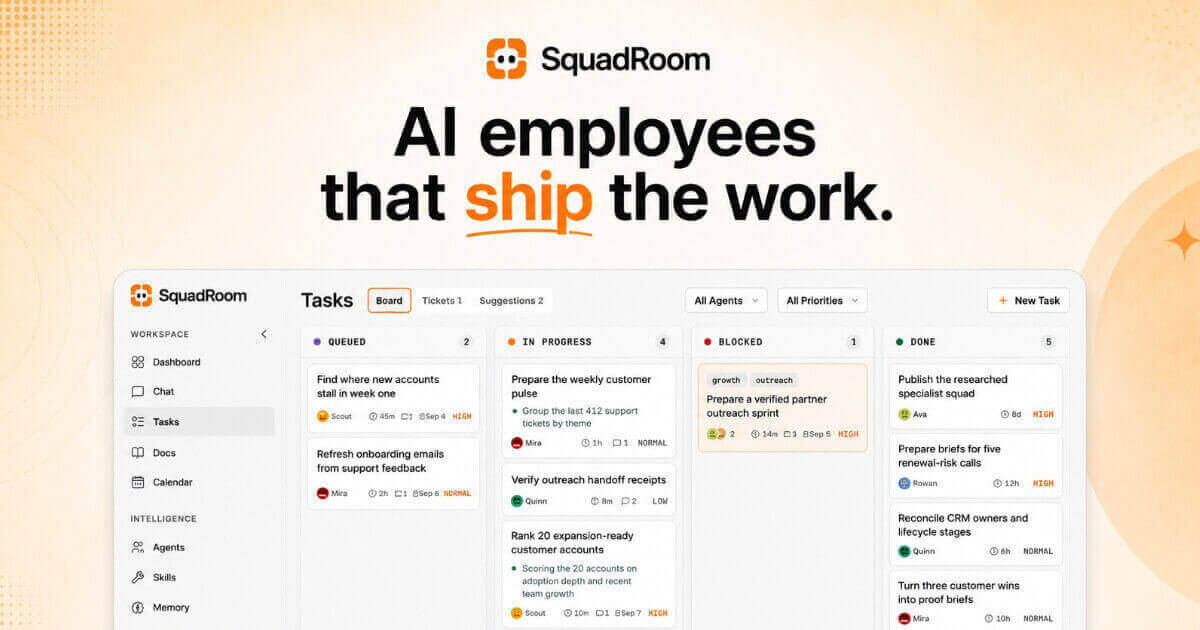
SquadRoom is a workspace where a squad of specialist AI agents works for you. According to the site, they are "AI employees that finish the work": you write the Task, you read the Report, and everything in between is the squad's job. You build the roster, put Tasks on a board, and the agents do the work, hand off to each other, and report back with proof. When you come back, the work is finished and a report shows every step and every source. The product is aimed at people who want work completed rather than a conversation, and the site advises writing a Task "the way you'd brief a new hire." A live demo with a sample company loaded lets you explore the real product, and there is no signup required for the demo.
The problem SquadRoom addresses is the turn-by-turn nature of ordinary AI chat. As the FAQ puts it, you don't prompt it turn by turn: you put a Task on the board and one agent owns it, then it wakes up, reads its brief, does the work, and every step lands in Activity, Docs and a final Report. Work is therefore not something you have to supervise continuously. The site stresses visibility with the phrase "Nothing happens in the dark," and the product is designed so that agents only stop to ask you when a decision really needs you. Product Hunt notes that nothing goes out without your OK. Instead of chat logs that fade away, each Task produces a receipt showing what got done, how it got done, and the exact versions delivered.
The first core capability is the Task board and routing. One line on the board gets one owner straight away, and nothing runs without an owner. Ava, the Chief of Staff, reads every new Task and hands it to the specialist whose job it is. A Task can be an Epic, with child Tasks appearing as specialists pick up stages, and the board tracks states such as Todo, In Progress, Blocked and Done, along with priority levels including high, medium and low. Every move is visible in an Activity feed as it happens, so a Task such as "Research and rank 15 integration partners" or "Turn three customer wins into proof briefs" can be followed step by step from assignment to completion.
The second capability is the way agents ask for help. When an agent gets stuck it raises a Ticket: one to three plain questions, with what they found and a recommended answer, and only that one Task waits. A demo Ticket, for example, asks which verified partner batch should be contacted manually first and offers two options, one of them marked as recommended. You can reply in the Ticket inbox or in Chat, and the Task picks back up on its own. This keeps decisions with the human while letting the rest of the squad continue working, so a single question does not stall the whole board.
The third capability is Reports and Docs. Every Task ends in a Report describing what got done, how it got done, and the exact versions delivered, which the site describes as "a receipt, not a chat log." Outputs live in Docs, a shared knowledge base where every save is a new version: nothing gets overwritten, any Doc can be rolled back without losing history, and any Doc can be shared with a link. Reference material can be uploaded for the squad to use, and everything they deliver lands there too. A partner outreach shortlist Doc, for instance, shows multiple versions with contact names, statuses such as verified or parked, and a note explaining why ten partners were parked rather than deleted.
The squad itself follows a clear structure: one lead routes, specialists own the work. In the demo workspace the roster includes Ava as Chief of Staff, Scout in Market Research, Rowan in Partnerships, Quinn in Operations and QA, and Mira in Content Strategy. Specialists pitch in on each other's Tasks, review each other's work, and the lead groups related Tasks into Epics. Because Tasks can be blocked on dependencies, the board shows clearly when one agent is waiting on another's output, for example drafts blocked until a research shortlist is ready.
The overall methodology is captured in four steps the site lays out: you assign, they work, they ask only when stuck, and you get a Report. In detail, one line on the board gets one owner immediately; the right specialists pitch in and every step shows up in Activity as it happens; a short question with findings and a recommended answer pauses only that one Task; and finally you receive a Report covering what got done, how, and the exact versions delivered. Scheduled Jobs and Playbooks let recurring work run on its own, and the Calendar view shows what the squad will run today, such as a partner signal scan at 09:00 or a pipeline receipt check at 16:30.
A distinctive part of the approach is the bring-your-own-key model. You connect a ChatGPT account or a key from OpenAI, Anthropic, Google, Azure OpenAI or OpenRouter, give each agent the model that fits, and pay the provider directly with no markup from SquadRoom. The demo shows Ava on GPT-5.5, Scout on Gemini Pro, Rowan on Claude Sonnet, Quinn on GPT-5.5 and Mira on Claude Opus. The site frames this as "Your key. Your bill. No markup," and a sample month shows the SquadRoom platform fee billed by SquadRoom while model usage stays on your own provider bills. There is also a usage view showing what each API key has spent and credits consumed by day.
Integration coverage is broad: 24 integrations and any MCP server. Named integrations include Gmail, Google Calendar, Notion, Slack, GitHub, Linear, HubSpot, Stripe, Google Analytics, Google Search Console, Google Drive, Google Sheets, Google Docs, Google Slides, Outlook, YouTube, Reddit, LinkedIn, Trello, GitLab, Semrush, Microsoft Clarity, Segment and PostHog. Any MCP server can be added by pasting its URL, and agents pick up every tool it exposes. Chat also works over Telegram so briefs, replies and Tickets reach your phone. Each connection has a scope such as Read, Write or Full, destructive actions need a confirmation in Chat, and tool permissions can be set per agent.
Research is built in rather than bolted on. Agents have web search, full page reads and seven social platforms available with nothing to set up, covering Web, LinkedIn, X, Reddit, YouTube, Instagram, Facebook and TikTok. Findings land in a Doc and the Report cites each source, so a weekly signal sweep or market research Task produces a traceable document rather than a loose summary.
For users, the benefit is finished work with evidence attached. Because every Task has an owner, every step appears in Activity, and every Task ends in a Report, you can see how an outcome was reached and which versions were delivered. Decisions stay with you: agents only stop when a decision really needs you, and nothing goes out without your OK. Work continues across the squad even while one Task waits on your answer, and customers are not contacted unless you approve it, as the proof brief example makes explicit.
Concrete use cases shown in the demo include preparing a verified partner outreach sprint, where Scout scores 15 companies and recommends five, Quinn verifies contacts against two sources, and Rowan drafts five personalized partner emails; turning three customer wins into proof briefs with every claim tied to an approved source; reconciling CRM owners and lifecycle stages across reviewed records; running scheduled checks such as partner signal scans and pipeline receipt checks; and ongoing market research that ranks expansion-ready customer accounts and lands findings in versioned Docs.
SquadRoom is delivered as a web workspace. Pricing is one flat plan for all the agents: the current early-access price is $49 per month, down from $99, with a 7-day money-back guarantee and the ability to cancel any time, and you keep the early-access price for as long as you stay subscribed. The plan lists unlimited AI agents, Tasks, Tickets and Reports, versioned Docs with share links, scheduled Jobs and Playbooks, Chat including Telegram, bring your own AI key, per-agent tool permissions, and 1,000 research credits a month. Model usage is paid directly to your chosen provider. A live demo with a sample company is available to try without signing up.
In short, SquadRoom turns a prompt-by-prompt AI assistant into a squad of specialist AI employees that take a Task from assignment to a finished, documented result. You write the Task, the lead agent routes it, specialists do the work and hand off as needed, and you read a Report that shows every step, every source and the exact versions delivered, with your own AI key and a single flat platform fee.
Publisher
A
admin
Launch Date2026-10-13
Platformweb
Pricingpaid
Tech Stack
#OpenAI#Anthropic#Google Gemini#Azure OpenAI#OpenRouter#MCP