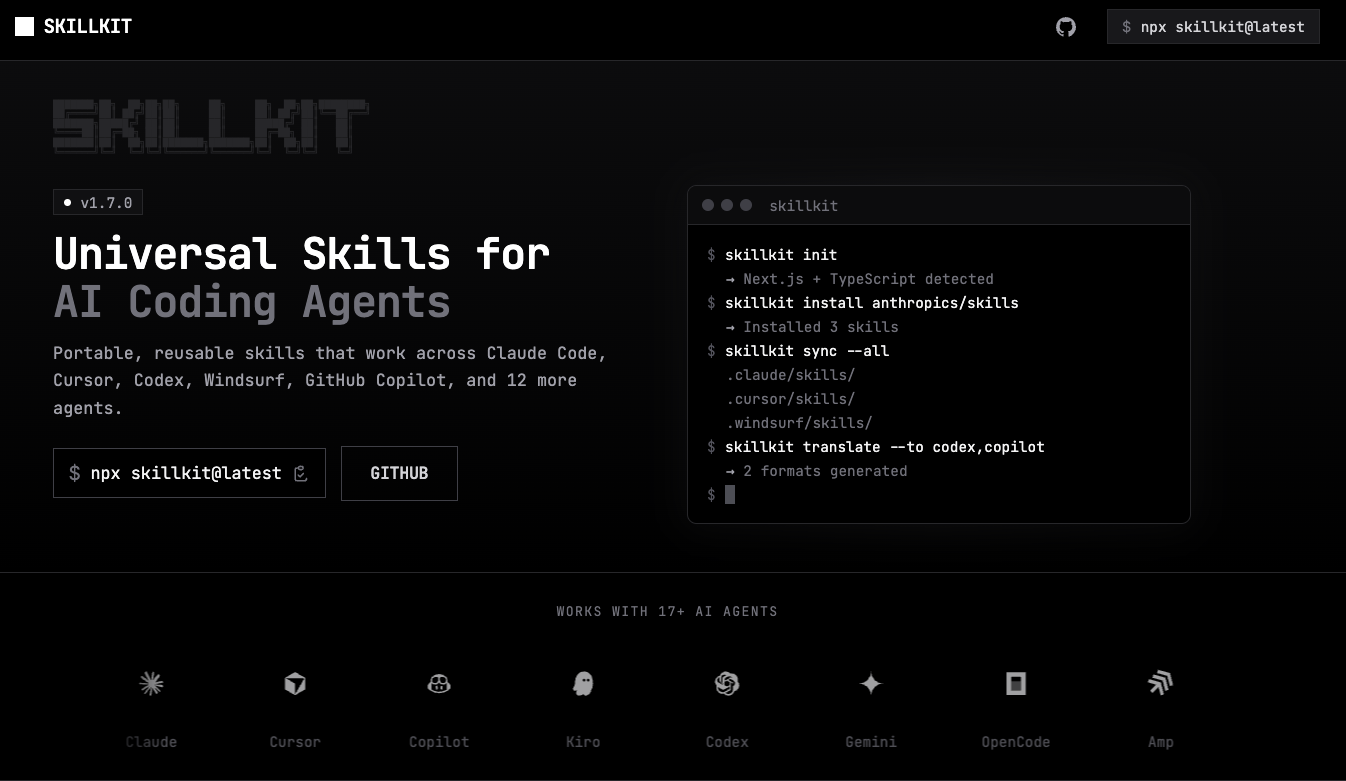
SkillKit is a universal skill platform for AI coding agents, acting as the "npm for agent skills." It is designed for developers and teams who need to create, manage, and distribute skills across a growing ecosystem of 46 different AI agents, including Claude, Cursor, Codex, Windsurf, and others. The core value proposition is simple: write a skill once using SkillKit's unified format, and it automatically becomes compatible with all supported agents. This eliminates the fragmentation caused by proprietary skill formats, where a skill built for one agent cannot be used on another without manual rewriting. With features like auto-translation to 45 agent-specific formats, persistent session memory, and a hierarchical skill tree with over 400,000 community-contributed skills, SkillKit provides the infrastructure for consistent, reusable, and intelligent agent capabilities.
The primary pain point SkillKit addresses is the stark fragmentation in the AI coding agent landscape. Developers spend significant time writing skills for specific agents like Claude Code, only to discover those skills are incompatible with other agents their team uses, such as Cursor or Windsurf. Onboarding new team members becomes a weeks-long process of manually configuring each agent with the right instructions and best practices. Moreover, knowledge gained across sessions is lost because agents lack persistent memory, forcing developers to repeat the same context. SkillKit solves this by providing a unified platform where skills are automatically translated to 45 formats, ensuring any skill works on any agent. The shared .skills manifest, managed via Git, guarantees that every team member has identical capabilities, reducing onboarding friction to a single command. This matters because it directly reduces duplication of effort, accelerates development cycles, and maintains consistency across large teams.
SkillKit includes a Smart Recommendations engine that analyzes your codebase to suggest relevant skills from a repository of over 400,000 community-contributed skills. This feature works by scanning your project's dependencies, file structures, and patterns, then matching them against the skill collection. For example, if your codebase uses React, SkillKit will recommend Vercel React Best Practices or similar skills. The Skill Tree organizes these 400,000+ skills into a hierarchical taxonomy with 12 categories, such as Frontend, Backend, DevOps, and Documentation, making discovery intuitive. Developers can browse by category or search directly. This reduces the time spent searching for best practices and ensures that teams adopt proven patterns from the community. The combination of AI-driven recommendations and structured categorization transforms skill discovery from a manual chore into a streamlined, context-aware process.
admin
A standout feature is Auto Translation, which allows developers to write a skill once in SkillKit's format and automatically have it translated into 45 different agent-specific formats. This means a single skill works on Claude, Cursor, Codex, Gemini, and 42 other agents without any manual conversion. The translation process handles differences in instruction syntax, tool definitions, and context window management. Complementing this is Primer, a tool that auto-generates agent instructions for all 46 agents directly from your codebase. By analyzing the project's environment, dependencies, and configuration, Primer produces optimized .md instruction files that each agent can read. This eliminates the tedious task of manually writing per-agent instructions, which often become outdated. Together, Auto Translation and Primer ensure that not only skills but also the meta-instructions for agents are consistent and up-to-date, significantly reducing configuration overhead.
SkillKit provides persistent session memory, enabling AI agents to learn and retain information across sessions and projects. This memory is stored and accessible to all agents using the platform, allowing for continuous improvement. The Security Scanner employs a 46-rule engine to detect prompt injection, secrets, and malicious patterns in skills before deployment, ensuring that only safe code reaches agents. Testing is built-in with a test framework that supports assertions, allowing developers to validate that skills behave correctly under various scenarios. For continuous integration, SkillKit offers CI/CD integrations with GitHub Actions, GitLab CI, and pre-commit hooks, automating the testing, translation, and deployment of skills. These features transform skill management from a manual, error-prone process into a robust, automated pipeline that ensures quality, security, and consistency across the entire agent ecosystem.
SkillKit operates as a command-line tool that developers install via npm (npx skillkit@latest). The workflow begins with creating or finding skills: developers can generate skills from natural language using the `skillkit generate` command, which pulls context from documentation, codebase patterns, and the marketplace. Skills are managed using a .skills manifest file that defines which skills are active, ensuring version control and team consistency. The `skillkit translate` command converts skills to formats for any of the 46 agents. For team synchronization, `skillkit team init` creates a shared manifest, and `skillkit team share` distributes it via Git. Advanced workflows include `skillkit mesh init` for setting up a mesh network for distributed agents, enabling encrypted P2P messaging and peer trust. The platform also exposes REST and MCP APIs, plus a Python client, for runtime discovery and integration into existing development pipelines.
For the multi-agent developer who has built skills for Claude Code but needs to use Cursor and Windsurf, SkillKit's translation capability allows a single command (`skillkit translate --to cursor,windsurf`) to instantly make all skills compatible, saving hours of manual conversion. A team lead facing inconsistent skill versions across developers can use `skillkit team init` to create a shared .skills manifest, ensuring everyone runs the same capabilities and reducing onboarding time from weeks to minutes. A new project starter can run `skillkit primer --all-agents` to auto-generate optimized instructions for all 46 agents, eliminating the need to manually configure each new project. An enterprise architect managing multiple machines can deploy a mesh network with `skillkit mesh init` to synchronize agents, maintain context, and enable inter-agent communication. The outcome is reduced duplication, faster setup, and consistent, high-quality agent behavior across the organization.
SkillKit is built for solo developers, team leads, and enterprise architects who work with AI coding agents such as Claude, Cursor, Codex, Windsurf, and many others. It supports 46 agents across various categories, with compatibility scores shown in a detailed matrix. The tech stack is lightweight: a Node.js CLI that can be run via npx, plus REST and MCP servers for runtime integration. SkillKit is open-source and free to use, with community contributions from sources like Anthropic Official, Vercel Labs, and Expo. While pricing information is not disclosed, the core platform is accessible to anyone with npm. In summary, SkillKit is the universal infrastructure for AI agent skills, solving fragmentation, enabling write-once-deploy-anywhere, and providing the tools needed for scalable, secure, and consistent AI agent development.
Solo developers, team leads, and enterprise architects working with AI coding agents such as Claude, Cursor, Codex, Windsurf, and others. It is ideal for those who need to manage skills across multiple agents, ensure team consistency, and streamline onboarding. Also suitable for DevOps engineers integrating skill management into CI/CD pipelines, and organizations wanting to standardize agent capabilities across distributed teams.