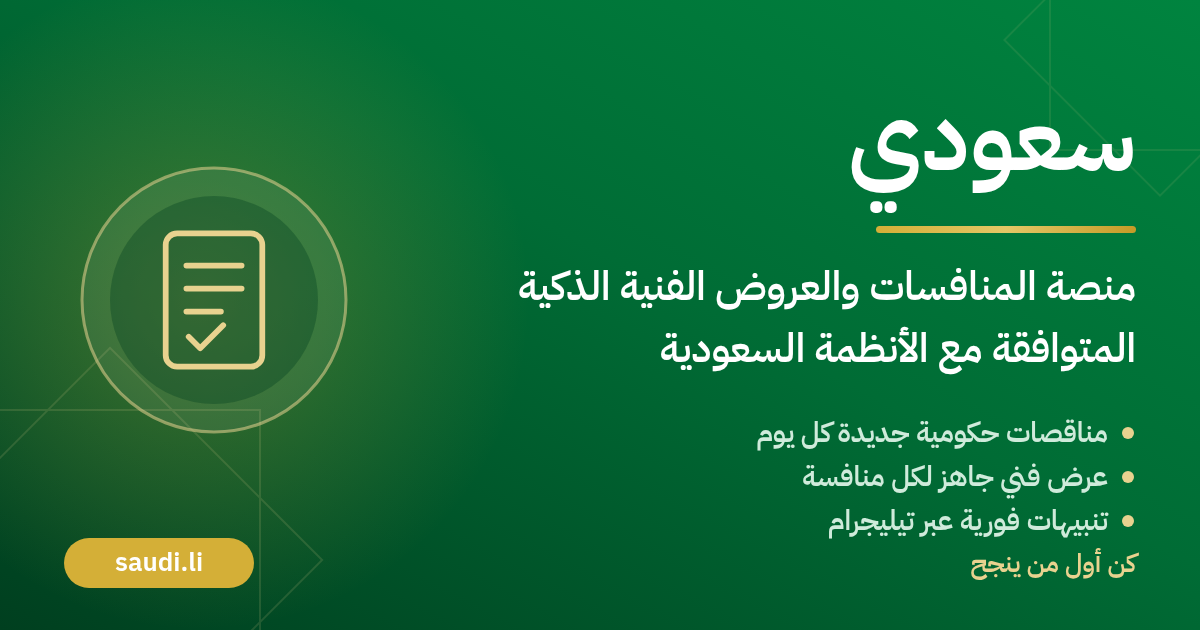
Saudi is a platform for Saudi government tenders that lists open Etimad tenders daily and prepares a ready, editable Arabic technical proposal for each one, aligned with the Government Tenders and Procurement Law. It is built for two audiences: suppliers and contractors who bid on tenders, and entities or companies that issue tenders themselves. For bidders, Saudi converts a selected tender into a technical proposal written for that tender's specific scope — including the implementation methodology, a compliance matrix, and the work team — and delivers it as an editable Word file. For buyers, it provides a specification-book builder that drafts a full twelve-section RFP in official Arabic, also in Word. The platform's stated purpose is to help suppliers showcase their competence and win tenders with smart technical proposals that comply with Saudi regulations, rather than starting from a blank page for every competition.
Preparing a technical proposal for a Saudi government tender is a document-heavy task. Each competition carries its own scope, its own deadlines, and its own requirements under the Government Tenders and Procurement Law, and the proposal has to be written in official Arabic. Saudi describes its starting point as the alternative to beginning from a blank page for each tender: the proposal is drafted on the tender's scope and linked to its compliance matrix. The platform also references the regulatory material relevant to documents — guarantees, penalties, and local content — and lists automated auditing of statutory percentages among its capabilities, since those ratios are details that must be right before a submission can be accepted.
On the tender side, Saudi publishes the latest live tenders and states that the list is updated every hour. Each listing carries the sector (for example information technology, supply, maintenance and operations, or construction and contracting), the remaining days and the exact submission deadline, the issuing entity, a description of what the competition aims to achieve, the expected contract duration, and the location of execution. Registered users can search the list by sector and by keyword rather than scrolling through everything. New opportunities can also arrive as instant tender alerts on Telegram, so a supplier hears about a matching competition without returning to the site every day.
For each live tender, Saudi provides a technical proposal model written specifically for that tender's scope, and users can also generate a custom proposal from their own company's experience, similar projects, and actual team. The generated document covers the implementation methodology, the compliance matrix that maps the offer against the requirements, and the work team. The output is an Arabic technical proposal that the user downloads as an editable Word file, adds their own touches to, and submits. Because the proposal is tied to the tender rather than being generic text, the supplier is not rewriting the same generic introduction for every competition.
Generating a proposal follows three steps. First, the user chooses a competition from the live tender list, or searches by sector and keyword. Second, the user enters their company data — experience, similar projects, team, and certificates — and that information is saved so it can be reused the next time. Third, the user downloads the audited technical proposal in Word format for final editing and submission. Saving the company profile once means the same facts feed every later proposal instead of being retyped for each new competition.
Saudi describes an independent audit step before a document is made available: it is reviewed by a different model, and an automated check verifies statutory percentages. That percentage check matters because tender documents and proposals contain ratios fixed by regulation, and an error there can undermine an otherwise strong offer. Automated auditing of statutory percentages is listed among the core capabilities alongside the hourly-updated tender list, proposals written for the tender scope, and the editable Word output, so quality control is presented as part of the generation flow rather than a separate service.
For entities and companies that issue tenders, the specification-book builder writes the requirements the user describes into a twelve-section specification book. The sections named in the content include guarantees, penalties, local content, scope of work, and the bill of quantities, and the document is delivered in Word format. Buyers can build a full twelve-section RFP from scratch or start from sector templates instead. This mirrors the bidder-side workflow: the buyer supplies the project inputs, the assistant drafts in official Arabic, and the result is a document tailored to the specific scope rather than generic text.
Saudi also offers a library of ready-made specification-book templates. Each template is described by sector, title, and a summary of what it covers — for example a template for supplying, installing, and operating desktop and laptop computers with three years of warranty and technical support, compliant with the Government Tenders and Procurement Law, containing twelve sections and eight line items in the bill of quantities. Templates state their section count and how many items their bill of quantities contains. One IT template is offered as a free sample, other templates are shown at 5.8 SAR with an 80% discount, and a White Friday promotion offers 80% off all files and packages with code FRIDAY.
The document pipeline is described in four stages. Inputs come either from the project requirements entered in the specification-book builder or from a real tender announcement in the supplier workflow. Relevant regulatory material is then retrieved — guarantees, penalties, and local content. Drafting follows, written in official Arabic and tailored to the specified scope rather than being generic text. Finally, an independent audit runs: a different model reviews the draft and an automated check inspects the statutory percentages before the document is made available. That combination of retrieval, scope-specific drafting, and independent review is the platform's stated method.
For suppliers, the outcome is a technical proposal ready during minutes rather than after a long drafting cycle, written in official Arabic and aligned with the Government Tenders and Procurement Law, with a compliance matrix already built and statutory percentages checked. For buyers, the outcome is a twelve-section specification book in Word that can be edited and issued. Both sides receive an editable Word file rather than a locked format, so the document can be reviewed, adjusted, and signed off by the organisation before it is submitted to a tender portal or published to bidders.
Concrete examples from the platform show the range of work it supports. A competition from the Insurance Authority for developing electronic legal-affairs services on the Seer platform, covering process automation and approval tracking to reduce legal risk and improve decision-making, with a 12-month execution period, no material supply items, and execution in Riyadh. A Saudi Water Authority supply competition for warehouse materials, shelving, and equipment for the Ras Al Khair production system, with a 180-day contract and execution in Ras Al Zour in the Eastern Region. A Ministry of Hajj and Umrah competition for vehicle washing and care services for 2027, lasting one year and covering Riyadh, Makkah (Jeddah and Makkah), and Madinah. Naval-base maintenance competitions in Jubail, where bidders must submit separate technical and financial files. Each of these can be turned into a generated technical proposal from the tender page.
Saudi is aimed at suppliers and contractors bidding on Saudi government tenders and at entities and companies that issue tenders. Sign-up is by Google account only, with no passwords, and the site states that no data beyond name and email is accessed. Registration is free and includes 3 credits, enough to generate a first technical proposal, and the platform also mentions a free 7-day trial. Access is through the web, with live tenders listed daily, proposals generated from saved company data, and specification books built section by section.
Overall, Saudi positions itself as a single place where a Saudi supplier can find a live Etimad tender, generate an Arabic technical proposal written for that tender's scope with a compliance matrix and work team, have statutory percentages checked, and download the result in editable Word — while buyers get the matching ability to draft a twelve-section specification book from the same regulatory reference.
Publisher
A
admin
Launch Date2026-11-28
Platformweb
Pricingfreemium