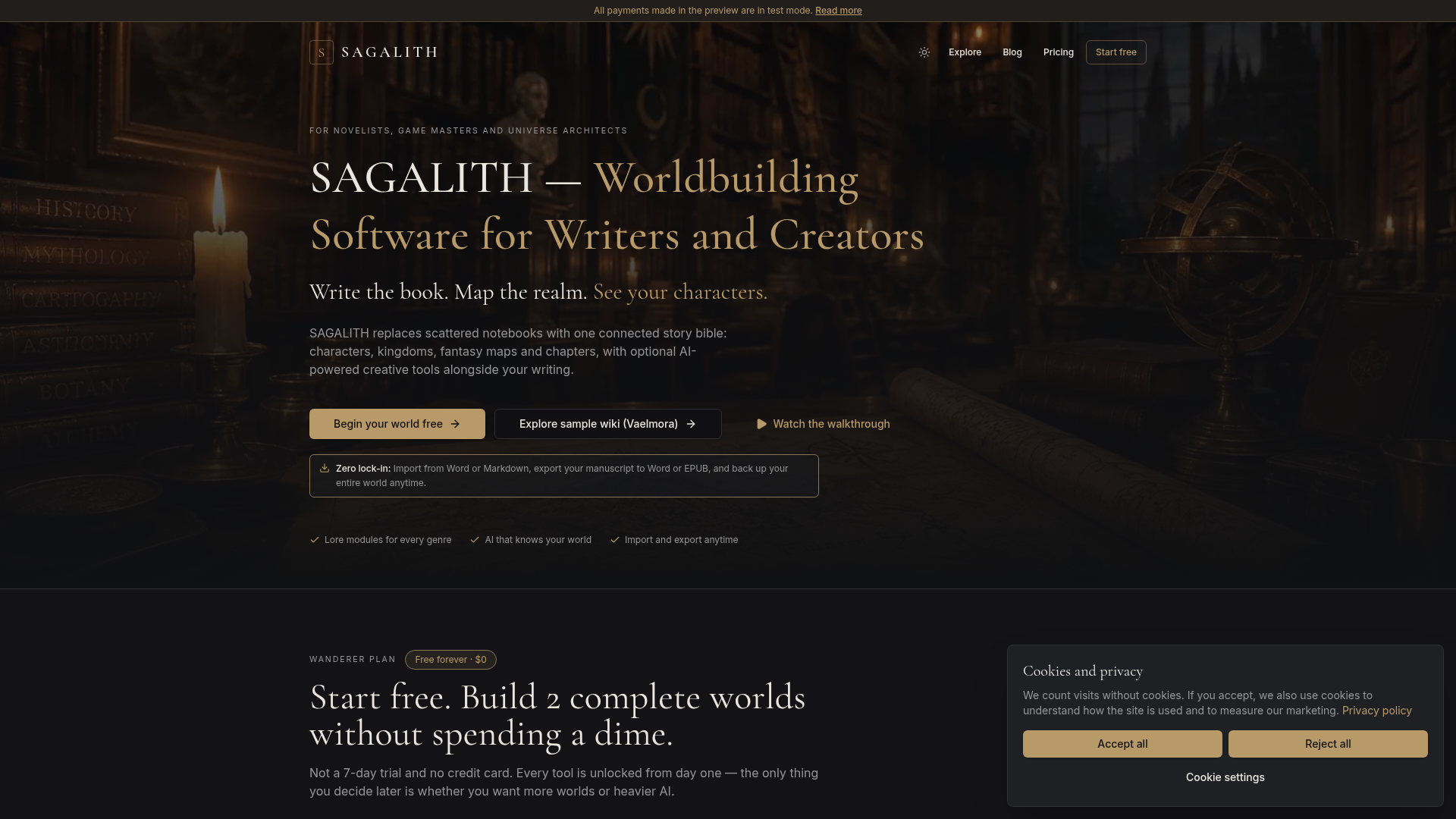
SAGALITH is worldbuilding and creative writing software designed for novelists, game masters and universe architects. It combines a connected story bible with a manuscript editor, so characters, kingdoms, fantasy maps and chapters live in one place rather than across scattered notebooks. The platform is built around three simple actions stated on its homepage: write the book, map the realm, and see your characters. Optional AI-powered creative tools sit alongside the writing rather than replacing it, and a free Wanderer plan lets anyone begin a world without a credit card. The promise is a single archive that grows with the story, from a first character name to a full manuscript and a publishable wiki.
The problem SAGALITH addresses is stated plainly: scattered notebooks. Worldbuilders typically accumulate characters, maps, timelines and lore across documents, files and paper, then struggle to keep a long manuscript consistent with that material. SAGALITH replaces those scattered notebooks with one connected story bible in which entries link to one another and to the chapters being written. Because the archive sits beside the manuscript rather than in a separate app, a writer can open the lore panel mid-scene and check a fact while drafting. For genres with heavy invented detail — fantasy kingdoms, star systems, cyberpunk megacorps, mystery case files — that connection is what keeps the world internally coherent as it grows.
The manuscript module is described as a distraction-free editor with chapters grouped into parts and acts. Beat sheets check pacing, and the editor supports word goals and autosave. Writers can import a Word manuscript and keep going without retyping, open the lore panel while inside a scene, and let the editorial AI review passages against the real world that has been built. A consistency check is included specifically to catch contradictions, which matters most in long series where details accumulate over hundreds of pages. Because the manuscript lives in the same archive as the lore, editorial feedback can be grounded in the actual established facts of the world rather than in generic writing advice.
The Atlas handles geography. Map Studio lets creators draw maps by hand — land and sea, mountains, forests, rivers and borders — with no AI required. Alternatively, a map can be painted with AI or uploaded as an existing image. Pins dropped on the map link to places and people in the archive, so a harbor city or a drowned cathedral becomes a navigable entry rather than a label. The stated zoom range runs from continent down to tavern, which means the same map can serve both an overview of a realm and the specific room where a scene takes place. Linking map pins to entries keeps geography tied to the characters and events that reference it.
The Archive is the core of the story bible: every entry linked to every other. Lore modules change with the genre, so science fiction worlds get star systems, cyberpunk worlds get megacorps, mysteries get cases and clues, and horror gets threat files. Entries carry genre-appropriate fields — a fantasy queen might record status, succession law and heir, while a starship captain records ship and FTL capability, and an occult detective records alibi and dread level. Alongside the entries sit family trees, a timeline and a connection map. Users can also ask the archive a question, turning stored lore into a queryable reference instead of a folder of documents.
Visual Studio addresses character appearance. A creator locks a character's visual identity, then generates portraits, gear and reference sheets that stay consistent — the same face every time, as the product puts it. The stated options include locked identity, reference sheets and five art styles. AI help is available on every field: for a name, a creed or a backstory, the system suggests ideas that fit the established world, or drafts a full entry from a one-line concept. AI is optional throughout, and the free plan includes 50 AI credits per month covering brainstorming, archive questions and entry drafts, refilled monthly whether or not the previous month's credits were used.
Structurally, SAGALITH works by linking rather than storing. Characters tie to the people and places around them, map pins tie to entries, and the manuscript sits alongside the same archive. Author-only secrets are held separately from public material: each sample character carries a hidden author secret that is explicitly kept out of the public wiki. That split lets a creator publish chosen entries as a clean public wiki for readers and players while keeping the revelations of the plot private. The result is one studio with four connected parts — manuscript, atlas, visual studio and archive — rather than four tools that happen to share a login.
The stated benefits centre on continuity and control. Contradictions get caught by the consistency check, portraits stay visually consistent, maps stay linked to lore, and editorial AI reviews passages against the real world. Zero lock-in is emphasised repeatedly: writers can import what they already have from Word, Markdown, CSV or JSON files, and export again as Word, EPUB, Markdown, print-ready pages or a full JSON backup of the entire world. Export is free on every plan, including the free tier. For authors preparing for beta readers, print and Word export are called out directly; for game masters, the public wiki is the delivery mechanism for players.
Use cases map to three named audiences. Authors import a Word manuscript and write beside their encyclopedia, use the consistency check on long drafts, and export to Word, EPUB or print for beta readers. Game masters build a campaign world and publish chosen entries as a public wiki for players, keeping secrets private. Game and screen writers build settings with genre modules suited to their material. Genre examples run across fantasy (Queen Oriane Varr of Ostrabel), science fiction (Captain Kaelen Voss and the Horizon Fleet), cyberpunk (information broker Valerie Zero) and horror and mystery (Inspector Arthur Vance of Ashgate Yard). A read-only sample world, Vaelmora, can be explored without an account.
Target users are novelists, game masters, game and screen writers, and universe architects generally. Pricing has three stated tiers. Wanderer is free forever at $0 and includes two complete worlds with unlimited characters, places, chapters and notes in each, 50 AI credits every month, every tool unlocked from day one, and free export. Chronicler costs $9 and Archon costs $19, positioned for users who want unlimited worlds or heavier AI. No credit card is required to start, and the free plan is described as not a seven-day trial. SAGALITH is accessed through the web, and a blog of worldbuilding and creative writing guides sits alongside the product.
SAGALITH's primary value proposition is simple: one connected story bible instead of scattered notebooks, with the manuscript, the map and the cast living in the same archive. Worldbuilding modules adapt to genre, maps link to entries, character visuals stay locked and consistent, and AI remains optional — available as a helper on every field rather than a requirement. Import from Word, Markdown, CSV or JSON and export to Word, EPUB, Markdown, print or a full backup at any time, on any plan. Start with a name; the archive grows with you.
Publisher
A
admin
Launch Date2026-11-21
Platformweb
Pricingfreemium