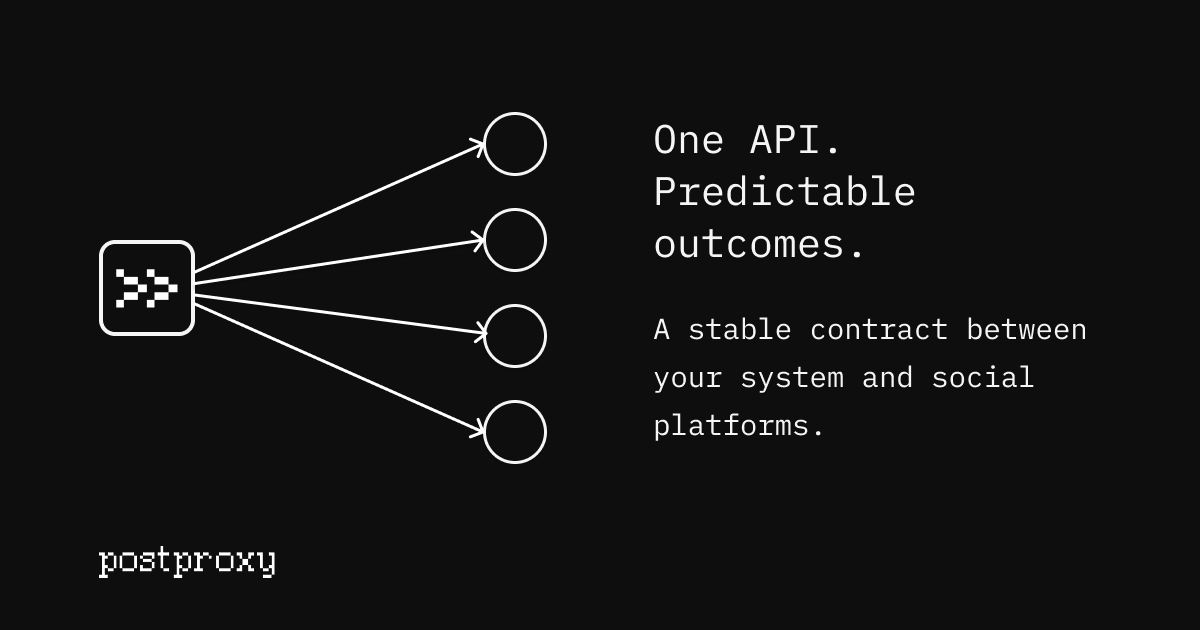
Postproxy is a unified API for publishing to social media platforms. It replaces individual platform integrations and handles platform-specific failures at publish time.
Postproxy is a unified social media API that replaces the need for individual platform integrations with a single, cohesive interface for publishing, managing comments, responding to direct messages, and reviewing insights across all major social networks. It is designed for developers building social features into SaaS products, automation engineers creating reliable content pipelines, agencies managing multiple client accounts, and marketers who need straightforward social media management without technical overhead. The core value proposition is eliminating weeks of per-platform integration work by providing one REST API that abstracts away the idiosyncrasies of each social network's rules, rate limits, and authentication flows. With Postproxy, teams can ship social capabilities in under 30 minutes instead of months.
Every social platform has its own API, authentication mechanism, rate limits, and error handling quirks. Developers typically spend weeks integrating each one, dealing with App Review processes that take days, managing token refresh cycles, and debugging failures that occur after a post is supposedly published. This operational friction is multiplied when managing multiple platforms or multiple client accounts. Postproxy solves this by absorbing all that complexity server-side. It handles OAuth flows, token storage and automatic refresh, format conversion (text, images, video per platform specs), and deterministic retries for failed deliveries. The result is that developers no longer need to maintain separate codebases for Facebook, LinkedIn, Twitter, TikTok, and others - they write one integration and Postproxy handles the rest.
The first major feature group is 'Single payload, multiple platforms' combined with 'Publishing with trace.' When you send a POST request to /api/posts with a JSON body containing your content, media URLs, and a list of target profiles, Postproxy maps that payload to each platform's specific requirements automatically. For example, an Instagram post might need square images and specific aspect ratios, while Twitter requires short text. The API transforms accordingly. Then it returns per-platform outcomes: published, processing, or failed - each with a timestamp, log link, and automatic retry status. This traceability is called 'Publishing with trace' because every attempt is logged and visible. Developers can see exactly what shipped, what failed, and why, enabling fast debugging and reliable delivery.
The second major feature group is 'Full engagement via API' which covers commenting, DMs, and reviews. Postproxy provides endpoints to reply to comments on Instagram, Facebook, LinkedIn, and other platforms, respond to direct messages, and manage reviews. This is crucial for brands that need to engage with their audience across channels without manually switching between native apps. The API also centralizes authentication: OAuth tokens are automatically refreshed, and the system handles permission scopes. Marketers benefit from 'Instant setup' - linking pages and profiles in two clicks without developer help, and 'Comments and reviews' - seeing all feedback connected to the content that started it. Every action is traceable with clear statuses and timestamps.
Publisher
A
admin
Launch Date2026-02-04
Platformweb
Pricingfreemium
Domain Authority
Ahrefs DR31/100