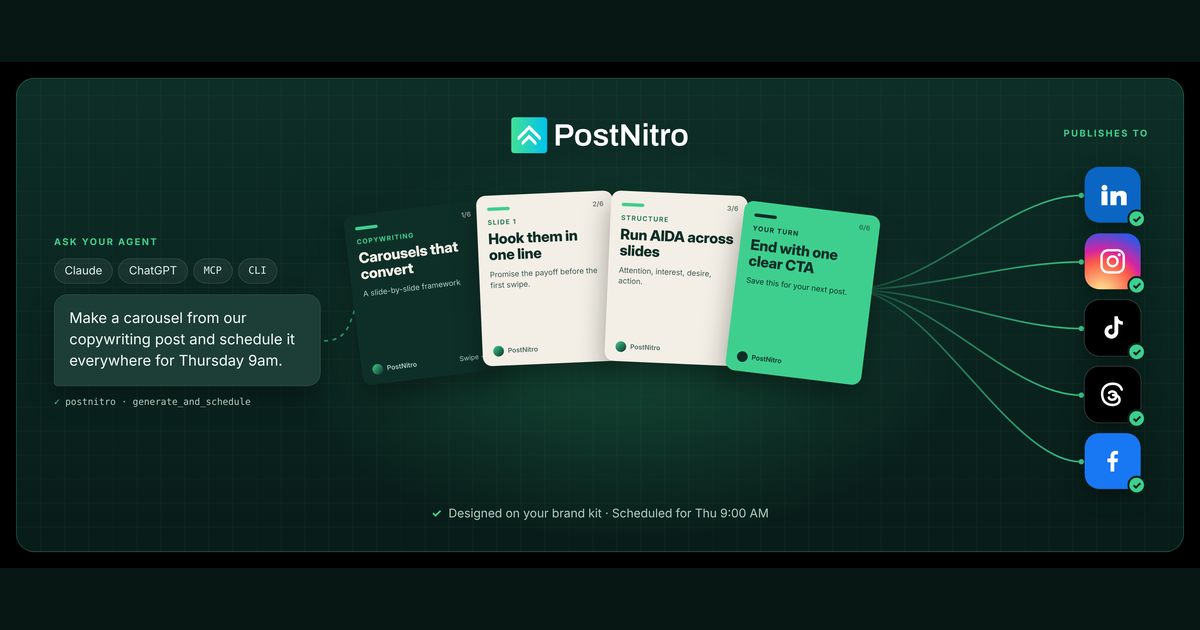
PostNitro for Agents is a social media API and design engine that lets AI agents create and publish social media content. Most social APIs an agent can reach will publish text or pre-made media, but PostNitro gives the agent the design layer too: on-brand carousels, single-image posts and animated video built from more than 100 templates and the user's own brand kit. The service then schedules and publishes that output natively to LinkedIn, Instagram, TikTok, Threads, Facebook and Pinterest. It is built for creators, marketers and teams who want one continuous chain, from prompt to designed, scheduled and published post, with no human in the loop unless they choose to add one. The site states the product is used by 85,000+ creators, with its editor embedded in 200+ platforms.
PostNitro frames the problem it addresses directly: most social APIs that an agent can reach will only publish text and pre-made media. An agent can therefore write a caption and push a finished file, but it cannot produce a designed post on its own, because the design engine lives outside the API in a graphic design tool that a human has to operate. PostNitro's stated purpose is to give your AI agent a design engine, not just a publishing API, so that the agent can own the entire chain. That matters because the formats that carry a social presence, such as multi-slide carousels, consistently branded image posts and short vertical video, are precisely the ones that normally require manual design work. Moving design into the API layer means a single prompt can produce a publishable, on-brand asset rather than only a caption or a pre-made image.
The creation capability covers carousels, single-image posts and short video, generated from several kinds of input: a topic, raw text, an article URL, or an X post. The agent can also add AI-generated images and bake them into slides as part of the same job. A separate import path lets the agent bring its own slide content and have PostNitro design it using the same templates and the same brand kit, with no AI writing step involved. That distinction matters for teams that already have approved copy: the design engine can be used purely as a layout and branding layer, so the agent's role can be limited to formatting and rendering rather than authoring. Combined, these two paths mean content can either be written by the model or supplied by the user, and either way it comes out designed rather than plain.
Everything PostNitro generates is meant to be on-brand, and the brand capability is exposed through the API rather than handled by a prompt. Agents can list, read, create and update brand kits, which cover fonts, colours, logos and headshots. The practical value is that output is on-brand without the model needing a prompt that describes the brand each time; the agent simply points a generation job at the right brand kit and the design engine applies it. Because brand kits can be created and updated programmatically, an agent or an automated pipeline can manage them as data, keeping multiple brands, sub-brands or client identities separate and current. This is what makes the output of an unattended agent something a marketing team can publish rather than something that needs to be redesigned from scratch before it is usable.
Scheduling and publishing are first-class capabilities in the toolset. Agents can create, read, update and delete scheduled posts, connect and inspect social accounts, and publish natively to six networks. Publishing destinations are LinkedIn, Instagram, TikTok, Threads, Facebook and Pinterest; X (Twitter) is supported as a content source and as an export format, but not as a publishing destination. The site also notes a recent addition, publishing straight to Facebook Pages and Pinterest boards. Alongside scheduling, a browse capability lets an agent list templates, AI presets and audio tracks so it can pick deliberately rather than accept a default. That gives an agent control over the look, the motion preset and the soundtrack of a video, all through the same interface it uses to generate and schedule the post.
Generation jobs are handled in two ways, which matters for how an agent behaves. Every generator has a fire-and-forget form and an and-wait form, plus status and output polling, so an agent can choose between streaming and blocking depending on its own design. A long design job does not have to stall the agent, and a short one does not have to be polled unnecessarily. A second, more unusual capability is the handoff: if the agent asks for the DESIGN output, PostNitro returns an editable design instead of a rendered file. The agent can do the work at 3am, and the human opens the result in the editor, changes the headline, and publishes. PostNitro describes this as the one place where the human and the agent share a workspace rather than a handover, because every publish-only API returns something you cannot edit.
Access works through six interfaces that share one engine, one account, one brand kit and one template library. Claude connects in one click via Claude's Connector Directory, and ChatGPT installs in one click via ChatGPT's plugin directory; both use OAuth, so there is no API key to fetch. Any MCP client can be pointed at mcp.postnitro.ai, which exposes the whole engine as 35 tools. The CLI installs with npm i -g @postnitro/cli and is described as JSON in, designed post out, script-safe and built for CI and automations. The REST API, whose design and publish chain is exposed at POST /post/initiate/generate, is the layer the others are built on. Finally, a Skill for OpenClaw and Claude Code installs with npx skills add postnitro/postnitro-agent so an agent can drive PostNitro end to end.
The core outcome the product promises is a shorter chain from idea to published post. The site's demo line is 56 seconds: prompt, designed on your brand kit, scheduled, published. An agent can generate, schedule and publish in a single chain with no review step, or it can save posts as drafts on the calendar so a human approves them and hits schedule. Output can be delivered as PNG, PDF, MP4 or an editable design, which lets the user choose between a finished asset and a working file. One benefit PostNitro calls out specifically concerns video: output video is the carousel slides rendered as an MP4 with animated slide text and an audio track the user chooses. It is a design feature rather than a generative video model, and the company notes this is how carousels reach TikTok, which static-export tools cannot do.
Concrete workflows are illustrated with sample prompts on the site. Turning a latest blog post into a LinkedIn carousel produces a carousel and a PDF. Announcing a launch as an Instagram post on a chosen brand kit produces an image post. Making a 20-second TikTok video from five tips produces video as MP4. Planning a week of content, three carousels from Monday to Wednesday at 9am, saves three drafts for review. Each of these runs through the same engine: the agent is handed a topic, article or X thread and returns an on-brand, designed asset, which is then either scheduled or held as a draft. Because the CLI is script-safe and the REST API accepts HTTP requests, the same jobs can also be wired into pipelines and automation tools without a human typing prompts.
PostNitro is designed for anything that speaks MCP, anything that can run a command, and anything that can make an HTTP request. Named MCP clients include Claude Desktop, Claude Code and the Claude web app, Cursor, ChatGPT and VS Code, along with agent frameworks that support MCP servers. The CLI is usable from OpenClaw via the Skill, n8n, Make and CI pipelines. Agent access is priced with the rest of the product: included in Creator+ at $30/month with 200 credits per month, and Team+ at $60/month with 500 credits, or available on the Starter plan as a $10/month add-on with 250 credits. Credit volume can be increased. An imported slide costs 1 credit and an AI-generated slide costs 2 credits, and the site states there is no free tier for the API.
Taken together, PostNitro for Agents positions design as the missing layer in agent-driven social publishing. Instead of asking an agent to write a caption for media that already exists, it exposes a design engine through MCP, CLI and REST so the agent can produce on-brand carousels, image posts and video, schedule them to six networks, or hand back an editable draft. The same engine, the same brand kit and the same templates sit behind every interface, and OAuth removes the key step for Claude and ChatGPT. For teams that want an AI agent to carry social content from a raw idea to a scheduled, publishable, on-brand post, that combination of design plus publishing in one API is the product's central value proposition.
Publisher
A
admin
Launch Date2026-10-14
Platformweb
Pricingpaid
Tech Stack
#MCP#REST API#CLI#OAuth 2.1