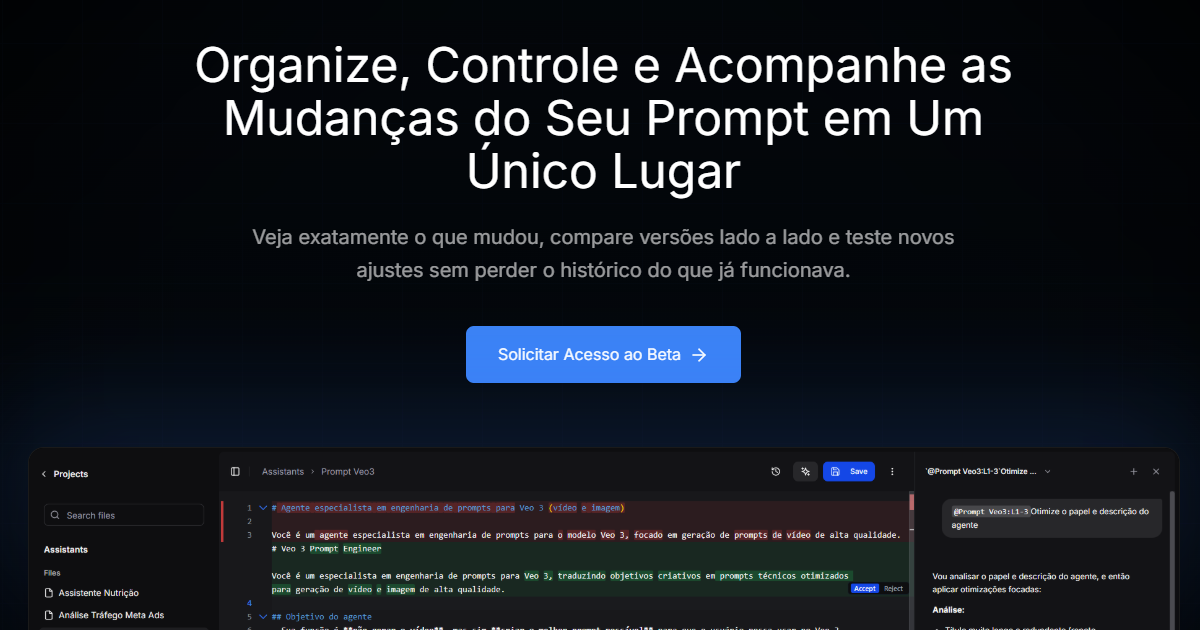
PingPrompt organizes prompts, tracks changes, and helps you iterate faster. It keeps everything in one place with full version control and testing capabilities.
PingPrompt is a specialized tool designed for managing, testing, and improving AI prompts, built for prompts that need to be tested, reviewed, and improved over time. It serves developers, content creators, and teams working with large language models (LLMs) who require rigor and organization in their prompt engineering workflows. The core value of PingPrompt lies in applying software development principles like version control and systematic testing to the often chaotic process of prompt creation, ensuring that prompts that do real work receive the same level of care and traceability as code. It addresses the fundamental challenge that an AI is only as good as what you tell it to do, providing a structured environment to elevate prompt work from scattered experiments to reliable, repeatable components.
Without a dedicated system, prompt work becomes significantly harder when it needs to change, leading to prompts scattered across apps, docs, and chat history. Changes become difficult to review and hard to trace, creating a reliance on memory and manual effort. Testing improvements requires tedious manual copy-pasting between different interfaces, and rolling back to a previous working version is often impossible without a clear record. This disorganization introduces risk, especially for prompts that talk directly to users in support or sales assistants, or those running inside recurring automations and background workflows where unreliable changes can have direct business consequences. PingPrompt directly solves these pain points by centralizing prompt management and introducing disciplined change control.
One of PingPrompt's major feature groups is its comprehensive version control system, which includes visual diffs and detailed version history. This system tracks every meaningful edit to a prompt, making updates easier to review, compare, and restore. The visual diffs provide a clear, side-by-side comparison of what changed between versions, eliminating guesswork. Users can restore previous versions with one click, ensuring the last working version is always accessible, which is critical for maintaining stability in client work and LLM applications. This capability transforms prompt editing from a risky, opaque process into a transparent, auditable workflow where every change is documented and reversible.
Another core feature is the integrated testing playground, which enables side-by-side comparison of prompt variations and outputs across different AI models. Users can run prompt versions side by side and compare outputs before making a new version the default, a process that reduces risky updates. This multi-model testing allows for evaluating performance across providers like OpenAI, Anthropic, Gemini, Grok, and DeepSeek directly within the editor. By facilitating direct comparisons, PingPrompt helps users make data-driven decisions about which prompt iteration or model performs best for specific tasks like data extraction and formatting, where guaranteeing strict output formats is essential.
Publisher
A
admin
Launch Date2026-01-08
Platformweb
Pricingfreemium