Parallax is a Mac app that runs every coding agent you already use side by side in one place. According to its website, it runs Claude Code, Codex, Cursor, Gemini CLI, OpenCode and pi, with Amp and Capy also supported, along with the sessions you run in Codex cloud and Claude Code on the web. Product Hunt metadata describes it as running Claude Code, Codex and 40+ more in one app, with 240+ models on your own subscriptions. The product's stated purpose is to give developers a single control surface for multiple agents rather than juggling separate tools. A component called the Captain sits above the agents: you give one ask, the Captain splits it into tasks for the agents that suit it, checks each step, and brings the work back as pull requests that match what you asked for.
Parallax is built around a diagnosis its website states directly: agents write better code now, and when work goes wrong it is usually because the session drifted from what you meant. That framing explains the product's design. Running several agents at once multiplies output, but it also multiplies the chances that an agent wanders off the ask, skips its tests or stops short. Reviewing that output is a second bottleneck, and a conventional diff review, the site argues, only shows the change, not whether the change answers the original request. A third friction point is capacity: developers who hold several Claude or Codex subscriptions still hit weekly limits and have to wait or manually reshuffle work. Parallax addresses all three — alignment, review and capacity — inside one application rather than treating them as separate problems.
The Captain is Parallax's orchestration layer, and the site describes four things it does. First, it splits your ask: one request becomes a task for each agent that suits it. The site's example ask is "Ship the CSV export for billing and stop the webhook drops. Tests for both," which the Captain turns into work for Claude Code, Codex and Cursor Agent, returning three pull requests. Second, it checks every step: each step is read against what you asked while the work happens, not only at the end. Third, it pulls drifting agents back — an agent that wanders off the ask, skips its tests or stops short is steered back. Fourth, it brings back what you meant: the work returns as pull requests that match the ask. The practical effect is that you describe the outcome once and review PRs, instead of writing separate prompts for each agent and reconciling inconsistent results yourself.
Parallax ships native code review, and the site makes a benchmark-backed claim for it. On Martian's open Code Review Benchmark — 50 pull requests, 21 tools — Parallax found 2.24 valid, merge-blocking comments per pull request, more than any of the other 20 tools listed. The comparison set includes GitHub Copilot and Qodo Extended at 1.38, cubic at 1.38, Augment at 1.36, CodeRabbit at 1.34, Qodo at 1.30, Claude Code at 1.26, Gemini Code Assist at 1.10, Cursor Bugbot at 1.06, Macroscope, Kodus and Devin at 1.04, and Greptile at 1.02. More important than the number is what the review reads. Parallax keeps the whole session and reviews the work against it, rather than reviewing only the diff. The site's example: a review bot approves a billing export that groups invoices by customer; Parallax points out that one row per invoice was requested, that three invoices for one customer would collapse into one row, and that a test with exactly that case fails on the change — then routes the fix as its own pull request.
Because agents are reviewed against the session and not just the change, Parallax needs reviewers that did not write the code. The Conifer router picks the best reviewers from labs other than the ones that wrote the code, so a Claude-written change is not graded only by Claude; the site's example comment reads "Reviewed by Gemini and Grok." Alongside review, Parallax handles capacity. You connect several Claude and Codex subscriptions, and when one hits its limit the work automatically moves to the next without losing progress. The site's example shows a Claude Max plan at 100% of the week's limit, a second Claude Max at 73% and in use with a billing CSV export still running, a Claude Pro at 12% and ready, and a Conifer credit balance of $50 ready after every plan. Product Hunt metadata adds fast merge, which ships your PRs in one click, and describes auto fallback as the mechanism that moves work to the next subscription.
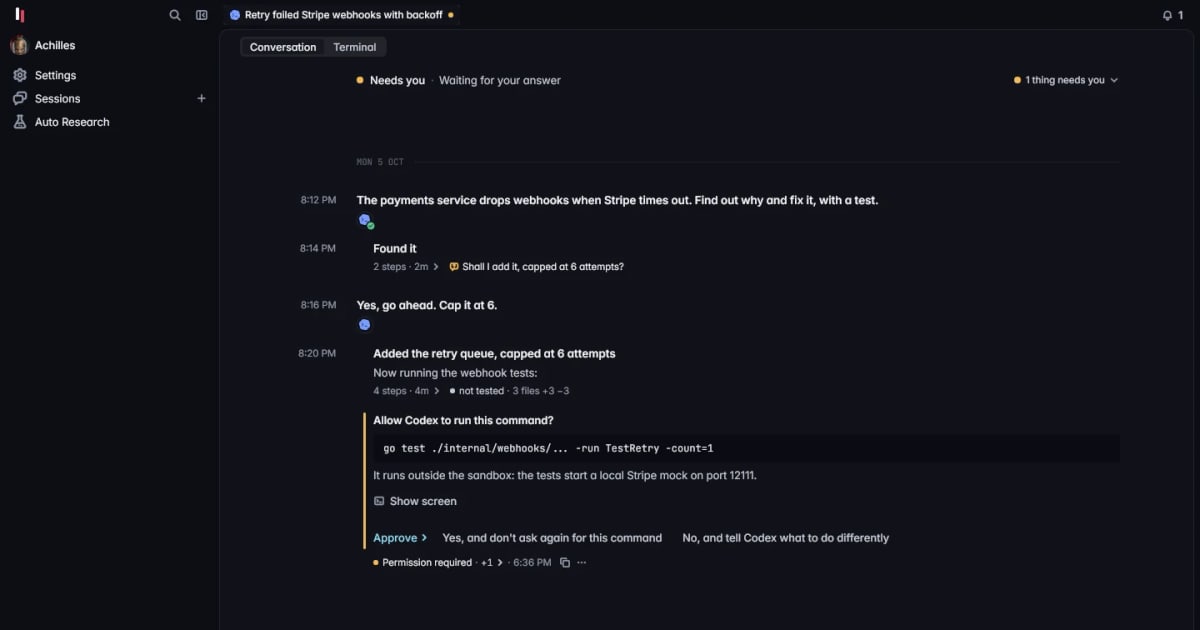
Overall, Parallax works as a single desktop surface over agents that remain, in the site's framing, the ones you already use. You converse with the Captain, the Captain distributes the work, the agents run, and results arrive as pull requests against your GitHub repository rather than as chat output you have to interpret. Human control is explicit: the site's hero shows a Codex session fixing failed Stripe webhooks stopping to ask before it runs its tests and waiting for Approve. Review is layered on top of the same session record, and subscription routing plus Conifer credit sit underneath as a capacity layer. Nothing in the described flow requires you to change which agent you prefer; Parallax adds orchestration, review and fallback around them. On Linux the same engine runs headless: you unpack the tarball, run ./parallax daemon, and open http://127.0.0.1:7878 in a browser, with no native window on Linux yet.
The stated outcomes follow from those pieces. You get one place to run every agent instead of several, so parallel work becomes practical rather than a bookkeeping problem. Work comes back aligned with the ask, because the Captain reads each step against your request while the work happens and steers drifting agents back. Review catches problems a diff misses — the benchmark measures exactly the merge-blocking kind, at 2.24 per pull request versus 1.38 for the next tools listed. Capacity stops being a wall: when a subscription hits its limit, the work continues on the next one, and Conifer credit covers the gap after every plan. Fast merge turns approved work into shipped PRs in one click. Fewer stalled sessions, fewer review misses and less manual coordination are the benefits the site claims.
The content describes concrete workflows. A multi-part request — ship a CSV export for billing, stop webhook drops, add tests for both — is split across Claude Code, Codex and Cursor Agent, each returning its own pull request. A Codex session fixing failed Stripe webhooks pauses before running its tests and waits for approval. A code review of a billing/export.ts change catches that grouping invoices by customer contradicts a one-row-per-invoice requirement, verifies it with a test, and files the fix as pull request #747. A developer with three subscriptions and a long-running export keeps working when the first plan hits 100% of its weekly limit, because the export moves to the next subscription still running. Teams running sessions in Codex cloud or Claude Code on the web get those sessions in the same place. Each scenario is a variation on one pattern: describe the outcome, let the agents work, approve the steps that matter, and review against intent.
Parallax is aimed at developers who already run coding agents and want to run more than one without losing track of them, and at anyone holding multiple Claude or Codex subscriptions. Supported agents named on the site are Claude Code, Codex, Cursor, Gemini CLI, OpenCode and pi, plus Amp and Capy, with Codex cloud and Claude Code on the web sessions included. GitHub is the integration surface for sign-in, repositories and pull requests. It is free to start: signing up with GitHub brings $50 of Conifer credit and 5 free reviews, and if you sign up by email you link GitHub in Settings and the credit arrives then. No Claude or ChatGPT plan is required — agents can run on the credit. It installs from a .dmg that is notarized by Apple, and Linux builds run as a daemon with a browser interface.
Parallax's value proposition is consolidation with control: every coding agent you run in one place, a Captain that keeps them aligned with what you asked, native code review that reads the session rather than only the diff, and automatic fallback across subscriptions so work keeps moving. For developers already committed to agent-assisted coding, that is the difference between running several agents and actually getting several agents' worth of finished work.
Publisher
A
admin
Launch Date2026-10-17
Platformdesktop
Pricingfreemium