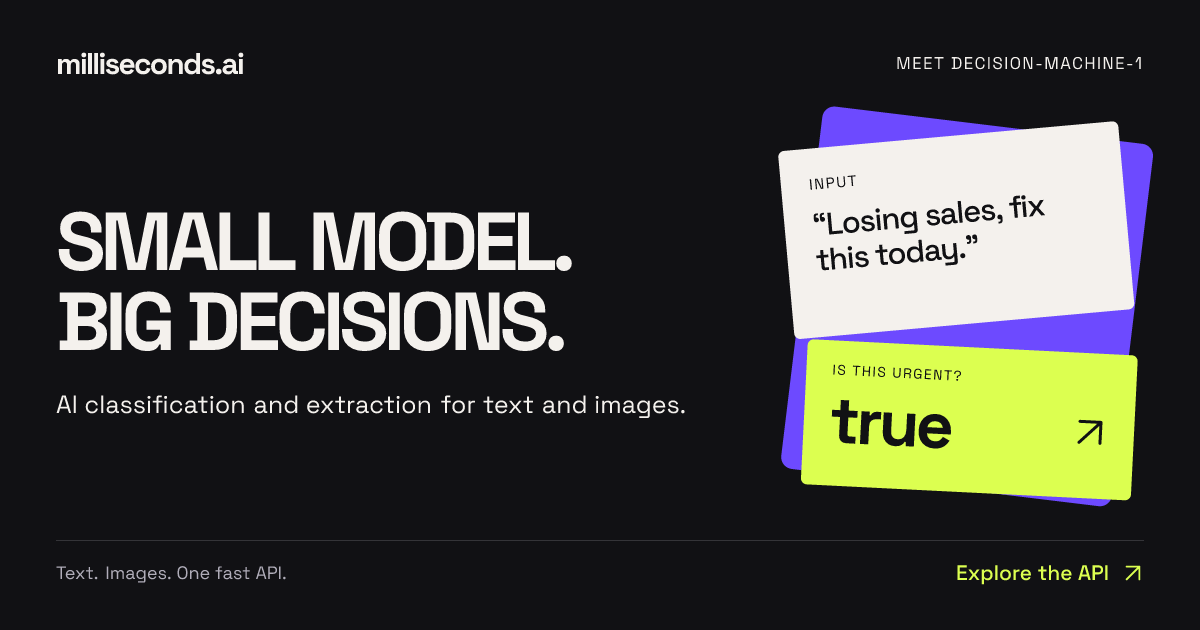
Milliseconds.ai is an API that turns text and images into decisions, classifications, and structured data. You send text or an image to a single endpoint and receive labels, fields, scores, or yes/no answers back as structured data that your application can act on. The product is built around decision-machine-1, described on the site as a small model behind the platform. Its stated purpose is AI decisions, classification and extraction via a simple API — the parts of an application that need an answer rather than a conversation. It is aimed at developers and product teams who need to route, tag, read, score, or check content inside their own software without building and hosting their own decision models.
The site frames the problem as verbosity. A typical model response to an invoice begins with "Certainly! Let's delve into a comprehensive overview of this invoice and its many fascinating details…" followed by pages of explanation. Milliseconds.ai contrasts that with "Just the fields. Thank you." and shows the output it returns: invoice_number A-1042, vendor Nordik Supply, total 4250, currency CAD. The message is that many real workflows — routing a support email, reading an invoice, checking a return against a policy — only need a label, a number, a boolean, or a small set of extracted fields, and that asking a large model to produce prose for those tasks adds cost and latency without adding value. The company positions its small model as a way to get the decision itself, in a form software can consume directly.
The API exposes separate endpoints for different kinds of decisions. POST /yes-no answers a binary question about a piece of text; the example flags messages that need a faster response and returns "answer": true with probability 1, and the site notes the boolean can be used to raise a ticket's priority. POST /classify assigns one label from a set you define; in the example a message is routed to support queues and comes back with label "billing" at 0.74, alongside scores for billing, shipping, technical, and other, plus a confidence value. POST /rate scores text on an ordered scale; the example turns customer frustration into a 0–3 score of 1.998, returning the level, a confidence figure, and the score for each level, with the site noting that nearly tied levels signal uncertainty.
A second group of endpoints returns content rather than a single decision. POST /answer locates a span of text that answers a question — for example, finding "Halifax warehouse" in a shipment status update with a probability of 0.992 and start and end offsets, so an application can show where the answer came from. POST /extract maps text to the fields in your own records; the invoice example returns four fields — invoice number, vendor, total, and currency — ready for validation before a record is written. POST /entities identifies typed entities such as person, organization, claim id, and date, each with a probability, described as useful for search and record matching. POST /verify checks a proposed value against source text; in the example a proposed $1,000 deductible is compared with policy text that says $500 and comes back as matches: false with the found value $500.
Milliseconds.ai is delivered as a developer tool first. The site says the service is available through REST, SDKs, and a CLI, and it points to both a TypeScript SDK and a Python SDK that return typed responses, plus a terminal workflow. For coding agents, it offers installable skills that teach an agent which API to call and how to evaluate results — summarised as "Hey, build me something with this." Documentation links include an API quickstart, a support triage recipe, and a document intake recipe for extracting fields, checking values against the source, and validating before writing a record. The site also provides live, editable examples for every endpoint, where a visitor can edit a request and run it to see the labels, scores, or fields the API returns, with raw JSON available.
The product's overall approach is summarised by the phrase "INPUT → DECISION → ACTION". Text or an image goes in; a decision comes out; the application acts on it. Around that core loop the responses are deliberately structured: booleans with probabilities, labels with score distributions and confidence, numeric ratings with per-level scores, extracted fields, typed entities, and answer spans with source offsets. The company describes decision-machine-1 as a small model, and contrasts its economics with larger alternatives: production usage costs $0.04 per million input tokens with no charge for output tokens, and free test keys include 125 million free input tokens per month with no card required. Demo applications show the same idea in practice — working apps whose results, token usage, and inference cost can be inspected.
The stated benefit for users is speed and directness: answers arrive in a shape an application can use immediately, so teams can automate the decisions their software already makes rather than inserting a conversational layer. Because the responses include probabilities, confidence values, and score distributions, an application can distinguish a confident decision from a borderline one — for example, flagging a nearly tied rating or a low-probability entity for review — and route only the uncertain cases to a human. Structured output also means the result can be validated before it is written to a record or used to trigger an action, as in the invoice and deductible examples where extracted or proposed values are checked against the source. The pricing model, with free output tokens, keeps cost tied to input volume rather than to the length of the answer.
The site documents several concrete workflows. Support triage combines a label to select a queue, a score to set priority, and a boolean to flag urgency. Document intake extracts fields, checks values against the source, then validates before writing a record; the Invoice Desk demo pulls the vendor, invoice number, and total from an invoice, compares them with the purchase order, and shows what needs attention. Sales intake separates demo requests from support tickets and vendor pitches and gives sales the budget, timing, and need already stated in the message — the example flags a demo request with a stated budget and a near-term start, suggesting the Sales destination. Private Share finds names, emails, and other personal details in a transcript so a teammate can review what to remove while keeping the context, leaving the bug report useful. The Product Hunt description adds routing emails, applying return policies, and "build your hot-dog identification empire" as further examples.
Milliseconds.ai is built for developers and product teams who need classification, extraction, or verification inside an application — the Product Hunt listing files it under API, Developer Tools, and Artificial Intelligence. The developer surface includes REST endpoints, TypeScript and Python SDKs, a CLI, and skills for coding agents, so the integration can be done from code or from an agent. Pricing has two stated parts: a free tier of 125 million input tokens per month on free test keys with no card required, and production usage at $0.04 per million input tokens with output tokens free. A sign-up page issues free test keys, and the site links to pricing details with the prompt "Big ideas. Small bill." The interactive examples run without an API key so teams can evaluate results before signing up.
The takeaway the site reinforces is narrow and deliberate: milliseconds.ai does not try to be a general chatbot. It provides a fast API for the small decisions that applications make constantly — is this urgent, which queue does this belong to, how frustrated is this customer, what are the invoice fields, which entities are in this claim note, does this value match the policy — and returns each as structured data with probabilities, so software can act on it. With a single small model, editable live examples for every endpoint, SDKs, a CLI and agent skills, plus a free monthly allowance and per-token production pricing, it packages decision-making as a straightforward building block for developers.
Publisher
A
admin
Launch Date2026-09-22
Platformweb
Pricingfreemium
Tech Stack
#REST API#TypeScript SDK#Python SDK#CLI