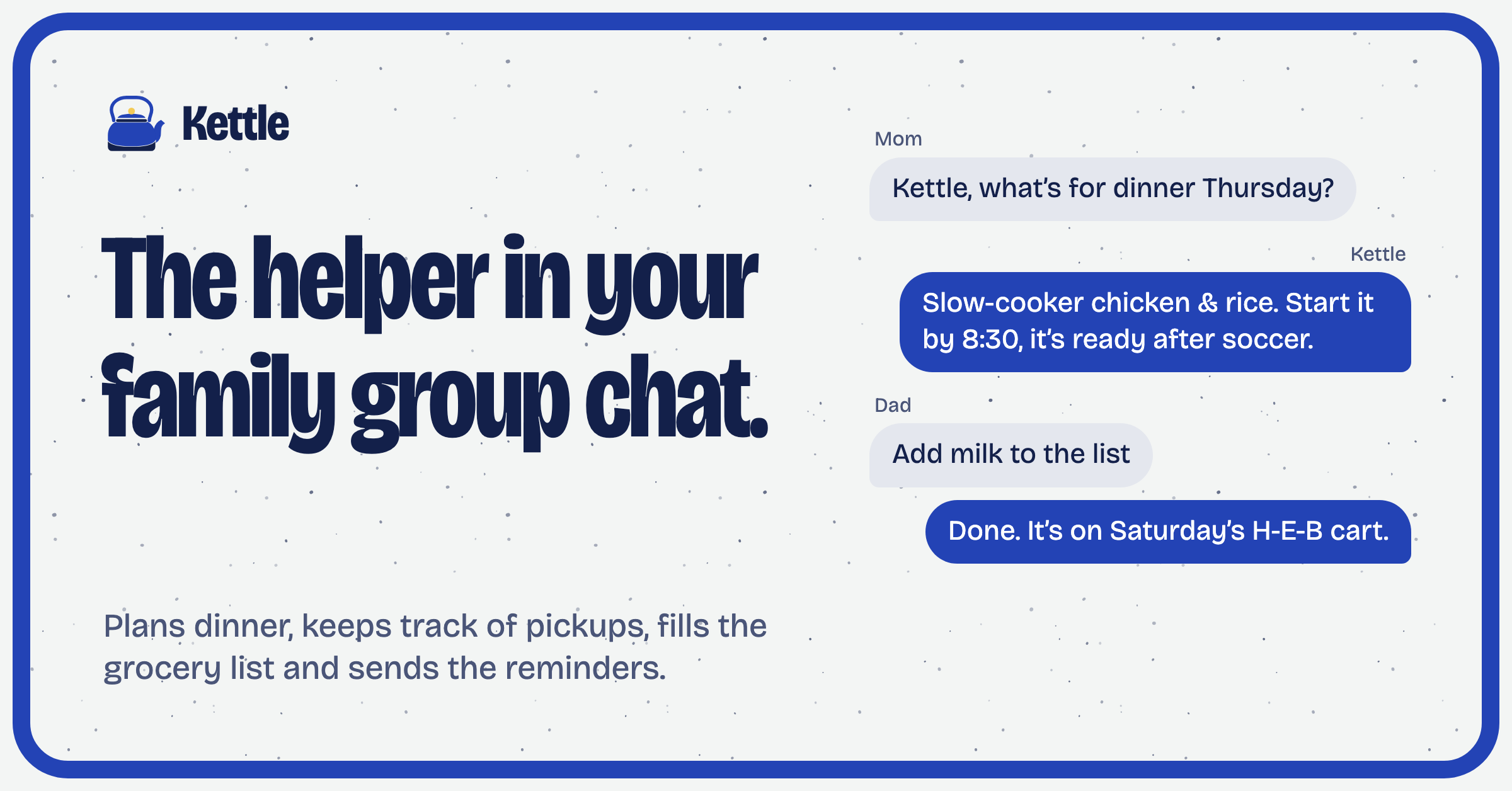
Kettle is a helper that lives inside your family's group chat. You text it like a person — either on its own number or by starting a message with "Kettle" in the family group — and it keeps track of pickups, plans dinners, fills the grocery list and sends the reminders. There is no app, no dashboard and nothing for anyone to set up: Kettle is a contact in Messages. It is built for families who already coordinate by text and want the everyday details handled without adding another tool anyone has to remember to open.
Family life runs on small details that are easy to lose: who is picking up which child, when picture day actually is, who finished the milk, what the dentist said about Maya, which night is soccer and which night is pizza night. Those details usually live in a scrolling group chat where they get buried within hours, or in one person's head. Kettle is aimed at exactly that gap — the things that fall through the cracks. Rather than asking a family to adopt a new app, maintain a shared calendar or learn a dashboard, Kettle joins the conversation that is already happening, so coordination stays where the family already looks every day.
Kettle remembers the details you tell it — allergies, teachers, shoe sizes, what the dentist said — and once you have told it, anyone in the family can ask later and get the answer in the chat. In the example shown on Kettle's site, when one family member asks whether picture day is tomorrow, Kettle answers that picture day is Thursday, that poster board and milk are on Ben's list, and that it will remind him at 5. That is the pattern: information given once to Kettle becomes available to the whole family, instead of being trapped in a private thread or in someone's memory.
Kettle plans dinner. It assembles a week of meals that fits around the family's schedule — soccer nights, for example — and around the people who will not eat mushrooms, drawing on recipes the family already likes. A parent can ask by text something as simple as "Plan dinners this week, no mushrooms" or "Dinners, no mushrooms," and Kettle comes back with the week's meals. Because the plan is built around the actual week rather than an abstract rotation, it can account for the nights when there is no time to cook and for the preferences of the people who will be sitting at the table.
Kettle fills the grocery cart. It turns the week's dinners and the running grocery list into an H-E-B cart, which the family reviews and checks out. Requests like "Add diapers to the list" or "Fill the H-E-B cart for the week" build that cart, and Kettle messages when it is ready — one example notification reads "Your H-E-B cart is ready: 23 items for this week's dinners." The point is that the list and the meal plan stay connected: whatever the week's dinners require, plus whatever anyone added to the list along the way, ends up in one cart to look over before checkout.
Kettle sends reminders — pickups, practice, birthdays and bills — to the person who needs them rather than sending everything to everybody. Family reminders go to the group and personal ones go only to the individual. Kettle also follows up: it asks again until someone says done, so a reminder is not simply a notification that disappears. Requests like "Remind us Friday is pizza night," "Put flu shots on the calendar" or "Text me when it's time to leave for soccer" are handled in the same chat, and the reminder arrives with the specific detail needed — for example, "Leave in 15 for soccer. Cleats and a water bottle for Leo."
Kettle texts first, at the right time. It sends a short morning brief, a nudge fifteen minutes before you need to leave, and a message when the grocery cart is ready. The sample brief shown on the site reads "Morning! Rain after 3, soccer at 5:30, and it's taco night." Other examples in the same thread include a note that library books are due tomorrow and that Maya has three checked out, and a note that Grandma lands at 6:40 with Ben on airport duty. Because Kettle starts the message instead of waiting to be asked, the family does not have to remember to check anything.
Any of that behavior can be changed by text, in plain language — for instance, "Kettle, skip the morning brief on weekends." Kettle is also private by default: what you text it on its own stays between the two of you, and in the family group it only shares what the whole family should know. The site states that Kettle checks who is in the group before every message, which matters in a chat where children, partners or extended family may be present. Privacy is handled through the same conversational interface as everything else, with no settings screen to configure.
Getting started takes three steps. First, you text Kettle hi at (205) 243-9463; it asks what to call you and what you would like help with first. Second, each person in the family texts Kettle once so it knows who is who. Third, you add Kettle to your family group — then you say "Kettle, say hi" and ask it anything. From there Kettle operates as a participant in Messages: in a group, a message that starts with "Kettle" is addressed to it, and in a one-to-one thread every message is. There is nothing to install and no dashboard to check, which is the whole design premise. Families moving from Ollie are also offered a way to bring what it knew to Kettle.
The outcome Kettle describes is that the things that fall through the cracks get handled. Because Kettle remembers what it is told, other family members can get answers themselves instead of asking the same person again. Because it plans dinners around the week and turns them into a cart, the meal plan and the shopping trip stop being separate chores. Because reminders go to the right person and Kettle asks again until someone says done, the follow-through does not depend on someone remembering to chase it. And because the brief and the nudges arrive on their own, the family does not have to check a tool to find out what is coming.
Typical use looks like the conversations shown on the site: someone asks "What time is Leo's game?" and gets an answer in the group; someone adds diapers to the list; a parent asks Kettle to plan the week's dinners with no mushrooms; flu shots go on the calendar; and the H-E-B cart gets filled for the week. In the background Kettle sends the morning brief, the fifteen-minute warning before soccer, the note that library books are due, and the message that the cart is ready. Reminders such as pizza Friday and bills go to whoever needs them, and Kettle keeps asking until someone says done.
Kettle is priced at 7 days free, then $19 a month for the whole family, and it tells you the day before your trial ends. The price covers the family rather than a single seat, which fits a product that only works when everyone is in the same thread. It is aimed at households already coordinating through text messages — parents juggling pickups, practices, dinners and appointments — and it runs through Messages rather than a standalone app or dashboard.
Kettle's value proposition is narrow and practical: put a helper in the family group chat, let everyone text it like a person, and let it hold the details, the dinners, the grocery cart and the reminders. No app, no dashboard, nothing to set up — just a contact that answers when asked and speaks up at the right time.
Publisher
A
admin
Launch Date2026-11-10
Platformmobile
Pricingpaid