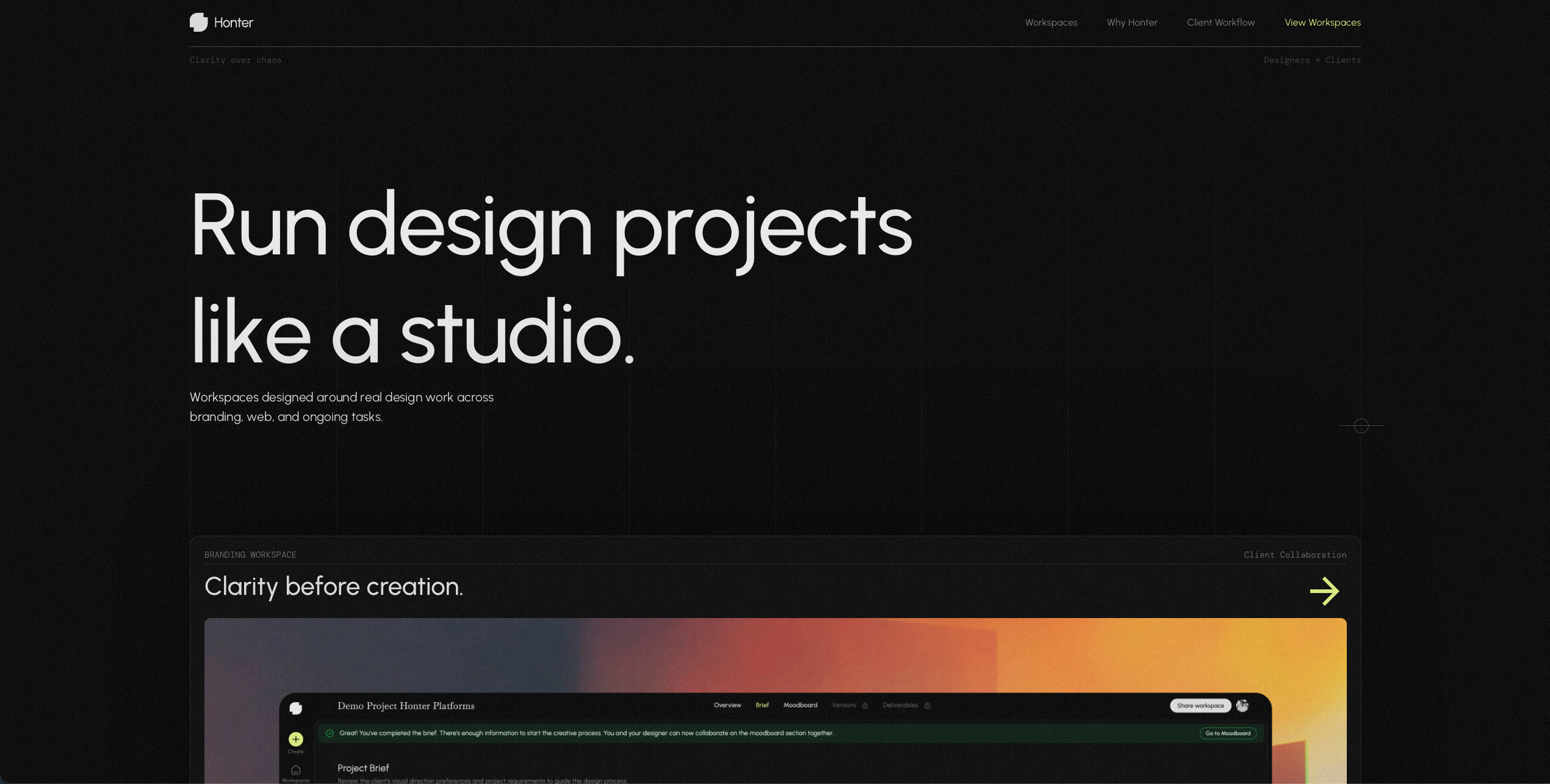
Honter is a design project management platform built specifically for designers and creative teams who want to run projects like a professional studio. It addresses the core chaos that plagues design workflows: vague feedback, scattered communication, and disjointed delivery. By providing structured workspaces, Honter gives every project a clear home where briefs, collaboration, feedback, and final delivery live together. The primary value is bringing clarity and accountability to the entire design process, from kickoff to handoff. For agency owners and freelancers alike, it replaces the ad-hoc mix of emails, Slack threads, and file-sharing with a single system that mirrors how design work actually happens. The tagline "the end of make-it-pop" captures its mission: to eliminate the frustrating feedback loop where non-designers lack the vocabulary to describe what they want.
The concrete problem Honter solves is the painful cycle of vague, unhelpful feedback that derails design projects. Designers often hear comments like "make it pop" or "I'll know it when I see it," which leave them guessing and iterating endlessly. This not only wastes time but also damages client relationships and erodes creative confidence. Honter tackles this by giving reviewers the words they need to articulate specific, actionable feedback. Instead of abstract opinions, stakeholders can pinpoint exactly what works or doesn't, reducing revisions and aligning everyone around clear goals. The result is faster approvals, happier clients, and a more predictable workflow. For design studios and agencies, this structured feedback loop becomes a competitive advantage, ensuring every project stays on track without the usual friction.
The first major feature group is structured workspaces for briefs. Honter organizes each project into a dedicated workspace where the initial brief is captured in detail. This ensures that from day one, everyone understands the project's scope, goals, and constraints. The brief workspace includes fields for background, audience, deliverables, and success criteria, all of which are visible to the entire team. By standardizing how briefs are created and stored, Honter eliminates the common problem of lost or misinterpreted project requirements. Designers can refer back to the brief at any stage, keeping their work aligned with the original vision. This feature is particularly useful for agencies juggling multiple clients, as it provides a consistent onboarding process that saves time and prevents misunderstandings.
admin
The second major feature group is the collaboration and feedback system. Honter enables teams to share designs, gather input, and track decisions in one place. Instead of relying on email chains or messy file comments, collaborators can leave feedback directly on designs using a guided vocabulary that replaces vague phrases with specific, design-oriented language. The system categorizes feedback into types such as layout, color, typography, and functionality, making it easy to prioritize and act upon. Reviewers choose from predefined options or write custom notes, but the structure ensures that all feedback is constructive and tied to the design. This dramatically reduces the back-and-forth and helps designers see exactly what needs to change. The platform also notifies the right people when feedback is submitted, keeping everyone in the loop without constant check-ins.
The third feature group is the delivery workflow. Once designs are approved, Honter streamlines the handoff by packaging deliverables with all necessary assets, notes, and version history. This eliminates the confusion of sending multiple files or emailing final versions. The delivery workspace provides a clean, professional presentation that clients and developers can access immediately. Designers can include specifications, style guides, and component libraries, ensuring nothing gets lost in translation. For agencies, this feature reinforces a polished, studio-quality experience that impresses clients and builds trust. The delivery process is fully traceable, so if questions arise later, the team can see exactly what was delivered and when. This end-to-end coverage from brief to delivery is what makes Honter feel like a complete studio operating system rather than just a feedback tool.
Honter works by adopting a project-based structure that mimics the natural phases of design work: brief, collaboration, feedback, and delivery. Each project gets its own workspace, and within that workspace, tools are organized sequentially to guide the team through the workflow. The platform does not require extensive setup or training; it is designed to be intuitive for creative professionals. Teams can invite stakeholders with different permission levels, ensuring that clients see only what is relevant while the internal team manages the full process. Notifications and activity logs keep everyone informed without overwhelming them. The entire approach emphasizes clarity over chaos, as the tagline suggests. By following this structured methodology, even complex, multi-stakeholder projects become manageable, with clear checkpoints and accountability at every stage.
Concrete use cases for Honter include design agency project management, where multiple client projects run simultaneously. A creative director can oversee several workspaces, review briefs, and track feedback across teams. Another scenario is freelance designers working with remote clients: Honter provides a professional interface for sharing concepts and collecting structured feedback, replacing endless email threads. In-house design teams can use Honter to manage product launches, ensuring that every design iteration is reviewed and approved before development. For design reviews, the platform eliminates the "I don't have the words" problem by offering guided feedback options, leading to faster, more accurate revisions. In each case, the outcome is a smoother workflow, fewer misunderstandings, and a higher quality of final deliverables, all while maintaining a professional studio-like presence.
Honter is built for designers, agency owners, and creative teams who want to elevate their project management from ad-hoc to studio-quality. It is ideal for small to medium-sized agencies, freelance designers, and in-house design departments that handle multiple projects and stakeholders. The platform is web-based, requiring no installation, and is designed to integrate seamlessly into existing workflows. Early supporters get founder pricing for life, making it accessible for independent creatives who want to invest in a tool that grows with them. The tech stack is modern and responsive, ensuring fast performance across devices. In summary, Honter transforms the design workflow by replacing chaos with structured workspaces and meaningful feedback, fulfilling its promise to end the era of "make-it-pop" and giving everyone the words they need to collaborate effectively.
Honter is designed for professional designers, creative agencies, and in-house design teams who manage multiple projects and stakeholders. It is ideal for freelance designers seeking a polished, studio-like workflow without the overhead of traditional project management tools. Agency owners and creative directors will benefit from the structured workspaces that bring clarity to every project phase—from brief to delivery. The platform also suits design departments within larger organizations that need a dedicated system for design reviews and client feedback. Early adopters include solo practitioners and small studios who value founder pricing and want to scale their operations without chaos.