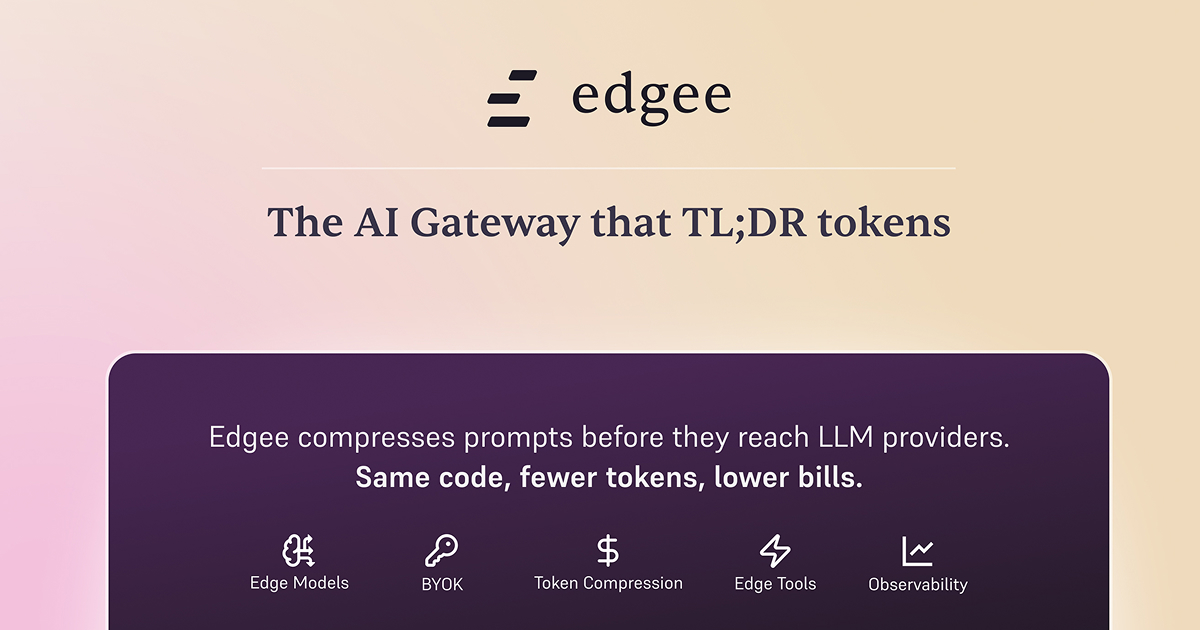
Edgee is an AI gateway that compresses prompts before they reach LLM providers, reducing token costs by up to 50%. It provides one OpenAI-compatible API for 200+ models with intelligent routing and cost governance.
Edgee is an AI gateway designed for developers and engineering teams who rely on coding agents and LLM-powered applications. It sits between your AI agents and LLM providers, compressing token usage without altering your code. The core value is straightforward: reduce LLM costs by up to 50% while maintaining output quality. This gateway is category-defining in the AI middleware space, offering a transparent proxy that integrates in under a minute. Targeted at teams using tools like Claude Code, Codex, Copilot, and Cursor, Edgee enables longer coding sessions and smarter resource allocation for enterprise AI workloads.
The primary pain point Edgee solves is the escalating cost of LLM API calls, especially from verbose coding agents. Tool-result payloads, repeated context, and inefficient provider handling inflate token counts dramatically. For teams running daily code generation sessions, these costs can exceed budgets quickly. Additionally, provider outages or rate limits disrupt workflows, causing frustration and lost productivity. Edgee addresses these issues by compressing input and output tokens automatically, ensuring that every request is optimized. This matters because LLM spending directly impacts a team's ability to scale AI usage, and wasted tokens mean reduced context for more complex problem-solving. By cutting token costs, Edgee lets teams run more iterations and tackle harder problems without increasing their monthly API bills.
The first major feature group is Token Compression, which operates on two layers. Layer 1 targets input payloads by trimming tool-result content, achieving 60-90% reduction for coding tasks. Layer 2 focuses on output brevity, instructing the model to produce more concise responses. This compression is semantically lossless, meaning the model's output quality remains identical while the billed tokens decrease significantly. Edgee applies this compression at the edge, before requests reach the LLM provider. The benefit is immediate: teams see lower costs on the first request without any code changes. This feature is particularly valuable for coding agents that generate massive tool-result logs, as it frees up context windows and reduces latency.
The second major feature group is Intelligent Routing and Fallback Models. Edgee provides a single OpenAI-compatible API that routes requests across 200+ models. If a provider fails or returns an error, Edgee automatically retries and falls back to the next available provider transparently. This ensures high availability and zero downtime for coding sessions. Additionally, Team Management capabilities allow administrators to track costs per repository and per pull request, manage team seats, and set model fallback policies. The combination of routing and team oversight gives engineering managers control over both infrastructure reliability and spending, addressing the need for governance in AI-powered development workflows.
Publisher
A
admin
Launch Date2026-02-12
Platformweb
Pricingfreemium
Domain Authority
Ahrefs DR34/100