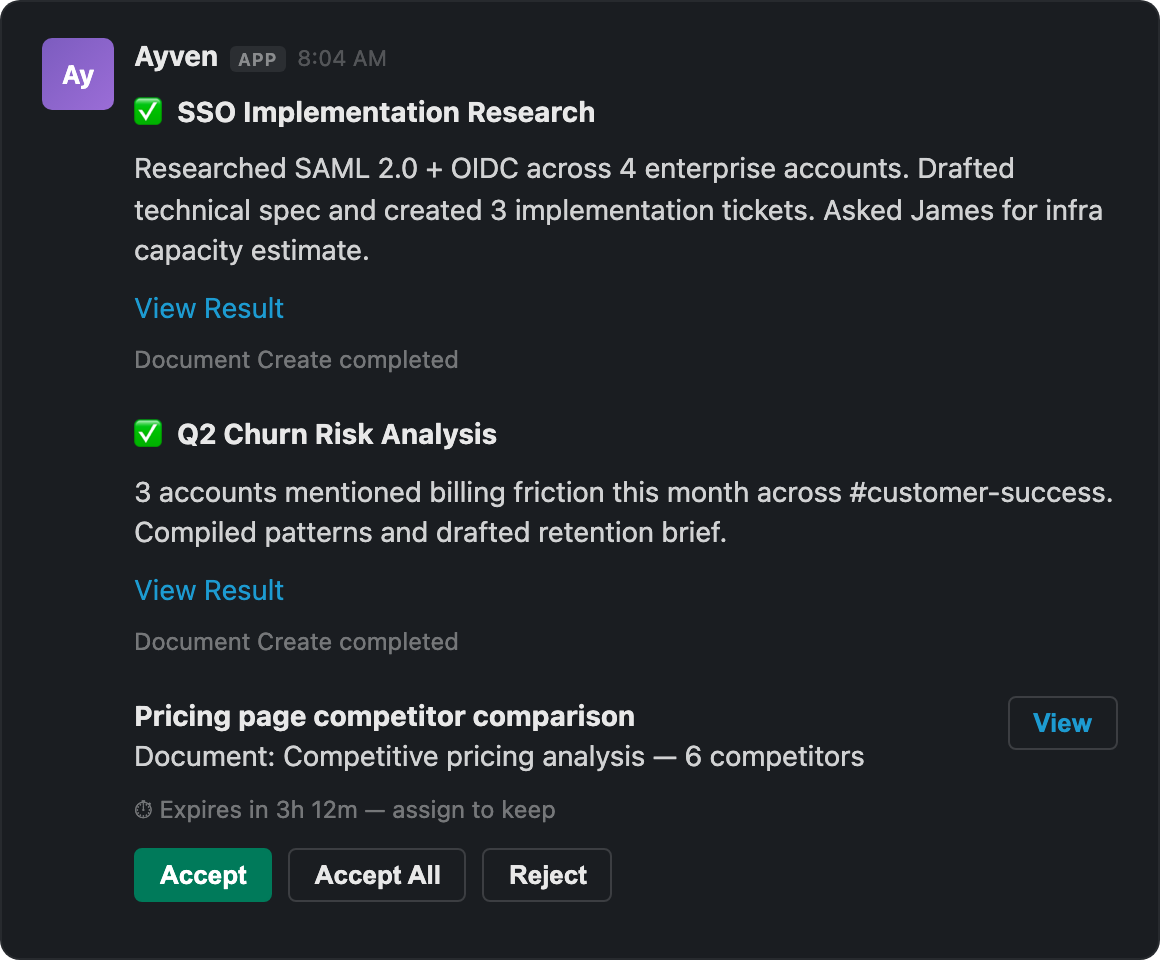
Ayven describes itself as the AI super coordinator that carries and drives your team's agenda. It works on Slack and Microsoft Teams: she reads what is due, asks the one person who can move it, hands off what she cannot do herself, and follows every piece through to Done, with a ticket changing only on its owner's yes. In practice that means Ayven observes the work, cuts it into pieces the team can take one at a time, puts an owner and a date on each, and files them in Jira or YouTrack. From there she runs, tracks and talks about the work for weeks — asking whoever knows, waiting, chasing silence and moving work when someone is away. Your team answers in Slack and the board moves. Ayven is aimed at the people who own outcomes for a team: the leads, executives and founders whose initiatives stall because no single person is explicitly holding the next step.
Every open question in new territory has no obvious owner, and the ones nobody owns are the ones that stall. That is the problem Ayven is built around. A ticket that gates a launch passes its due date and quietly sits there. A question asked at six dies in the thread until tomorrow, and nobody counts the day it cost. Three days with no next step is a stall. When you are finding out, what was true on Monday is wrong by Wednesday, and someone has to ask around. Worse, the few people who can push into the unknown are the ceiling, and every new initiative waits on them. Teams that staff this kind of work hire a chief of staff at a $160,000 median base, which is the coordination burden Ayven is designed to carry instead.
Ayven's first job is driving and delegating the work itself. She observes what is happening, cuts it into pieces your team can take one at a time, puts an owner and a due date on each, and files them into the board your team already uses, such as Jira, YouTrack or Asana. What she cannot do herself becomes a ticket with an owner and a due date, filed after you approve it, and she follows it until the board says Done. When work runs late, she keeps it moving: past its due date she asks the assignee on the ticket, then hands the work to a teammate who can carry it once you say yes. She also moves work when someone is away. Throughout, she tells whoever raised the work as it moves, so the person who reported a problem hears about it the moment the ticket changes.
Ayven also asks the person who actually holds each answer. She sends the question to whoever can answer it — one person by direct message, or the channel when anyone can. Before she asks, she reads the relevant ticket or document, so she is checking rather than guessing. She takes 'no reply yet' as an answer, asks another person when one goes quiet, and tells the asker who answered. One example on the site shows her checking billing and finding that the annual discount is applied at invoice time rather than at checkout, so the demo bug is in checkout, not pricing — she found the answer in the code and asked no one. Another shows her checking competitor prices before putting a pricing decision to a person, because the call gates the pricing page.
A third capability is that Ayven reads the tools you already run rather than asking you to move into a new one. She reads Slack threads before writing, reads the live Google Drive doc, and re-reads Notion pages before she acts. She reads a ticket's state and due date in Asana, watches a Jira ticket through to Done, reads the due date off a YouTrack ticket, and reads a GitHub issue's state and owner. She reads the live SharePoint file and can browse any Microsoft Teams channel on demand. She asks through Slack and Microsoft Teams, checks the ticket or the doc before she asks, and files or reassigns on the board only after you approve the exact change.
Ayven is built to work over time and in the background, over months. A promised Thursday is a deadline she keeps, no ask is left waiting forever, and she follows up in step with the deadline. On the site she works to a morning clock at 08:00, tracks expiry windows, and comments on a ticket the day it passes its date. For a goal such as a launch by a given date, she reads the due date off the ticket, notes a blocker, and acts — commenting on the ticket the morning after it passes, emailing you if the launch projects past its date, and recomputing after every step. The stated outcome is that she warns you about a slip while you can still do something about it, rather than after the fact.
The centre of Ayven's approach is that her messages and comments go out on their own, but a change to a ticket waits for your yes. She files work she cannot do as a ticket once you approve it, reassigns only on your yes, and is watched to Done without ever marking a ticket Done herself. Missions hold multi-week work: you give the outcome, she messages the people each step waits on, comments on tickets past their date, and files or changes a ticket after you approve the exact change. A reply on the ticket or a move on the board updates the mission automatically, so the record stays true without anyone re-explaining it.
The benefits follow directly from that model. Because Ayven carries the asking, the following-up and the coordination between people, those things happen on their own instead of waiting on a human to remember them. Planning stops being the barrier, and the team ships its agenda faster. More gets done with the same team, because the few people who can push into the unknown are no longer the bottleneck for every unrelated step. Responsibility stays clear — every piece has an owner and a date — and you are told when a ticket you care about moves, and when something you own slips, with enough time left to act.
Concrete scenarios appear throughout the site. An account executive reports that two prospects hit the checkout bug in demos; Ayven files it as a ticket to an engineer, due Thursday, watches it until the board shows Done, and tells the account executive as it moves. A senior executive asks for a summer team trip to be organised; Ayven asks four people one question each — dates, venue, headcount and budget — in direct messages. A finance, product and sales update becomes one assembled draft on Google Drive, filed on the requester's yes, with each team asked for its own numbers by a Thursday noon deadline. Late work is chased on the ticket, then handed to a teammate once approved, and a launch-gating ticket past its due date triggers a comment on the ticket the same day.
Ayven runs on Slack and Microsoft Teams and integrates with Google Drive, Notion, SharePoint, Asana, Jira, YouTrack and GitHub, so it reads the tools a team already runs rather than replacing them. Its stated audience is teams that would otherwise staff this coordination work by hiring a chief of staff, whose median base is $160,000. Pricing starts with a free plan at $0 that includes 500 credits a month, every integration included, and no card required; a 15-minute demo can also be booked. There is no mention of a separate paid tier on the site, though the credit-based free plan implies usage is metered.
Taken together, Ayven is a coordinator rather than a dashboard: it takes the outcome you give it, asks the one person who can move each step, files and tracks tickets to Done, and keeps every change behind your approval. Its value proposition is that the asking, the chasing and the coordination stop depending on a human remembering them — the board moves, the record stays true, and you hear about a slip while you can still do something about it.
Publisher
A
admin
Launch Date2026-10-12
Platformweb
Pricingfreemium