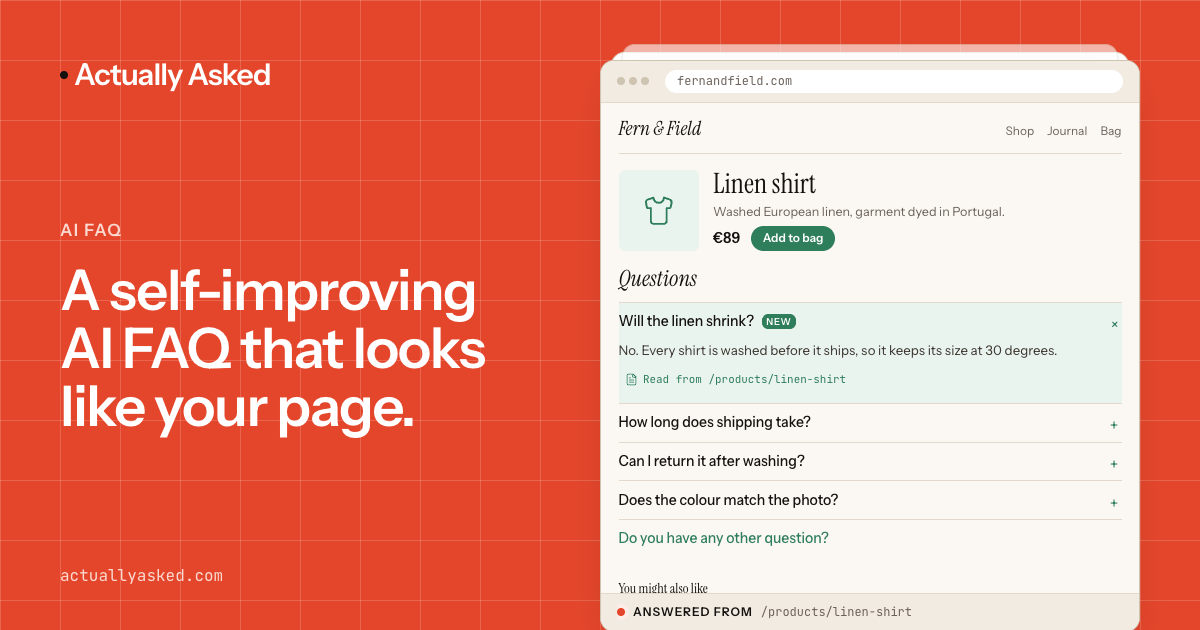
Actually Asked is an AI FAQ app for websites and Shopify stores. Rather than adding a floating chat bubble, it places a FAQ section directly inside your page, styled in your own fonts and colours, so it looks like part of the site. Visitors ask their question in their own words and receive answers taken only from your own pages, your help center and files you upload. The questions visitors ask most then join your FAQ on their own.
The problem it addresses is a familiar one: businesses answer the same questions again and again by email. Sizing, shipping times, caffeine content, whether a jacket is truly waterproof, what a cancellation policy covers, what to bring to a first appointment. The answers usually already exist somewhere on a product page, in a help centre article or inside a PDF, but visitors either cannot find them or do not want to dig. Actually Asked is aimed at any site where people ask before they buy, book or sign up. The company puts the filter simply: if people email you the same questions again and again, it is for you; if nobody asks you anything yet, it is not.
Three features carry the core experience. The first is an inline FAQ: a FAQ section that lives in your page rather than a chat bubble, and that is styled like your site. The marketing content shows the same widget rendered in the look of three different shops, a linen shirt store, a coffee roaster and an outdoor gear shop, each with its own typography and colours. The second is highlight to ask. Visitors select any sentence on the page and ask a question about it, which turns a specific line of copy, such as a sizing note or a care instruction, into an entry point for an answer. The third is the self-improving FAQ. The questions visitors ask most join your FAQ on their own, with nothing for you to approve. You can still edit, pin or remove any entry, and the product states that your edits are never overwritten.
Answers are restricted to your own sources and nothing else. On the Sources page you connect your site, its pages, and on Shopify your products and store policies, which are read again every 7 days. You can add the address of a help center or knowledge base, and you can upload PDF or Word files such as size charts, care guides, manuals and price lists, including files that are not public. Answers can quote a file but never link to it. The onboarding view shows a site of 38 pages, a Shopify catalogue of 212 pages and four policy pages, all read at 04:00 with the next read scheduled for 04:00 the following day.
The weekly gap report arrives as one email every Monday. It lists the questions asked most, the ones your pages do not answer, and what was added to your FAQ. A sample report shows 214 questions asked in the week, 87% of them answered and nine with no answer to write about. A separate leads feature captures visitors who leave an email address, so you have someone ready to reply to. Finally, an MCP integration lets you manage your FAQ by asking Claude, ChatGPT or another assistant, for example publishing FAQ entries through a tool call.
Setup is presented as three steps. First, you add your domain, plus your help center or PDF and Word files if you have them; those sources are read, private files included, and your first FAQ entries are written from them. Second, you paste two lines, a div carrying your site key and an async script tag from the Actually Asked CDN, and the FAQ appears where you put it; on Shopify you add it as a block in the theme editor instead. Third, visitors ask, and your FAQ grows. The distinguishing choices are the absence of a chat bubble, the tight sourcing rule that answers come only from your pages, and the fact that popular questions are promoted into the FAQ automatically rather than waiting on a human editor.
The outcome the product describes is a FAQ that looks like yours and learns from visitors. Popular questions are answered once and added permanently, so the same email does not need to be written twice. Because answers are grounded only in your own material, the reply a visitor sees reflects what you already publish. The Monday report gives a regular view of the questions your pages fail to answer, which points at content worth writing. Leads are collected for follow-up, and the whole FAQ can be maintained from a dashboard, the Shopify admin or an AI assistant.
Four use cases are documented. Online stores, including Shopify, WooCommerce, Squarespace and custom shops, use it for product and policy questions such as whether a size runs small. SaaS and apps use it on pricing pages and documentation for plan and "does it do X" questions, illustrated by a per-seat pricing example where an annual discount question is answered from the /pricing page. Travel and hospitality businesses such as hotels, rentals and tours handle check-in, cancellations and what is included, illustrated by a room booking page answering whether breakfast is included from the /rooms page. Services and clinics, including agencies, clinics, studios and coaches, cover booking, pricing and what to expect, illustrated by a first-visit page that answers what to bring.
Actually Asked was built first for Shopify stores but works on any website whose visitors have questions before they buy, book or sign up. Integration paths include a Shopify theme block, a WordPress Custom HTML block or footer script, a Webflow Code Embed, a Framer Marketplace plugin or pasted component, a Squarespace Code block, and static HTML, React, Next.js or custom templates. There is also a free gap-finder tool to find FAQ gaps and an MCP route for managing the FAQ through Claude or ChatGPT. Pricing starts free with 50 AI answers a month on one site, then $12 a month; every plan includes unlimited team members, and you pay for the answers you use and the sites you run.
Actually Asked replaces the chat bubble with something more durable: a branded, inline FAQ that answers from your own sources and quietly grows with the questions visitors actually ask. It is free to start, live on your site in about ten minutes, and aimed at any business that keeps answering the same question by email.
Publisher
A
admin
Launch Date2026-10-16
Platformweb
Pricingfreemium