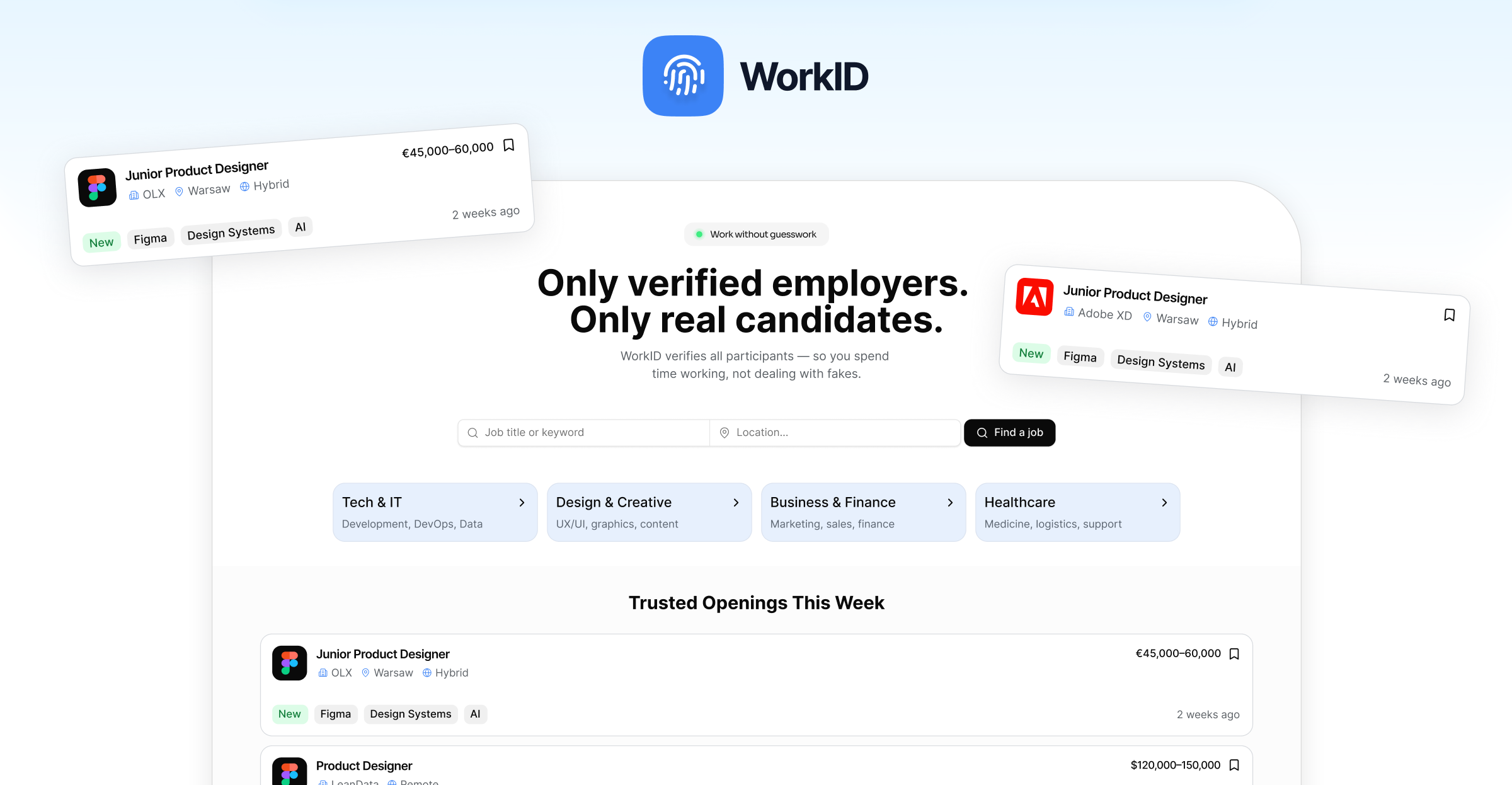
WorkID.ai is a hiring platform where every participant is verified before they take part. It describes itself as the first job board you can rely on, and it is built around a simple promise: only verified employers, and only real candidates. Candidates verify their identity and their work experience, so their profile becomes a checked record rather than a list of claims. Employers are verified too, so job seekers know that the roles they see come from real companies. Between the two sides, WorkID states that it matches people to the roles they actually fit, so job seekers spend their time working instead of dealing with fakes, and companies spend their time interviewing real people, not facades.
The problem WorkID was built to solve is that hiring still runs on self-claims. A CV says whatever someone types into it, and the recruiter has to take it on faith. There is no independent check standing behind the words on the page, which means a recruiter cannot easily tell a genuine track record from an invented one. The cost falls on everyone. Candidates, knowing how little a CV is trusted, send out a hundred applications and hear nothing back, while employers wade through volume that has no verification behind it. WorkID's answer is to move verification to the front of the process: identity, work history and references are checked on both sides before anyone starts screening. Instead of asking a recruiter to trust a document, the platform hands over a profile that has already been verified, and instead of asking a candidate to hope, it gives them a profile recruiters can trust.
On the candidate side, WorkID verifies identity and work history. A verified profile displays an identity confirmed check alongside the person's name and location, so it is immediately clear that the person behind the profile is who they say they are. Each position in the work history carries its own verified marker, which means the roles, companies and dates shown on the profile have been checked rather than simply typed in. A candidate profile shows current title, city, employment period, employment type and work arrangement for the current role, followed by earlier positions with the same detail, each with a verified indication. References are verified as well, adding a third layer beyond identity and history. The profile also carries a longer professional summary, in the example shown a senior drilling engineer with more than fourteen years in offshore drilling and subsea operations, described through specific expertise and named employers and projects. Because the experience is verified at the source, the summary is backed by checks rather than standing alone as a claim.
On the employer side, WorkID verifies employers so that job listings come from real companies. Job seekers browse jobs from verified employers rather than unverified postings, which removes a common source of wasted applications. The platform also surfaces a current trust score on the profile, shown in the example as a score out of one hundred, giving a single quick read on how much verification stands behind a person. Companies hiring appear openly on the platform, with employer names and logos listed under companies hiring this week, and a company profile page for those who join. For employers, the practical effect is that they see profiles that have been checked rather than a list of claims, which the platform says speeds up screening because the vetting is already done before the first conversation.
The core of the product is the job board and the job categories it organises around. WorkID groups opportunities into broad fields: Tech & IT, covering development, DevOps and data; Design & Creative, covering UX and UI, graphics and content; Business & Finance, covering marketing, sales and finance; and Healthcare, covering medicine, logistics and support. Listings include the job title, the employer, the location, the work arrangement and the seniority level, so a candidate can scan quickly for roles such as lead or principal positions, senior positions and remote roles. The platform also highlights remote work, with sections built around remote jobs and remote roles, and shows how recently a job was posted, down to same-day listings. Because every employer posting is verified and every candidate browsing is verified, the board itself is designed to be a place you can rely on rather than a place where applications disappear into silence.
WorkID's overall approach is to verify first and screen second. Verification happens before the first screening, so recruiters are not spending their first conversation establishing whether the basic facts are true. The platform checks identity, work history and references on both sides of hiring, then uses that verified base to match candidates with roles they actually fit. Signing up is free and is described as taking two minutes to set up, and the candidate chooses what to share, which keeps control over personal information in the hands of the person being verified. That combination, verification up front, matching on top of it, and a short setup path, is how WorkID positions itself as a job board that is materially different from a list of self-reported profiles.
The benefits for users follow directly from that design. Candidates get a profile recruiters can trust and can stand out with it, rather than competing on the strength of unverifiable claims, and they avoid the familiar pattern of mass applications that get no response. Employers get a candidate pool where identity and history have already been checked, which reduces time lost to fake or exaggerated profiles and lets them focus on interviewing the real people who reach them. Both sides spend less time on verification and administration and more time on the work itself, which is the promise the platform states most directly: spend time working, not dealing with fakes. The visible trust score and verified markers give everyone a common, understandable signal to work from.
Typical use cases include a professional building a verified profile so their employment history, references and identity are confirmed once and can be trusted by every employer they approach, and a recruiter browsing checked profiles instead of wading through self-claimed CVs. A job seeker can search the board by category, such as Tech & IT or Healthcare, and filter their attention to verified employers posting remote or senior roles, including roles posted that same day. An employer can join WorkID, appear among companies hiring, and publish listings to participate in the verified network. Candidates can also connect with other verified professionals across the European network the platform highlights, using those connections while they search for remote work or a new role in their field.
WorkID is aimed at candidates and employers who want hiring to start from verified facts. The platform states it is for hiring globally, and it highlights a European network of verified professionals, with example profiles and job listings from Norway and Sweden. It is free to start and takes two minutes to set up, and candidates decide what they share. Employers appear on the platform with their company profiles and current openings, and job categories span technology, design, business and healthcare. The wider context is a labour market where global hiring and remote work make it harder to know who is on the other side of an application, which is precisely where verification adds the most value.
The takeaway is that WorkID replaces trust-on-faith hiring with trust-by-verification. By checking identity, work history and references for both employers and candidates, by showing a trust score and verified markers on each profile, and by matching people to roles they actually fit, it lets companies interview real people and lets candidates be believed. Free to start, verifiable at the source, and built for hiring across borders, it positions itself as the job board you can rely on.
Publisher
A
admin
Launch Date2026-09-10
Platformweb
Pricingfreemium