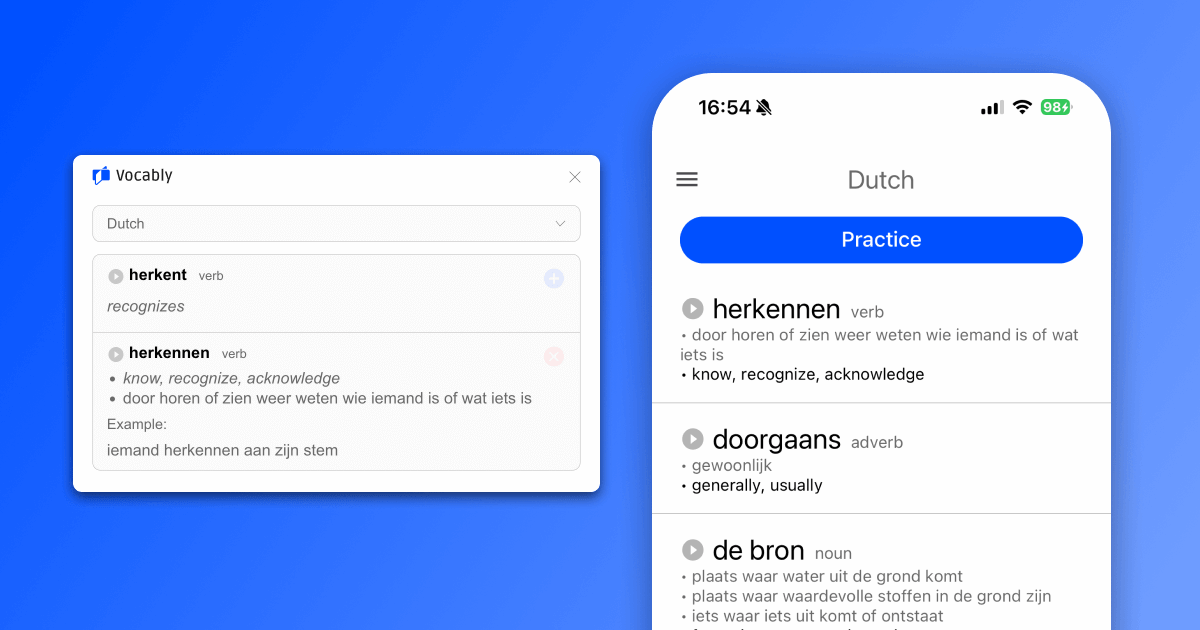
Vocably is an AI-powered language learning tool that combines a contextual dictionary with flashcards, designed specifically for intermediate to advanced learners targeting B1-C1 proficiency. By integrating seamlessly into the Chrome browser and offering a mobile companion app, it bridges the gap between passive content consumption and active vocabulary building. Its core value lies in making foreign language acquisition effortless and context-rich, using AI to deliver accurate translations and definitions tailored to each user's target language. This approach transforms everyday web browsing and YouTube watching into productive study sessions, enabling users to capture and review new words without disrupting their flow.
Traditional language learning often requires switching between tabs or apps to look up unfamiliar words, breaking concentration and reducing immersion. Many learners struggle to retain new vocabulary because they lack a systematic review method that fits into their daily routine. Vocably solves this by providing instant inline translations and one-click flashcard creation, minimizing the friction between discovery and study. This eliminates the pain point of disjointed learning, allowing users to build a personalized vocabulary deck while consuming real-world content. By learning words in their natural context, users improve comprehension and long-term retention, finally bridging the gap to advanced fluency.
The first major feature group is Vocably's instant translation system, powered by AI. When a user highlights a word on any webpage, a compact popup appears with the translation and multiple possible meanings. The AI analyzes the surrounding sentence to offer the most relevant definition, along with example sentences that demonstrate usage. Users can select the correct meaning or edit the definition to make it more personal or memorable. This feature eliminates the need to open a separate dictionary, keeping the user fully immersed in the content. Many reviewers praise the accuracy of AI-translated features, noting that they seamlessly integrate with platforms like YouTube and other reading sources.
The second major feature group is the effortless flashcard creation and spaced repetition system. With a single click, any translated word can be saved as a flashcard directly from the popup, instantly added to the user's personal deck. These flashcards automatically sync to the Vocably mobile app, which employs a spaced repetition algorithm to schedule reviews at optimal intervals. This method reinforces memory over time, ensuring words move from short-term to long-term recall. Users appreciate that they can review their saved words on their phone during commutes or breaks, making learning continuous and convenient. Unlike traditional flashcard apps like Anki, Vocably eliminates manual card creation and context switching, as noted by users who find it 'better than Anki for creating flashcards.'
admin
Vocably also integrates with YouTube subtitles, a unique capability highlighted by multiple reviewers. When watching videos with captions, learners can click on any subtitle word to get an instant translation and add it to their flashcards without pausing the video. This turns passive video watching into an active learning session, capturing words used in authentic spoken contexts. Additionally, the seamless cross-platform sync between the Chrome extension and the Android mobile app ensures that words saved on a desktop are instantly available on a phone. As one reviewer described, 'I can be on my computer reading or watching something on YouTube and with some clicks I get the word in my phone for reviewing later.'
Vocably operates on a simple three-step workflow: discover, capture, and review. While browsing the web or watching YouTube, users encounter unfamiliar words. They double-click or highlight the word, and Vocably displays an AI-generated translation with examples. If the word is worth learning, they click a save button to add it to their personal deck. Later, they open the Vocably mobile app to review these words through spaced repetition flashcards. The entire process is designed to be frictionless, requiring no manual data entry or app switching. Users can also edit the definitions and add personal notes to make each card more memorable, further personalizing their learning experience to fit their individual preferences and memory aids.
Concrete use cases demonstrate the product's effectiveness. A learner preparing for a German B1 exam used Vocably to build vocabulary while reading online articles and watching German YouTube videos. By saving words encountered in context, they efficiently expanded their lexicon and passed the exam, crediting Vocably's friction-free addition and review cycle. Another user, a polyglot practicing English and Italian, reads newsletters and highlights unfamiliar words, saving them for later review on the mobile app during daily commutes. The outcome is a steadily growing vocabulary without needing dedicated study sessions. Even learners who previously struggled with other flashcard apps find Vocably easier to stick with because it removes the overhead of card creation and context switching.
Vocably is designed for language learners from intermediate to advanced levels (B1-C1) who want to learn in context. It is available as a Chrome extension and an Android mobile app, with pricing possibly including a free tier and a paid version for additional features (though explicit pricing is not stated in the provided reviews). The target audience includes self-directed learners, exam students, polyglots, and anyone consuming foreign language content online. Key platforms are Chrome browsers and Android devices. With its AI-powered translations, one-click flashcard creation, and spaced repetition, Vocably delivers a streamlined approach to vocabulary building that integrates naturally into daily digital life, making it an essential tool for serious language learners aiming to finally cross into B2 or C1 territory.
Vocably is designed for language learners at intermediate to advanced levels (B1-C1) who want to expand their vocabulary through real-world content. The audience includes self-taught language learners, students preparing for language exams (e.g., German B1), polyglots learning multiple languages simultaneously, and English learners seeking to improve their vocabulary. It is also suited for Chrome browser users and Android mobile device owners who prefer learning in context rather than from textbooks. The tool appeals to power users of flashcard apps who want a more integrated experience, as well as anyone who consumes foreign language content online and seeks to turn passive reading or watching into active vocabulary acquisition.