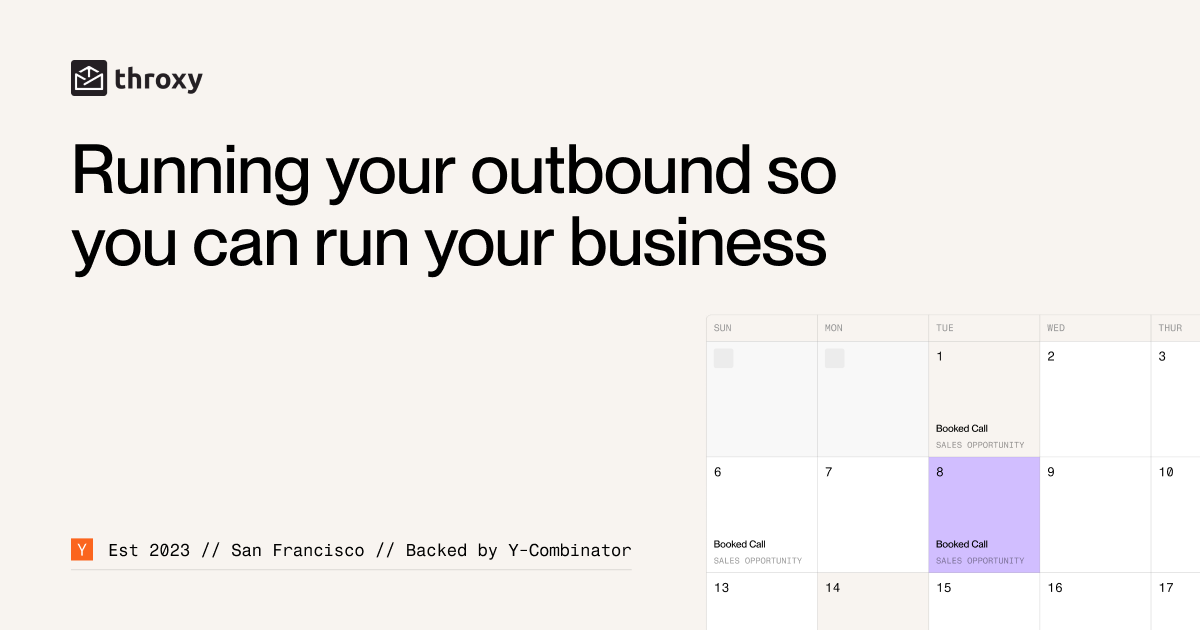
throxy is an outbound partner built for B2B companies selling into complex, hard-to-crack industries such as manufacturing, logistics, construction, education and healthcare — markets where generic outreach usually fails. Rather than handing you another dashboard, throxy builds prospect lists using custom, proprietary technology and then puts human sales development representatives on the phone and in the inbox to book qualified sales meetings on your behalf. The arrangement is simple on the buyer's side: you do not hire, ramp or manage anyone; you only choose which of the qualified meetings you want to take. throxy describes itself as Y Combinator's first AI-native sales agency and positions the service as a true outbound growth partner rather than just another sales platform, combining proprietary technology, data intelligence and human expertise. The stated purpose is to create a steady, predictable flow of high-value conversations with decision-makers in industries that are hard to reach but lucrative.
The website is direct about the problem it addresses. Most tools, it says, overwhelm: they require tinkering, testing and fixing issues, and they lean on stale data or firmographic filters from generic data providers. Most agencies disappoint: they promise results but deliver poor leads, while SDRs are slow to ramp and need handholding. The industries throxy targets are described as complex, relationship-driven and full of noise — manufacturing is called one of the toughest markets to crack. Most outbound, the site argues, floods your calendar with noise, so the buyers actually worth your time get buried among unqualified conversations. throxy's answer is to combine its own outbound technology with a fully managed human team, so companies selling into traditional industries get real conversations instead of spam, and so internal sales teams can focus on what they do best: closing deals.
The first pillar is custom lead targeting. Rather than renting access to a generic database, throxy builds tailored prospect databases from scratch based on your exact ideal customer profile. The site contrasts this with tools that rely on stale data or broad firmographic filters, and it emphasizes custom databases, niche-specific targeting and proprietary infrastructure that reaches buyers others cannot find. Lead research draws on scraped sources including LinkedIn, the prospect's website and Glassdoor, and it hunts for specific triggers — a recent fleet expansion, a new partnership — that make outreach timely. This matters in traditional industries where buyers are not searching for new vendors and where a well-chosen trigger is often the difference between a reply and silence.
The second pillar is cold calling, powered by Maestro, the dialer throxy built itself to put SDRs on live conversations instead of dial tones. The site reports that the same team books twice the meetings on Maestro, with 121% more meetings booked per week since the dialer launched, 71% more meetings when calling is added, an 11% booking rate on calls lasting over two minutes, and zero people the customer needs to hire or train. A newer capability routes calls to an SDR who speaks the lead's language: a plant manager in Lyon hears French, a buyer in Munich hears German. The published interface shows an SDR note being written during a live call — qualified on production line downtime, interested in a Q3 pilot, asking about case studies in DACH, ready to book — illustrating how qualification happens inside the conversation rather than afterwards.
The third pillar is qualification and approval. Every lead is qualified before it ever reaches your calendar against criteria the site lists as ICP (right company size), decision-maker confirmed, budget authority and timing confirmed, with leads failing a criterion marked to skip. Even after qualification, meetings go through a meeting approval step where you accept or skip each one, and throxy states plainly that it never books without your approval. A sample weekly calendar shows only the accepted names — a VP of Operations, a CEO, a CTO — reinforcing the promise that only qualified buyers make it through, with no noise and no wasted calls.
The fourth pillar is messaging. throxy pairs email and cold calling end to end, using context-aware personalization drawn from scraped LinkedIn profiles and websites. The example on the site pairs a trigger observation ("Saw your recent Fleet expansion") with a website observation ("Congrats on your DHL partnership") before asking whether fleet expansion is relevant right now. Messaging-market fit is tested through A/B tests, such as Email version 1 versus a combined email and call sequence, and email deliverability is handled as a managed service, including warming email infrastructure during campaign buildout. The company lists its solution areas as lead finding and qualification, cold calling, messaging, deliverability and closed-loop optimisation, all delivered as a done-for-you service.
How the whole thing runs is spelled out as a timeline. On days 1–2, throxy completes onboarding and strategy: ICP definition, qualification criteria and messaging frameworks are signed off, the team scrapes websites, LinkedIn and Glassdoor while searching for triggers, and briefs SDRs on value propositions and objections. On days 3–5 comes campaign buildout: the lead list is built and enriched, the SDR team is briefed and email infrastructure is warmed. From day 5 onward, calls and emails run in parallel, replies are managed and qualified leads are passed to you. From weeks 3–4 onwards, qualified meetings land on your calendar alongside weekly updates, A/B testing and continuous optimisation. The headline is that you are live within a week and see meetings within the month.
The intended outcomes follow directly from that model. There are no dashboards to manage, no systems to learn and no resources to hire; the prospecting burden — finding targets, crafting personalised outreach, managing replies and booking meetings — is taken off your plate so your team can focus exclusively on closing. Because the system keeps testing and optimising, throxy says it learns and improves for your specific business the longer you work together. The result it promises is outbound sales that is predictable, profitable and painless, with a steady flow of high-value conversations in markets where outbound is hard, ignored or broken.
Concrete scenarios appear throughout the site. A manufacturing software company describes throxy as more than a tool and a true outbound partner, starting real conversations rather than sending spam so the sales team can concentrate on closing. An education solutions provider credits personalised outbound with putting the right message in front of every educator at the perfect moment, unlocking qualified opportunities and freeing time for customers. A third customer reports 12 meetings in 20 days in December — described as the toughest month for outbound — and 137 meetings booked by July 2026 with an 80% show rate. The site also illustrates trigger-driven work with a mid-market logistics ICP: Director of Operations persona, fleet expansion trigger, and outreach referencing a DHL partnership.
throxy is aimed at B2B companies selling into traditional, complex or niche industries — manufacturing, logistics, construction, education and healthcare are all named — including teams that have been burned by generic data providers or agencies delivering poor leads. Both email and cold calling are fully managed, and all SDRs are humans. On commercial terms, throxy states that you pay for meetings you accept that actually happen, which shifts the cost toward delivered pipeline rather than effort. The site does not publish tiers or list prices; instead it routes prospects to a strategy call booking form, and its FAQ addresses setup requirements, cold calling, using your own CRM or pipeline tools, niche industries, time to first meetings and how the service differs from a traditional lead gen agency.
The takeaway is that throxy sells outcomes rather than software: proprietary list-building technology plus a human SDR team running email and multilingual cold calling, with qualification and approval gates so only meetings worth your time reach your calendar. For companies in hard-to-crack industries, the value proposition is pipeline delivered without hiring, ramping or managing anyone — and paying only for meetings you accept that actually happen.
Publisher
A
admin
Launch Date2026-10-29
Platformweb
Pricingpaid