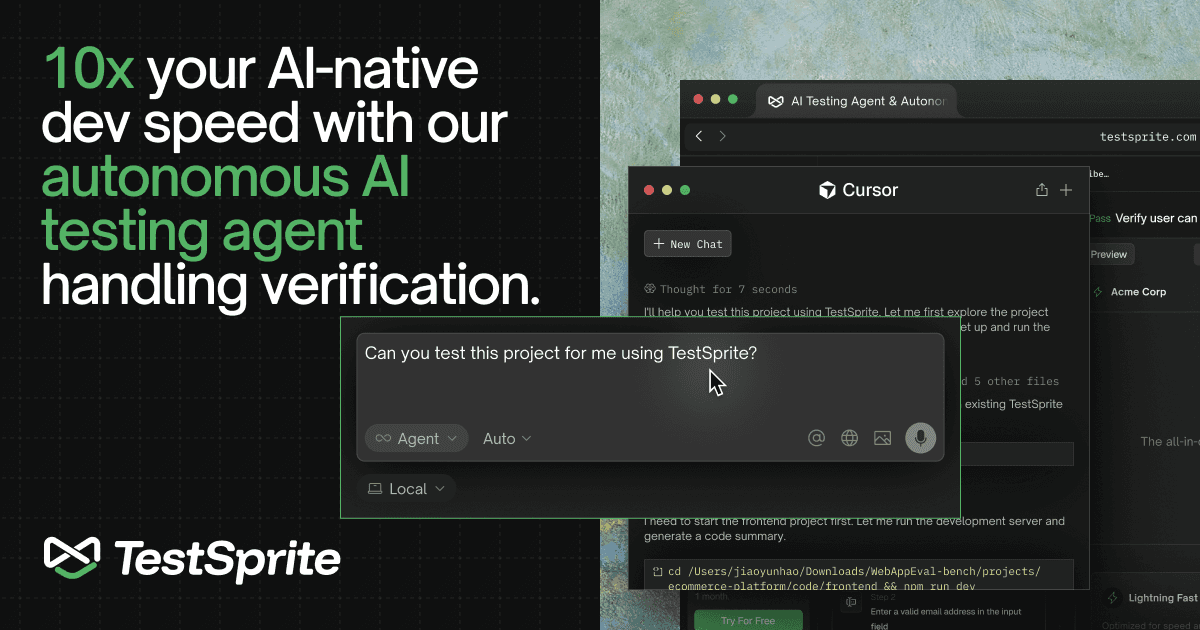
TestSprite
TestSprite is an autonomous AI testing agent that automates the entire software testing process. It generates, executes, and maintains test cases across applications to boost AI-code pass rates from 42% to 93%.
TestSprite is an autonomous AI testing agent designed for AI-native teams that ship code in minutes but struggle to verify it. This category of tool fills the critical verification gap that emerges when coding agents produce output faster than humans can review. TestSprite automates the entire software testing lifecycle by generating, executing, and maintaining test cases across web applications, APIs, and visual interfaces. Its core value is transforming the software delivery pipeline: by providing a self-driving QA loop, it boosts AI-generated code pass rates from 42% to 93%, as demonstrated in head-to-head competitions like CoderCup. The product is built for teams who rely on coding agents and need a verifier that works where their agents work.
The problem TestSprite solves is what the site calls "the verification gap." Coding agents routinely report tasks as complete even when the page does not render or a change in one file breaks functionality three files away. Even the strongest measured runs regress approximately 12–25% of previously passing features in a single change, and weaker runs approach 25%. Existing verifiers assume a human is watching a screen, but agents work autonomously overnight in a terminal or IDE. TestSprite closes this gap by giving agents their own verification loop that can run unattended, catching regressions and dropped requirements before they reach production. Without such a loop, teams spend time babysitting autonomous tools, undermining the speed they were meant to gain.
The first major feature group is that TestSprite actually uses your app instead of just reading it and guessing. It reads your code and product requirements documents (PRDs) to understand context, then proves functionality against the running product. Dozens of agents open your live application simultaneously and click through every feature like a real user would, driving a real browser or hitting a live API. This approach avoids assertions on mocks and ensures tests reflect actual user behavior. The system also records every session as video for replay, providing visual evidence of what occurred. This feature matters because it catches issues that static analysis or mocked tests would miss, such as rendering failures or broken workflows that only appear in a live environment.
The second major feature group is the failure bundle that agents can actually act on. When a test fails, TestSprite returns a single self-consistent bundle containing the failing step and its neighbors, screenshots, DOM snapshots, the test source code, a root-cause hypothesis, and a recommended fix. The agent reads this bundle, fixes the code, and reruns the test. This machine-readable format eliminates guessing and flaky pass/fail noise. Additionally, an auto-heal capability repairs tests when the UI drifts, reducing maintenance burden. The bundle is tied to one snapshot of the application state, preventing the common problem of chasing moving state. This feature turns a failed test into an actionable debugging session rather than a vague error.
Publisher
A
admin
Launch Date2026-03-08
Platformweb
Pricingfreemium
Domain Authority
Ahrefs DR40/100