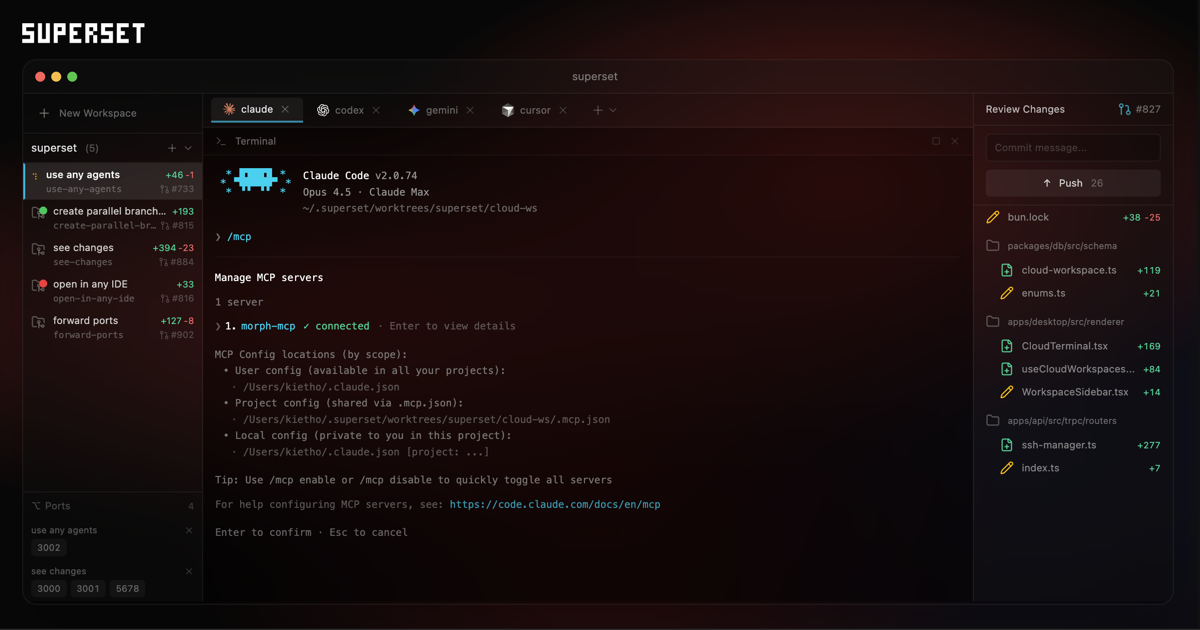
Superset is a code editor designed exclusively for the AI era, purpose-built to orchestrate over 100 AI coding agents in parallel. It targets developers and engineering teams who want to maximize the productivity of AI coding tools by running multiple agents simultaneously on a single machine. The core value lies in eliminating the serial bottleneck of traditional AI workflows, allowing users to work on features, fix bugs, and refactor code concurrently without the overhead of context switching. Built for modern development workflows, Superset integrates seamlessly with any CLI-based AI coding agent, making it an agnostic platform that empowers users to choose the best tool for each task. This paradigm shift from waiting for one agent to finish to orchestrating a team of agents transforms how developers approach complex software projects, accelerating delivery cycles and improving code quality.
The primary pain point Superset solves is the inefficiency of serial AI agent usage. Developers using AI coding tools often find themselves waiting for one agent to complete a task before starting another, leading to significant wasted time and underutilization of AI capabilities. This context switching between different tasks and agents breaks flow and reduces overall productivity. For teams building complex features or maintaining large codebases, the inability to run multiple independent AI agents in parallel creates a bottleneck that slows down development cycles and limits the potential of AI-assisted coding. Superset directly addresses this by providing an environment where agents work concurrently in isolated workspaces, ensuring that progress on one task never blocks another. This matters because time is the most valuable resource in software development, and unlocking parallel AI execution can dramatically accelerate delivery without sacrificing code quality.
The first major feature group is Parallel Execution, which allows users to launch multiple AI coding agents across different tasks simultaneously. As stated on the site, you can "run dozens of agents at once" and "work on features, fix bugs, and refactor code — all in parallel." This works by creating separate workspaces for each agent, each with its own Git worktree and environment. The benefit is profound: instead of sequentially executing AI prompts, developers can dispatch an army of agents to tackle independent tasks concurrently, reducing the time to complete a feature set from days to hours. The interface shows a "Superset In Progress" list and "Ready for Review" list, giving clear visibility into agent workflows. This orchestration capability is reminiscent of managing a distributed team, but here each agent is an AI-powered coder operating at machine speed.
admin
The second major feature group is Universal Compatibility, meaning Superset is agent-agnostic and works with any CLI-based coding tool. The site explicitly lists support for Claude Code, OpenCode, Cursor, Codex, Gemini, Copilot, Amp, and more. Users can switch between agents seamlessly, even within the same session. This is useful because it prevents vendor lock-in and allows developers to use the best agent for each specific task. For example, a user might prefer Claude Code for complex refactoring and Cursor for quick bug fixes. Superset's terminal-based interface shows multiple agent terminals side by side, enabling easy monitoring and control. This flexibility ensures teams can adopt new AI tools as they emerge without being tied to a single provider. Additionally, the product allows using any agents from the start, as shown in the UI with buttons to "use any agents" and "create parallel branches."
The third feature group combines Isolation and Open Anywhere. Isolation ensures that each agent runs in its own isolated Git worktree, meaning changes are completely separate until reviewed and merged. The site emphasizes "no merge conflicts, no stepping on each other's changes." Developers can review changes side by side before accepting them, using a diff interface that shows files, changes, and a review panel. Open Anywhere allows users to open any worktree in their preferred IDE with a single click, supporting VS Code, Cursor, Xcode, JetBrains IDEs, Sublime Text, and even the terminal. This seamless integration into existing workflows means developers can use their familiar tools while benefiting from Superset's orchestration capabilities. Together, these features eliminate the chaos of simultaneous AI work and give developers complete control over what gets merged.
Superset's approach to parallel AI coding is delivered through a workspace-based workflow. Users start by creating a "New Workspace" and then assign agents to tasks. Each agent operates in its own environment, forwarding ports as needed. The system displays a real-time status of agents (in progress, ready for review) and provides a diff view of changes against the main branch. Users can approve or comment on changes before merging. The product also features automations and supports cloud, mobile, and CLI access. Notably, closing a laptop does not kill sessions, as confirmed by testimonials. The UI includes a terminal with agent tabs, a file explorer, and a changes panel. Users can also see stats like "+1,128 −98·10 files" per PR. This workflow reduces friction and keeps development moving, allowing developers to focus on high-level decisions rather than micromanaging AI agents.
Concrete use cases from testimonials and features include parallel bug fixing, where a developer dispatches multiple agents to fix different bugs simultaneously, cutting resolution time from hours to minutes. Another scenario is simultaneous feature development: while one agent builds a new UI component, another refactors backend logic, and a third writes tests. The outcome is faster feature delivery and higher code quality. A user from Cloudflare mentioned using Superset as their primary terminal, while another runs it on a Mac mini via remote desktop to access powerful local compute. Users report that Superset has become their default tool for all AI-assisted coding, describing it as a "generational product" and a "complete paradigm shift" in how they use AI to code. The ability to see git changes within the editor and review them before merging gives teams confidence in AI-generated code.
Superset targets developers, engineering teams, and companies ranging from startups to enterprises like Microsoft, OpenAI, Salesforce, and Datadog. It is built for anyone who uses AI coding agents and wants to scale their usage beyond single-agent workflows. The platform is available as a desktop application with cloud, mobile, and CLI interfaces, as indicated on the site. Pricing is not explicitly stated, but the site shows "Join Waitlist" and "View on GitHub," suggesting it is open-source or in early access with free usage. Users can bring their own API keys for agents. In summary, Superset redefines the developer experience by enabling true parallel AI collaboration, delivering massive productivity gains and transforming how code is written in the AI era. It gives developers a powerful orchestration layer that turns a single AI assistant into a scalable team of autonomous coders.
Software engineers, full-stack developers, engineering teams, tech leads, and AI researchers who actively use AI coding agents like Claude Code, Cursor, OpenCode, or Codex. Perfect for teams looking to scale AI-assisted development beyond single-agent workflows, reduce context switching, and accelerate delivery. Also suitable for open-source contributors and remote developers who need persistent agent sessions across devices. Trusted by builders from Microsoft, OpenAI, Salesforce, and more.