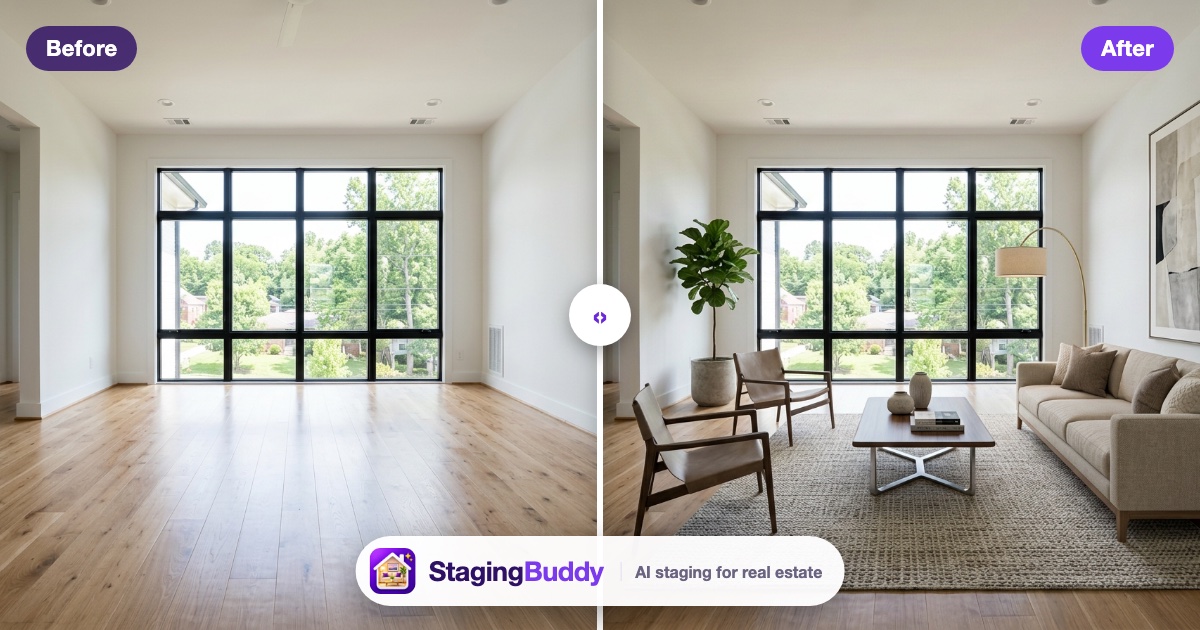
StagingBuddy is an AI virtual staging tool built for real estate. Its purpose is straightforward: you upload a photo of an empty room, pick a furniture style, and receive a realistic, listing-ready staged photo in seconds. The product is aimed at real estate sale and rental listings, where an empty-room photograph needs to communicate how a space could look when furnished. StagingBuddy describes the output as photorealistic, with real furniture, real light and real perspective, while the room itself stays exactly as it is. The company frames the tool as a fraction of the cost of physical staging, and the workflow requires no designers, no furniture rental and no waiting.
Empty rooms are hard to present in a photograph. Physical staging — bringing in furniture, working with designers and renting pieces — takes weeks and costs thousands, per StagingBuddy's own framing. That delay and expense matters because a listing photo of a bare room shows square footage but not possibility; it does not show how the space could be lived in. StagingBuddy's stated goal is to "sell the space, not the emptiness," replacing the weeks-long physical staging cycle with a process measured in seconds. The product therefore addresses both the cost barrier and the speed barrier that keep many listings from being staged at all.
The core workflow is deliberately short and is described on the site as staged in three steps. First, you add your room photos: snap a photo on your phone or upload up to three empty-room shots at once. Second, you pick a style, choosing from 9 interior styles and adding any custom instructions you like. Third, you download and list: you get a photorealistic staged photo in seconds, ready to drop into your listing. Because the process accepts up to three shots in one go, a user can work through several rooms of a property in a single pass rather than repeating the flow room by room, and because every step is self-serve, there is no back-and-forth with a designer or a staging vendor.
Style choice is the heart of the product. StagingBuddy offers 9 interior styles — Modern, Luxury, Scandinavian, Coastal, Farmhouse, Minimalist, Mid-Century, Industrial and Bohemian — and the site illustrates the same room rendered in different looks, described as "one room, any look." Users can also add any custom instructions they like alongside the style selection, which lets a staging request carry additional direction beyond the preset. The value here is range without extra work: a realtor listing a coastal property and a realtor listing an industrial loft can both produce a look appropriate to the space from the same empty-room photo, and different styles can be compared on the same room before committing to one for the listing.
StagingBuddy's "why" section makes four claims. Seconds, not days: physical staging takes weeks and costs thousands, while StagingBuddy takes seconds — the site cites roughly 15 seconds a photo. A fraction of the cost: the site says you can stage every room in a listing for less than the price of one cup of coffee, and that the output costs a fraction of physical staging. Photorealistic: the company describes the result as real furniture, real light, real perspective, with the room staying exactly as it is, and the site includes a before/after slider letting a visitor drag to reveal the same room, beautifully staged. Private by design: your photos stay on your device and are never stored on the company's servers, which the site summarizes as "on-device" privacy.
Overall, StagingBuddy works as a photo-to-photo transformation rather than a 3D model or a floor-plan tool. The input is a photograph of an empty room, taken on a phone or uploaded; the output is a staged version of that same photograph. The site emphasizes that the room stays exactly as it is, meaning the staging is applied to the existing room rather than replacing or altering it. Processing is described as fast — roughly 15 seconds per photo — and privacy is handled by keeping photos on the user's device and never storing them on the company's servers. The whole method is intentionally reduced to three steps: add photos, pick a style, download and list.
The outcomes the site states are speed, cost and photo quality. Instead of weeks of physical staging, a user gets a staged photo in seconds. Instead of thousands of dollars, the cost is compared to a cup of coffee for a whole listing's rooms. Instead of a bare room in a listing photo, the listing shows a furnished space in a chosen style. Because output is described as listing-ready and downloadable, it can be dropped directly into a listing. And because photos stay on the device and are never stored on the servers, users do not have to weigh privacy against convenience when handling photos of properties.
The site names five groups the product is built for: realtors, property managers, landlords, investors and photographers. For a realtor, that means taking a phone photo of an empty room and producing a listing-ready staged image in a chosen style before publishing. For a property manager or landlord, it means staging a rental listing without renting furniture. For an investor, it means presenting an empty property attractively without committing to physical staging spend. For a photographer, it means delivering furnished-looking shots from an empty-room shoot. The product covers both real estate sale and rental listings, and the empty-room photo can come from a phone snap or an upload of up to three shots at once.
StagingBuddy offers a free tier and a paid Unlimited tier. Free is $0/mo and includes 3 staged photos per month, all 9 styles, and no credit card required. Unlimited is $19.95/mo and includes unlimited staged photos plus all styles and custom instructions, with an annual option at $199.50/yr described as two months free. The site labels Unlimited as most popular. StagingBuddy runs on the web at stagingbuddy.co, and the site also points to an Android app: "Prefer an app? Get it on Google Play," linking to a Google Play listing for com.stagingbuddy.app.
In summary, StagingBuddy turns a photo of an empty room into a photorealistic staged photo in seconds by letting the user choose from 9 interior styles, with custom instructions available, and download a listing-ready image. Its value proposition is speed and cost against physical staging, phrased on the site as selling the space rather than the emptiness, with the additional promise that photos stay on the device and are never stored on the servers.
Publisher
A
admin
Launch Date2026-11-18
Platformweb
Pricingfreemium