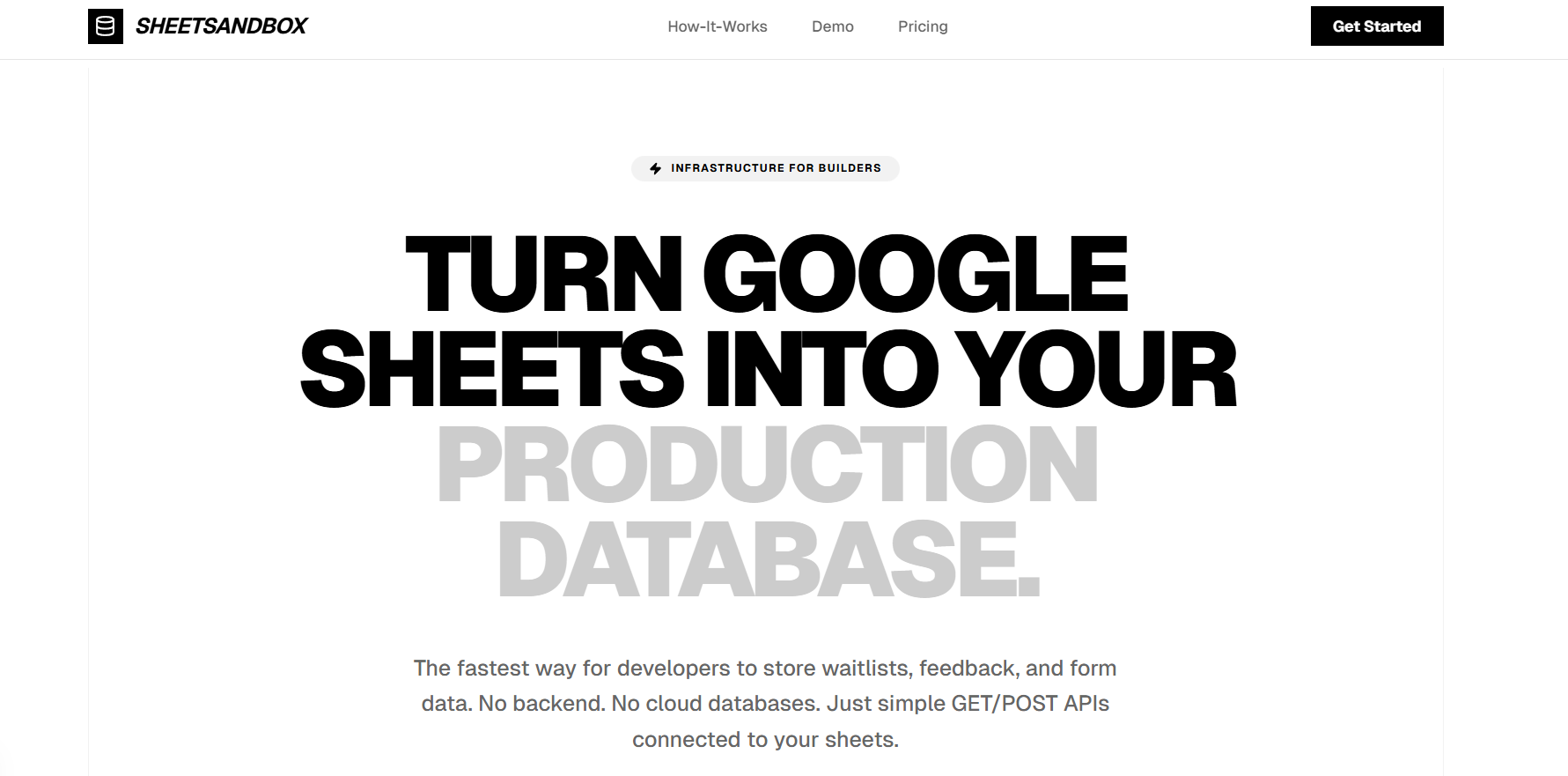
SheetSandbox turns Google Sheets into a production-ready database for developers. It instantly creates APIs for waitlists, feedback, and form data without requiring any backend infrastructure.
SheetSandbox is a developer tool that transforms Google Sheets into a fully functional database, providing instant REST APIs for rapid prototyping and small-scale applications. Designed specifically for indie developers and lean teams building minimum viable products (MVPs), it eliminates the need for traditional backend infrastructure by leveraging the familiar spreadsheet interface as a data store. This approach allows developers to focus on building features rather than managing databases, making it ideal for early-stage projects that require simple data collection and management. The core value proposition lies in its ability to turn a Google Sheet into a production-ready database within minutes, complete with auto-generated API tokens and secure Google Auth integration.
Developers often face significant overhead when setting up backend infrastructure for simple data collection needs like waitlists, feedback forms, or contact pages. This infrastructure complexity slows down prototyping, increases costs, and distracts from core product development. SheetSandbox addresses this concrete pain point by providing a zero-infrastructure solution that bypasses AWS, Vercel Functions, and database clusters entirely. For indie developers working on small MVPs, this means they can ship functional prototypes in minutes rather than days, avoiding the cloud database overhead that's unnecessary for early validation stages. The problem of over-engineering simple data collection is particularly acute for solo developers and small teams who need to validate ideas quickly without committing to complex infrastructure.
The REST API feature provides full CRUD (Create, Read, Update, Delete) operations on any Google Sheet through simple HTTP requests. Developers can POST data to their sheets using fetch calls with JSON payloads, receiving instant JSON responses confirming successful insertion. This works by authorizing SheetSandbox to access specific Google Sheets, then using auto-generated API tokens for authentication in API calls. The system automatically structures incoming data into the spreadsheet's rows and columns, eliminating manual data entry. This feature is useful because it allows developers to treat spreadsheets as database tables while maintaining the visual accessibility of Google Sheets for non-technical team members who might need to view or edit data.
The Node.js Package offers a type-safe, promise-based SDK that further simplifies integration for JavaScript and TypeScript developers. After installing via npm, developers initialize a client with their API token and can then use methods like client.post(), client.get(), and client.getById() to interact with their sheet data. This package handles all the underlying HTTP requests and error handling, providing a clean, developer-friendly interface that integrates seamlessly into existing Node.js applications. The TypeScript support ensures better code quality and developer experience through autocompletion and type checking. This feature group is particularly valuable for developers building server-side applications who want to avoid writing repetitive API call boilerplate code.
Publisher
A
admin
Launch Date2025-12-29
Platformweb
Pricingfreemium
Domain Authority
Ahrefs DR5/100
Traffic Insights
Month2026-03
Estimated Visits1K
MoM Visits GrowthN/A(+1K)
Avg Time on Site0s