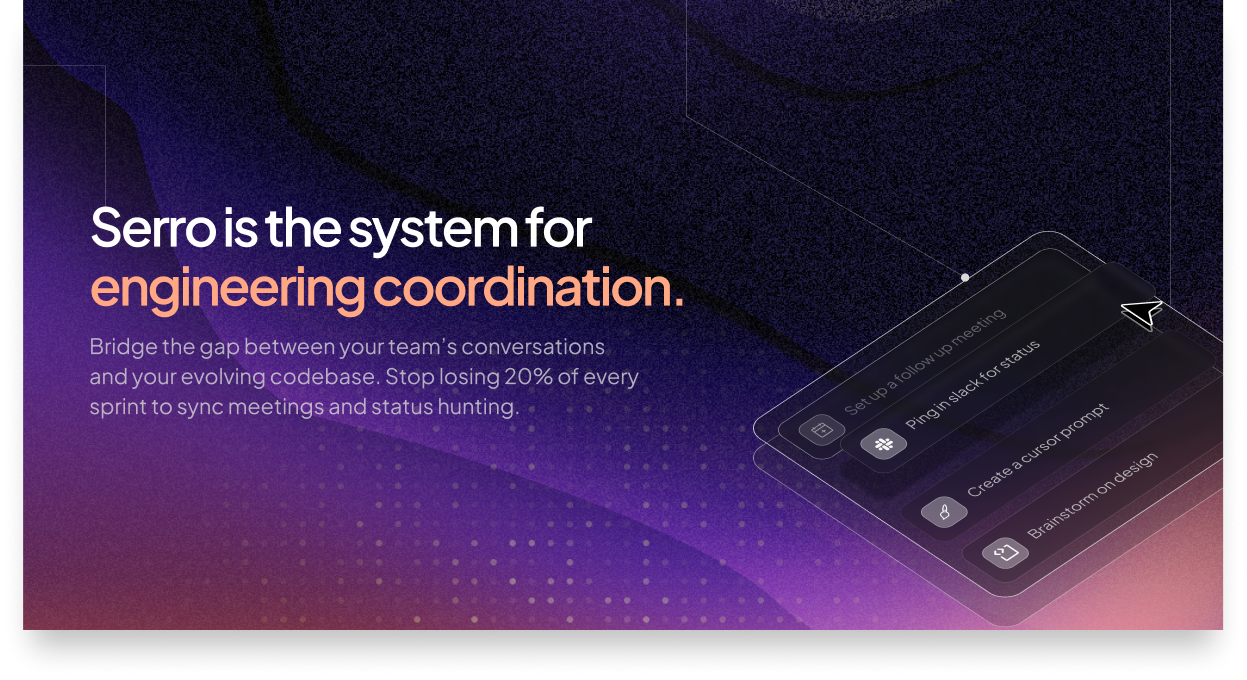
Serro is an AI-powered coordination layer designed for modern engineering organizations that operate with both human and agent team members. It sits at the intersection of communication tools, project management systems, and code repositories, providing a unified, live representation of every active program. The core value lies in turning fragmented updates, decisions, and conversations from Slack, Linear, GitHub, Jira, Zoom, and more into a continuously updated program-native memory. This eliminates the need to reconstruct context after the fact and enables teams to move faster with full alignment. Serro is built for technical program managers, engineering managers, product managers, and leaders who need a single source of truth for complex, cross-functional work.
The primary pain point Serro addresses is the coordination bottleneck that has emerged as AI tools accelerate individual output. Engineering organizations now produce more code, more decisions, and more moving parts than ever before, yet the infrastructure for keeping everyone aligned hasn't scaled. Teams waste hours reconstructing context from disparate sources, chasing status updates, and scheduling extra meetings to understand what's happening. This coordination overhead directly slows down program execution, increases risk of misalignment, and frustrates team members. Serro solves this by continuously ingesting signals across all integrated tools and presenting a live, queryable picture of organizational reality. It turns the problem of information fragmentation into a solved system.
Program Memory is Serro's foundational feature that maintains live, comprehensive state for every active program. It automatically captures decisions, risks, owners, history, and activity from connected tools, ensuring that nothing important falls through the cracks. When a Slack thread reaches a conclusion, a Jira ticket is updated, or a Zoom meeting ends with action items, Program Memory ingests these signals and updates the program's brain. This means team members never have to manually document or chase information—they can simply query Serro for the current state of any program. The benefit is immediate: reduced context-switching, faster onboarding for new members, and a reliable audit trail for every decision made.
Loops on Programs is a feature that automates the repetitive coordination work that slows down complex programs. These loops are recurring processes that keep work moving—such as generating daily or weekly status summaries, following up on outstanding action items, and prompting owners for updates. Serro orchestrates these loops based on the program's temporal cadence and the data already in its memory. For example, a technical program manager can set a loop to produce a weekly update email that aggregates progress across multiple workstreams. This reduces the coordination burden on humans and ensures that stakeholders stay informed without additional meetings or manual reporting. Loops make execution scalable.
admin
Agent Governance provides the control layer necessary for managing both human and AI agents working on programs. As engineering teams increasingly deploy autonomous agents to write code, triage tickets, or generate reports, it becomes critical to ensure they operate within defined boundaries. Serro's Agent Governance system assigns permissions, enforces rules, and monitors agent outputs to prevent drift or misalignment with program goals. Program leads can specify which agents have access to which programs, what actions they can take, and how they should behave. This feature gives teams confidence to delegate work to agents while maintaining human oversight. It directly addresses the emerging challenge of coordinating human-agent teams at scale.
Program Analytics delivers a system-level view across the entire organization, offering real-time insights into momentum, blockers, coordination gaps, and operational risk. Instead of relying on fragmented reports or gut feelings, leaders can see exactly how each program is progressing, where resources are strained, and which dependencies are critical. The analytics layer aggregates data from all connected tools and Program Memory to produce dashboards and alerts. For example, an engineering executive can instantly view which programs have fallen behind schedule, which teams are overcommitted, and where coordination failures are occurring. This empowers faster, data-driven decision-making and helps identify systemic issues before they escalate.
Serro works through a straightforward workflow: connect your stack, Serro finds your programs, every program gets a brain, then you ask, report, and follow through. The first step is integrating existing tools—Slack, Linear, GitHub, Jira, Zoom, Notion, email, and the codebase. Once connected, Serro automatically ingests and analyzes signals across these tools to identify active programs. The user then names each program, confirms ownership, and decides what information is shared. After that, Program Memory continuously updates the program's state without manual effort. Users can query any program in natural language, generate automated reports on a cadence, and turn meeting outcomes into tracked actions. The entire system operates as a shared control plane for human-agent organizations.
Concrete use cases span multiple roles. A Technical Program Manager uses Serro to run more cross-functional programs simultaneously by delegating the overhead of status tracking and follow-ups to the platform. An Engineering Manager can see what's moving across teams without chasing updates, focusing instead on execution and team health. A Product Manager connects roadmap shifts, decisions, and delivery progress into one live view, keeping product direction tied to execution. Engineering and Executive leaders gain a real-time picture of organizational health, including momentum, blockers, and coordination gaps. These scenarios result in faster decision-making, reduced meeting load, and higher alignment across departments.
Serro is purpose-built for technical program managers, engineering managers, product managers, and engineering executives in high-velocity work environments. It integrates with Slack, Linear, GitHub, Jira, Zoom, Notion, and email, with codebase ingestion. The platform is designed for organizations where both humans and AI agents collaborate. Pricing details are not publicly listed, but early access is available. Serro promises to pay for itself on day one by reducing coordination overhead and enabling teams to focus on high-impact work. The core value is a shared operating system for human-agent engineering organizations that eliminates context-switching and keeps everyone aligned on program reality.
Serro is built for technical program managers who need to drive multiple complex programs with less overhead, engineering managers seeking a real-time view of team execution and health, product managers who must keep decisions and timelines aligned across teams, and engineering or executive leaders who require organizational-level program analytics. It also serves operators in high-velocity engineering environments where human and AI agents collaborate. The platform is designed for modern engineering organizations using tools like Slack, Linear, GitHub, Jira, and Zoom who struggle with coordination fragmentation.