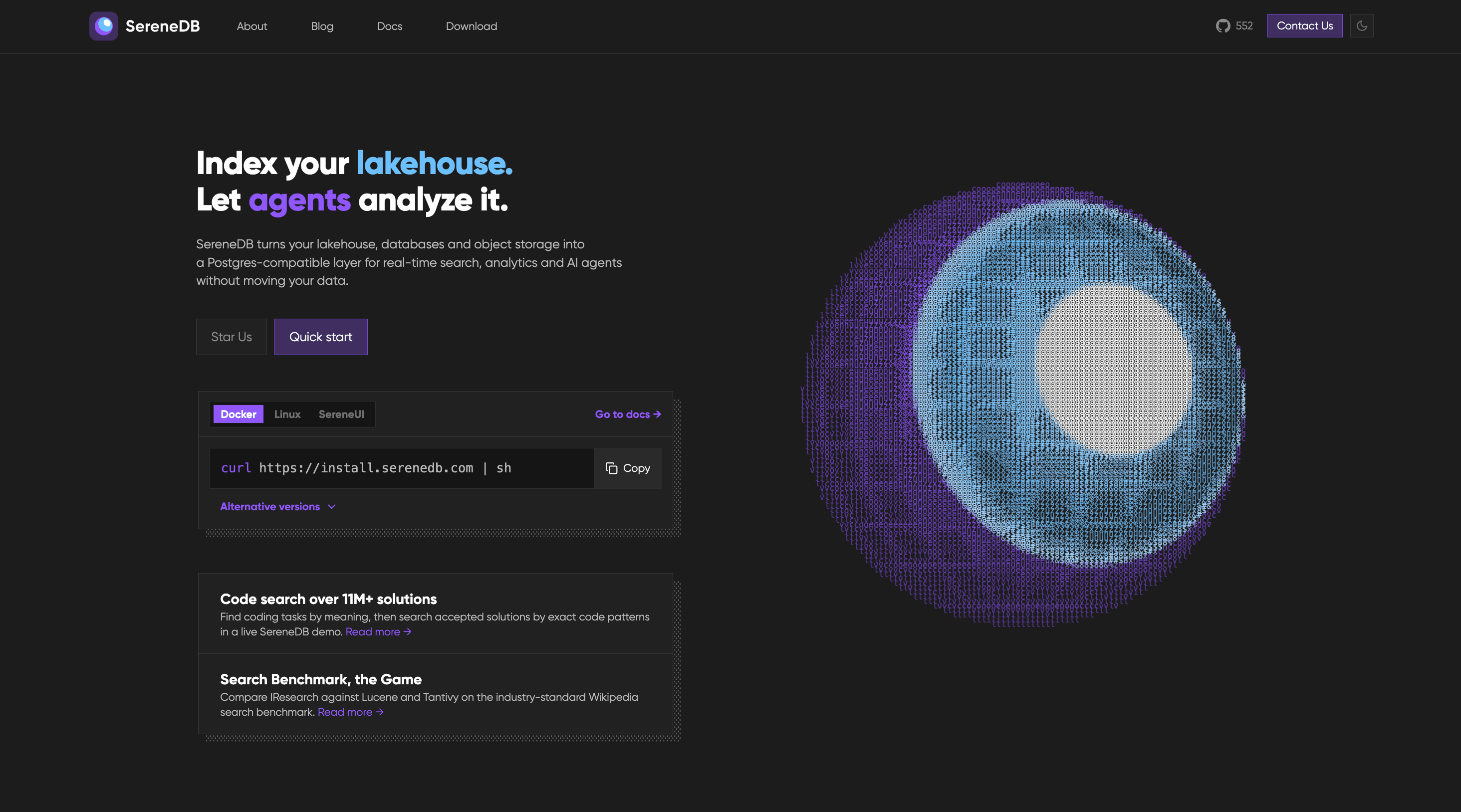
SereneDB is an open-source database that combines ultra-fast full-text search with fast analytics in a single engine. Its website describes it as a real-time search analytics database with full-text, vector and hybrid search, SQL execution, and a PostgreSQL-compatible frontend. The project presents itself as the result of twelve years of development, and it is aimed at teams that need search and analytics over the same data instead of operating separate systems for each. SereneDB also describes itself as Agentic AI ready, placing AI agent workloads, retrieval-augmented generation, and documentation search alongside classic search and analytical queries.
The problem SereneDB targets is a familiar one for engineering teams: search and analytics usually live in different systems, which means data has to be duplicated and kept in sync through ETL pipelines. SereneDB is both Postgres- and Elastic-compatible, so teams can keep their SQL, their drivers and their Elastic clients while dropping the second system and the ETL between them. The website captures this positioning with the phrase that your data stays where it is, emphasising that data can be queried in place rather than copied into yet another store. For organisations whose data keeps growing, that means fewer moving parts to operate, one set of compatibility guarantees to rely on, and no dedicated pipeline whose only job is to move the same records from one engine to another.
On the search side, SereneDB provides full-text search with BM25 ranking over tables and files, so relevance-scored keyword search runs directly against relational data and file content rather than through a separate search cluster. Vector search is supported through ANN indexes that sit beside relational data, which means embeddings and structured records can be queried from the same system instead of being split between a vector store and a relational database. Hybrid search combines BM25 and vector scores in one query, which matters because lexical retrieval and semantic retrieval often disagree: keyword matching is precise but literal, while vector similarity captures meaning but can drift, and merging both scores in a single query lets a user get the benefits of each without reconciling two result sets by hand. SereneDB also describes Postgres search, letting users keep their existing drivers and their SQL while adding search capabilities on top.
For analytics and data work, SereneDB offers real-time analytics that aggregate fresh data without a nightly job, so dashboards and reports can reflect current data rather than a batch that ran the previous evening. It is described as an OLAP database that performs columnar scans over billions of rows, which is the query pattern needed for large-scale aggregation. Search over a data lake lets users index object storage in place, and zero-ETL search lets queries run against remote sources where they live rather than migrating the data first. Together these capabilities mean the same engine can answer a relevance-ranked search request and a heavy analytical aggregation, including over data that was never copied into the database.
For AI and agent workloads, SereneDB is presented as a database for AI agents, offering agent-ready SQL over every source it can reach. It is also positioned as a RAG database, acting as the retrieval layer for grounded answers in retrieval-augmented generation workflows, so that generated responses can be anchored in data the system actually stores and can query. A related use case is documentation search: searching over documentation and knowledge bases, which the project demonstrates on its own documentation through Serene Docs Search. The website references a LangChain integration on its blog, connecting the database to common AI application frameworks.
Under the hood, SereneDB unifies search and analytics with a columnar engine, vectorized SQL execution, and hybrid storage behind a PostgreSQL-compatible frontend. That combination is what allows full-text, vector and hybrid search to coexist with SQL and analytical query patterns in one system rather than being stitched together from separate products. Benchmarks published by the project compare SereneDB against Elasticsearch, ClickHouse and PostgreSQL search extensions. The vendor states that SereneDB outperforms those alternatives and that it indexed one billion logs in under eight minutes using roughly ten times less disk. The methodology, the raw results and the source code are public, and the project is released under the Apache 2.0 licence, which means the performance claims can be inspected rather than taken on faith.
The practical benefit for users is consolidation. Teams keep familiar SQL, drivers and Elastic clients while removing a second system and the ETL that connected it, so there is less infrastructure to run and less data movement to monitor. Search relevance, vector similarity and analytical aggregation no longer require three separate stacks, and the same data can serve keyword search, semantic search, dashboards and AI retrieval. Because data can stay where it is, in object storage or remote sources, teams can index and query in place instead of migrating data into a new silo. Real-time aggregation removes the dependency on nightly batch jobs, so answers reflect what is happening now, and the reported disk efficiency of the published indexing benchmark reduces the storage footprint that large log volumes otherwise demand.
The website groups concrete use cases into three areas. Search covers full-text BM25 ranking over tables and files, vector search with ANN indexes beside relational data, hybrid search that merges BM25 and vector scores in one query, and Postgres search that preserves existing drivers and SQL. Analytics and data covers real-time analytics over fresh data without a nightly job, OLAP columnar scans over billions of rows, search over a data lake by indexing object storage in place, and zero-ETL search against remote sources. AI and agents covers using SereneDB as a database for AI agents with agent-ready SQL over every source, as a RAG retrieval layer for grounded answers, and as a documentation search engine over docs and knowledge bases. Published benchmark work includes 92 search and analytics queries over 100M, 1B and 10B OpenTelemetry logs on a single instance, along with comparisons against the Lucene world, namely Elasticsearch, OpenSearch and CrateDB, at 100M and 1B logs.
SereneDB is built for developers, data teams and platform engineers who need search and analytics together. It is distributed as open source under Apache 2.0 and is listed on Product Hunt under the topics Open Source, Developer Tools, GitHub and Database. Installation options include Docker and Linux, along with a one-line shell installer, and SereneUI is referenced as a companion user interface. Compatibility is central to the product: a PostgreSQL-compatible frontend, support for existing Postgres drivers and SQL, and Elastic-compatible clients. A LangChain integration is referenced for AI workflows, and OpenTelemetry logs are the data set used in published benchmarks. The code is hosted on GitHub. Beyond the open-source licence, no pricing or plan details are described in the provided content.
SereneDB's core promise is straightforward: ultra-fast full-text search and fast analytics in one open-source, PostgreSQL-compatible engine, so teams can keep their SQL, drivers and Elastic clients while removing a second system and the ETL between them. With a columnar engine, vectorized SQL execution, hybrid storage, BM25 full-text search, vector and hybrid search, in-place indexing of object storage and remote sources, and agent-ready SQL for RAG and AI workflows, it targets the consolidation of search, analytics and AI retrieval onto a single database.
Publisher
A
admin
Launch Date2026-09-23
Platformapi
Pricingfree
Tech Stack
#Docker#Linux#PostgreSQL#Apache 2.0