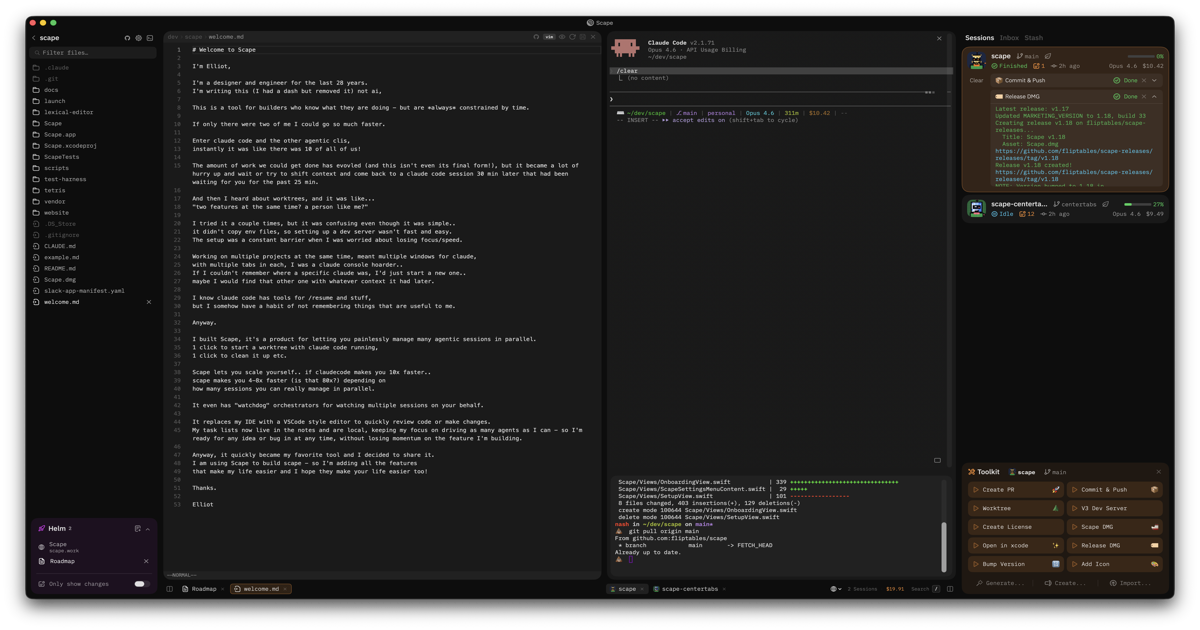
Scape is a macOS application for orchestrating fleets of AI coding agents, and Argus is the loop orchestrator that ships with it. In Scape's own definition, an orchestrator is an agent whose job is to run other agents on a loop: you hand it an objective and a heartbeat, it wakes up on that heartbeat, does a round of work, files what it found, and goes back to sleep until the next one. Scape's example orchestrator is named Lloyd, and it manages some of the engineering work on Scape itself. The page exists to show a real working example rather than a diagram, so people can see what one of these orchestrators actually looks like for an engineer and designer who has spent 20+ years building software.
The problem the orchestrator addresses is that someone still has to decide what work should happen, keep those priorities in view, and notice when something is wrong. Scape's answer is to give the agent a fixed objective, a cadence for acting, a memory of its own, and a short standing checklist — the same way you would keep priorities in front of a person you manage. Because an orchestrator can do anything, Scape argues that giving it a database to manage its own memory has compounding value over time, and that the whole shape works precisely because it is simple.
Memory is the first piece. Lloyd's primary goal is managing its own internal tickets table, which in this case is a simple SQLite table. It has managed over 600 tickets that it can query, functioning like its own internal Jira that the owner can click through. Every time a new ticket arrives, the orchestrator can look up previous, related tickets — the same behavior you would expect from a person picking up newly assigned work. That gives the agent a database of tribal knowledge that can be passed to any model. In Scape, the Internal Tickets table is viewable as a table, a kanban, or a gantt, and it holds plain-language summaries of the bugs and spikes the orchestrator filed.
The heartbeat is the second piece, and Scape points to it as where the value visibly comes from. Lloyd wakes up on a heartbeat the owner sets — a bit over two hours in this example, shown as a HEARTBEAT card set to 147m — and the owner caps how many child agents it is allowed to run at once, shown as a MAX CHILDREN card set to 16. Each time it wakes, it works through the same short list of standing checks the owner gave it. That list is the pulse. In Lloyd's mission note, the Every-Pulse Actions include running a "Bug Reports from Feedback" playbook, checking for new bugs and thread replies, checking the backlog for items that were not staffed, and determining whether any docs need updating.
The pulse in practice covers four things. First, Lloyd runs a playbook — an automation script — to check email for any new bug reports from customers, and it checks for previous context before staffing a ticket. Second, it checks whether any docs need to be updated on the website. Third, it checks the app's own running logs to see what is up; Scape calls this a very important practice because it surfaces bugs nobody reported and that never produced an error, such as a noisy problem that never crashed anything. Fourth, it adds its own tickets for bugs and enhancements along the way, which gives the agent a voice to surface ideas and problems for the owner to triage. Scape highlights that last part as the one it likes most: the agent has the agency to create its own work and put it on the table for triage.
When the orchestrator decides work needs doing, it staffs it. Scape gives every project its own SQLite tables, synced to your iCloud. Playbooks are the automations the orchestrator runs. The fleet of child agents is the orchestrator staffing the work across isolated worktrees, and each child runs an adversarial review on its work before it reaches the owner. Scape names the orchestrator Argus, after the hundred-eyed watcher, because keeping a pulse on the whole fleet is the entire job.
The whole shape of the system is a table the orchestrator owns, a heartbeat, and a short list of things it checks every time it wakes up. Scape states that this works because it is simple: every pulse it puts the priorities back in front of the model, the same way you would keep them in front of a person you manage. That simplicity is also what makes the operation legible — the mission note shows the heartbeat and the Every-Pulse Actions in the center, with the live fleet of running agent sessions down the right, so the owner can see the state of the whole thing at a glance.
The outcome for the user is an agent that remembers, repeats, and reports. Its memory means new work is staffed with the benefit of everything that came before. Its heartbeat means priorities are re-presented on a fixed cadence instead of depending on someone remembering to re-prompt. Its log checks mean problems surface before anyone reports them. Its self-filed tickets mean the owner gets a steady stream of ideas and problems to triage rather than silence. And its adversarial reviews mean child-agent work is checked before it reaches the owner, so the orchestrator is not simply generating volume.
Concrete uses described in the content include running engineering work on a project: Lloyd manages some of the engineering work on Scape and has filed over 600 tickets. Another is monitoring customer feedback, where a playbook checks email for new bug reports from customers and looks up previous context before staffing a ticket. Another is documentation upkeep, checking whether any docs on the website need updating. Another is log review, watching the app's own running logs to catch noisy problems nobody reported. Another is backlog triage, checking for items that were never staffed. And another is parallel delivery, where child agents work in isolated worktrees and each runs an adversarial review.
Scape runs on macOS and is local-first: the code never leaves your machine. It brings its own set of supported agent harnesses — Claude Code, Codex, Copilot, and Cursor are listed alongside OpenCode and omp — and you bring your own subscription. Projects get their own SQLite tables synced to iCloud. Argus ships with Scape, and you can download it to start with no account, no credit card, and no license key: it is free to try for 7 days on macOS, with pricing available on the site. A sample mission note can be cloned from a shared link if you already use Scape.
In short, Scape turns agent management into a loop you can watch: one table the orchestrator owns, one heartbeat that wakes it, and one short pulse of standing checks that keeps priorities in front of the model — so bugs, docs, backlog gaps, and new work are surfaced continuously instead of waiting to be reported.
Publisher
A
admin
Launch Date2026-10-14
Platformdesktop
Pricingpaid
Tech Stack
#SQLite#iCloud