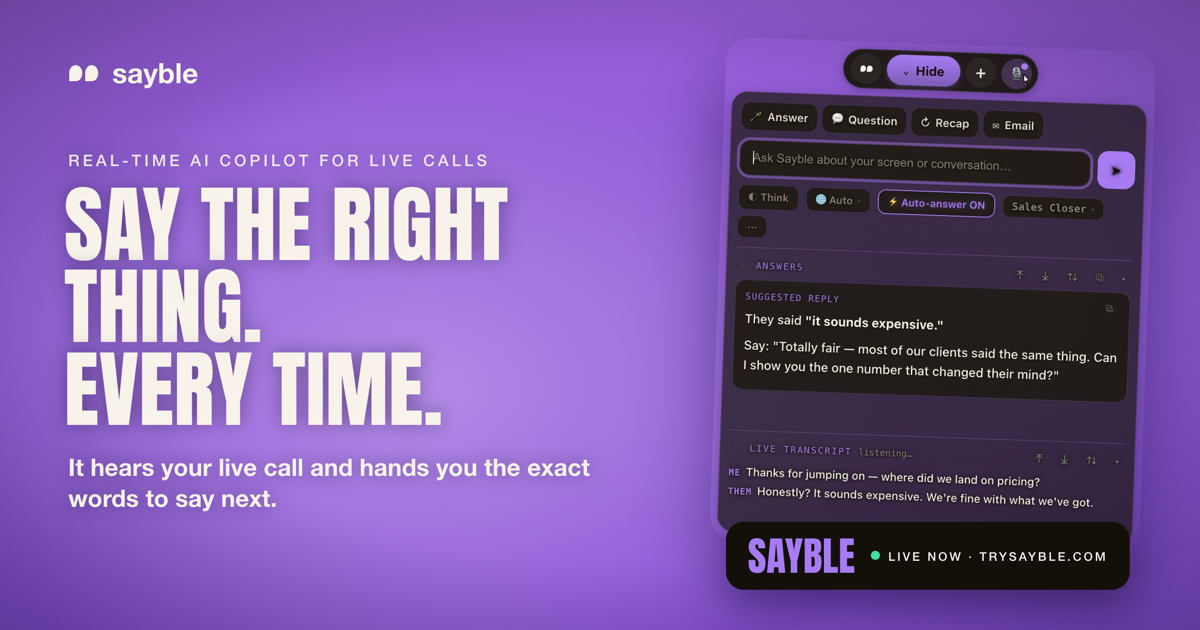
Sayble is a real-time AI copilot for conversations that matter — sales calls, client meetings, negotiations and everyday professional calls. It listens to your live call, hears what the other person just said, and hands you the exact words to say next, plus a backup line, in about half a second. When the call ends, it writes a structured recap and a ready-to-send follow-up email. Sayble runs on Mac and Windows, hears and answers in 10 languages, and is built for professionals who close, pitch and advise — people whose income depends on the next conversation going well. Its stated purpose is simple: perform better when the conversation matters, with sharper objection handling, faster thinking and confidence under pressure.
High-stakes conversations move faster than most people can think. A prospect says "honestly, your price is way higher than the other quote I got," and the answer you give in the next few seconds often decides the deal. Under pressure, people reach for the wrong words, defend the price instead of reframing it, forget what was promised, and let follow-ups slip. Sayble is built for that exact moment. Instead of turning the conversation into a wall of text you would never read mid-sentence, it gives you one clean line you can actually say out loud — and then it turns the whole call into a written record you can act on afterwards.
The core of Sayble is real-time assistance. It listens to the other person's latest point and returns the single best thing to say next — one line, not a wall of text. The site states the timing as 0.8 seconds from words spoken to answer on your screen, or roughly half a second. Each suggestion also comes with a backup line, so if the first approach does not land you have another ready. The website shows this in practice: when the other side says "Honestly, it sounds expensive. We're fine with what we have," Sayble suggests "Totally fair — most of our clients said that too. Can I show you the number that changed their mind?" and offers a backup line: "What would it need to save you monthly to be worth a look?"
The second you hang up, Sayble writes the recap. The recap is pulled from the real transcript and captures what was decided, the objection that actually stuck, and what you owe them — the site's example reads "Decided: Pilot on 3 sites, 60 days," "Objection that stuck: Onboarding ate a month of our time last vendor," and "You owe them: Pricing sheet + the 3-day onboarding plan, by Friday." The follow-up email is drafted from what was actually agreed, so it is written before you have closed the laptop. You review it, send it, and move on. Call recording, recaps and drafted follow-ups are all included in the plan.
The Home screen keeps your calls in one place. Today's calls are pulled from Google Calendar with one-click join, every recorded call is ready to replay, and each one carries an auto-written recap plus a follow-up email. A live transcription engine transcribes both sides of the conversation as it is said and separates who said what, so nothing is lost or misremembered. Sayble auto-detects the language of the conversation and answers in kind across 10 languages. It works on the calls you already take — Google Meet, Zoom, Microsoft Teams, Slack huddles, phone calls and anything on screen. Your modes, prompts and reference files follow your account across every device, and six skins with day and night canvases let you change the whole app's look without restarting.
Sayble's approach is deliberately narrow. Rather than narrating the meeting in real time or filling the screen with analysis, it focuses on the next sentence — one line, in quotes, ready to speak. It is also built to stay off screen share: Sayble is designed to stay hidden from screen sharing and recording software, and that protection is included in your plan rather than sold as an expensive add-on. Everything it produces is grounded in the transcript of the actual call, which is why the live suggestions, the recap, the follow-up email and the answers you can interrogate later all come from what was really said. The site also carries an explicit AI notice: Sayble uses AI to analyze the conversation and generate real-time suggestions, AI output can be incomplete or inaccurate, and the user stays in control and always uses their own judgment.
The conversation intelligence layer turns your calls into data. Sayble remembers every call, meeting and pitch, then lets you interrogate them in plain language — described as a private analyst that has sat in on all of your conversations and forgets nothing. You can scope the question to the last 5 days, the last 30 days, 100 calls or this quarter, then ask things like "What objection cost me the most deals this month?" The site illustrates the answer: "'It's too expensive' showed up in 61% of the calls you lost. In the 3 you won after it, you reframed to monthly savings within 20 seconds. In the ones you lost, you defended the price instead." Ask who to follow up with first and it reportedly flags the contacts who asked for pricing and never got a recap email, and offers the drafts. You can also ask what changed the mind of everyone who bought, and get back the exact lines that worked.
The benefits compound across a book of business. Live, you get sharper objection handling, faster thinking and confidence under pressure. After the call, you never lose the thread of a back-to-back day, because live talking points during the call are followed by a structured recap and a drafted email afterwards. Over time, Sayble surfaces the objection you fumble most, the moment calls go quiet and the promise you keep forgetting — pulled from your own transcripts rather than a guess. Because it can read whole ranges of calls and answer with the lines that worked, you can scale what your best calls do and make your average conversation perform like your best one.
Sayble is used across a range of high-stakes calls. Closers and SDRs use it to kill objections while the prospect is still talking — "too expensive," "let me think about it," "we already have a vendor" — and get a clean, human answer in quotes, ready to speak. Founders bring it into partnerships, negotiations and raises, where it keeps a record of what was actually said and keeps them sharp when the room gets expensive. Customer success and support teams use it to stay warm, on-message and quick under pressure. Recruiters use it to ask the sharp follow-up and summarise what matters accurately every time. Anyone working back-to-back days uses it to hold the thread from a live call through to a structured recap.
The named audiences are sales closers, SDRs, account executives, founders, mortgage pros, insurance, real estate, customer success, call centers, recruiters, consultants, coaches and financial advisors. The app runs on macOS (Apple Silicon, .dmg) and Windows 10 and 11 (.exe), with the newest build listed as 1.2.30. Mobile for iOS and Android is listed as coming soon with a waitlist, and App Store, Google Play, Mac App Store and Microsoft Store availability is described as coming soon. It works alongside Google Meet, Zoom, Microsoft Teams, Slack huddles and phone calls, and uses Google Calendar for today's meetings on the Home screen. Pricing begins with a free download and a 3-minute live session with no card required. Sayble Pro is $24.99/month at the founder rate for the first 12 months, then $39.99/month, and includes unlimited real-time live-call copilot, screen-share hiding, objection handling and closing lines, follow-ups, recaps and email drafts, call recording and multilingual support on Mac and Windows. Sayble Teams is custom-priced per seat for sales floors and client-facing teams, with team onboarding, priority support and volume pricing for call centers.
For professionals whose income depends on the next conversation going well, Sayble positions itself as a quiet edge: one line to say next in the moment, a recap and follow-up the moment the call ends, and a searchable record of every conversation you have ever had.
Publisher
A
admin
Launch Date2026-09-29
Platformdesktop
Pricingfreemium