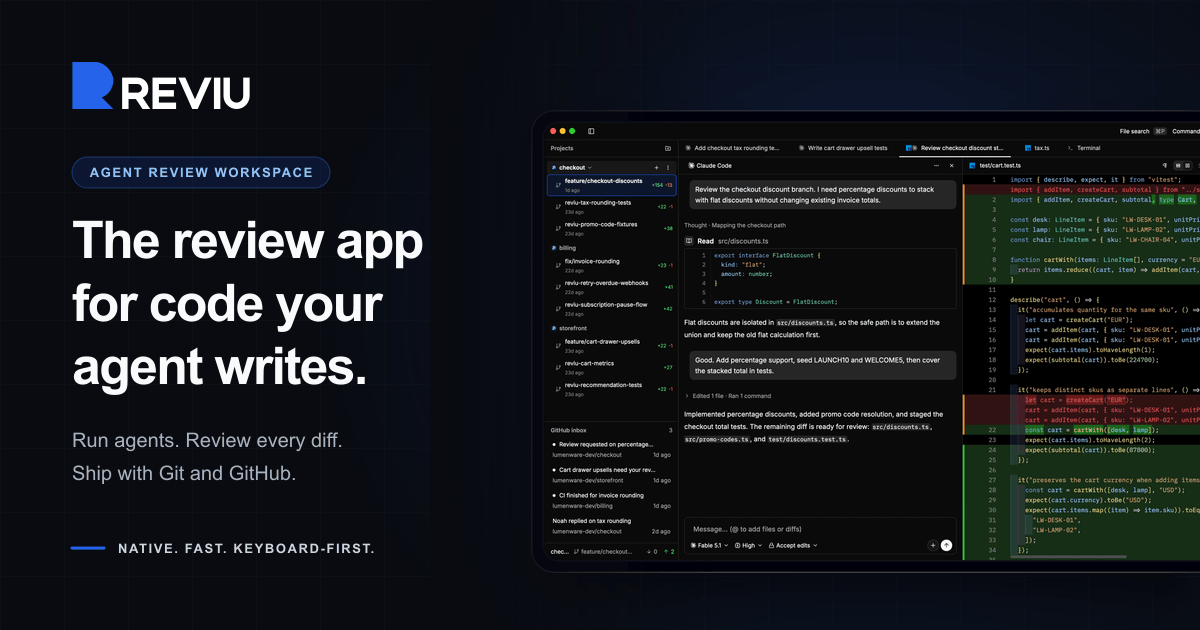
Reviu is a native desktop app for reviewing the code your coding agents write. It is built for developers who run agentic coding tools such as Claude Code, Codex, or Gemini and want a dedicated place to inspect what those agents produced before it lands on a branch. Rather than treating an agent run as a disposable chat, Reviu turns each task into a durable session with its own conversation, branch, terminal, checkpoints, file edits, and review queue. From that session you watch the agent work, review every diff, send line comments back, and then finish the branch with real Git - staging, rebasing, committing, and pushing without leaving the app. Reviu sums this up by calling itself the review app for code your agent writes.
Since the first launch, Reviu was rebuilt from a Git client with an agent panel into a review workspace for coding agents. The gap it targets sits between agent output and a clean commit: an agent can produce a large diff quickly, but a human still has to read it, decide what to keep, and turn those decisions into a tidy branch. Reviu states the premise directly - agent work only matters when it becomes a clean commit. The app is therefore built around the loop that starts before the commit: the agent works in a durable session, you review the diff, send fixes back from inline comments, then finish with hunk staging, interactive rebase, conflicts, history, and push in the same application. Reviu also positions itself next to existing Git tooling rather than replacing it, inviting users to keep the Git tools they already like and add the missing agent review layer.
Reviu manages sessions like real work. Each task becomes a durable session rather than a disposable chat, carrying its own conversation, branch, terminal, checkpoints, file edits, and review queue, and you can switch between sessions without stopping running agents. Parallel worktrees let you run multiple agents at once without letting one task dirty another checkout - the product shows a main checkout alongside separate agent worktrees for tasks such as discount work and tax rounding. Attention states make the status of each session visible, showing what is running, waiting, failed, or ready for review. Readable agent activity keeps commands, reads, edits, permissions, and failures grouped as reviewable events, so an edit of forty-two added and eight removed lines in a source file, or a test command run, shows up as an event you can inspect rather than as an opaque log line.
Diff review is the core of the app. You inspect the diff and leave line comments on local changes, including file, line, and side context, then batch those comments and send them back to the agent. The content illustrates this with a review queue on a feature branch where three comments are selected: a request to apply flat discounts before percentage discounts, a fix for discount order, a new rounding test, and a rename for an unclear helper. Once the comments are sent, the agent can act on them directly. Reviews happen against an isolated worktree so parallel agent tasks stay out of your main checkout. Reviu also describes the ability to checkpoint or undo turns, giving turn-level control over what the agent changed.
Underneath the review layer is real Git. You shape the diff by staging the hunks you trust, unstaging others for another pass, and restoring the rest. You clean the branch before the pull request exists by squashing, fixup, dropping, and reordering commits. You recover from messy states by resolving conflicts, continuing rebases, stashing work, cherry-picking, and undoing mistakes. Every surface in the app follows the checkout, so changes, history, terminal, and review stay in sync with whatever branch is active. Git actions are reachable from the command palette in the same keyboard-first flow as the rest of the app: commit, amend commit, push, force push with lease, interactive rebase, and pop stash. The result is staged hunks, rewritten history, and a branch you can push with confidence.
Reviu Pro adds GitHub. The paid tier is for developers whose local agent work ends in a GitHub pull request review and merge. A pull request dock brings your branch, agent session, working tree, review threads, checks, and merge button into one window, so you can use GitHub without turning every review into a browser tab hunt. An inbox surfaces events such as a requested change, a CI run finishing, or a reply in a file. When checks have passed and the review is approved, the dock shows that the merge is ready and lets you create a merge commit. The PR follows your branch: check out a branch and Reviu finds its pull request, or helps create one from the header. You can review GitHub diffs locally by opening PR files in the editor, commenting inline, replying to threads, and submitting a full review. Merging works like GitHub would, with squash, merge, or rebase using GitHub's generated title, message, bullets, and trailers. A browser extension adds an Open in Reviu button to GitHub pull requests, opening the branch locally ready for diff review, files, and terminal; it is available for Firefox and Chrome.
Reviu's approach is local by default. It launches the agent CLI you already installed and signed into, so agents run as local processes on your machine with your existing subscription and no API key to paste. Your code and the agent process stay on your machine; Reviu does not run agents in the cloud and does not meter your agent usage. It drives any agent from the official Agent Client Protocol registry, naming Claude Code, Codex, Gemini, Copilot, Cline, and about twenty others. The app itself is fully native, built with Rust and GPUI, a Rust-based GPU-accelerated UI framework - no Electron and no webview. No account is required for agent sessions or local Git features; signing in is only needed for the GitHub integration in Reviu Pro.
For users, the benefit is a single place where agent output becomes a reviewed, clean branch. The review queue turns scattered comments into batched instructions the agent can act on, isolated worktrees keep parallel agent tasks from interfering with each other, and attention states make it obvious which sessions need you now. Because Git stays close to the diff, review decisions become staged hunks, rewritten history, and a pushable branch rather than a manual cleanup exercise after the fact. On Pro, the pull request dock collapses branch, threads, checks, and merge into one window, reducing context switching between the local workflow and GitHub.
Concrete workflows described in the content include running several agents in parallel on separate tasks - for example discount work, tax rounding, and cart property tests - each in its own worktree, and switching between those sessions while they continue running. Another is reviewing an agent's diff on a feature branch, leaving line comments with file and side context, and sending a batch back to the agent so it can correct the order of discount calculations or add a rounding test. A third is finishing a branch before any pull request exists: staging trusted hunks, reordering or squashing commits, resolving conflicts, and pushing. Pro workflows include finding a branch's pull request from the header, reviewing and commenting on PR files locally, submitting a review, watching checks and notifications in the inbox, and merging with squash, merge, or rebase. The browser extension supports starting in GitHub and finishing the local review in Reviu.
Reviu is aimed at developers who use coding agents on their own machines and want to review that work with real Git tooling. It integrates with agents from the Agent Client Protocol registry, with GitHub on Pro, and with Firefox and Chrome through the Open in Reviu extension. It runs as a native desktop app on macOS for Apple Silicon and Intel, on Windows for ARM64 and x64, and on Linux through a terminal install command. Pricing is straightforward: the local agent review tier is free at $0 and covers agent sessions with ACP registry agents, parallel worktrees and durable session state, diff review with comments sent back to the agent, and local Git including staging, rebase, conflicts, and terminal. Pro is $9 per month or $79 per year, which the site lists as a 27% saving, with a 14-day free trial and cancel anytime; it adds the pull request dock with checks and merge, GitHub review comments and submit review, and inbox notifications and the browser extension. Mobile access and remote over SSH to servers and VPS are listed as planned rather than available today.
Reviu occupies the space between an agent writing code and a branch being merged. It keeps the review loop - durable sessions, isolated worktrees, inline comments sent back to the agent - free on the desktop, and adds GitHub pull requests, checks, merge, and notifications as a Pro layer, all built on real Git and a native Rust and GPUI app rather than a webview.
Publisher
A
admin
Launch Date2026-10-06
Platformdesktop
Pricingfreemium
Tech Stack
#Rust#GPUI#Agent Client Protocol (ACP)