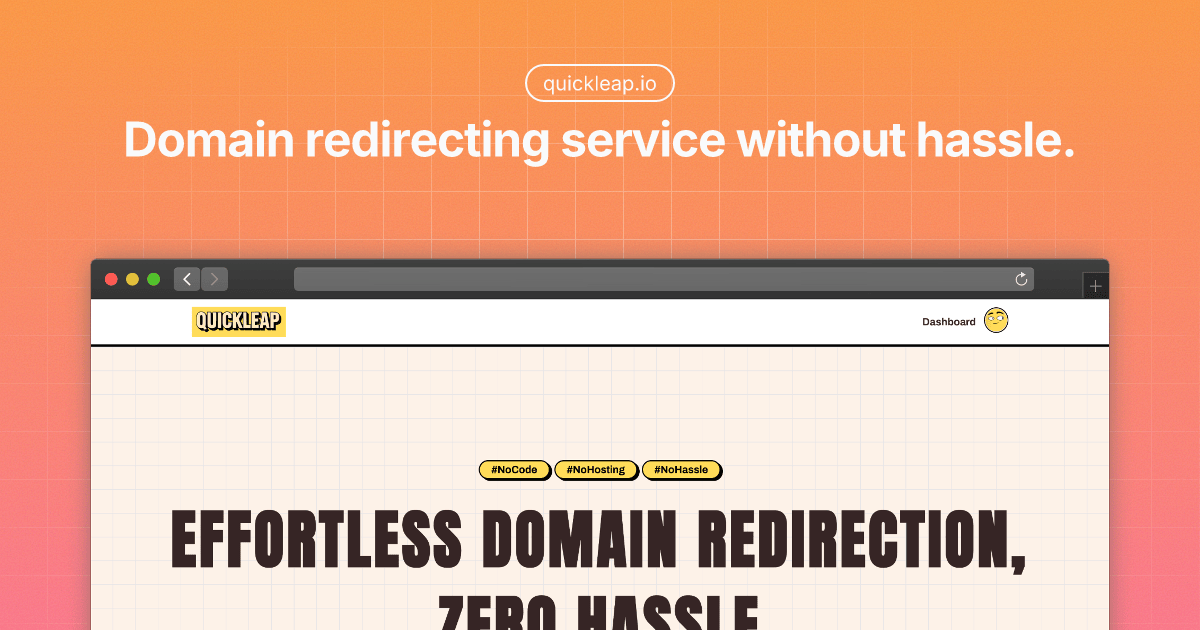
Quickleap is a professional domain redirect and URL forwarding service that provides automatic HTTPS/SSL, 301/302 redirects, path forwarding, and API support. It allows users to redirect unlimited domains without hosting hassles, offering enterprise-grade reliability and a free trial.
Quickleap is a professional domain redirect and URL forwarding service. It falls into the category of domain management tools, specifically designed for web developers, marketers, and business owners who need to redirect domains without the hassle of hosting. The core value of Quickleap is simplifying the complex process of managing multiple domain redirects by providing automatic HTTPS/SSL, 301/302 redirects, path forwarding, and API support. Users can redirect an unlimited number of domains with enterprise-grade reliability, and a free trial is available to test the service. This service removes the need for technical infrastructure, letting users focus on their primary business activities while ensuring smooth traffic redirection.
The concrete problem Quickleap solves is the high cost and technical complexity associated with redirecting domains. Traditionally, redirecting a domain required purchasing hosting plans, configuring web servers, and managing SSL certificates manually. This is time-consuming and expensive, especially for users who need to manage multiple domains. Quickleap eliminates these hassles by offering a straightforward redirect service that handles all underlying technical details automatically. The importance of this solution lies in preventing lost traffic, broken links, and security warnings that can harm user experience and SEO rankings. By providing a simple, overhead-free way to forward domains, Quickleap allows users to protect their online presence without dedicated IT resources.
The first major feature is automatic HTTPS/SSL. Quickleap automatically provisions SSL certificates for each redirected domain, ensuring that all traffic is encrypted and secure. This works by integrating with Let's Encrypt or a similar CA, automatically renewing certificates before expiry. The benefit is that users do not need to manage SSL themselves—no manual configuration, no renewal reminders, no risk of expired certificates causing browser warnings. This is crucial for maintaining user trust and SEO, as search engines prioritize secure sites. The automatic SSL also works seamlessly with the 301/302 redirects, so visitors are safely forwarded to the destination without any security gaps.
The second major feature group comprises 301 and 302 redirects. Quickleap supports both permanent (301) and temporary (302) redirects, which are fundamental for URL management. A 301 redirect informs search engines that the page has permanently moved, transferring link equity and preserving rankings. A 302 redirect is used for temporary forwarding, such as during site maintenance. The service allows users to specify which type of redirect to apply to each domain or path. This granular control is useful for SEO professionals and marketers who need to manage redirects strategically. The feature works with simple dashboard settings, eliminating the need to edit .htaccess files or server configurations, making redirect management accessible to non-technical users.
Publisher
A
admin
Launch Date2025-12-19
Platformweb
Pricingfreemium
Tech Stack
#HTTPS/SSL#RESTful API#DNS