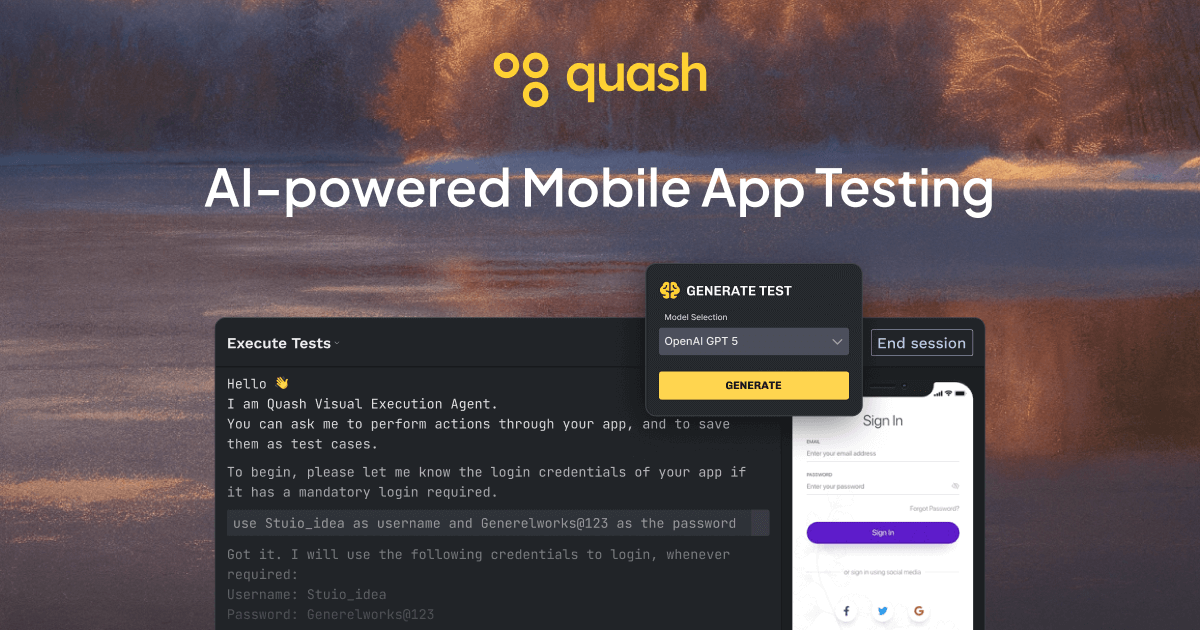
Quash is an AI-powered mobile QA agent that runs functional and visual tests without scripts using natural language. It streamlines mobile testing from pull request to release with intelligent execution and seamless test management.
Quash is an AI-powered mobile testing platform designed specifically for QA teams, SDETs, and product managers who need to keep up with rapid mobile app releases. By allowing testers to describe app flows in plain language, Quash eliminates the traditional barrier of writing and maintaining brittle test scripts. Its core value lies in converting test intent directly into executable actions on real devices, reducing the time from idea to execution. This makes it the mobile testing platform that QA teams actually want to adopt, as it adapts to UI changes and dynamic screens automatically. With Quash, test coverage increases by 87%, edge cases caught multiply by 4X, and test suite creation becomes 25X faster, while manual testing effort drops by 85%.
The primary pain point Quash solves is the disconnect between rapid developer shipping speed and QA's ability to keep pace. Traditional mobile testing requires writing scripts with fragile locators that break every sprint, leading to constant test maintenance and slow execution. This forces many teams to choose between comprehensive testing and fast releases. Quash removes the translation of test intent into code by letting testers describe flows naturally. It adapts to UI changes, loading states, and data differences, so tests no longer need rewriting every sprint. This reduces maintenance effort dramatically and allows QA to focus on finding bugs rather than fixing broken tests, enabling teams to catch 4X more edge cases across releases.
The first major feature group is Intent-driven Test Execution, which is the core of Quash. Testers describe an app flow in plain language, and Quash handles taps, swipes, typing, navigation, and form interactions automatically. The tests run against actual app behavior on real devices, not mocked or script-driven environments. The AI agent adapts to UI changes, loading states, and dynamic screens during execution, ensuring tests remain valid across app updates. This feature is useful because it eliminates the need for testers to know any coding language or UI hierarchy. It bridges the gap between test intent and execution, making mobile testing accessible to non-technical team members while dramatically increasing test creation speed—up to 25 times faster than manual scripting.
The second feature group is Backend Validation and Device Flexibility. Quash allows teams to validate backend responses and system behavior during the same mobile test run, catching bugs that the UI hides. This is not a separate step after UI testing but happens concurrently. Additionally, Quash offers complete device flexibility: tests can be executed on local devices, emulators, or cloud devices without setting up or maintaining testing infrastructure. There is no vendor lock-in, as teams can use their own devices or leverage Quash's infrastructure. This combination of backend validation and infrastructure choice gives QA teams deeper insight into application health and removes barriers to scaling test execution across multiple device types and environments.
Publisher
A
admin
Launch Date2026-02-07
Platformweb
Pricingfreemium
Domain Authority
Ahrefs DR31/100