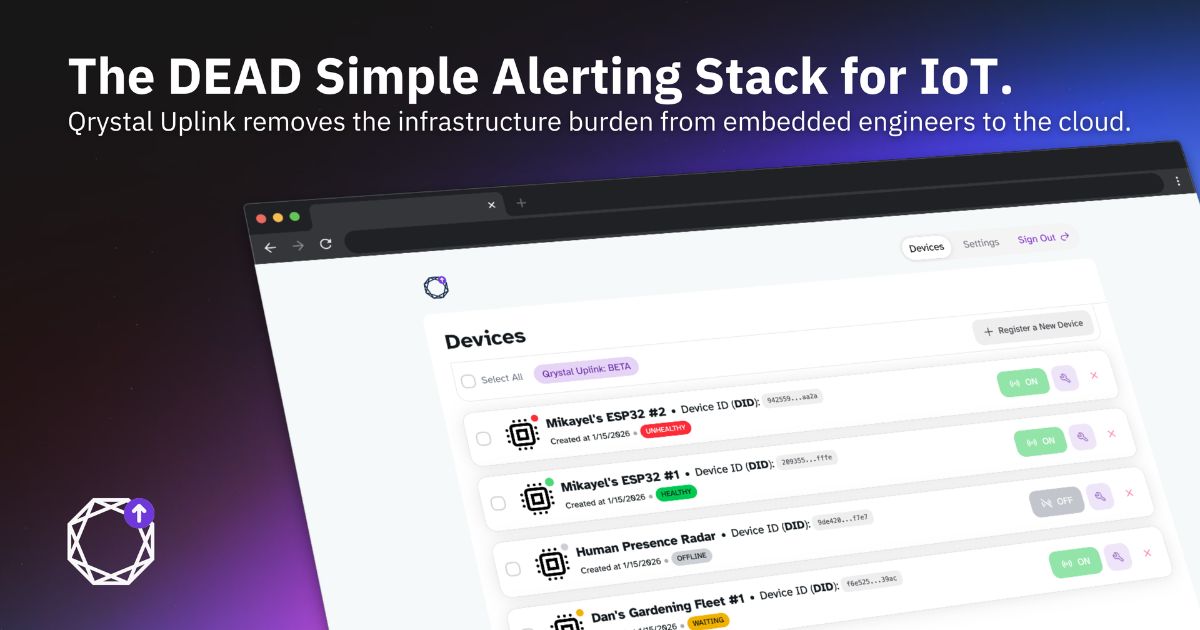
Qrystal Uplink is a cloud-based IoT device uptime monitoring platform purpose-built for organizations that depend on fleets of connected devices operating in the field, on factory floors, or across distributed sites. It delivers a streamlined approach to visibility by receiving heartbeat signals from each device and instantly detecting when any endpoint falls silent. The service is designed for operations managers, IT administrators, and IoT solution providers who need reliable, real-time awareness without the burden of managing a separate monitoring stack. By centralizing uptime tracking in the cloud, Qrystal Uplink allows teams to stop wondering whether sensors, trackers, or controllers are still online and instead receive proactive confirmation—or immediate notification when something is wrong. This shift from reactive troubleshooting to proactive alerting keeps IoT deployments reliable and reduces the risk of undetected outages.
Managing a growing network of IoT devices introduces a persistent pain point: traditional monitoring tools demand significant configuration, dedicated hardware, and ongoing maintenance. When a sensor at a remote pumping station or a temperature logger inside a cold-chain container stops reporting, the first indication is often a disappointed customer or a missing data log. Custom scripts, cron jobs, and self-hosted dashboards can provide partial answers, but they require engineering time and constant tuning. Qrystal Uplink addresses this headache by offering a turnkey cloud service that monitors device reachability using nothing more than lightweight heartbeats. By removing the need to stand up Nagios instances, write SNMP polling logic, or manage alerting pipelines, the platform lets teams reclaim hundreds of hours previously lost to monitoring infrastructure. This matters because every minute a device is offline can translate into lost revenue, safety gaps, or regulatory non-compliance. With instant awareness, users can dispatch a technician, reboot a gateway, or fail over to a redundant device before the problem cascades.
The foundation of Qrystal Uplink’s reliability lies in its heartbeat signal monitoring engine. Each IoT device is configured to emit a periodic heartbeat—a tiny, payload-efficient packet—to the platform’s ingress endpoints. The service tracks the cadence of these heartbeats against a user-defined threshold, typically ranging from seconds to hours depending on the criticality of the asset. When heartbeats arrive on schedule, the device is marked as healthy and its uptime streak continues. If a heartbeat is missed beyond the grace period, the platform immediately transitions the device’s status and triggers the alerting workflow. This approach is inherently friendly for constrained devices because heartbeats consume negligible bandwidth and processing power, preserving battery life on cellular LPWAN nodes or energy-harvesting sensors. Moreover, because the heartbeat listener is stateless and horizontally scalable within the cloud, the system can absorb millions of concurrent device registrations without degrading response time. Users gain a high-resolution timeline of every device’s connectivity health, turning sporadic offline events into actionable data points.
admin
Instant alerts represent the second pillar of Qrystal Uplink’s value proposition. The moment a heartbeat gap is detected, the platform dispatches a notification through pre-configured channels, ensuring that the right person sees the event within seconds. This immediacy transforms downtimes from being discovered hours later in a weekly report into items that can be handled while the impact is still contained. Operations teams can route alerts to email, push notifications, or integrated messaging platforms, allowing frontline technicians to receive a precise device identifier, the last known heartbeat timestamp, and a link to the device’s status history. Because the alert is triggered directly by the absence of the expected heartbeat, it eliminates the false negatives that often plague ping-based monitoring or port checks when intermediate network gear masks a true endpoint failure. The result is a dramatic reduction in mean-time-to-resolution, because trouble tickets are created automatically and enriched with the exact moment the connection was lost.
The platform’s cloud-native architecture is the third key capability that separates Qrystal Uplink from DIY monitoring setups. There is no on-premise appliance to deploy, no virtual machine to patch, and no database cluster to tune. Users sign up, onboard their devices via a web portal or API, and begin receiving heartbeat data within minutes. The service auto-scales underneath, so adding a thousand new asset trackers does not require a capacity planning exercise. All uptime data is stored durably in the provider’s cloud infrastructure, giving teams a centralized source of truth that is accessible from any browser. This architecture eliminates the capital expenditure and operational overhead of maintaining custom monitoring infrastructure, directly addressing the pain point described earlier. Because the platform is multitenant by design, each organization’s device fleet is logically isolated, and role-based access controls allow granular permissions for different teams. Integration with existing identity providers streamlines user management, making the platform enterprise-ready without the typical enterprise complexity.
Under the hood, Qrystal Uplink operates on a straightforward yet robust workflow. After account creation, an administrator defines a device profile that specifies the expected heartbeat interval and the alerting rules. Each physical or virtual device is assigned a unique token or endpoint URL to which it sends its regular heartbeat signal. The platform ingests these signals, time-stamps them, and updates an always-current view of device status on the management dashboard. When a device misses its scheduled check-in, the alerting engine evaluates any escalation policies—if the first responder does not acknowledge the alert, a secondary contact is notified. All events, from successful heartbeats to alert triggers and acknowledgments, are logged in an immutable audit trail that supports retrospective analysis and compliance reporting. This methodology ensures that teams are not merely told that something went offline; they gain a complete operational record that can be correlated with firmware updates, network changes, or environmental events to identify root causes quickly.
Concrete use cases illustrate how Qrystal Uplink delivers outcomes in real-world scenarios. In precision agriculture, a cooperative deploys hundreds of soil moisture sensors across remote fields; they configure the platform to expect a heartbeat every fifteen minutes, and the moment a sensor stops communicating—perhaps because a solar panel was obscured—the agronomy team receives an alert and can dispatch a field worker before the irrigation schedule is disrupted. A cold-chain logistics provider tracks temperature loggers inside refrigerated trailers; if a logger fails to check in, the logistics coordinator is alerted and can reroute the shipment to a depot for inspection, preventing spoilage. An industrial manufacturer monitors vibration sensors on conveyor motors; a missed heartbeat from a motor sensor signals a potential gateway failure, prompting maintenance to intervene before unscheduled downtime halts the production line. Across these scenarios, the common thread is early awareness that converts unpredictability into manageable operations, preserving uptime and protecting service-level agreements.
Qrystal Uplink is engineered for a diverse audience that includes IoT system integrators, device OEMs, facility managers, network operation center analysts, and operations leaders in sectors such as logistics, smart cities, manufacturing, and utilities. It supports devices running on any network capable of sending HTTP or MQTT messages, making it compatible with Wi-Fi, cellular, LoRaWAN gateways, and satellite terminals. The platform’s lightweight heartbeat contract means even extremely constrained microcontrollers can participate without complex firmware changes. While exact pricing tiers are not detailed in the provided content, the service is positioned as a subscription-based cloud offering with a free starter tier that allows teams to evaluate uptime monitoring on a small fleet before scaling. Ultimately, Qrystal Uplink transforms IoT device uptime monitoring from a technical chore into a simple, always-on background service that gives organizations the confidence to scale their connected ecosystems without sacrificing reliability or drowning in infrastructure noise.
IoT system integrators, device manufacturers, operations managers, IT administrators, and network operation center analysts who are responsible for maintaining uptime across fleets of connected devices. The platform serves organizations deploying sensors, trackers, controllers, and actuators in industrial, agricultural, logistics, smart city, and facility management environments. Users who benefit most are those seeking to replace fragile DIY monitoring scripts with a reliable, cloud-based alternative that does not require dedicated server maintenance. The service is also valuable for support teams and field technicians who need immediate awareness of device disconnections to meet service-level agreements.