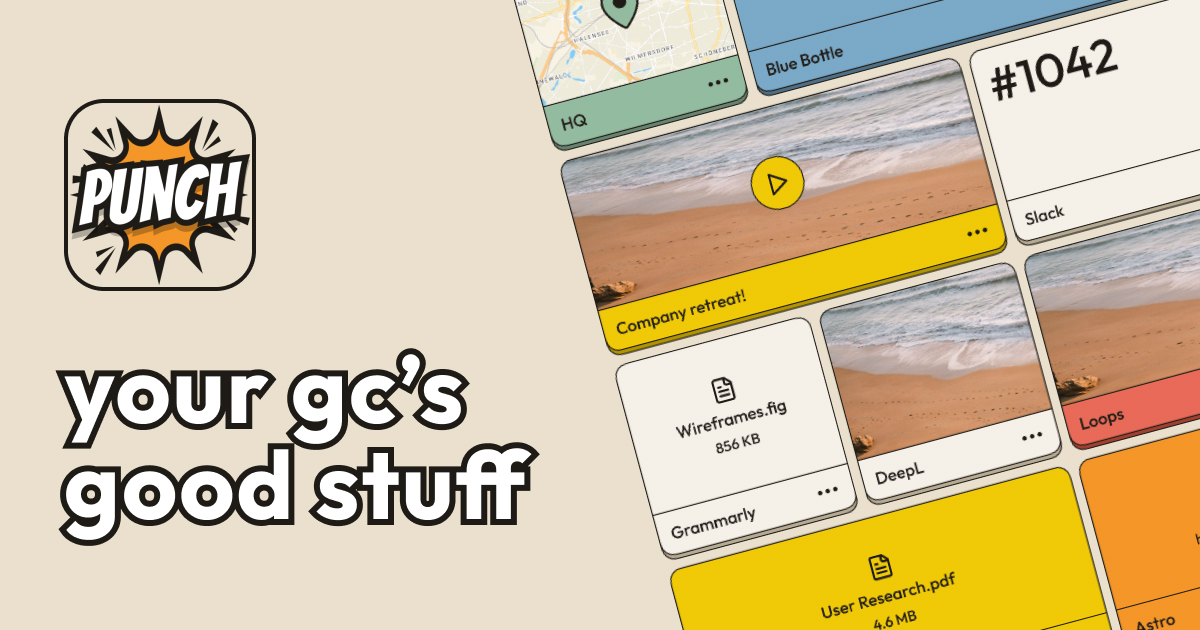
Punch is an app built around a simple idea: it is where your group chat keeps its stuff. Instead of treating notes as a private, single-user document, Punch gives you a shared space where the things you and your people actually need — the Airbnb address, the door code, the rendezvous spot, an important note, a link, a photo, a video, or even that meme you cannot stop laughing at — live in one place. The app is described on its site as a place where you can save anything, summarized in three words: notes, quick, shared. It is aimed at friends, family, and crews who coordinate in group chats and keep losing the details they need. Its purpose is to make that information easy to save once and easy to find again, whether you are planning a trip, coordinating a meetup, or simply collecting ideas you want to keep.
Group chats are wonderful at generating conversation and terrible at keeping information retrievable. The classic example on Punch's Product Hunt page is a vacation with friends: you need to know the Airbnb address, the door code, and the rendezvous spot, and instead of scrolling through one hundred or more messages to find them, you save that information on Punch and share it with your friends and family. The site frames the same frustration with two questions people keep asking in chats: 'Where are we meeting again?' and 'Where's that link you sent a few days ago?' Punch's product page explains why existing options fall short. The Notes app on your phone can fill up quickly, can start to look clunky after a while, does not let you share individual pieces from a note, and suffers from incompatibility between operating systems. Cloud storage services like Drive and Dropbox have the storage and shareability aspect, but they are more geared toward storage than toward the quick, conversational sharing a group chat actually needs.
The first thing Punch does is let you save anything. The examples given on the site span the mundane and the fun: the Airbnb address, important notes, gift ideas for your mom, and even that meme you cannot stop laughing at. A screenshot of the app referenced on the site shows a Punch space containing notes, links, photos, and videos, which indicates that a saved item is not limited to plain text — the things you keep can carry the visual context of the moment. Because the emphasis is on speed, saving is meant to be quick: the tagline on the site summarizes the product as 'Notes. Quick. Shared.' The value of that flexibility is that you do not have to decide in advance what counts as worth keeping. A door code, a link to a reservation, a photo of a meeting spot, and a joke you want to remember all go into the same shared space, and they can all be found again without scrolling back through the conversation.
Sharing is the second half of the product. Punch is described as letting you save your brilliant ideas and share them with your crew in a snap, and the site positions it as where your group chat keeps its stuff — which means the people in the chat can see the same saved information. Because the content you save is stored as individual notes rather than as one monolithic document, the sharing model avoids one of the specific complaints Punch raises about the phone's built-in Notes app: that you cannot share individual pieces from a note. Instead, a single saved item — one address, one link, one photo — can be the unit you put in front of your friends and family. The description also frames Punch as a creative vault, ready to unleash inspiration whenever you need it, which suggests the shared space doubles as a place to keep ideas rather than only logistics.
Punch is available as a mobile app. The site links directly to the App Store, where it appears under the name 'Punch: Visual Shared Spaces,' and to Google Play under the package com.remedy.punch, so it runs on both iOS and Android — which addresses the cross-operating-system incompatibility Punch calls out as a weakness of the built-in Notes app. The product is published by Remedy Apps LLC. On Product Hunt, Punch is listed under the topics Android, iOS, Productivity, and iMessage Apps, indicating that the product is positioned as a productivity tool spread across both major mobile platforms and that an iMessage app is part of how it reaches users. Being mobile-first matters for the audience: the information Punch holds is the information you need while you are out in the world — at the rental, at the meeting point, at the store looking for a gift.
The overall approach is to move important information out of the river of chat messages and into a shared space. Rather than searching, scrolling, and asking people to repeat themselves, you save the thing when you see it, and it stays in a place your group can return to. The site describes the result as a visual shared space: notes, links, photos, and videos sit together, which makes it easier to recognize what you are looking for at a glance. The naming choices in the product's metadata reinforce the same idea — Punch is tagged around notes, ideas, a creative vault, sharing ideas, collaboration, and note taking. In practice, Punch functions as a lightweight shared clipboard for a group: whatever the chat produces that is worth keeping gets punched into the vault, and the vault is what the group consults afterward.
The benefit a user gets is the end of repetitive questions. The site lists the things you will no longer have to say in the group chat: 'Where are we meeting again?' and 'Where's that link you sent a few days ago?' Those two questions are the symptom Punch is designed to remove. Instead of scrolling through one hundred or more messages, you look in Punch. Because notes are quick and shared, the effort of saving is small and the payoff is that everybody in the group has the same answer. Because you can save anything, the tool covers the full range of what a group needs — logistics like addresses and door codes, references like links, and lighter material like memes and gift ideas. And because the saved material is visual, you get recognition instead of recall: you can spot the photo of the meeting spot rather than remember which message it was buried in.
The most concrete use case given is a vacation with friends: you need the Airbnb address, the door code, and the rendezvous spot, and you save all of that on Punch and share it with your friends and family. The same pattern applies to any group trip or family holiday where details are agreed in chat and then need to be found again later. Another use case is link keeping: the site asks where the link someone sent a few days ago went, and Punch answers by giving links a permanent home in a shared space. Gift ideas are a third: saving ideas for your mom is the example given, turning a passing chat message into something you can come back to when it is time to buy. Sharing memes is a fourth: the meme you cannot stop laughing at is explicitly listed among the things you can save and share. More broadly, any group coordinating a meetup, a plan, or a collection of ideas is a candidate.
Punch is aimed at people who coordinate through group chats: friends planning and taking trips together, families sharing logistics, and crews keeping track of links, ideas, and running jokes. It is a mobile product for iOS and Android, downloadable from the App Store and Google Play, and listed on Product Hunt under Android, iOS, Productivity, and iMessage Apps. The app is published by Remedy Apps LLC. Beyond the availability of the app itself, the provided information does not state pricing or subscription plans, so no pricing detail is claimed here.
Punch's proposition is narrow and clear: it is where your group chat keeps its stuff. Save anything — an address, a door code, a note, a link, a photo, a video, a meme, a gift idea — and share it with your crew in a snap, so nobody has to scroll through a hundred messages or ask where the meeting is again. Notes. Quick. Shared.
Publisher
A
admin
Launch Date2026-09-20
Platformmobile
Pricingfree