Promptsy is an AI prompt management tool that serves as a personal vault for AI power users, developers, marketers, and writers who rely on large language models. It centralizes the storage, organization, versioning, and sharing of prompts, ensuring that your best AI instructions are never lost. Instead of scattering prompts across text files, chats, and sticky notes, Promptsy gives you a single workspace where every prompt is categorized with tags, collections, and metadata. This intelligent system is designed for anyone who crafts prompts regularly—from solo prompt engineers to collaborative teams—and it elevates prompt workflow from an afterthought to a core productivity asset. With features like version history, AI optimization, and cross-platform access, Promptsy transforms raw prompt text into a managed, searchable library that grows with your expertise.
The core pain point Promptsy addresses is the chaotic fragmentation of AI prompts. Most users save prompts in disjointed places: a notes app, a Word document, chat history, or even email drafts. This makes it impossible to find the right prompt when needed, leaves no trace of which version worked best, and forces repeated trial-and-error. Worse, losing a high-performing prompt means missing out on consistent AI output quality, leading to wasted time and subpar results. For professionals whose output depends on precise AI instructions—like a content strategist who needs a proven email launch sequence or a developer relying on a tested code review prompt—this disorganization directly hurts business outcomes. Promptsy eliminates this mess by providing a dedicated prompt management environment, so you always know exactly where your prompts are, which version is authoritative, and how to instantly reuse or adapt them.
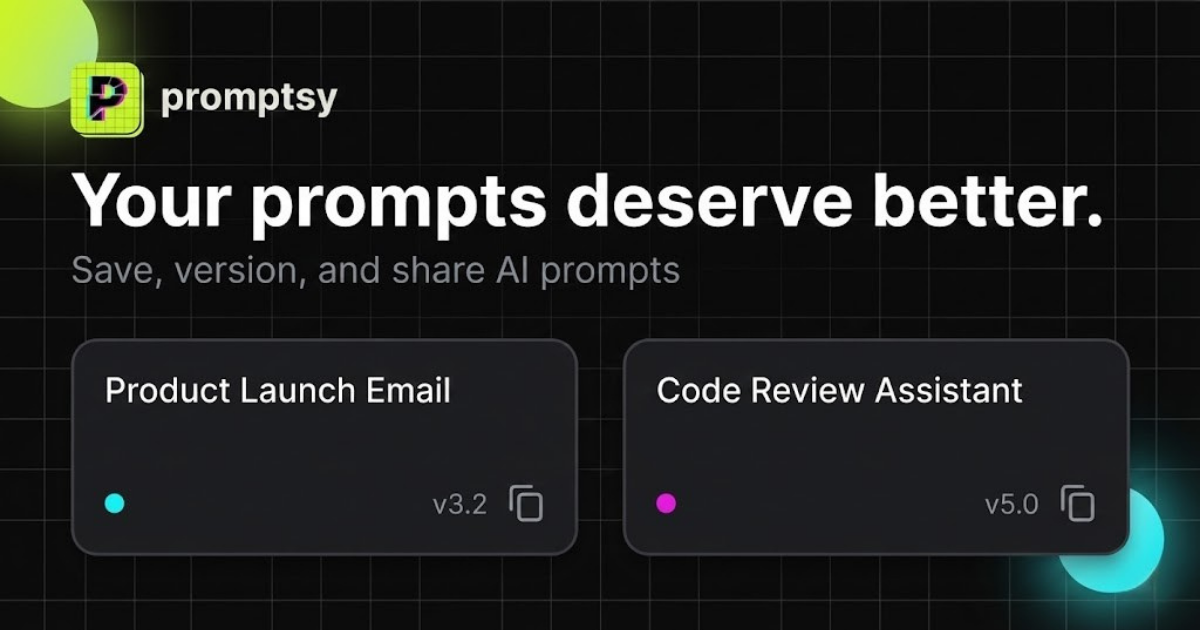
The Save & Organize feature group lies at the heart of Promptsy. You can add any prompt to your private vault and attach tags such as 'marketing', 'code', or 'writing' to make it instantly searchable. Collections let you group related prompts—for instance, you might have a 'Product Launch' collection containing email copy, social media captions, and ad headlines. Each prompt entry supports descriptions and metadata, so you can document its intended use and expected AI model. The blazing-fast search scans titles, tags, and content, returning results in milliseconds. This structured approach means that even with hundreds of prompts, you never waste time scrolling through old chats. When you sit down to create a new marketing email, you simply type 'launch email' into the search bar and pull up the exact v3.2 of your Product Launch Email prompt, complete with all context.
admin
Version History gives you a complete audit trail for every prompt. Whenever you edit a prompt, Promptsy automatically saves the new version with a timestamp and a version number like v5.0 or v2.1. You can view diffs between any two versions—exactly like code version control—highlighting exactly what changed: a tweaked phrase, a new example, or a refined instruction. If a new version underperforms, you can instantly roll back to a previous, proven state. This capability is invaluable for iterative prompt optimization, where you experiment with different wording to improve AI responses. Instead of manually tracking copies like 'prompt_final' and 'prompt_final_v2', you always have a clear lineage. The Version History transforms prompt crafting from an ephemeral art into a repeatable, data-informed engineering practice.
AI-Powered Optimization elevates your prompts with one click. Using AI credits that refresh monthly, Promptsy can reformat a messy prompt into a clean, structured template, expand a terse instruction into a detailed, context-rich one, or tighten a verbose prompt to remove fluff while preserving power. In addition, the AI Prompt Generator (available in Solo and Team plans) lets you describe a desired prompt in plain English, and Promptsy will auto-generate a polished prompt ready for use. Variable Sets, another advanced feature, allow you to save reusable values like brand names, target audiences, or tone keywords, which get inserted into prompts dynamically. This means a single prompt template can adapt to multiple campaigns without manually editing it each time. Together, these optimization tools ensure your prompts are always concise, effective, and consistent, reducing the manual labor of prompt engineering.
Promptsy works as a cross-platform ecosystem. You can access your vault via the Web App, the Chrome Extension, directly inside ChatGPT, or through the MCP Server for Claude and other AI assistants. The Chrome Extension lets you capture any prompt snippet from a webpage and later inject your saved prompts into ChatGPT, Claude, or any chat interface with a single click. The ChatGPT integration brings a side panel right into your conversation, where you can browse and insert prompts without leaving the chat. The MCP Server follows the Model Context Protocol, enabling AI agents to search your vault, retrieve relevant prompts, and use them automatically. This means your prompt library follows you everywhere: at your desk, in a browser tab, or inside an AI-assisted coding session. The workflow is straightforward: save a prompt once, tag it, and it becomes accessible from any tool you prefer.
Real-world use cases demonstrate Promptsy's impact. A marketing team preparing a product launch uses the shared workspace to maintain a collection of prompts: a Product Launch Email sequence (v4.2 with 1.2k copies in the community), a Social Media Caption prompt, and a Press Release template. Team members fork public prompts, customize them, and track versions—ensuring everyone uses the latest high-converting copy. A software developer keeps a Code Review Assistant prompt (v5.0) that analyzes code for bugs and performance issues; with version history, they can safely tweak the prompt after new linting rules appear. A freelance writer manages a Blog Post Outliner (v2.1) to generate SEO-optimized structures; the AI optimization tool quickly expands an outline for a specific client. Researchers benefit from the Research Paper Summarizer to extract key findings from academic papers, while the community explore over 5,000 public prompts to discover new techniques. In each scenario, Promptsy turns prompt reuse from a haphazard copy-paste into a managed, shareable asset, boosting productivity and output quality.
Promptsy is built for a spectrum of users: AI product managers like Sarah Chen, content strategists like Marcus Rodriguez, growth heads like Alex Kim, and solo prompt engineers or developers. It supports individuals with the Free plan (10 private prompts, version history, basic search) and scales to teams with the Team plan ($12/seat/month offering shared workspaces, permissions, pooled credits, and priority support). The Solo plan ($6/month) unlocks unlimited prompts, advanced search, the Chrome Extension, MCP Server, ChatGPT integration, and AI optimization features. Technical integrations span web browsers, ChatGPT, and MCP-compatible assistants like Claude. With a 4.9/5 user rating and 99.9% uptime, Promptsy proves its reliability. Ultimately, Promptsy is more than a storage bin—it is the operating system for your prompt engineering practice, ensuring that your best AI instructions are always ready, shareable, and improving over time.
Promptsy is designed for AI power users who depend on high-quality prompts for daily work. Core audiences include AI product managers, content strategists, marketers, growth hackers, freelance writers, and SEO specialists who craft and reuse prompts across projects. Software developers and prompt engineers benefit from version control and repository-like workflows. Small to large marketing teams use shared workspaces and pooled credits to standardize their AI interactions. Researchers and academics leverage the vault to store and share literature-review prompts. Essentially, anyone who writes, tests, or manages AI prompts—whether for ChatGPT, Claude, or other large language models—will find Promptsy an indispensable tool for organization, optimization, and collaboration.