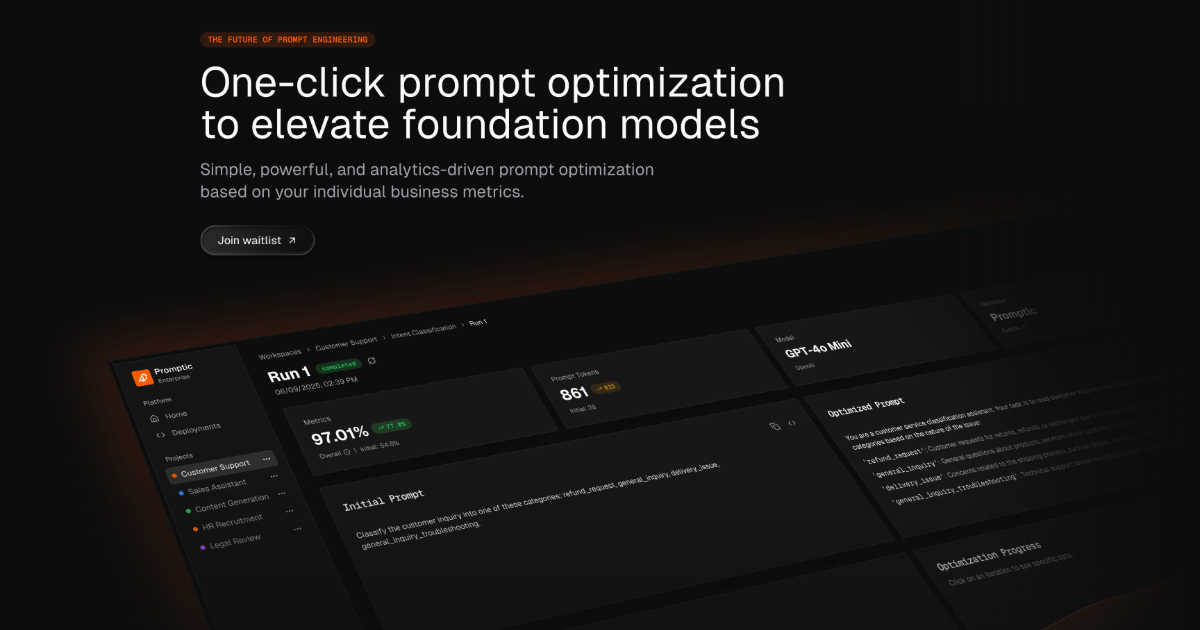
Promptic is an optimization platform for GenAI applications, built around a single promise: better quality at lower cost. According to its own description, it benchmarks models, tunes prompts and agents, and optimizes tool use against your own data and business metrics. The product is aimed at the people who actually have to decide what a generative AI application ships with — which foundation model, which prompt, which agent setup, which tools — and it exists so those decisions rest on measured evidence rather than intuition. Promptic presents itself as simple, powerful, and analytics-driven, with one-click prompt optimization and foundation model optimization as its headline capabilities.
The problem Promptic addresses is the gap between how GenAI applications are configured and how they are judged in production. Modern applications built on large language models involve a long chain of choices: which model to call, how the prompt is worded, how an agent is structured, and how tools are invoked. Each of those choices affects both the quality of the output and the cost of producing it, and the space of possible combinations is far larger than any team can explore by hand. The product description states the consequence directly: without a disciplined way to compare candidates, you ship the configuration that sounded right instead of the one that wins. Promptic's stated mission is to replace that guesswork with analytics-driven optimization tied to the individual business metrics a team cares about, so quality and cost are evaluated together rather than traded off blindly.
The first capability Promptic describes is model benchmarking. Rather than relying on generic leaderboards or vendor claims, the platform benchmarks models against your own data and business metrics. That matters because the model that performs best on a public benchmark is frequently not the model that performs best on the specific tasks, tone, domain vocabulary, and edge cases of a given application. By running the comparison on the organization's own inputs and scoring the results against the metrics it already tracks, Promptic lets teams see how candidate foundation models behave on the work that actually matters to them. The outcome is a defensible basis for choosing a model — or for confirming that an existing choice is still the right one — instead of an opinion formed from a handful of manual tests.
The second capability is prompt and agent tuning. Promptic describes tuning prompts and agents as core to the platform, and its messaging leads with one-click prompt optimization to elevate LLMs. Prompt engineering is iterative by nature: small changes in wording, structure, or examples can shift output quality noticeably, and agents add another layer of complexity on top because their behaviour depends on instructions, intermediate steps, and the sequence of actions they take. Promptic treats these as things to be optimized systematically rather than edited by feel. The "one click" framing signals that the platform is intended to lower the barrier to running an optimization, so that teams can generate and evaluate improved configurations without hand-writing and hand-testing every variation. Because agents are named alongside prompts, the same approach is extended beyond a single instruction string to the broader agent definition.
Promptic also covers tool use. In GenAI systems that call external tools, the model's effectiveness depends on how tools are described, when they are selected, and how their results are fed back into the workflow. The platform states that it optimizes tool use against your own data and business metrics, which places tool configuration in the same evidence-based loop as model choice and prompt wording. Running through all of this is the scoring mechanism: every candidate is scored on the quality and cost you actually care about. Quality and cost are presented as the two dimensions that matter, and because candidates are scored on both, a team can see the trade-offs between them rather than optimizing one in isolation. The result the description promises is that you ship the configuration that wins, not the one that merely sounded plausible.
Promptic's overall approach is analytics-driven optimization anchored to individual business metrics, and it is designed to run wherever a team already works. The description names three surfaces: a dashboard UI, your CI, and your coding agent. The dashboard gives a graphical place to run and review optimizations, which suits teams that want to inspect results, compare candidates, and share findings. Running in CI places optimization inside the development pipeline, so configurations can be evaluated as part of the same process that builds and tests the software, before changes reach users. Running from a coding agent keeps the work inside the environment where the developer is already writing code, so an optimization can be triggered without switching context. That flexibility is the distinguishing element of the stated methodology: the same optimization capability is delivered through different surfaces so it can fit the workflow a team prefers, whether that is an interactive session in a browser, an automated check in a pipeline, or an action taken directly from an AI coding environment.
The benefits Promptic states follow from that methodology. Teams get better quality at lower cost, because candidates are evaluated on both dimensions and the winning configuration is the one that performs best on the metrics that matter. Decisions become evidence-based: rather than debating which prompt or model feels better, a team can point to scores produced against its own data and business metrics. The one-click framing reduces the effort required to explore alternatives, which makes it practical to revisit model and prompt choices as models are updated or requirements change. And because optimization can run in the dashboard, in CI, or from a coding agent, it can be folded into existing habits rather than requiring a separate process. The overarching benefit described is confidence: shipping the configuration that wins instead of the one that sounded right.
Several concrete scenarios follow from the capabilities described. A team building a new GenAI feature can benchmark multiple foundation models against its own data before committing to one, rather than guessing based on reputation or a public leaderboard. An application already in production can have its prompts tuned through one-click optimization to lift quality without changing the underlying model. Teams working with agents can tune the agent definition — the instructions and behaviour that shape its multi-step work — using the same optimization loop. Projects that depend on external tools can optimize how those tools are used so the model calls them more effectively. Organizations with a delivery pipeline can run optimizations in CI, treating a configuration as something to be evaluated automatically as part of the build, so a change that degrades quality or raises cost is visible before it ships. Developers who work inside a coding agent can trigger optimization from that environment, keeping the whole task in one place. In each case, the candidate configurations that result are scored on quality and cost, and the configuration that wins is the one put into production.
Promptic is aimed at teams and developers building generative AI applications — the people responsible for choosing models, writing and refining prompts, assembling agents, and wiring up tool calls. Its topics on Product Hunt include SaaS, Developer Tools, and Artificial Intelligence, which aligns with that audience: it is a tool for people who build software with AI rather than an end-user application. The product is described as running in a dashboard UI, in your CI, and in your coding agent, so it reaches both interactive and automated development workflows. It is positioned as an optimization platform rather than a model provider, sitting alongside whatever foundation models and infrastructure a team already uses. No pricing or plan details, technology stack, or specific third-party integrations are stated in the material available, so those aspects are not described here.
In short, Promptic is a one-click, analytics-driven optimization platform for GenAI applications. It benchmarks models, tunes prompts and agents, and optimizes tool use against a team's own data and business metrics, scoring every candidate on the quality and cost that actually matter. The value proposition is straightforward: replace configuration guesswork with measured results and ship the configuration that wins.
Publisher
A
admin
Launch Date2026-09-26
Platformweb
Pricingfree