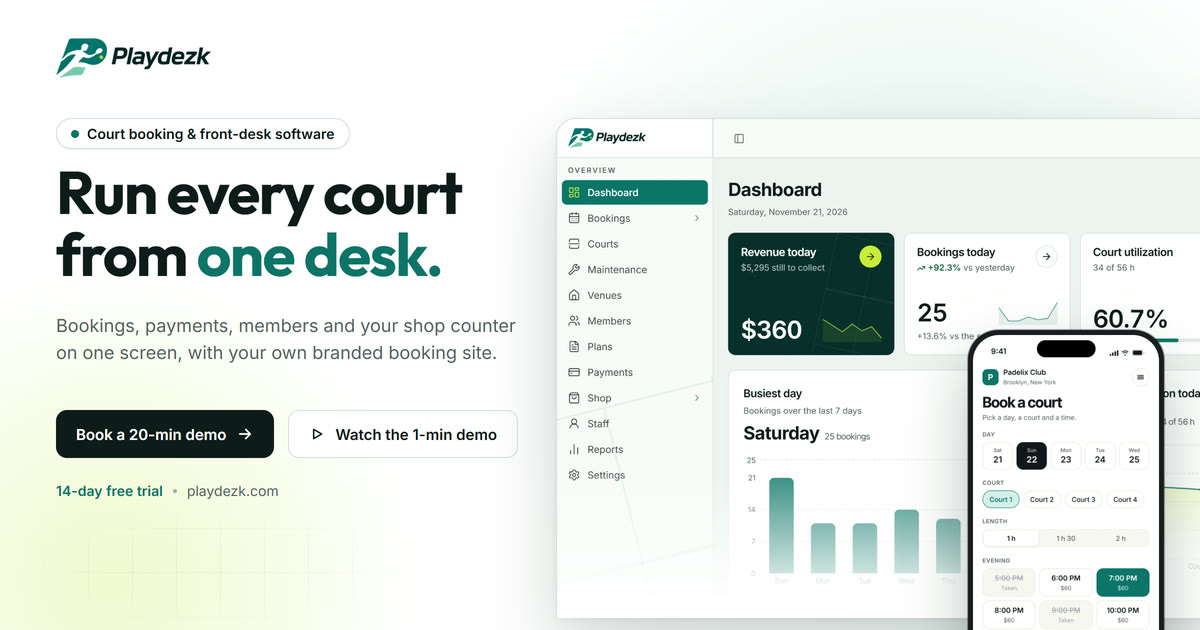
Playdezk is court booking and front-desk software for sports clubs and court venues, described by its makers as a way to run every court from one desk. It puts bookings, payments, members and the shop counter on a single screen, and gives each venue its own branded booking site where players can reserve a court themselves. The product is built for padel, pickleball, tennis, futsal, cricket nets, badminton and squash venues, and for the people who run the desk day to day as well as the owners who need to see the numbers. Its stated purpose is to remove the need for anything to be written down twice, so the front desk stops juggling five separate tools and works from one place instead.
Playdezk frames the core problem as a desk doing five jobs in five places: WhatsApp, a paper register, a till, a bank app and a spreadsheet. Bookings arrive by message, phone and walk-in, and when they are written down in more than one place, two people can end up with the same court — the site calls this out as double bookings from WhatsApp, showing a WhatsApp booking and a register entry for the same court at the same time. Payments create a second gap: cash lands in a notebook, card payments in a till or an app, and at the end of the week nobody can say what was paid for which booking. A third gap is visibility: without one view of the week, quiet hours go unnoticed, so a venue cannot price or promote the hours that sit empty. Playdezk positions itself as the single screen that closes all three gaps.
On Playdezk, every court and every hour live on one board. The day and week board shows every court side by side, with free, booked, pending and blocked slots distinguished so paid and unpaid bookings can be read at a glance; staff can scroll through the evening rush and switch between day and week views in one tap. Taking a booking at the desk is a short flow: open New booking, choose the court, date and length, and find the player by name or phone. The court rate is filled in automatically, and the booking can be marked paid by cash or card, or left unpaid and flagged. Players do not need an app: they book from a link using their name and phone number, on the venue's own branded booking site, which Playdezk presents as the reason the phone stops ringing.
Payments for online, cash and card all sit in one place, together with members and plans. The reports view shows payments taken online and at the desk, refunds and what is still owed, so a venue can reconcile takings without matching a notebook against a bank app. The shop counter is part of the same screen: a counter sale such as balls and energy drinks lands on the same day board and in the same day's takings as the court bookings. Because every booking can be marked cash, card or unpaid, staff always know which bookings have been settled and which are still outstanding, and unpaid bookings stay flagged rather than disappearing into a till.
Reporting is generated from the bookings themselves. Owners can pick a date range and a venue and see bookings, memberships and shop sales; revenue, bookings and what is still owed; and utilisation and cancellations at a glance. The dashboard surfaces revenue today, bookings, court utilisation, the busiest day and a week of bookings for a club, and the busiest-day view shows how many bookings each day of the last week took. The point Playdezk makes is that owners can know their numbers without calling the desk, and can see which hours sit empty so quiet periods can be priced or promoted.
Access is split by role. Owner, Manager and Staff logins each see a different slice: the owner gets reports, prices and every venue; the manager gets courts, staff and the day board; staff get bookings, payments and the shop, while reports stay with the owner. A venue group can run more than one venue from a single login and switch between branches, with prices and reports per venue and courts listed with their hours, maintenance blocks and assigned staff logins. Managers can block a court for coaching, and blocked time cannot be booked online or at the desk. Onboarding is done around the venue: a short call covering courts, prices and opening hours, then Playdezk sets up courts and prices, membership plans and staff logins, then a go-live check with staff trained, a test booking made and the booking site checked.
The outcomes Playdezk connects to these features are concrete rather than abstract. A booking system that refuses a second booking on the same court and time removes the double-booking problem that comes from keeping bookings in more than one place. A branded booking site shifts routine reservations away from messages and phone calls, so players book themselves while staff are opening up. Consolidating cash, card, online and shop sales into the same takings removes the end-of-week reconciliation exercise. Role-based logins mean staff can take bookings and payments without seeing or changing everything, and can be limited to each person's venues. And booking-derived reports replace spreadsheets built when you have time with utilisation, revenue and peak hours that are already worked out.
The site walks through a Saturday to show how a venue runs on Playdezk. At 07:00 online slots open and courts fill while staff are still opening up, with players booking on the venue's own site. At 09:15 walk-ins and shop sales are rung up at the desk — a name, court and time, or a drink at the counter — and both land on the same board and in the day's takings. At 18:00 a manager blocks a court for coaching, and that blocked time cannot be booked online or at the desk, with both the online and desk views showing the court closed. At 23:00 the owner opens the day's report and sees bookings, what was collected and how full each court was across the evening. Other stated scenarios include switching between two venues from one login with bookings and takings per branch, and checking utilisation and cancellations for a chosen date range.
Playdezk is aimed at sports clubs and court venues across padel, pickleball, tennis, futsal, cricket nets, badminton and squash, and at the owners, managers and front-desk staff inside them. It runs in the browser on any phone, tablet or desk computer, and players do not need to install an app to book. Pricing is not a one-size plan: Playdezk prices by the venue's setup and court count, with a one-time setup fee, a simple monthly plan and a 14-day free trial. Venues already using another system or a spreadsheet can switch, with Playdezk setting up courts, rates and members together with them and agreeing how to carry over upcoming bookings; there is no automatic import yet. Demos are booked as a 20-minute call shown with the venue's own courts, with the venue's courts and staff set up around how it works.
Taken together, Playdezk's value proposition is consolidation: one live board for every court, one branded booking site for players, one place for payments, members and shop sales, and one set of reports derived from the bookings. For a club currently running WhatsApp, a paper register, a till, a bank app and a spreadsheet in parallel, the product promises to remove duplicate entry, make paid and unpaid bookings visible, and turn booking data into utilisation and revenue insight — all from a single desk that runs on any device with a browser.
Publisher
A
admin
Launch Date2026-11-26
Platformweb
Pricingpaid