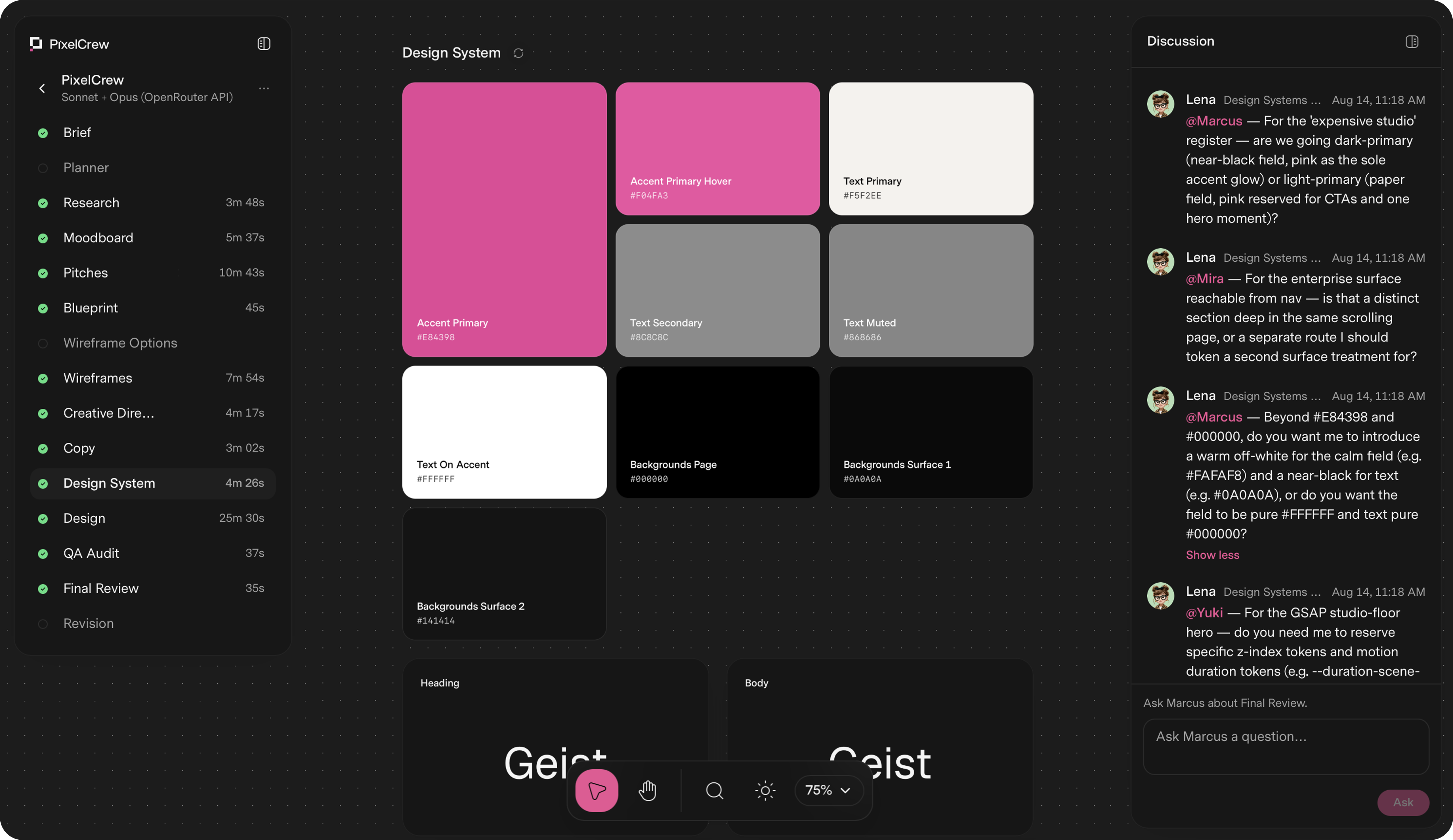
PixelCrew is a web-based platform that turns a written design brief into production-ready design output using a crew of specialized AI agents. It is designed for designers, developers, small teams, startups, and enterprises that need to ship landing pages, product dashboards, design systems, or pitch decks without waiting weeks for a traditional design cycle. Instead of relying on a single AI model to generate generic output, PixelCrew coordinates multiple agents with defined roles and handoffs to produce structured, shippable deliverables such as production-ready HTML, Tailwind CSS, wireframes, copy, and a complete design system. Users submit a free-text brief describing their intent, and the agents read that brief to infer requirements, audience, and direction.
Traditional design workflows require coordination between researchers, art directors, UX designers, copywriters, and QA reviewers. This process can take weeks, especially for small teams or founders without a full design department. PixelCrew addresses this by compressing the workflow into a single brief-driven sequence. The problem it solves is the gap between having an idea and having production-quality design assets that can actually be shipped or handed to a developer. Rather than filling out templates, users describe what they need in free text, and the agents execute structured discovery, creative direction, wireframing, copywriting, design system assembly, and QA review. The result is bespoke design output produced in 25–45 minutes on average.
The core of PixelCrew is its crew of specialized agents. Elena, the Researcher for Strategy, runs first. She reads the brief and executes structured discovery: audience personas, competitive analysis, jobs-to-be-done mapping, and an information architecture recommendation. She hands Marcus a validated research foundation, not assumptions, with outputs including a research document, personas, and an IA spec. Marcus, the Director for Art Direction, runs second. He takes Elena's research and makes creative decisions: visual direction, brand language, and layout approach. He writes three distinct visual pitches, selects the strongest, and produces a full creative brief with palette, typography, layout direction, and section-by-section composition guidance, including a moodboard. Mira, the Designer for UX Architecture, runs third. She takes Marcus's creative brief and builds the blueprint: wireframes, user flows, information architecture, and a section-by-section spec. Her outputs include wireframes, a UX flow file, and a navigation spec. The build crew then turns this into production HTML.
PixelCrew produces a range of production-ready outputs. After the agent crew runs, users receive production-ready HTML and Tailwind, a complete design system, and documentation. Specific deliverables include a landing page HTML file, a design system JSON file, and docs. The crew also writes the copy and assembles the design system, including tokens, type scale, color, and components. Design happens inside the system, not around it. Every screen goes through a QA audit and a final review pass. Issues get flagged, revised, and rechecked before anything reaches the user. Outputs from the process include research-brief.md, personas, IA spec, CREATIVE_BRIEF.md, moodboard, three pitches, wireframes.html, ux-flow.json, nav-spec, copy.md, tokens, components, qa-report.md, revisions, landing-page.html, design-system.json, and docs. This means users get everything their engineering team needs to ship, or hand to any developer.
PixelCrew is free while in alpha, and it uses a bring-your-own-key model for AI model access. Users connect their own API key from OpenRouter, which is the recommended path, or from Anthropic or Google Gemini. The agents run on that key, and users pay model costs directly to the provider. There is no subscription, no markup, and no card on file. A typical brief costs a few dollars in model usage. Users can set their own spend limit. This approach gives flexibility to run the crew on whichever models they prefer. Pro and Enterprise plans are coming. Pro will offer hosted keys with zero setup, no API key required, model costs included in one bill, priority processing queue, brief history and versioning, and team seats. Enterprise is custom and for teams that ship at scale, with custom agent configuration, your design system baked in, SSO and security review, and invoice billing.
The unique approach of PixelCrew is sequential, context-aware agent coordination. Each agent runs in order and passes structured outputs to the next: Elena passes research-brief-output.md to Marcus, Marcus passes CREATIVE_BRIEF.md to Mira, and Mira passes wireframes.html to the build crew. This mimics the way a real team works, with each specialist building on the previous agent's work rather than starting from scratch. Users provide context through their brief, and the agents coordinate to produce the final deliverable. While the crew runs, users can watch the agents discuss decisions. The process is broken into clear steps: submit your brief, Elena maps the research, Marcus sets creative direction, Mira builds the wireframe, copy and design system take shape, QA audit and final review, and finally the user receives production output.
The benefits of PixelCrew are speed, structure, and production quality. Average delivery is 25–45 minutes, compared to weeks for a traditional design cycle. Users receive production-quality output they can ship or hand to a developer. The design system ensures consistency across screens and components, and the QA audit catches issues before delivery. Because the agents work sequentially with context, the output is coherent and tailored to the brief rather than generic. The bring-your-own-key model means users have control over model choice and costs, with no subscription or markup. Overall, PixelCrew turns a written brief into a complete set of design assets, reducing the time and coordination required to go from idea to shippable design.
PixelCrew has been used for demonstration projects produced from written briefs. These include After Dark, a neighborhood coffee shop website that feels like the room: dark, warm, and unhurried, with menu, hours, and atmosphere shipped as production HTML. Modena Coupé is a luxury automotive landing page in an editorial register, with full-bleed photography, serif display type, performance stats, and a request-information flow. MicroProject is a working task manager UI for small teams, with list views, project sidebar, shared lists, overdue states, a light theme, and a complete component set. Geisha Porto is a coffee roastery and jazz listening lounge in Porto, with a product catalog including harvest data, a vinyl audio archive, and a rooftop terrace section in a Swiss editorial layout. Other briefs can be for landing pages, product dashboards, design systems, or pitch decks.
PixelCrew is for designers, developers, small teams, startups, and enterprises that ship at scale. It is especially useful for founders and teams without a full design department, as well as engineering teams that need shippable HTML and Tailwind. Integrations include bring-your-own-key support for OpenRouter, Anthropic, and Google Gemini. The product runs on the web at app.pixelcrew.ai. Pricing: free during alpha with a full agent crew, unlimited briefs, HTML and Tailwind output, and landing pages, dashboards, and design systems supported. Model usage is billed by the key provider, not by PixelCrew. Pro is coming soon with hosted keys, model costs included, priority processing, brief history and versioning, and team seats. Enterprise is custom with custom agent configuration, your design system baked in, SSO and security review, and invoice billing.
PixelCrew's primary value proposition is turning a written design brief into production-ready design through a coordinated crew of specialized AI agents. It delivers bespoke, shippable design in minutes instead of weeks, with the flexibility to run on the models you choose via your own API key. By mimicking a real design team's sequential workflow, PixelCrew produces coherent, production-quality HTML, Tailwind, wireframes, copy, and a complete design system that engineering teams can ship or hand to any developer.
Publisher
A
admin
Launch Date2026-09-23
Platformweb
Pricingfree